“This hatchling has no value. Send him to the labor colony.”
When Dale arrived at the council chamber, he found six elders waiting beneath the enormous stone statues of ancient Dravari warriors. Unlike the bonding hall, this room was comfortably warm. Ryden immediately noticed the difference.
“Why is it warm here?” he whispered.
Dale had no answer that wouldn’t make him angry.
Elder Orth sat at the center of the chamber. Beside him stood a silver-scaled Dravari wearing the insignia of the planetary research division.
“We have reviewed Observer Wes’s preliminary reports,” Orth announced. “The hatchling appears to possess unusual cognitive abilities.”
“He’s intelligent,” Dale replied. “There’s nothing unusual about a child learning when someone actually teaches him.”
The silver-scaled Dravari stepped forward.
“I am Research Director Varek. We would like to conduct several examinations.”
“What kind of examinations?”
“Neurological mapping, sensory deprivation assessments, environmental stress testing, and genetic analysis.”
Dale felt Ryden move closer to his leg.
“Absolutely not.”
Varek blinked. Apparently, he wasn’t accustomed to being refused.
“You misunderstand. These examinations could establish whether the hatchling possesses commercially significant abilities.”
“Commercially significant?”
“His capacity to identify logistical discrepancies may prove useful.”
Dale looked around the chamber. Not one elder seemed disturbed by those words.
“You were going to send him somewhere to die three days ago. Now you want to turn him into equipment?”
Orth struck his staff against the floor.
“Remember your position, human.”
“I remember it perfectly. I’m his guardian.”
“Temporarily,” Orth reminded him.
Wes stepped between them.
“Under the guardianship provision, invasive examinations require the guardian’s consent. The human is within his rights.”
Orth’s nostrils flared.
“Very well. We shall observe the remaining twenty-seven days with considerable interest.”
Outside the chamber, Ryden remained unusually quiet. It wasn’t until they returned to Dale’s quarters that he finally spoke.
“What is commercially significant?”
Dale set down his bag.
“It means something they think could make them money.”
“Am I something?”
Dale turned toward him.
“No. You’re someone.”
Ryden considered that answer for a long moment.
Then he climbed onto the couch and pressed his small head against Dale’s arm.
That evening, Dale received a formal warning from Ambassador Din. His actions had placed human trade negotiations under unnecessary strain. He was instructed to cooperate with local authorities and avoid further confrontation.
Dale deleted the message.
The following morning, he began investigating Dravari developmental standards.
What he discovered made him sick.
Hatchlings were tested within hours of emerging from their eggs. Their ability to generate heat, spread their wings, recognize commands, and display distinctive scale pigmentation determined their social classification.
Those who failed were rarely examined again.
There was no consideration for delayed development, nutritional deficiencies, or environmental conditions.
Dale pulled up Ryden’s medical records.
His egg had been incubated at a temperature eleven degrees below the recommended range for his particular genetic lineage.
“Wes, look at this.”
The Stonefolk observer studied the records.
“That is a substantial discrepancy.”
“And they blamed him for it.”
Wes remained silent.
Dale continued searching. Within an hour, he found seventeen similar cases. Every hatchling had been classified as Dullborn. Every one had been transferred to the same labor colony.
He submitted a request for their current medical status.
The request was denied.
Meanwhile, Ryden continued developing at an astonishing rate. His wings became stronger. His scales gradually lost their muddy appearance, revealing subtle copper patterns beneath the brown.
But flying remained difficult.
Dale constructed a small training platform using discarded cargo cushions. Every evening, Ryden practiced jumping from one platform to another.
Sometimes he landed successfully.
Sometimes he crashed.
Whenever that happened, he looked at Dale with an expression of terrible uncertainty.
“Did I fail?”
“You fell,” Dale corrected. “There’s a difference.”
On the twelfth day, Ryden managed to remain airborne for nearly four seconds.
Dale cheered so loudly that their neighbors complained.
Ryden spent the rest of the evening proudly telling Wes about his flight.
For a little while, they almost forgot about the council.
Then a package arrived.
Inside was a black identification collar bearing Ryden’s name and a labor registration number.
There was also a document confirming his scheduled transfer at the conclusion of the guardianship period.
Dale stared at the paperwork.
They had already made their decision.
Wes immediately contacted the council administration. He was informed that the registration was merely a precautionary measure.
Ryden didn’t understand the explanation, but he recognized the collar.
He backed into a corner.
“No,” he whispered.
Dale threw the collar into a storage drawer.
“Nobody’s putting that on you.”
“Other hatchlings wore those.”
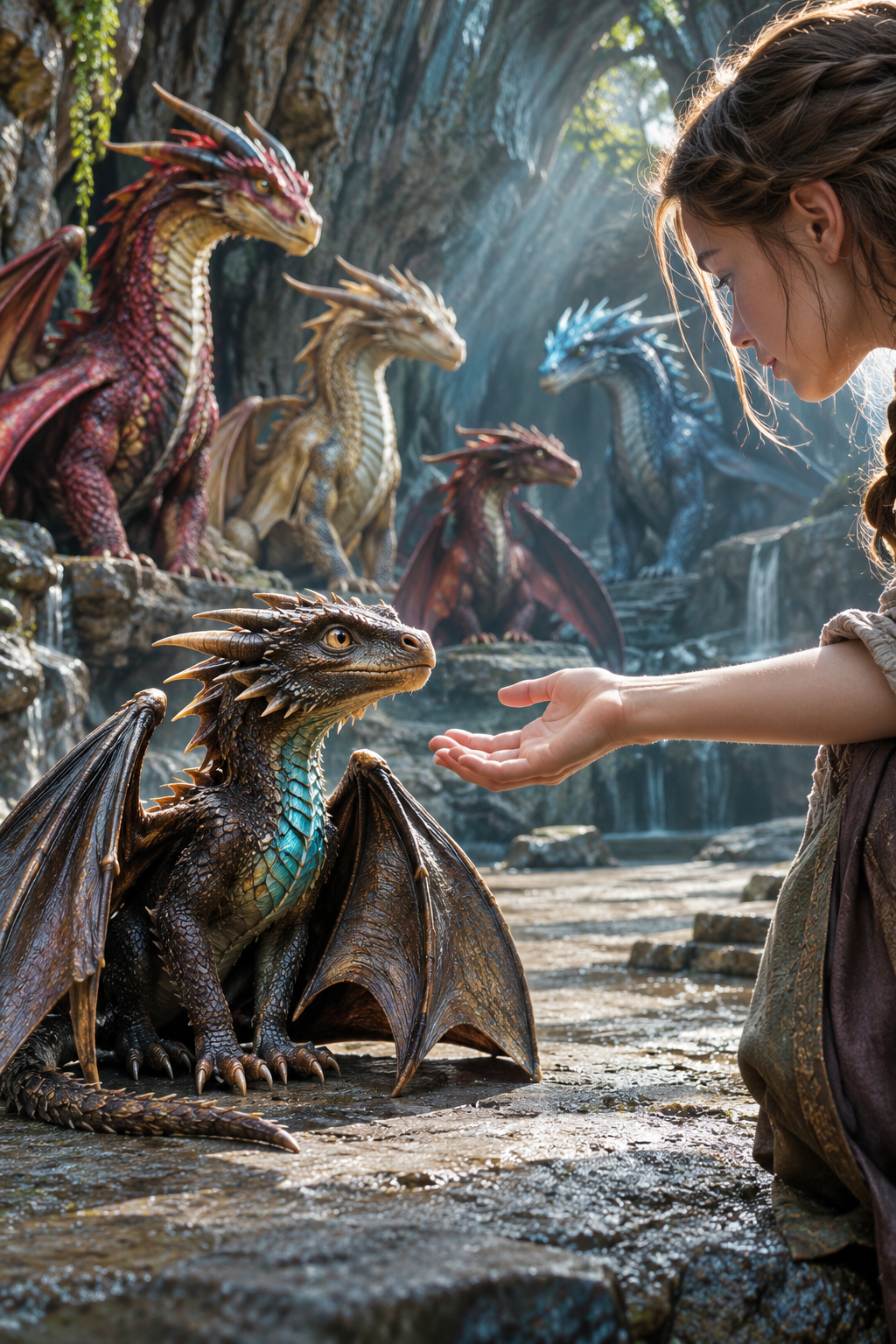
Dale crouched beside him.
“You remember them?”
Ryden nodded.
“They cried when the doors closed.”
His voice became smaller.
“Will I cry too?”
Dale pulled him gently into his arms.
“I’m going to do everything I can to keep you here.”
For the first time since their meeting, Dale was afraid that everything he could do might not be enough.
On the eighteenth day, the station’s emergency alarms sounded.
A transport carrying industrial supplies had suffered a propulsion malfunction while approaching Voras. Its damaged navigation system was transmitting contradictory coordinates.
Dale rushed to the logistics control center with Ryden and Wes following behind.
The situation was worse than anyone had expected.
The disabled transport was drifting toward a densely populated orbital habitat. Rescue vessels couldn’t approach safely because the transport’s cargo included unstable reactor components.
Controllers were arguing over possible trajectories when Ryden climbed onto an empty chair.
He watched the enormous navigation display.
“It’s turning,” he said.
A controller glanced at him.
“Someone remove that hatchling.”
Dale looked at the screen.
“What do you see, Ryden?”
“The little lights. They move together. But that one doesn’t.”
He pointed toward an auxiliary navigation marker.
Dale examined the raw telemetry.
The transport’s primary sensors were compensating for a rotation that its damaged secondary systems hadn’t registered. Every projected trajectory was based on incomplete information.
“Recalculate using the auxiliary beacon,” Dale ordered.
The senior controller frowned.
“That’s not standard procedure.”
“Just run it!”
The new projection appeared.
The room went silent.
The transport wasn’t heading toward the habitat’s reinforced exterior, as previously believed. It was approaching the main docking assembly, where hundreds of civilians were waiting to board passenger vessels.
Emergency crews immediately adjusted their response.
Ryden continued watching.
“Can that ship push it?”
He pointed toward an unmanned maintenance tug.
Dale understood.
The tug could approach without risking a crew, attach itself to the transport, and alter its trajectory just enough to prevent a collision.
The controllers implemented the plan.
Seven minutes later, the disabled transport passed harmlessly beneath the habitat.
The control center erupted in celebration.
Dale lifted Ryden into the air.
“You did it!”
Ryden smiled, exposing a row of tiny teeth.
“Did everyone go home?”
“Everyone’s safe.”
Wes recorded the entire incident.
By evening, footage of the little brown dragon helping prevent a disaster had spread across Voras.
People began asking how a Dullborn hatchling could accomplish something that experienced navigation officers had overlooked.
For the first time in generations, the classification system faced public criticism.
Dale thought the council would have no choice but to reconsider.
He was wrong.
The following morning, Ambassador Din arrived at his quarters accompanied by two security officers.
“Dale, we have a serious problem.”
“What now?”
“The council has accused you of unauthorized developmental manipulation.”
Dale stared at him.
“They’re claiming you altered the hatchling’s natural abilities using prohibited human technology.”
“That’s ridiculous.”
“I know.”
“Then tell them that.”
Din looked exhausted.
“They’re threatening to suspend diplomatic relations.”
Ryden emerged from his sleeping area.
“Did I do something bad?”
Nobody answered immediately.
Din looked away.
“The council has issued an emergency custody order.”
Dale felt his blood run cold.
“They can’t do that. We still have eleven days.”
“They’ve invoked a planetary security exception.”
Wes stepped forward.
“An exception requiring evidence of immediate danger.”
“The council considers his unexplained abilities sufficient evidence.”
The security officers approached.
Ryden scrambled behind Dale.
“No! I can be better! I can fly longer!”
Dale stood between him and the officers.
“Don’t touch him.”
Din lowered his voice.
“Please don’t make this worse.”
But Dale could hear Ryden crying behind him.
“I’ll learn faster,” the hatchling pleaded. “I won’t make mistakes anymore.”
Something inside Dale broke.
He turned, knelt, and held Ryden’s trembling face between his hands.
“Listen to me. You don’t have to earn the right to be loved. Do you understand?”
Ryden shook his head desperately.
“You haven’t done anything wrong.”
The officers hesitated.
Then their commander received an order through his communication device.
They took Ryden away.
His cries followed Dale long after the transport doors closed.
For several minutes, Dale stood motionless in the corridor.
Then Wes placed a heavy stone hand on his shoulder.
“I have been an observer for thirty-one years,” he said quietly. “I believe it is time I became something else.”
He handed Dale a data crystal.
“What is this?”
“Evidence.”
Inside were copies of medical records, council communications, and classified reports concerning the labor colonies.
Wes had been collecting them since Dale discovered the incubation discrepancies.
What they revealed was far worse than negligence.
The council received financial compensation for every hatchling transferred to industrial service. Labor contractors depended on a steady supply of young workers, and certain elders personally benefited from those arrangements.
Over the years, medical standards had been adjusted to increase the number of rejected hatchlings.
Some incubation facilities had even been deliberately underfunded.
Dale felt physically ill.
“How many?”
“Thousands,” Wes answered.
Among the documents was a research report written fourteen years earlier by Director Varek.
It described unusual cognitive development in several Dullborn hatchlings.
Their abilities had never been publicly acknowledged.
Instead, the hatchlings had disappeared into restricted industrial facilities.
Dale understood why the council wanted Ryden.
He wasn’t merely valuable.
He was living proof that their entire system was built on a lie.
“We need to get this to the Conclave.”
“I already attempted that,” Wes replied. “The planetary communications authority blocked the transmission.”
Dale looked toward the orbital station visible through his window.
“Then we’ll deliver it ourselves.”
Before they could leave, Dale received an unexpected message.
It came from an unfamiliar Dravari medical technician.
The message contained only six words.
They are transferring him tonight. Hurry.
Attached was a transport manifest.
Ryden was scheduled to depart for Labor Colony Seven in less than three hours.
Dale contacted Ambassador Din.
This time, he didn’t ask for permission.
He sent Din the evidence and told him exactly what would happen if the human embassy remained silent.
“History won’t remember your trade agreement,” Dale said. “It’ll remember what you allowed to happen to children.”
Din disconnected without answering.
Dale and Wes headed toward the cargo terminal.
They had barely reached the entrance when security barriers descended.
Orth’s face appeared on the overhead monitors.
“Human citizen Dale, you are hereby detained pending investigation.”
Security personnel surrounded them.
Dale looked at Wes.
“Any ideas?”
“Several. None are particularly diplomatic.”
Before either could move, another voice echoed through the terminal.
“Stand down.”
Ambassador Din walked through the security checkpoint, accompanied by members of the human diplomatic protection service.
He held up a Conclave authorization.
“The guardianship dispute has been elevated to an emergency interspecies tribunal. Until that tribunal convenes, neither Dale nor the hatchling may be removed from this jurisdiction.”
Orth’s image disappeared.
The security officers reluctantly lowered their weapons.
Din approached Dale.
“I spent twenty years building diplomatic relationships,” he said. “Somewhere along the way, I forgot what those relationships were supposed to protect.”
“Where’s Ryden?”
Din’s expression darkened.
“The transport departed early.”
Dale’s heart sank.
“But we know where it’s going.”
Labor Colony Seven occupied a barren moon beyond Voras’s outer orbital stations. Its industrial facilities extended deep beneath the surface, extracting minerals used in advanced energy systems.
As the human diplomatic vessel approached, its crew detected unusual thermal activity.
Then came a distress signal.
A geological disturbance had damaged the colony’s underground power network. Several tunnels had collapsed, trapping workers beneath the surface.
The colony administration insisted the situation was under control.
Its emergency communications suggested otherwise.
Dale demanded immediate access.
When they landed, he found hundreds of young Dravari gathered inside overcrowded shelters. Their scales were dull, their wings scarred, their bodies painfully thin.
Some were barely larger than Ryden.
A colony supervisor attempted to block his path.
“Unauthorized personnel are prohibited beyond this point.”
Din displayed his authorization.
“Move.”
They located Ryden’s transport near the central processing facility.
Its holding compartment was empty.
Dale grabbed the nearest attendant.
“Where are the hatchlings?”
“Some escaped during the disturbance.”
“Escaped where?”
The attendant pointed toward a damaged service passage.
Dale ran.
Inside, emergency lights flickered through clouds of dust. The floor vibrated beneath his boots.
“Ryden!”
A faint voice answered.
“Dale?”
He followed the sound around a collapsed support beam.
Ryden was crouched beside three younger hatchlings. One had an injured wing. Another was crying uncontrollably.
When Ryden saw Dale, he launched himself forward.
Dale caught him and held him so tightly that the little dragon squeaked.
“You came.”
“Of course I came.”
Ryden buried his face against Dale’s chest.
“I told them someone would come.”
Dale looked at the other hatchlings.
“Let’s get all of you out.”
But Ryden pulled away.
“There are more.”
He pointed toward a sealed maintenance door.
“Behind there. I heard them.”
Wes examined the structural damage.
“The passage is unstable. We cannot enter safely.”
A colony engineer arrived and explained that the lower chambers had lost ventilation. The main access tunnel was blocked, and rescue teams couldn’t determine which secondary passages remained intact.
Ryden looked at a damaged facility map mounted beside the door.
“Where does the warm air go?”
The engineer frowned.
“What?”
Ryden pointed toward several ventilation shafts.
“If the warm air goes up here, they can go up too.”
Dale studied the map.
An old maintenance network connected the lower chambers to an abandoned processing platform. The route wasn’t marked as an evacuation passage because it was too narrow for adult Dravari.
But the trapped workers were children.
The engineer quickly checked the remaining sensors.
“He’s right.”
Rescue crews established communication with the lower chambers. Following instructions relayed through emergency speakers, the trapped hatchlings began moving toward the maintenance network.
One by one, they emerged onto the processing platform.
Dale watched medical personnel carry them to safety.
Then the engineer received another report.
A group of six hatchlings remained behind a jammed emergency barrier.
Their chamber was losing breathable air.
Rescue workers reached the barrier from the maintenance side, but its damaged locking mechanism resisted their equipment.
For several agonizing minutes, nobody knew whether they would succeed.
Finally, the barrier opened.
The last six hatchlings were carried out just before the lower power network failed completely.
Ryden watched them emerge.
“Are they going home now?”
Dale looked at the frightened children.
He couldn’t bring himself to explain that many of them had never had a home.
“They’re going somewhere safe.”
Wes recorded everything.
This time, the council couldn’t suppress the evidence. Ambassador Din transmitted the colony records, rescue footage, and Wes’s findings directly through the human diplomatic network.
Within hours, the Conclave ordered all Dravari labor colonies suspended pending investigation.
Elder Orth and Director Varek were summoned before an international tribunal.
But Dale still had one battle left.
His thirty-day guardianship period was about to expire.
The final hearing took place in the same bonding hall where Ryden had first been rejected.
Orth arrived under guard.
Despite the evidence against him, he remained defiant.
“Our traditions have preserved Dravari civilization for centuries,” he declared. “One exceptional hatchling does not invalidate an entire social structure.”
Dale stood before the tribunal with Ryden beside him.
“You’re right about one thing,” he said.
Orth looked surprised.
“One exceptional hatchling shouldn’t determine whether thousands of others deserve to live.”
Dale turned toward the assembled representatives.
“What if Ryden had never learned to read navigation displays? What if he had never helped save those people? What if his wings had remained weak forever?”
He looked down at the little dragon.
“Would that have made sending him to a labor colony acceptable?”
Nobody spoke.
“You keep discussing what these children can contribute. But they’re children. Their lives shouldn’t depend on whether they’re useful to someone more powerful.”
Wes presented his final report.
It contained thirty days of observations, including Ryden’s developmental progress, emotional responses, and growing attachment to Dale.
At the bottom was a personal statement.
The Stonefolk observer had written that Ryden’s greatest achievement was not his intelligence, but his willingness to help others despite having received so little kindness himself.
The tribunal deliberated for nearly two hours.
Ryden sat beside Dale, nervously scratching the floor.
“Will they take me again?”
Dale held his claw.
“Whatever happens, you’re not facing it alone.”
Finally, the presiding representative returned.
The tribunal declared the Dullborn classification incompatible with Conclave protections for dependent sentient beings. All compulsory labor transfers involving hatchlings were permanently prohibited.
An independent commission would investigate the council’s financial arrangements and oversee the rehabilitation of surviving colony workers.
Then the representative addressed Dale.
“Your temporary guardianship has been reviewed. We find that you have fulfilled every responsibility required under the charter.”
Dale barely breathed.
“Permanent guardianship is hereby granted.”
Ryden looked up.
“Permanent?”
Dale smiled through tears.
“It means you’re coming home with me.”
“For thirty more days?”
“For as long as you need me.”
Ryden climbed into his arms.
Around them, the bonding hall filled with applause.
Two years later, the building looked very different.
The enormous classification platforms had been removed. The temperature was adjusted for individual hatchlings, and medical specialists worked alongside prospective guardians.
No child was assigned a labor registration number.
Dale had left his logistics position to help establish a rehabilitation center for displaced hatchlings. Wes became its director, while Din secured funding from several Conclave member worlds.
Ryden grew stronger.
His scales developed into a beautiful mixture of copper and earth tones. His wings never became as large as those of other Dravari his age, but he learned to fly short distances.
He also learned something Dale considered far more important.
He learned how to play.
One afternoon, a newly rescued hatchling arrived at the center. She was small, gray, and terrified of everyone.
She refused food and hid beneath a bench.
Ryden approached her slowly.
“Hello. I’m Ryden.”
The little hatchling stared at him.
“I’m useless,” she whispered.
Ryden tilted his head.
“Who told you that?”
“The elders.”
He settled beside her, folding his copper-colored wings.
“They told me that too.”
“Were they wrong?”
Ryden glanced toward Dale, who was repairing a damaged toy across the room.
“Yes,” he answered. “But you don’t have to prove they’re wrong.”
He pushed a soft blanket toward her.
“You can just be little for a while.”
The hatchling cautiously moved closer.
Dale watched as Ryden shared his favorite toy with her, patiently waiting until she felt comfortable enough to come out.
He remembered the frightened creature standing alone in the bonding hall, trying desperately to hide his trembling wings.
Back then, Dale had believed he was saving one life.
He hadn’t understood how far that single decision would reach.
Voras had spent centuries searching for greatness in brilliant scales, powerful wings, and extraordinary abilities. Yet the change its civilization desperately needed had begun with a seemingly ordinary human who refused to walk past a frightened child.
Ryden eventually became known throughout the Conclave, but not because of the disaster he had prevented or the intelligence that had astonished the elders.
He became known because, wherever a frightened hatchling arrived, he was usually the first to welcome them.
And every evening, when the rehabilitation center closed, Ryden returned home with Dale.
He still occasionally made mistakes. He broke dishes, forgot instructions, and sometimes crashed into furniture while practicing his flying.
But he no longer apologized for existing.
He knew that when he fell, someone would help him stand again.
And perhaps that was the greatest thing humanity had taught the Dravari.
A life does not become precious when it proves its usefulness.
It was precious from the very beginning.
Years passed, and the changes on Voras began reaching places Dale had never imagined.
Former labor colonies were transformed into medical facilities and educational centers. Families who had once been ashamed of producing Dullborn hatchlings began searching for the children they had surrendered.
Some reunions were joyful.
Others were heartbreaking.
Not every child wanted to return to the family that had abandoned them.
Dale understood that forgiveness could never be demanded from someone simply because the person who hurt them had finally recognized their mistake.
Ryden understood it too.
By his ninth year, he had become an exceptionally talented student of engineering and navigation. Several prestigious institutions offered him scholarships, and the Conclave invited him to participate in an advanced research program.
But before accepting any offer, Ryden made an unexpected request.
“I want to visit Elder Orth.”
Dale slowly lowered his cup.
“Are you sure?”
Ryden nodded.
“I’ve been thinking about it for a long time.”
Orth had been stripped of his position and sentenced to imprisonment for his involvement in the labor colony system. His health had deteriorated considerably, and few visitors came to see him.
When Dale and Ryden entered the detention facility, they found an elderly dragon sitting beside a narrow window.
His once-brilliant scales had faded.
His powerful wings hung loosely against his back.
Orth recognized Dale immediately.
Then he looked at Ryden.
“The human’s hatchling.”
“My name is Ryden.”
Orth lowered his eyes.
“Yes. I remember.”
For several moments, neither spoke.
Finally, Orth asked the question that had troubled him throughout his imprisonment.
“Did you come to show me what you became?”
Ryden shook his head.
“I came because I wanted to understand something.”
“What?”
“Why did you think I deserved to die?”
Orth opened his mouth, but no words emerged.
He looked toward the window.
“When I was young, my father taught me that weakness threatened our civilization. His father taught him the same thing. We believed that only the strongest deserved to carry our future.”
“And did you ever question him?”
“No.”
“Why not?”
Orth’s claws tightened against the armrest.
“Because I was afraid of being considered weak myself.”
Ryden studied the old dragon.
For years, he had imagined Orth as a monster incapable of feeling anything. Now, sitting across from him, he saw something different.
He saw someone who had allowed fear to become cruelty.
Someone who had inherited a terrible belief and chosen to pass it on instead of challenging it.
That didn’t excuse what Orth had done.
But it explained how such suffering had continued for generations.
“Do you hate me?” Orth asked.
Ryden thought carefully before answering.
“I used to.”
“And now?”
“Now I hope nobody ever becomes like you again.”
Orth closed his eyes.
A tear rolled between his faded scales.
“I cannot undo what I did.”
“No,” Ryden replied. “But you can tell the truth about it.”
Three weeks later, Orth submitted a complete confession to the Conclave. He identified officials who had escaped prosecution, revealed previously undisclosed colony locations, and provided information that helped hundreds of families discover what had happened to their missing children.
It was the first genuinely courageous decision he had made in decades.
Ryden never visited him again.
He had not gone there to offer forgiveness.
He had gone there to prevent the past from repeating itself.
And he had succeeded.
Many years later, Dale sat outside his home beneath the golden evening sky of Voras.
His hair had turned white. His hands were no longer steady, and walking even short distances had become difficult.
Beside him stood a fully grown copper-colored dragon.
Ryden had become one of the Conclave’s most respected engineers. His work had improved emergency evacuation systems across dozens of worlds.
Yet every opportunity to relocate had been refused.
He always returned to Voras.
He always returned to Dale.
That evening, Ryden placed a small wooden box on Dale’s lap.
“What’s this?” Dale asked.
“Open it.”
Inside was an old identification collar.
Black metal. Faded lettering. A labor registration number.
Dale recognized it immediately.
“I thought I threw this away.”
“You put it in a drawer.”
Ryden sat beside him.
“I kept it.”
“Why would you want to remember something like that?”
“Because I remember what happened after.”
Ryden gently turned the collar over.
Attached to its underside was a small photograph of Dale holding a muddy little hatchling outside the bonding hall.
“You were the first person who looked at me and saw something other than a failure.”
Dale smiled.
“You were never a failure.”
“I know that now.”
Ryden rested his enormous head against Dale’s shoulder, just as he had when he was small enough to fit on the couch.
“Do you ever regret standing up that day?”
Dale laughed softly.
“Only when you started chewing through my furniture.”
Ryden chuckled.
Then Dale reached out and touched his copper scales.
“Taking you home was the best decision I ever made.”
Several months later, Dale passed away peacefully in his sleep.
Ryden was beside him.
For the first time in many years, the great dragon felt like that frightened little hatchling again.
He wanted to hear Dale’s voice.
He wanted to feel those gentle hands helping him stretch his wings.
He wanted one more ordinary evening at home.
But some things, even the greatest intelligence in the universe could not repair.
Thousands attended Dale’s memorial.
Among them were former colony workers, diplomats, engineers, medical specialists, and families whose children had been saved by the reforms his actions had inspired.
Wes stood beside Ryden throughout the ceremony.
When it was time to speak, Ryden approached the memorial platform.
“My father was not a powerful man,” he began.
“He had no army, no fortune, and no extraordinary abilities. He was a logistics worker who happened to be sitting in a room where something terrible was about to happen.”
Ryden looked across the gathering.
“He could have remained seated. Everyone expected him to. It would have been easier, safer, and better for his career.”
His voice trembled.
“But he stood up.”
Ryden looked down at the old photograph resting beside Dale’s memorial.
“Everything I became began with that decision. Not because he discovered that I was intelligent, but because he cared about me before he knew what I could become.”
In the years that followed, a statue was erected outside the original bonding hall.
It depicted an ordinary human kneeling before a tiny, frightened dragon.
There were no weapons, medals, or symbols of political authority.
Beneath the statue were seven simple words.
Someone stood up when everyone else watched.
Ryden continued visiting the rehabilitation center for the remainder of his life.
Whenever a frightened hatchling asked whether they were good enough to deserve a family, he remembered Dale’s voice.
And he gave them the same answer his father had given him so many years ago.
“You don’t have to earn the right to be loved.”
On Voras, generations of children grew up hearing the story of the human who challenged an entire civilization to protect one unwanted hatchling.
Some believed it was a story about courage.
Others believed it was about justice.
But Ryden knew it was something simpler.
It was about kindness, and the extraordinary things that ordinary people could accomplish when they refused to accept cruelty as normal.
Dale had never intended to become a hero.
He had simply seen a child who needed someone.
And he had decided to be that someone.
In doing so, he had given thousands of children a future, an entire civilization a second chance, and one little dragon something more valuable than any extraordinary ability.
A place where he belonged.
THE END.