The brochure arrived just three days before the company’s anniversary celebration. When I opened it, I couldn’t believe what I was reading.
“I’ve decided not to sell my father’s car. And I’m not going to display it at the anniversary celebration either.”
I leaned back in my chair, confused.
“Then what are you going to do with it?”
For a few seconds, she said nothing. I could hear faint traffic through the phone on her end.
“I’m going to give it back to the person who helped me understand what it was really worth.”
I frowned.
“I’m not sure I understand.”
“I’m donating it to a new automotive education program. But not just any program. I want to build something for children who love engineering but might never have the opportunity to explore it. Something that gives them access to tools, training, and mentors.”
I smiled slightly.
“That sounds like a wonderful idea.”
“It does,” she replied. “But there’s something else. I want you to run the practical training side of the program.”
I nearly laughed.
“Ma’am, I’m a mechanic. I run a small repair shop. I’m not an educator or a businessman.”
“That’s exactly why I want you.”
I didn’t know what to say.
She continued.
“My father started his company in a garage. He wasn’t born into wealth. He was a young man who loved taking things apart and figuring out how to put them back together. Somewhere along the way, he became so focused on building a successful company that he forgot why he’d started.”
Her voice softened.
“When I was little, he used to let me sit beside him while he worked on engines. I never understood how much those afternoons meant until he was gone. I don’t want another generation of children to lose that kind of opportunity.”
I looked toward the office door.
My daughter was sitting at her little desk, surrounded by colored pencils, cardboard gears, and a half-finished model of a race car.
“That’s a beautiful thought,” I said. “But why me?”
“Because you reminded me that someone’s value isn’t measured by the size of their business or the amount of money they make. And because I watched you work on that roadster. You never treated it like an expensive object. You treated it like something that deserved to be understood.”
I glanced at the clock.
It was getting late, and I had an engine waiting on the lift the following morning.
“I appreciate the offer,” I said carefully. “But I need to think about it.”
“Of course. And there’s one more thing.”
“What is it?”
“I’d like to meet your daughter. Not to put her in another brochure. Not to use her story. I simply want to know the little engineer who kept you company while you rebuilt my father’s car.”
For the first time that evening, I genuinely laughed.
“She’ll probably ask you more questions about engines than you’ve been asked in your entire life.”
“I hope she does.”
We ended the call shortly afterward.
But I didn’t sleep much that night.
I kept thinking about the offer, the roadster, and the possibility of building something bigger than my little repair shop.
It sounded wonderful.
It also sounded dangerous.
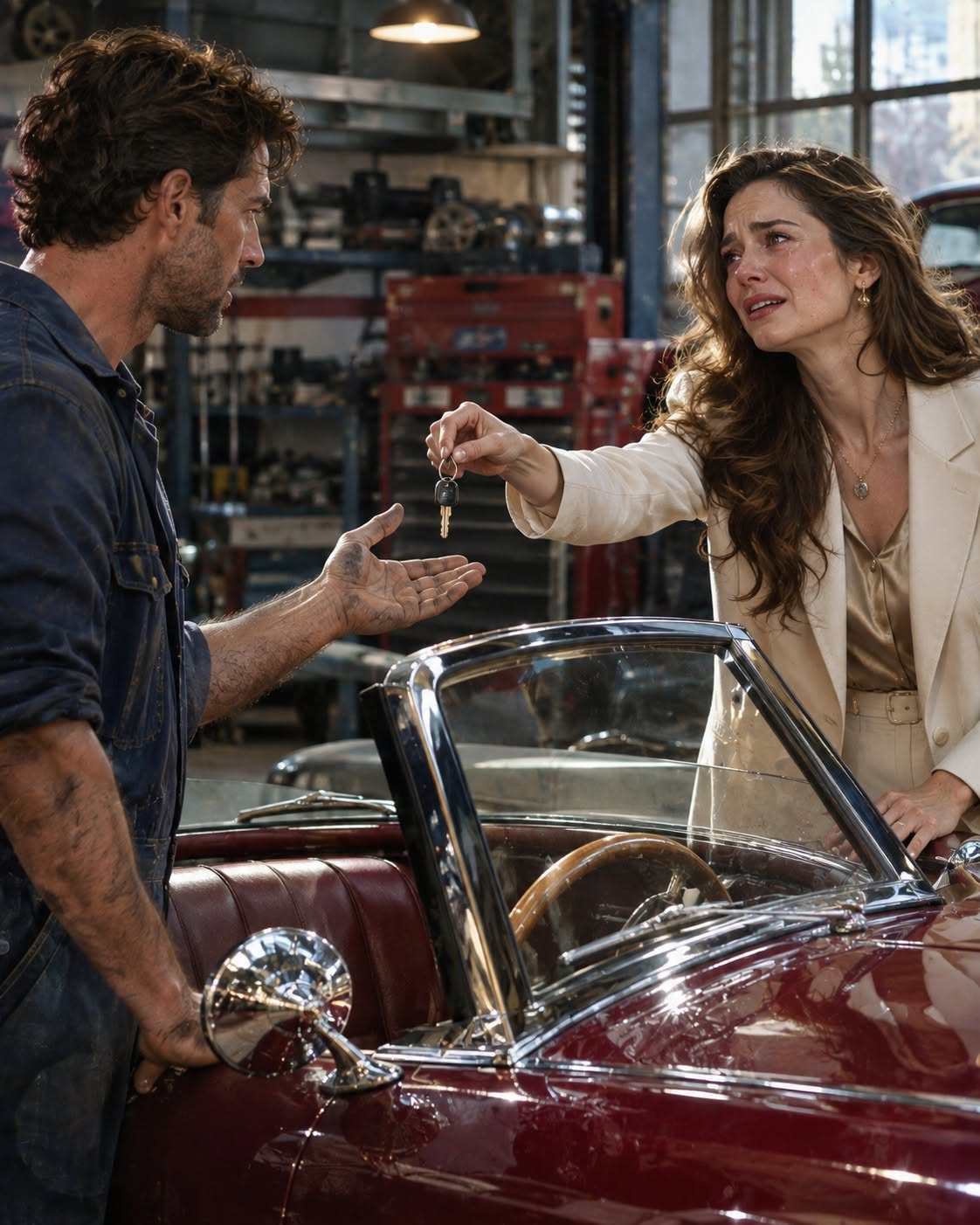
I’d spent years learning that promises made by wealthy people could disappear as quickly as they arrived. I couldn’t afford to gamble with my daughter’s future because someone with a generous idea had suddenly developed a conscience.
The following Saturday, I took my daughter to her school racing event.
She was eight years old, wore oversized safety glasses, and had spent almost three weeks building a small battery-powered car from recycled materials.
It wasn’t particularly fast.
The wheels were slightly uneven, and the steering mechanism occasionally pulled to the left.
But she’d built almost everything herself.
When we arrived, several parents were already helping their children prepare.
Some had professional-looking kits. Others had elaborate designs with shiny plastic bodies and polished wheels.
My daughter’s little machine looked like something rescued from a recycling bin.
She noticed the difference immediately.
“Daddy, do you think mine looks funny?”
I crouched beside her.
“I think it looks like a machine built by someone who understands how machines work.”
She smiled.
“Even if it doesn’t win?”
“Especially if it doesn’t win. Winning tells you that something worked once. Building teaches you how to make it work again.”
She hugged me before running toward the starting area.
I watched her race.
Her car started beautifully, then veered toward the edge of the track. She tried to correct it, but one wheel caught against a small barrier.
The other children sped past.
She finished last.
When she returned, she was trying very hard not to cry.
I knelt and examined the car.
“What happened?”
“The front wheel kept turning by itself.”
I nodded.
“Then we have something to investigate.”
She looked at me.
“Are you disappointed?”
I shook my head.
“I’m proud of you. You built something that didn’t exist before you started. That’s never a failure.”
A voice behind me interrupted.
“I couldn’t agree more.”
I turned around.
The CEO was standing a few feet away, wearing jeans, a simple jacket, and carrying two paper cups of coffee.
For a moment, I was speechless.
“What are you doing here?”
She smiled.
“I asked your daughter when the event was. She was kind enough to tell me.”
My daughter looked between us.
“You’re the lady with the old car?”
“I am.”
“The red one?”
“Bordeaux red,” she corrected gently.
My daughter considered that.
“That’s a fancy way to say dark red.”
The CEO laughed.
“It certainly is.”
Then she crouched beside the little racing car.
“May I see what you’ve built?”
My daughter immediately began explaining the motor, the battery placement, and the steering system. She spoke with the confidence of someone who had spent weeks thinking about nothing else.
The CEO listened carefully.
She didn’t interrupt.
She didn’t look at her phone.
She didn’t glance around to see who might be watching.
When my daughter finished, the woman pointed toward the front wheel.
“Do you think the steering rod might be slightly too loose?”
My daughter stared at it.
Then she looked at me.
I smiled.
“That’s worth checking.”
For the next twenty minutes, the three of us sat on the grass, examining the tiny car.
The CEO had no special technical knowledge, but she asked thoughtful questions.
And my daughter answered every one.
Before leaving, the woman handed my daughter a small envelope.
My daughter looked at me before accepting it.
“What’s this?”
“An invitation,” the CEO said. “I’m organizing a workshop next month. We’re going to bring together a few young people who enjoy building things. I’d love for you to come.”
My daughter opened the envelope.
Inside was a simple invitation with a picture of an old engine.
“Can I really go?”
“If your father says it’s all right.”
My daughter turned toward me.
I nodded.
“We’ll talk about it.”
The CEO stood up.
Then she looked at me.
“I think I understand your hesitation now.”
I raised an eyebrow.
“What do you mean?”
“You’re not afraid of the work. You’re afraid of letting someone make promises that affect your daughter and then disappear.”
I didn’t answer.
She nodded as though my silence had told her enough.
“That’s fair. So let me offer you something different. Don’t take my word for anything. I’ll have my legal team prepare the entire program structure, funding commitments, and employment terms. You can review everything with an independent attorney. No publicity requirements. No photographs of your daughter. No sentimental stories about your personal life.”
She paused.
“And if you decide not to participate, I’ll still build the program.”
That last sentence caught my attention.
“You will?”
“Yes. It shouldn’t depend on whether you agree to work for me. If I believe children deserve these opportunities, I should be willing to make it happen regardless.”
For the first time, I began to believe she meant it.
But I wasn’t prepared for what happened three days later.
On Tuesday morning, I received an unexpected visitor at my shop.
It was a man in an expensive gray suit, carrying a leather briefcase.
He introduced himself as Daniel, the company’s communications director.
I’d seen his name on several of the emails exchanged during the restoration.
He was also the person responsible for the brochure.
“Mr. Carter,” he said, extending his hand. “I hope I’m not interrupting.”
I wiped my hands on a rag.
“What can I do for you?”
He glanced around the shop.
“I wanted to discuss the anniversary materials. There seems to have been a misunderstanding.”
I felt my shoulders tighten.
“What kind of misunderstanding?”
He opened his briefcase and placed a printed document on my workbench.
It was a proposed public statement.
According to the document, the restoration had been completed through a collaborative charitable arrangement between the company and my repair shop.
There was no mention of payment.
There was no acknowledgment that I’d objected to the brochure.
And there was certainly no apology.
Daniel smiled.
“We’d like to put this behind us. The CEO believes everyone would benefit from a positive resolution.”
I read the statement twice.
Then I looked up.
“Did she approve this?”
He hesitated.
“She asked us to find a way forward.”
“That wasn’t my question.”
His smile faded.
“I’ve been instructed to handle the communications.”
I pushed the paper back toward him.
“Then tell her I won’t sign it.”
Daniel sighed.
“Look, I understand you’re frustrated. But you have to consider the exposure this gives your business. Your shop could receive a tremendous amount of attention.”
“I didn’t ask for attention.”
“Sometimes opportunities come in unexpected forms.”
I stared at him.
“My daughter is not an opportunity. My work isn’t a charity campaign. And I’m not going to sign a document that turns a lie into an official company statement.”
He closed his briefcase.
“I think you’re making this more difficult than it needs to be.”
“Then perhaps you should stop making it difficult.”
He left without another word.
I thought that would be the end of it.
I was wrong.
That afternoon, I received an email from the company’s legal department.
It informed me that the anniversary materials had already been printed and distributed to several business partners. They requested that I refrain from making public statements that might damage the company’s reputation while the matter was being reviewed.
I read the email several times.
It wasn’t an outright threat.
But it was close enough to make my stomach turn.
For a moment, I considered calling the CEO.
Instead, I called my lawyer.
He had handled the paperwork for my shop when I first opened it and had helped me through a difficult insurance dispute years earlier.
After reviewing the emails and invoices, he gave me one piece of advice.
“Don’t argue emotionally. Keep every document. If they want to tell a story, make sure the facts are available.”
So I did.
I gathered the original restoration agreement, payment records, work logs, photographs, and every email exchanged during the project.
I also found the first message in which the CEO had clearly described the restoration as a paid professional service.
There was no ambiguity.
The company had commissioned the work.
I had completed it.
They had paid for it.
And nobody had donated anything.
Then, on Thursday evening, the CEO called.
She sounded exhausted.
“Daniel contacted you, didn’t he?”
“Yes.”
“I’m sorry.”
I waited.
“He went beyond what I authorized. I asked him to prepare a factual correction, but he believes the company needs to control the narrative.”
I leaned against the workbench.
“Your company can control its advertising. It cannot control what happened.”
“I know.”
“Then why is your legal department telling me not to speak?”
There was a long silence.
Finally, she said something unexpected.
“Because I’m fighting with my own board.”
I straightened.
“What?”
“My father’s company has a board of directors. They believe the anniversary should be a celebration of his legacy, and they think the restoration story is useful publicity. Some of them also believe the education program is an unnecessary expense.”
She took a breath.
“They’re concerned that I’ll use company money to fund something that doesn’t produce an immediate financial return.”
“And what do you think?”
“I think my father spent forty years building a company that gave people jobs. But he also spent forty years forgetting that the people who worked for him had lives outside the factory gates.”
Her voice cracked slightly.
“I don’t want to repeat that mistake.”
I looked at the darkened office window.
“Then you need to decide what matters more to you. Winning an argument with your board or building something you actually believe in.”
She gave a quiet laugh.
“You sound like my father.”
I wasn’t sure whether that was a compliment.
Then she said, “Would you come to the anniversary presentation? Not as a guest. I want you there because I intend to correct the record publicly.”
I thought about my daughter.
Her racing event had already passed, and the next one wasn’t for several weeks.
“I’ll come,” I said.
“But only if the truth is told. All of it.”
“Agreed.”
The anniversary celebration was held in a grand hotel downtown.
The entrance was lined with white flowers, polished brass signs, and photographs documenting the company’s history.
Several hundred guests attended.
Executives, investors, employees, suppliers, and members of the press filled the ballroom.
I felt completely out of place in my cleanest work shirt and dark jacket.
My daughter sat beside me, swinging her legs beneath the table.
She had insisted on bringing her little racing car.
“Daddy,” she whispered, “are there going to be famous people here?”
“Probably.”
“Do you think they know how to fix cars?”
I smiled.
“Some might.”
She looked around.
“Then why are they all wearing such uncomfortable shoes?”
I nearly laughed out loud.
The presentation began with a short film about the company’s founder.
It showed old photographs of a young man working in a small garage, followed by footage of factories, offices, and international expansion.
Then the roadster appeared.
It looked magnificent beneath the ballroom lights.
The deep Bordeaux paint reflected the chandeliers. Its restored chrome trim shone without looking artificial. Even from a distance, I could see the careful details I’d spent weeks preserving.
The audience applauded.
The CEO walked onto the stage.
She wore a dark blue suit and carried a small folder.
“Thank you for being here tonight,” she began. “This celebration is about a company, but more importantly, it’s about the people who built it.”
She spoke about her father.
About his ambition.
About the mistakes he made.
About the sacrifices his employees had made over the decades.
Then she turned toward the roadster.
“This car belonged to my father. For years, I believed restoring it would help me preserve his memory. I thought if I could bring it back to life, perhaps I could hold on to the part of him I missed most.”
She paused.
“But I learned something during the restoration. A car can be repaired with tools, patience, and skill. A family legacy requires something different. It requires honesty.”
The room became quiet.
She opened her folder.
“A few weeks ago, our marketing department distributed a brochure describing this restoration as an unpaid charitable donation. It also included personal details about the mechanic who completed the work and his young daughter.”
I felt every pair of eyes turn toward me.
She continued.
“That description was false. The restoration was a professional commission. The mechanic was paid according to our agreement, and his work deserves recognition as skilled labor, not as a gift to a wealthy company.”
A murmur spread across the ballroom.
She looked directly toward my table.
“More importantly, his daughter never agreed to become part of our advertising. Neither did he.”
For a moment, she seemed to struggle with her next words.
“I approved a culture in which a compelling story became more important than the people whose lives were being used to tell it. That was my responsibility, and I apologize.”
The room remained silent.
Then she invited me onto the stage.
I looked at my daughter.
She gave me a small thumbs-up.
I stood.
Walking toward the microphone, I felt my hands begin to sweat.
I had repaired engines for twenty years. I had negotiated with insurance companies, difficult customers, and suppliers who thought a mechanic’s time was worth less than a replacement part.
But standing in front of hundreds of strangers was different.
The CEO stepped aside.
I took the microphone.
“I didn’t come here expecting applause,” I began. “I came because I believe work should be respected.”
I looked at the roadster.
“When this car arrived at my shop, it was more than a collection of old parts. It was a piece of someone’s life. I understood that. So I treated it with care.”
I glanced toward the audience.
“But I also need people to understand something. Being a single father doesn’t make my labor free. Loving my daughter doesn’t mean my time has no value. And doing something with passion doesn’t mean someone else gets to decide what it should cost.”
Several people nodded.
I continued.
“I’ve never been wealthy. My shop is small. Some months are difficult. But I take pride in earning an honest living. I want my daughter to grow up knowing that skill matters, promises matter, and people should never have to surrender their dignity to receive an opportunity.”
My daughter was watching me closely.
I smiled at her.
“That’s what I hope she remembers.”
I returned the microphone.
The applause began slowly.
Then it grew.
Not the polite applause reserved for an executive presentation, but something warmer.
I wasn’t sure what to do with my hands.
The CEO approached me.
“Thank you,” she whispered.
I nodded.
But the biggest surprise of the evening was still coming.
She returned to the microphone.
“I’d also like to announce that the company will establish the Carter Automotive Learning Foundation.”
A large screen behind her displayed a photograph of an old garage.
“My father began his career in a garage like this. We will create a fully equipped training center where young people can learn mechanical engineering, restoration, electrical systems, and practical problem-solving.”
She explained that the foundation would be funded through a separate endowment, with independent financial oversight.
It would offer free training to students from families who couldn’t otherwise afford specialized technical education.
Then she announced the first instructor.
“Someone who has spent his life proving that great engineering isn’t about expensive equipment or impressive titles. It’s about curiosity, patience, and respect for the work.”
She looked toward me.
“I’d like to invite him to become our founding workshop director.”
The room applauded again.
I stood frozen.
I hadn’t agreed to anything yet.
The CEO noticed my expression and quickly added, “Subject, of course, to the terms we discussed and his final approval.”
That made me laugh.
Even in the middle of a grand announcement, she remembered that I had the right to say no.
I didn’t answer immediately.
Instead, I looked at my daughter.
She was staring at the giant photograph of the old garage.
“Daddy,” she whispered, “will they have tools there?”
“Probably a lot of them.”
“Can I build things?”
I smiled.
“If they let you.”
She turned toward the CEO.
“Can I build a car that doesn’t turn left by itself?”
The CEO laughed.
“I think that would be an excellent first project.”
The audience laughed with her.
But behind the celebration, trouble was developing.
During the reception, a member of the company’s board approached us.
His name was Richard Hale.
He was older, sharply dressed, and had the kind of expression that suggested he rarely heard the word no.
“Mr. Carter,” he said. “Congratulations. Quite a speech.”
“Thank you.”
He looked at my daughter.
“Charming little girl.”
I immediately felt uncomfortable.
Then he turned toward the CEO.
“We need to discuss your announcement.”
She smiled politely.
“Of course, Richard.”
“Privately.”
“Then schedule a meeting with my office.”
His expression hardened.
“I’m afraid this is more urgent than that.”
He lowered his voice.
“You’ve just committed the company to a substantial expenditure without board approval. You also publicly criticized an internal department during our largest annual event.”
The CEO didn’t look away.
“I corrected a false statement.”
“You embarrassed the company.”
“No. We embarrassed ourselves when we printed that brochure.”
Richard’s jaw tightened.
He glanced at me again.
“Perhaps we should remember that this is a business event, not a charity gathering.”
The CEO stepped forward.
“Then perhaps we should remember that businesses are built by people, Richard.”
He walked away without responding.
I watched him disappear into the crowd.
“You might have made yourself an enemy,” I said quietly.
She gave a tired smile.
“I think I already had one.”
Later that night, she told me the full story.
The board had been divided over her leadership for months.
Some members wanted to sell several of the company’s older manufacturing facilities and move production overseas.
Others wanted to reduce employee benefits to improve short-term profitability.
Her father’s original values were being used in presentations, but nobody seemed interested in the people those values were supposed to protect.
The restoration brochure had become part of a larger problem.
It was designed to present the company as compassionate and community-minded while quietly avoiding the reality of how it treated people.
“I thought I could change things gradually,” she admitted. “But every time I tried, someone reminded me that I was only in this position because my father left it to me.”
I listened.
Then I asked, “Do you want to keep running the company?”
She stared at the roadster.
“I don’t know anymore.”
I thought about the old car.
About the way its engine had sounded when I first started it after weeks of work.
It hadn’t been perfect.
It had rattled, coughed, and struggled before finally settling into a steady rhythm.
“Maybe you don’t need to make it perfect,” I said. “Maybe you just need to decide what you want it to run for.”
She smiled faintly.
“That’s a mechanic’s answer.”
“It’s the only kind I’ve got.”
The following weeks were difficult.
The board launched an internal review of the marketing department.
Daniel was removed from the anniversary campaign and later resigned.
The company issued a public correction, withdrew the misleading brochure from its remaining distribution channels, and confirmed that my shop had been paid in full under a professional contract.
I never asked for additional money.
I wanted the truth corrected.
But the biggest change came when the foundation’s legal structure was finalized.
It would have its own governing board, a protected endowment, and transparent annual reporting.
The company couldn’t quietly withdraw the money whenever someone decided the project was inconvenient.
I hired an independent attorney to review my employment contract.
The terms were fair.
I would receive a proper salary, retain professional control over the workshop, and help design the curriculum.
My repair shop would remain open, with a trusted employee managing daily operations.
For the first time in years, I could imagine a future that didn’t require choosing between earning a living and spending time with my daughter.
Still, I was nervous.
A month later, I visited the building selected for the learning center.
It was an old industrial warehouse on the edge of town.
The roof needed repairs.
The floors were stained with decades of oil.
Half the electrical system didn’t work.
But the space had enormous potential.
Sunlight came through the high windows, illuminating the empty workshop floor.
I walked around slowly.
“This place needs a lot of work,” I said.
The CEO stood beside me.
“Do you think it’s possible?”
I looked at the walls.
“Everything is possible if you have the right tools, enough time, and people who are willing to do the work.”
She smiled.
“Then let’s get started.”
The renovation took four months.
We installed workbenches, safety equipment, engine stands, welding stations, and several training vehicles.
The company donated tools, but we also invited local businesses to contribute equipment and expertise.
Some of the most valuable contributions came from people nobody expected.
A retired electrician offered to teach basic circuits.
A former factory supervisor volunteered to explain manufacturing processes.
A woman who ran a small machine shop donated several precision tools she’d owned for thirty years.
And one afternoon, an elderly man arrived carrying a wooden toolbox.
He introduced himself as Thomas.
He had worked alongside the CEO’s father in the original garage.
“I heard you were building something here,” he said.
I invited him inside.
He walked slowly through the workshop, looking at the equipment.
Then he stopped near the center of the floor.
“Your father would have loved this,” he said.
The CEO, who had been reviewing plans nearby, froze.
“Thomas?”
He turned.
For a moment, neither spoke.
Then he smiled.
“Hello, sweetheart.”
She crossed the room and hugged him.
I watched as the two of them began talking about the old days.
Apparently, Thomas had left the company years earlier after disagreeing with her father about the direction the business was taking.
He had been one of the people who believed the company was losing its connection to its workers.
“I never hated your father,” Thomas told her. “I just hated watching him become someone he hadn’t intended to be.”
She lowered her eyes.
“I think I’ve been afraid of doing the same thing.”
Thomas placed a hand on her shoulder.
“Then don’t be afraid of making mistakes. Be afraid of refusing to learn from them.”
Those words stayed with me.
The learning center officially opened on a cool Saturday morning.
We expected thirty students.
More than eighty arrived.
Some came with parents.
Others came with grandparents, teachers, or older siblings.
A few had never held a wrench before.
One boy admitted that he’d only applied because he thought it might help him get a job someday.
A girl named Emily stood near the entrance, holding a notebook tightly against her chest.
She looked around the workshop but didn’t approach anything.
I walked over.
“First time in a place like this?”
She nodded.
“My mom says I shouldn’t take things apart because I’ll never be able to put them back together.”
I smiled.
“That’s actually how most good mechanics learn.”
She looked surprised.
“Really?”
“Of course. The important part is remembering what you took apart and being patient enough to figure out how everything works.”
She smiled for the first time.
Then I handed her a small engine component.
“Tell me what you think this does.”
She examined it carefully.
Within minutes, she was asking questions.
By the end of the morning, she was helping another student assemble a simple motor.
I looked across the workshop.
My daughter was standing beside the CEO, showing her a new design for a miniature electric vehicle.
The CEO was listening with the same attention she’d shown at the school racing event.
For a moment, I felt something I hadn’t felt in a long time.
Peace.
Not because everything had become easy.
But because something good had grown from something that could easily have become ugly.
Six months passed.
The learning center began receiving applications from schools across the region.
Students who had never considered engineering started exploring it.
Some discovered an interest in restoration.
Others preferred electronics, robotics, or manufacturing.
We organized weekend projects where families could work together.
And every few weeks, I invited Thomas to tell stories about the company’s early days.
He never spoke about stock prices or executive titles.
He talked about people.
The machinist who could repair almost anything.
The apprentice who designed a better production tool.
The young woman who had taught herself to operate equipment nobody else wanted to learn.
Those stories gave the students something no textbook could provide.
They showed them that engineering was never just about machines.
It was about imagination, persistence, and the willingness to solve problems that mattered.
Then, almost a year after the roadster first arrived at my shop, the CEO made another announcement.
The company was creating a permanent apprenticeship program.
Students from the learning center would have opportunities to work alongside experienced technicians in its manufacturing facilities.
The board had finally approved the initiative after reviewing the center’s results and hearing directly from employees.
Richard Hale had voted against it.
But he was no longer the chairman of the board.
Several shareholders had supported the CEO’s leadership after seeing the changes she had made.
The company wasn’t perfect.
No company ever was.
But it had started moving in a better direction.
One afternoon, I found the CEO standing alone in the learning center.
She was looking at the roadster.
The car had been placed near the entrance, not as a trophy, but as the centerpiece of a small exhibit about the history of the original garage.
Visitors could read about its restoration and the people who had helped preserve it.
A small plaque stood beside the driver’s door.
It read:
Restored through skilled hands, preserved through shared memories, and dedicated to the next generation of builders.
She noticed me approaching.
“Do you ever regret not letting me auction it?”
I considered the question.
“Not really. Why?”
She smiled.
“Because I sometimes wonder whether my father would have preferred seeing it sold and the money given to charity.”
I looked at the car.
“Maybe. But I think he’d have liked knowing it helped someone discover what they could do with their hands.”
She nodded.
Then she reached into her jacket and pulled out an old photograph.
It showed a younger version of her father standing beside the roadster in front of a tiny garage.
A little girl stood next to him, holding a wrench almost as large as her arm.
“That was me,” she said.
I smiled.
“You looked serious.”
“I was trying to help.”
She looked at the photograph for a long time.
“Do you know what I remember most about that day?”
“What?”
“He let me hold the wrench while he tightened a bolt. I didn’t do anything useful, but he told me I’d helped him finish the car.”
Her eyes filled with tears.
“I spent years thinking I needed to build something as big as his company to make him proud.”
She looked around the learning center.
“Now I think he might have been proud of this instead.”
I didn’t know what to say.
So I simply stood beside her.
A few minutes later, my daughter came running across the workshop.
“Daddy! Emily figured out the steering problem!”
I turned.
Emily was standing beside a small electric vehicle with a huge smile.
My daughter continued.
“She fixed the alignment, and now it goes straight!”
I looked toward the CEO.
She laughed.
“Sounds like we have some talented engineers here.”
My daughter shook her head.
“Not engineers yet. We’re still learning.”
I smiled.
“That’s exactly how it starts.”
That evening, after everyone had left, I stayed behind to clean the workshop.
My daughter sat at the workbench, drawing another vehicle design.
I watched her for a moment.
She had grown more confident.
Her hands were still small, but she no longer hesitated when faced with something complicated.
She knew that mistakes were part of the process.
She understood that being curious was something to be proud of.
And most importantly, she had learned that her ideas deserved to be taken seriously.
I thought about the brochure that had started everything.
At the time, I had felt humiliated.
Someone had taken weeks of honest work and turned it into a story that made them look generous.
Someone had used my daughter’s existence as a way to make that story more appealing.
I could have stayed angry.
I could have walked away.
I could have accepted the attention and pretended everything was fine.
But I had chosen to speak up.
That decision hadn’t magically fixed everything.
It had created arguments, uncomfortable conversations, and difficult choices.
Yet it had also forced people to confront something they had been avoiding.
Respect cannot be printed on a brochure.
It cannot be purchased with a generous announcement.
And it certainly cannot be earned by telling someone else’s story without permission.
The CEO eventually learned that leadership wasn’t about controlling every narrative.
It was about accepting responsibility when the truth became uncomfortable.
And I learned that standing up for yourself doesn’t always mean demanding more.
Sometimes it means refusing to let someone decide what your work, your time, or your family is worth.
A year later, the learning center held its first student exhibition.
My daughter entered a small electric vehicle she’d designed herself.
It wasn’t perfect.
The bodywork was uneven, and the battery compartment was slightly oversized.
But the steering worked beautifully.
When she placed it on the demonstration track, the little car moved forward in a straight line.
The students cheered.
She ran toward me, grinning.
“Daddy! It worked!”
I lifted her into my arms.
“I knew you could do it.”
The CEO was standing nearby.
She had brought something with her.
A framed photograph.
It showed her father standing beside the original roadster, with his young daughter holding a wrench.
Underneath it was a handwritten sentence:
The best things we build are the ones that give someone else a chance to begin.
She handed it to my daughter.
“Would you like to help us put this up?”
My daughter nodded enthusiastically.
Together, they carried it to the wall.
I stood back and watched them.
The woman who had once been afraid of losing her father’s legacy was now helping children create their own.
And the little girl whose life had nearly become a marketing slogan was now building machines because she genuinely loved doing it.
For a long time, I had believed my job was simply to repair broken things.
Engines.
Transmissions.
Suspensions.
Machines that had stopped working.
But that year taught me something different.
Sometimes the most important repair has nothing to do with the thing sitting on the workbench.
Sometimes it’s a relationship that needs honesty.
Sometimes it’s a company that needs to remember its people.
Sometimes it’s a child who needs someone to believe in her ideas.
And sometimes it’s a man who needs to understand that being a good father doesn’t mean sacrificing every part of himself.
It means showing your child what dignity looks like, even when standing up for it is difficult.
As the exhibition came to an end, my daughter took my hand.
“Daddy, do you think Grandpa would have liked the learning center?”
I looked toward the roadster.
Its engine had been started earlier that morning, and the familiar sound still seemed to echo in my memory.
“I think he would have loved it,” I said.
She smiled.
“Then maybe we should build something else next year.”
I laughed.
“Maybe we should.”
We walked toward the parking lot together.
Behind us, the workshop lights remained on.
Inside, a group of students were already discussing their next project.
There were tools scattered across the benches, drawings taped to the walls, and unfinished machines waiting for someone patient enough to understand them.
Nothing was perfect.
Nothing was finished.
And for once, that felt exactly right.
Because the greatest legacy isn’t always the business someone leaves behind, the money they accumulate, or the beautiful things they once owned.
Sometimes it’s the opportunity they create for people they will never meet.
Sometimes it’s the courage to admit when you’ve been wrong.
And sometimes it’s simply making sure the next generation knows that their dreams are worth the effort.
I had gone into that restoration believing I was bringing an old car back to life.
I never imagined it would change the direction of so many lives.
But looking at my daughter, surrounded by the tools she loved, I finally understood something.
The roadster had never really been the most important thing in the story.
It was what happened because we chose to treat people with respect that mattered.
And that was a legacy worth building.