The black fighter jet with the white stripe had already killed nine of our pilots. And as I watched the latest gun-camera footage
The cannon sight settled into place.
For the first time since the battle began, the Shepherd was directly in front of me, and I knew exactly where he was going.
My finger rested against the trigger.
I had one clean opportunity.
One second.
Maybe less.
Then something unexpected happened.
His black aircraft suddenly rolled left instead of continuing its climb.
It was the first time I’d seen him abandon his familiar maneuver.
He knew.
Somehow, he knew I’d figured him out.
I fired.
The Lynx’s cannon erupted, sending a stream of bright flashes through the clouds. The first rounds missed. The next few passed beneath his right wing.
Then I saw a burst of sparks near his engine housing.
The Shepherd’s aircraft shuddered.
“Direct hit!” Noah shouted.
But the black jet didn’t fall.
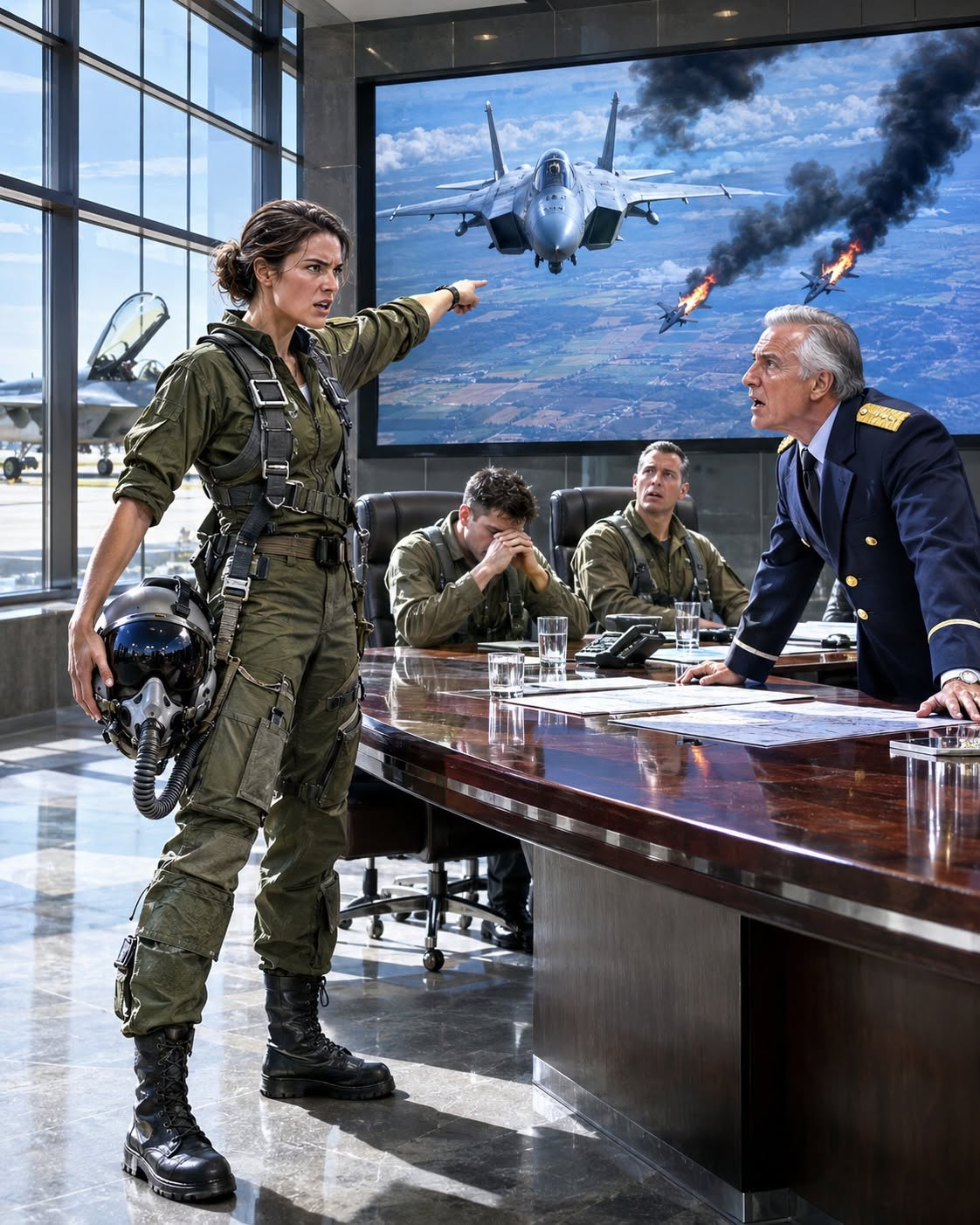
It rolled violently, released a trail of dark smoke, and disappeared into a bank of clouds.
I pulled up, trying to keep him in sight.
“Wren, break off!” Noah warned. “You’re getting too close to the island!”
I glanced at my navigation display.
He was right.
The enemy jamming field was stronger here. My instruments were flickering, and the warning lights were beginning to flash.
But the Shepherd was wounded.
If I let him escape, he might return tomorrow.
And tomorrow, someone else might die.
“I’m not leaving him.”
I pushed forward.
The clouds swallowed my aircraft.
For several seconds, I could see nothing but gray.
Then a warning tone sounded.
Missile lock.
My stomach dropped.
“Missile! Six o’clock!” Noah screamed.
I threw the Lynx into a hard defensive turn.
A bright streak cut through the clouds behind me.
The missile passed close enough to shake my aircraft before disappearing into the distance.
I breathed out sharply.
Then I realized something.
The Shepherd hadn’t fired at me.
The missile had come from somewhere else.
“Control, this is Wren. Do we have another hostile aircraft?”
Static answered.
I tried again.
Nothing.
Then a strange voice crackled through my headset.
“Captain Vance.”
I froze.
It was the Shepherd.
His voice was calm, almost conversational.
“An interesting maneuver back there. Who taught you to stop being afraid?”
I tightened my grip on the controls.
“Someone who understood that fear isn’t the same as weakness.”
A short silence followed.
Then he laughed.
“Your instructor should have taught you something else. Never chase a wounded animal into its own territory.”
The transmission ended.
I looked through the canopy.
There, barely visible beneath the clouds, was the dark outline of Scarn Island.
And suddenly, I understood.
The Shepherd wasn’t running.
He was leading me somewhere.
“Break off!” I shouted into the radio. “Noah, get away from the island!”
“Wren, what are you talking about?”
“The missile didn’t come from the Shepherd. There’s another threat down there.”
Before Noah could respond, the sky lit up.
Three missiles rose from the island’s coastline.
They weren’t air-to-air missiles.
They were surface-launched interceptors.
And they were coming directly toward us.
I pulled hard to the right.
Noah disappeared beneath the cloud layer.
“Brooks! Report!”
Nothing.
My radar flickered, then went completely dark.
The black jet emerged from the clouds ahead of me.
Its engine was damaged, smoke pouring from its rear section, but it was still flying.
The Shepherd had brought me into range of the island’s defenses deliberately.
He had never intended to defeat me in a fair dogfight.
He wanted the island to finish the job.
I could almost hear David’s voice in my head.
When everything in your body tells you to react, count to three first.
I looked at the watch strapped beneath my flight suit.
The second hand was still moving.
One.
Two.
Three.
I stopped trying to chase the black aircraft.
Instead, I turned toward the coast.
The Shepherd had made one mistake.
He believed I was still trying to kill him.
I wasn’t.
I was trying to understand the battlefield.
And the moment I stopped looking at him, I noticed something I hadn’t seen before.
A small communications tower stood on the northern edge of the island.
Its antenna was rotating.
Every time it passed a certain direction, my instruments briefly flickered back to life.
The electronic warfare system wasn’t operating as one single machine.
It depended on a coordinated network.
And that network had a weak point.
“Control, this is Wren. Do you copy?”
Static.
I changed frequencies.
Still nothing.
Then Noah’s voice broke through.
“Wren! I’m alive. Lost visual contact. I’ve got damage to my left stabilizer.”
Relief washed over me.
“Can you still fly?”
“Not comfortably.”
“Then get out of here. Head west. I’ll find you.”
“What about the Shepherd?”
I watched the black aircraft disappear behind the island’s mountain ridge.
“I’m changing the plan.”
I turned toward the northern coastline.
The missiles were still tracking us, but they had begun to spread out. Their guidance appeared to be struggling whenever the communications tower rotated away from our position.
I didn’t need to destroy the entire defense system.
I only needed to disrupt the connection long enough to get us home.
I switched to a secure emergency frequency.
“Corbin Ridge, this is Captain Vance. I need an immediate transmission to our electronic warfare team. The island’s jamming network appears to rely on a rotating relay near the northern coastline.”
For several seconds, there was no answer.
Then a familiar voice came through.
Commander Holloway.
“Wren, your aircraft is dangerously close to the island. Explain.”
“I believe I’ve found a weakness in their system. I need the team to examine the relay’s signal pattern.”
“You’re asking me to trust a theory while you’re flying blind?”
“Yes, ma’am.”
Another silence.
Then Holloway replied.
“Understood. Give us two minutes.”
Two minutes.
I had no idea whether I had that long.
The Shepherd reappeared on my left.
His black aircraft was moving unevenly now. The damaged engine was clearly losing power.
He turned toward me.
I expected him to attack.
Instead, he opened a radio channel.
“Captain Vance, you have a choice.”
I didn’t answer.
“Leave now, and I may allow you to survive.”
I almost laughed.
“You’ve already had your chance.”
His voice became colder.
“You think shooting down my aircraft will end this? You have no idea what you’re fighting.”
“Then why don’t you tell me?”
For the first time, he sounded genuinely irritated.
“Because you wouldn’t understand.”
He banked toward the island.
And then I saw something that made my blood run cold.
A second black aircraft emerged from the mountains.
It had the same white stripe.
The same shape.
The same markings.
For a moment, I thought I was seeing double.
Then I realized the truth.
There wasn’t just one Shepherd.
There were two.
“Control, we’ve got another hostile fighter!” I shouted.
Holloway’s voice returned immediately.
“Confirmed. Intelligence has identified a second aircraft operating from Scarn Island. Vance, you are not authorized to engage both. Withdraw immediately.”
I looked at the two black jets.
One was damaged.
The other was fresh, fast, and positioned behind me.
The Shepherd had never been undefeated because he was impossible to beat.
He had been protected by a system designed to make every encounter look like a contest between two individual pilots.
But it wasn’t.
It was a coordinated operation.
One aircraft baited the enemy.
The second attacked when the opponent became distracted.
The ground-based jamming system blinded everyone else.
Nine pilots had died because they believed they were fighting a single extraordinary man.
I had been wrong about one thing.
The Shepherd didn’t just make people blink.
He made sure they never saw the second threat coming.
“Brooks, do you have visual on the second aircraft?”
“Affirmative. It’s moving toward your six.”
“Can you distract it?”
Noah hesitated.
“My aircraft is barely holding together.”
“I know.”
“Wren, this is a terrible idea.”
“I know that too.”
He exhaled.
“All right. Let’s make it a terrible idea they remember.”
Noah banked toward the second black jet.
His damaged aircraft moved awkwardly, but it was enough to force the enemy pilot to adjust his course.
For a few precious seconds, the second Shepherd had to defend himself.
I turned toward the first.
The damaged black aircraft was descending toward the coastline.
I could have fired again.
I had a partial firing solution.
But something about his movements bothered me.
He wasn’t trying to escape anymore.
He was trying to reach a narrow stretch of coastline below the relay tower.
There, several military vehicles were moving along a service road.
One of them carried what looked like a large equipment container.
I zoomed in through the optical camera.
The container had markings I recognized from the intelligence briefings.
It was communications equipment.
Not ordinary equipment.
A mobile command unit.
My eyes widened.
The island’s electronic warfare system wasn’t simply protecting the airfield.
It was moving.
They were preparing to relocate the entire complex.
If that happened, our intelligence team would lose the only opportunity to identify the network’s weaknesses.
“Commander, there’s a mobile command unit moving along the northern service road. They’re evacuating equipment.”
Holloway answered immediately.
“Can you confirm?”
“Confirmed. I’m sending the visual feed.”
“Do not attack. Repeat, do not attack. Our ground team is preparing an interception.”
I watched the vehicles disappear behind a ridge.
Then the Shepherd’s voice returned.
“You are beginning to understand, Captain.”
I turned toward his aircraft.
He was still close enough to communicate.
“Nine pilots died because they believed the story you wanted them to believe,” I said.
“No. Nine pilots died because they made mistakes.”
“That’s what you tell yourself?”
A pause.
Then he answered quietly.
“That’s what I have to tell myself.”
For the first time, I heard something beneath his confidence.
Exhaustion.
Not fear.
Something heavier.
I didn’t know what to make of it.
Before I could ask another question, the second aircraft broke away from Noah and accelerated toward me.
“Wren, he’s coming in hot!”
I pulled upward.
The black jet followed.
My warning system screamed as the distance between us collapsed.
I rolled right, then dropped beneath his nose.
He followed the movement with impressive precision.
This pilot was different.
He didn’t rely on the same climbing maneuver.
He was faster to react and much more aggressive.
I tried to gain distance, but the damaged instruments made it difficult to judge my position.
A warning light flashed.
Fuel pressure.
Another flashed.
Hydraulic temperature.
I was running out of time.
“Brooks, status!”
“Still here. But I can’t keep this up much longer.”
“Get out of the engagement.”
“Not without you.”
I wanted to argue.
Then the radio crackled again.
“Captain Vance, this is Major Mensah.”
I almost forgot to breathe.
“David?”
“You’re making a mess of my morning, Wren.”
His voice sounded weak but unmistakable.
“How are you transmitting?”
“Borrowed a communications station in the hospital. Don’t ask how.”
Despite everything, I smiled.
“You’re supposed to be resting.”
“And you’re supposed to be following orders. Apparently neither of us is doing very well.”
Then his tone changed.
“I’ve been watching your telemetry. Your flight path is taking you too close to the island’s northern ridge.”
“I know.”
“No, listen. I remember something from our previous operations. That mountain range creates a strong interference shadow. The jamming signal weakens on the western side.”
I looked at the terrain display.
He was right.
The ridge could block the relay’s signal temporarily.
But there was a problem.
The valley between the mountains was narrow.
Too narrow for a comfortable maneuver at our current speed.
“Can you make it?” David asked.
I watched the second black aircraft closing behind me.
“Not comfortably.”
“That’s not what I asked.”
I glanced at the old steel watch beneath my sleeve.
Its second hand continued moving.
“Yes,” I said. “I can make it.”
I turned toward the mountain ridge.
The enemy pilot followed.
Behind him, the damaged Shepherd remained at a distance.
The valley grew larger in my canopy.
The walls of the mountain seemed to rise on both sides.
I descended.
The black jet followed.
My aircraft shook violently as the air currents changed.
A warning tone sounded.
Then another.
“Vance, pull up!” Holloway shouted through a brief burst of restored communication.
I ignored her.
The valley narrowed.
My speed was still too high.
I made a small adjustment.
Then another.
The second aircraft entered the valley behind me.
I could hear its engine through the radio transmission.
For a few seconds, everything seemed to slow down.
Then my instruments came back to life.
One by one, the displays restored their readings.
The jamming signal had weakened.
And with it, the enemy pilot lost the advantage he had enjoyed throughout the battle.
I checked my rear camera.
His aircraft was still following.
But he was no longer perfectly positioned.
He had entered the valley too aggressively.
His wingtip passed dangerously close to the rocky wall.
He corrected.
Too late.
The black jet clipped the edge of a rock formation.
A flash of sparks erupted beneath its wing.
The aircraft rolled sideways.
I watched in horror as it dropped toward the valley floor.
“Mayday! Mayday! I’m losing control!”
The voice was young.
Much younger than I expected.
I pulled away from the ridge.
The black aircraft continued descending, trailing smoke.
For a brief moment, I saw its pilot eject.
A parachute opened against the gray sky.
The aircraft struck the mountainside and exploded.
My heart pounded.
I had survived.
But the battle was far from over.
The first Shepherd was still flying.
And now he was coming directly toward me.
His damaged aircraft moved slowly, almost gracefully, through the clouds.
I turned to face him.
Noah was nowhere in sight.
“Brooks, report!”
No response.
I tried again.
Nothing.
Then the Shepherd’s voice came through.
“Alone at last.”
I tightened my grip.
“Where’s your wingman?”
“Where is yours?”
I looked at the empty sky.
I didn’t know.
And that frightened me more than I wanted to admit.
The Shepherd closed the distance.
His aircraft was damaged, but he still had enough control to fight.
I had limited ammunition.
My instruments were recovering, but several systems remained unreliable.
Neither of us had much left.
Then he did something I hadn’t expected.
He slowed down.
His aircraft settled into a steady path.
He opened a radio channel.
“Captain Vance, I want to make a deal.”
I said nothing.
“You’ve demonstrated that you’re better than the nine who came before you. You understand the game now.”
“I’m not interested in your approval.”
“You should be interested in surviving.”
I glanced at the fuel indicator.
It was lower than I wanted.
“What’s the deal?”
He paused.
“Turn away. Return to your base. Tell your commander that my aircraft was destroyed.”
“And the island?”
“Leave it alone.”
I looked toward the coastline.
The mobile command unit was gone.
The relay tower was still rotating.
He wanted me to leave.
Not because he had defeated me.
Because something was happening on the island that he needed time to protect.
“Why are you so desperate to keep me away from that place?” I asked.
His answer came slowly.
“Because there are people down there who have nothing to do with this war.”
I frowned.
“What?”
“The jamming station is located beside an old civilian settlement. The command unit has been ordered to relocate before the next attack. If your forces strike the wrong target, hundreds of people could die.”
I stared at the island.
For the first time, I wondered whether the intelligence we had received was incomplete.
“You’re lying.”
“Perhaps.”
“Why should I believe you?”
“Because I could have killed you in the valley.”
I said nothing.
He continued.
“My second pilot was inexperienced. He was supposed to distract your wingman, not pursue you into the mountains. I tried to stop him.”
I remembered the young voice over the radio.
The panic.
The desperate call for help.
It hadn’t sounded like a hardened enemy.
It had sounded like a frightened young man.
“Then surrender,” I said. “Give us the location of the command unit.”
He laughed softly.
“You still believe this is a simple war between good people and bad people.”
“No. I believe people should have a chance to stop making it worse.”
For several seconds, neither of us spoke.
Then his aircraft moved.
A sharp turn.
A sudden acceleration.
He was attacking.
I reacted instinctively, pulling the Lynx into a defensive roll.
The Shepherd’s cannon flashed.
Rounds passed beneath my left wing.
I turned hard and tried to bring my nose around.
But my aircraft was slower now.
The damaged systems were beginning to fail.
He slipped behind me.
My warning system screamed.
I could almost see the nine pilots who had died before me.
I understood now how they must have felt.
The fear.
The exhaustion.
The sudden realization that the enemy was behind them.
My hand moved toward the controls.
Then I remembered David’s watch.
One.
Two.
Three.
Instead of turning sharply, I made a small controlled adjustment.
The Shepherd anticipated the aggressive maneuver.
He moved to intercept the position he expected me to occupy.
But I wasn’t there.
I had deliberately slowed my turn.
His cannon fire passed harmlessly ahead of my aircraft.
For the first time, he had committed to a prediction that was wrong.
I pushed the throttle forward.
My nose came around.
The black aircraft crossed my sights.
I had him.
The firing solution was perfect.
My finger tightened.
Then I noticed something.
His cockpit canopy was cracked.
A small red warning light flashed behind the glass.
He was struggling to maintain altitude.
He wasn’t trying to kill me anymore.
He was trying to stay in the air.
I had one clear shot.
One that could end the battle.
One that could make me the pilot who finally defeated the Shepherd.
But the target was no longer just a black aircraft.
There was a person inside it.
A person who had made terrible choices.
A person who had killed nine of ours.
And a person who was now losing control of his machine.
I released the trigger.
Instead, I opened the radio.
“Colonel Lindqvist, your aircraft is damaged. Eject now.”
He didn’t respond.
“Henrik, eject!”
For the first time, I used his actual name.
His aircraft began to descend.
Then I heard a voice.
“Why?”
I swallowed.
“Because I don’t need another body to prove that you’re beaten.”
Silence.
Then his canopy separated.
A small figure dropped away from the black jet.
His parachute opened.
The aircraft continued downward and crashed into the sea.
I watched the parachute drift toward the water.
My fuel warning sounded again.
I had no time to celebrate.
“Control, this is Wren. The Shepherd has ejected. I repeat, the Shepherd has ejected. Request immediate rescue coordination.”
A burst of static.
Then Holloway’s voice.
“Copy, Wren. Search and rescue is being dispatched. Now return to base.”
I looked around.
The sky was strangely quiet.
No missiles.
No cannon fire.
No enemy aircraft.
Just clouds moving slowly over the island.
Then Noah’s voice broke through.
“Wren?”
I nearly shouted.
“Brooks!”
“I’m here. Damaged, embarrassed, and possibly going to need a new aircraft.”
A laugh escaped me.
“You’re buying the first round of coffee.”
“Deal. As long as you promise not to fly through any more mountains.”
I smiled.
“Can’t promise that.”
We turned west.
The flight home felt longer than the battle itself.
My hands were shaking.
My legs ached.
My head hurt from the strain of the G-forces.
But I was alive.
And for the first time in thirteen days, I could see the horizon without expecting another black aircraft to emerge from it.
When we landed at Corbin Ridge, the ground crew rushed toward us.
Noah climbed out first.
His aircraft looked like it had been dragged through a storm.
Mine wasn’t much better.
Commander Holloway stood near the hangar with two intelligence officers.
She didn’t smile when I approached.
“Captain Vance, do you have any idea how many regulations you violated today?”
I removed my helmet.
“Several, ma’am.”
“Several?”
“Possibly all the important ones.”
For a moment, she stared at me.
Then her expression softened.
“You also brought back information that may save hundreds of lives.”
She handed me a tablet.
On the screen was an image from our aircraft’s optical camera.
The mobile command unit had been tracked to an old industrial facility on the island’s eastern side.
It wasn’t a military bunker.
It was a converted power station located less than a mile from a civilian medical shelter.
A planned strike had been scheduled for that evening.
The intelligence team had already begun reviewing the target.
Because of the footage I had transmitted, the operation had been suspended.
Instead of launching an attack, our commanders had contacted the appropriate humanitarian observers and arranged a corridor for civilian evacuation.
The jamming complex was still operating.
The war wasn’t over.
But hundreds of people had been given a chance to get out.
I stared at the screen.
“How did you know the command unit was there?”
Holloway shook her head.
“We didn’t. Not until your footage arrived.”
She paused.
“Your decision to stop pursuing the Shepherd may have changed the outcome of this entire operation.”
I didn’t know what to say.
I had gone into the sky expecting to face a monster.
I had returned with a prisoner, a wounded wingman, and a different understanding of what victory meant.
That evening, I visited Major David Mensah in the hospital.
He was sitting beside the window when I entered.
His arm was still bandaged, but he looked considerably better.
He noticed the old steel watch in my hand.
“Looks like you brought it back.”
I placed it on his bedside table.
“Your watch did more than you know.”
He picked it up and examined the scratched glass.
“Did you remember to count?”
“Every time I wanted to do something stupid.”
He laughed.
“Then it did its job.”
I pulled a chair beside his bed.
For a while, neither of us spoke.
Finally, I told him about the Shepherd.
About the second aircraft.
About the young pilot in the mountains.
And about the moment when I had a perfect shot but chose not to take it.
David listened without interrupting.
When I finished, he leaned back.
“Do you think you made the right decision?”
I looked down at my hands.
“I don’t know.”
“Good.”
I frowned.
“Good?”
He nodded.
“People who are absolutely certain they were right sometimes stop thinking about what they did. The important thing is that you keep asking yourself why.”
I considered that.
Then he pointed toward the watch.
“There’s something else you should know about that thing.”
I picked it up.
“What?”
“It belonged to my father. He carried it during his service. He used to tell me that the hands of a clock never move backward, no matter how badly you wish they would.”
I looked at the worn steel casing.
“Sounds like something he’d say.”
“He also used to tell me that being brave doesn’t mean never being afraid.”
David smiled faintly.
“It means being responsible for what you do when you’re afraid.”
I remembered the Shepherd’s black aircraft.
The nine empty chairs in our briefing room.
The young pilot’s desperate voice.
And the moment I had almost fired.
I finally understood what David had been trying to teach me.
The following morning, Colonel Henrik Lindqvist was transferred to a secure military medical facility.
He had survived the crash with several broken ribs and a concussion.
During questioning, he revealed the truth about the Shepherd operation.
The black aircraft had never been a single legendary fighter.
It was a designation shared by a small group of pilots trained to use coordinated deception, electronic interference, and carefully planned ambushes.
The white stripe was not a personal symbol.
It was a mark of the operation.
Lindqvist had been its most experienced pilot, and the man responsible for training the others.
He had allowed the legend to grow because fear made his opponents predictable.
He hadn’t needed to be invincible.
He only needed everyone else to believe he was.
The information helped our intelligence teams identify the remaining aircraft and understand how the island’s electronic warfare network operated.
Within days, the enemy complex was isolated.
The jamming equipment was eventually disabled through a coordinated operation that avoided the civilian settlement.
The Forty-First Squadron returned to regular patrol duties.
But something had changed.
The nine pilots who had died were no longer remembered as victims of an unbeatable enemy.
Their recordings became part of a new training program.
Not to teach younger pilots how to imitate me.
Not to encourage them to ignore danger.
But to teach them how to recognize manipulation, question assumptions, and make decisions under pressure.
I attended the first training session.
At the front of the room, a young lieutenant raised his hand.
“Captain Vance, what was the hardest part of facing the Shepherd?”
I thought about it.
“The first few seconds.”
“Because you were afraid?”
“Because I thought being afraid meant I had to do something immediately.”
The room became quiet.
I continued.
“Fear is useful. It tells you something matters. It tells you to pay attention. But fear is a terrible commander. If you let it make every decision, someone else can control you without ever touching your aircraft.”
The young lieutenant nodded.
“Is that why you held your course?”
“Partly.”
I looked toward the nine photographs displayed along the wall.
“But holding your course doesn’t always mean refusing to turn. Sometimes the bravest thing you can do is change direction when everyone expects you to keep fighting.”
After the session, I returned to the hangar.
My Lynx was being repaired.
The left wing had several fresh patches, and the maintenance crew was replacing damaged components near the engine housing.
Noah stood beside it, holding two cups of coffee.
“One for the hero,” he said, handing me a cup.
“And one for the pilot who almost crashed into a mountain?”
“Exactly.”
We stood together for a while, watching the ground crew work.
Then Noah asked something I hadn’t expected.
“Do you think Lindqvist will ever fly again?”
I looked toward the runway.
“I don’t know.”
“Do you forgive him?”
I took a slow sip of coffee.
“No.”
Noah looked surprised.
I continued.
“Forgiving someone and understanding them aren’t the same thing. I understand how he built that operation. I understand why people followed him. But understanding doesn’t erase what he did.”
Noah nodded.
“Fair enough.”
A week later, I received a small package from the hospital.
Inside was David’s old watch.
I turned it over and noticed something engraved on the back that I hadn’t seen before.
Three words.
COURAGE REQUIRES CHOICE.
I stood there for a long time, running my thumb over the letters.
Then I placed the watch inside my flight suit.
It had become more than a reminder to count to three.
It reminded me that every decision carried a consequence.
Every trigger pull.
Every maneuver.
Every moment when fear tried to convince me there was only one way forward.
A month after the battle, the Forty-First Squadron held a memorial for the nine pilots.
Their families stood beneath the flags.
Their photographs were arranged in a line.
There were no speeches about glory.
No promises that their deaths had been necessary.
Commander Holloway simply spoke their names.
One by one.
When she finished, she invited me to say a few words.
I stepped forward.
I had prepared a speech, but when I looked at the photographs, every sentence disappeared from my mind.
So I spoke without notes.
“I used to think courage meant being the person who never turned away. I was wrong.”
I looked at the families.
“Courage means knowing what you’re protecting. It means recognizing when someone is trying to use your fear against you. And sometimes, it means choosing not to fire, even when you have every reason to do so.”
I paused.
“These nine pilots were not weak because they turned away. They were doing what they believed would keep them alive. The enemy exploited that instinct. Their deaths were not failures of courage. They were a reminder that courage alone is not enough. We need knowledge, discipline, teamwork, and the willingness to question what we think we know.”
I stepped back.
For several seconds, the airfield remained silent.
Then David, who had attended in a wheelchair, began to clap.
Others joined him.
I didn’t feel like a hero.
I felt like someone who had been given another chance and needed to make it count.
That night, I returned to the hangar alone.
The repaired Lynx stood beneath the overhead lights.
Its white identification markings gleamed against the dark fuselage.
I climbed the ladder and sat inside the cockpit.
The familiar smell of metal, fuel, and worn leather surrounded me.
I placed my hand on the control stick.
For thirteen days, the black aircraft with the white stripe had represented everything we feared.
Now, it represented something else.
A lesson.
The most dangerous enemy isn’t always the fastest, strongest, or most experienced.
Sometimes, it’s the one who understands your fear better than you understand yourself.
And the most important battle doesn’t always happen in the sky.
Sometimes, it happens in the few seconds between feeling afraid and deciding what to do next.
I looked down at David’s watch.
The second hand moved steadily.
One.
Two.
Three.
I smiled.
Then I climbed out of the cockpit and switched off the hangar lights.
Tomorrow, we’d fly again.
Not because we had stopped being afraid.
Not because we believed we couldn’t lose.
But because the people who depended on us deserved pilots who could think clearly when the sky turned dark.
And as I walked toward the exit, I finally understood something that the Shepherd had never learned.
Fear can make people turn away. But courage is not simply the decision to keep moving forward. It is the wisdom to know which direction is worth moving toward.