The billionaire was seconds away from buying the entire steel factory when a single father in a worn-out jacket raised his hand and offered $400.
The auctioneer opened the file, and the color drained from his face.
“These aren’t ordinary equipment transfer records,” he said. “They’re emergency removal orders. Someone authorized the dismantling of the factory’s original production line three days ago, even though the auction hasn’t been completed.”
The billionaire CEO, Victoria Sterling, snatched the papers from his hand.
“Who signed this?”
The auctioneer hesitated.
Then he pointed to a name at the bottom of the page.
“Richard Cole. The company’s chief operating officer.”
A murmur swept through the auction hall.
Richard Cole was standing just behind Victoria. He was a tall man in an expensive charcoal suit, with silver hair and the kind of polished smile that made people trust him before they knew anything about him.
He had been watching me since I raised my hand.
Now that smile was gone.
“That’s ridiculous,” Richard said. “Those orders were part of a routine asset liquidation. The factory is closing. We have every legal right to recover the equipment.”
Victoria didn’t look at him.
“Then why were the original engineering systems removed before the sale?”
Richard adjusted his tie.
“Because they’re obsolete.”
I finally spoke.
“They aren’t obsolete.”
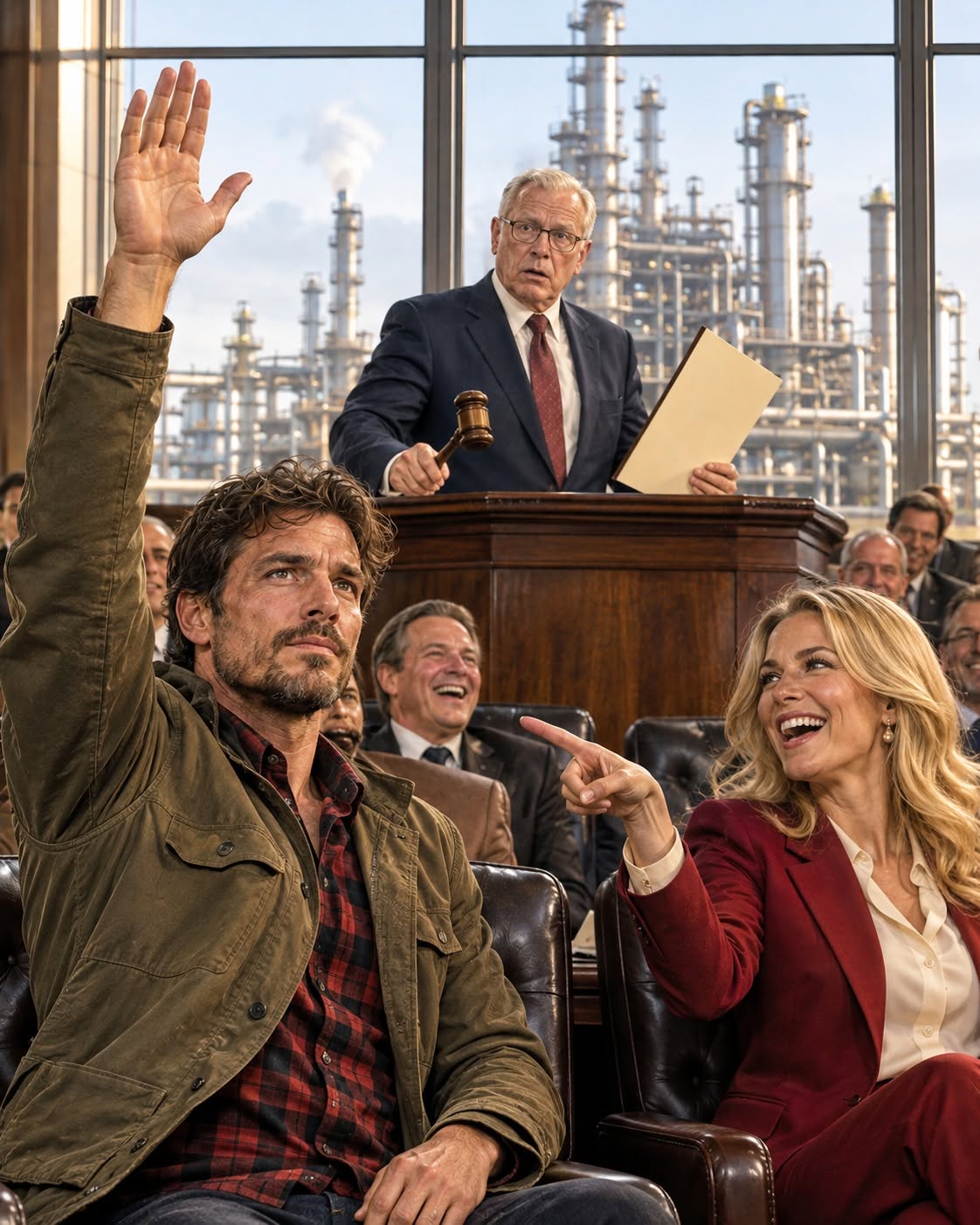
Every head turned toward me.
I opened my leather case and removed a yellowed blueprint. The paper was brittle around the edges, but the drawings were still clear. Across the top was the title of a production system I had spent eleven years developing.
“The equipment you ordered removed isn’t the most valuable part of this factory,” I explained. “It’s the physical interface for a process that was never fully documented in the company’s modern records.”
Victoria studied the blueprint.
“Explain.”
I took a breath.
“Twenty-eight years ago, I designed a system that allowed this plant to produce specialized steel using significantly less energy than conventional methods. It was the reason this factory survived two recessions when competitors were shutting down.”
I pointed to a series of markings along the bottom of the page.
“But there was a second part to my design. A protected control mechanism. Without it, the production line can still operate, but it cannot reach its full capacity. Whoever removes the equipment without understanding that system could destroy the only remaining version of the technology.”
Richard laughed nervously.
“He’s telling stories. This man was a former employee who was dismissed for poor performance.”
I looked directly at him.
“Then you shouldn’t have any problem explaining why your signature appears on the document that transferred my engineering patents to a company registered in the Cayman Islands.”
The room went completely silent.
Victoria slowly lowered the blueprint.
“Richard, what is he talking about?”
He shook his head.
“He’s confused. Those patents were legally purchased years ago.”
“By whom?” I asked.
Richard didn’t answer.
I reached into my case again and removed a small envelope. Inside was a certified copy of an agreement bearing the signatures of the factory’s original founders.
Victoria read the first paragraph.
Then she read it again.
Her eyes narrowed.
“Is this authentic?”
“The original is in the state archives,” I replied. “This is a certified copy. You can verify it yourself.”
She turned toward her legal counsel.
“Do it. Right now.”
The attorney took the document and began examining it.
Meanwhile, Richard moved toward the exit.
Two security guards stepped into his path.
“Where are you going?” Victoria asked.
“I have a conference call.”
“Your conference call can wait.”
For the first time, I noticed something unusual about Victoria Sterling. She was ruthless, certainly. Her reputation was built on acquiring failing companies, eliminating waste, and turning struggling businesses into profitable operations.
But she wasn’t stupid.
And she was beginning to understand that the man she had hired to manage this acquisition might have been hiding something much bigger than a few missing machines.
The attorney finally looked up.
“Ms. Sterling, the document appears genuine.”
Victoria’s expression hardened.
“Read it aloud.”
He did.
The agreement stated that the original engineering system was protected by a special intellectual property arrangement. If the factory attempted to sell or transfer its core production assets without preserving the engineer’s rights, the original inventor retained the right to reclaim the protected technology and challenge the transfer.
There was also a clause concerning unauthorized removal or destruction of the equipment.
If triggered, it required an independent review before the sale could proceed.
Richard interrupted.
“This is meaningless! The agreement expired years ago!”
“Then why did you spend three years trying to have it removed from the archives?” I asked.
His face turned red.
Victoria looked at him.
“Three years?”
I nodded.
“After I was fired, I tried to contact the board. I sent letters. I hired an attorney. I even requested a meeting with the new owners. Every attempt was rejected.”
I paused.
“Then my attorney died, and the legal fight became too expensive for me to continue.”
Victoria glanced at my worn jacket.
“How long ago?”
“Seventeen years.”
For a moment, the room seemed to grow smaller.
Seventeen years of being ignored. Seventeen years of watching other people build fortunes from something I had created. Seventeen years of carrying the original documents in a leather case because I had nowhere else to keep them safe.
Victoria looked down at the $400 bid recorded on the auction sheet.
“Why four hundred dollars?”
I gave her a faint smile.
“Because that’s the amount written into the original agreement as the symbolic consideration required to initiate the review procedure. I didn’t come here to buy a multimillion-dollar factory. I came here to stop someone from selling something they never had the right to sell.”
Richard suddenly slammed his hand against the table.
“This is a setup!”
Nobody responded.
He pointed at me.
“He’s been waiting for years to ambush this company. He knows exactly what he’s doing!”
“You’re right about one thing,” I said quietly. “I’ve been waiting a long time.”
Then I leaned forward.
“But I didn’t arrange for those machines to disappear three days before an auction.”
Victoria turned to security.
“Lock down the facility. No equipment leaves. No employee destroys or removes any records. Contact outside counsel and preserve every digital backup.”
Richard stepped forward.
“You can’t do that. I’m the chief operating officer!”
“Not anymore.”
Victoria took out her phone.
“Effective immediately, you’re suspended pending an independent investigation.”
Richard stared at her.
“You can’t fire me based on the word of a disgruntled former employee.”
“I’m not firing you based on his word,” she replied. “I’m suspending you because the documents you signed suggest that you may have been stealing from the company I came here to acquire.”
Two security officers escorted him out.
As the doors closed behind him, I thought the worst was over.
I was wrong.
Twenty minutes later, a young woman in a navy-blue jacket rushed into the auction hall. She carried a laptop and a thick folder.
“Ms. Sterling, you need to see this.”
Victoria recognized her.
“Emily? What’s happened?”
“I’m from the financial due diligence team. We traced the equipment removal orders to a storage facility outside the city.”
She opened her laptop.
On the screen were photographs of industrial machinery, metal control cabinets, and several large components covered in plastic.
“These items were supposed to be destroyed,” Emily explained. “Instead, they’ve been transported to a private warehouse owned by a company called Northbridge Industrial Holdings.”
I felt my stomach tighten.
I knew that name.
It was the same company listed on the patent transfer agreement.
“Who owns it?” I asked.
Emily hesitated.
“According to the corporate filings, the beneficial owner is Daniel Mercer.”
I closed my eyes.
Daniel Mercer.
The former chairman of the steel company.
The man who had fired me.
The man who had once told me that engineers were replaceable and that no individual was bigger than the corporation.
I had not heard his name in almost two decades.
Victoria noticed my reaction.
“You know him?”
“He’s the reason I lost everything.”
She studied me carefully.
“Then I think we need to hear the entire story.”
I sat down.
For the first time that afternoon, I told them what had happened.
Twenty-eight years earlier, the factory had been close to bankruptcy. Its furnaces consumed enormous amounts of energy, production was inconsistent, and customers were abandoning it.
I was a young engineer with a wife, a newborn son, and more ambition than money.
I spent nights in the plant, sleeping in my office and testing ideas that senior engineers dismissed as impossible.
Eventually, I developed a new production system that changed everything.
It reduced energy consumption, improved output, and allowed the factory to manufacture a specialized steel used in bridges, railways, and industrial construction.
The company went from losing money to becoming one of the most profitable steel producers in the region.
For a while, I believed I had finally built something that would give my family a secure future.
Then Daniel Mercer took control.
He offered me a promotion and asked me to sign a new intellectual property agreement.
I refused because the agreement transferred ownership of all my future inventions to the company without compensation or attribution.
Three weeks later, I was accused of leaking confidential information.
The allegations were false, but the investigation was controlled by people who answered directly to Mercer.
I was fired.
My security access was revoked. My research disappeared from the laboratory. My name was removed from technical reports.
The company kept my inventions.
I lost my salary, my professional reputation, and eventually my home.
My wife, Margaret, stood beside me for as long as she could.
But years of financial pressure and legal battles took their toll.
She died after a long illness, leaving me to raise our son, Noah, alone.
I never told him the entire truth.
I didn’t want him growing up believing that the world owed us something.
I wanted him to believe that hard work still mattered.
But there were nights when I wondered whether I had made the right choice.
Victoria listened without interrupting.
When I finished, she asked a question I wasn’t expecting.
“Where is your son now?”
“He’s thirty-one. He works as a mechanical engineer in another state.”
“Does he know you’re here?”
“No.”
Victoria nodded slowly.
“Call him.”
I hesitated.
“Why?”
“Because if this investigation becomes what I suspect it will become, you’re going to need someone you trust.”
I looked at the phone in my hand.
I hadn’t wanted Noah involved.
He had spent his childhood watching me struggle. I didn’t want to drag him back into something that had already taken so much from our family.
But I called anyway.
He answered after the second ring.
“Dad? Everything okay?”
I looked around the auction hall.
Investors were whispering. Lawyers were reviewing documents. Security personnel were coordinating with the factory.
For the first time in years, I felt as if the truth might finally have somewhere to go.
“Noah,” I said. “I need you to listen carefully.”
I explained everything.
He was silent for several seconds.
Then he asked, “Are you telling me the company stole your work?”
“That’s what the documents suggest.”
“And you’re trying to get it back?”
“I’m trying to make sure they can’t destroy it.”
There was another pause.
Then he said something that made my eyes sting.
“Mom always told me you were the smartest engineer she’d ever met. I used to think she was just being a good wife.”
I swallowed.
“She wasn’t.”
“I know that now. Send me the address. I’m coming.”
The call ended.
Victoria looked at me.
“He’s coming?”
“Yes.”
“Good.”
She closed her laptop.
“Because I have a feeling the people behind this operation aren’t going to surrender quietly.”
She was right.
At 6:15 that evening, the first threat arrived.
It came in the form of an anonymous message sent to my phone.
STOP DIGGING. TAKE THE MONEY AND DISAPPEAR.
Attached was a photograph of my house.
Someone had taken it that afternoon.
I stared at the screen, feeling a cold wave pass through my chest.
Victoria read the message.
Her expression changed immediately.
“That’s a threat.”
“It’s probably just an attempt to frighten me.”
“Maybe. But we’re not taking chances.”
She instructed her security director to contact the authorities and arrange protection.
I wanted to protest.
I had spent too many years being afraid.
But the thought of Noah walking into the middle of this made me reconsider.
That night, we traveled to the factory under security escort.
The building stood at the edge of town, its enormous steel chimneys rising against a darkening sky.
I hadn’t seen it in seventeen years.
The gates were rusty. Several windows were broken. Weeds had grown through cracks in the concrete.
Yet the main production building was still standing.
I stepped out of the vehicle and stared at it.
For a moment, I could almost hear the old machines running.
I remembered the first successful test. The smell of hot metal. The excitement of seeing numbers on a control screen finally match the calculations in my notebook.
This place had been more than a job.
It had been the greatest achievement of my life.
Victoria stood beside me.
“Was it really that important to you?”
I looked at her.
“It was where I learned that an idea can change thousands of lives. It was where I thought my son would grow up knowing that his father had built something meaningful.”
She didn’t answer.
Instead, she walked toward the entrance.
Inside, the factory was almost completely dark.
Our footsteps echoed through the enormous production hall.
Emily followed us with a flashlight.
We reached the central control room, where a large section of the original machinery had already been disconnected.
Several cables had been cut.
A control cabinet lay open.
I moved closer.
Then I saw something that made my heart stop.
The main control module was missing.
“Where is it?” I whispered.
Emily checked the removal inventory.
“It was listed as transferred to the warehouse.”
I shook my head.
“No. Not that module.”
Victoria turned toward me.
“Why?”
I pointed to the empty mounting frame.
“That is the heart of the original system. Without it, the remaining machinery is useless. And if someone destroys it, they won’t just be destroying equipment.”
I looked at the exposed wiring.
“They’ll be destroying the only physical record of how the system works.”
Victoria called her security director.
“Find that warehouse. I want the authorities there tonight.”
Then a voice came from behind us.
“You’re too late.”
We turned.
A man stood near the entrance.
He was older now, heavier, and his hair had turned almost completely white.
But I recognized him immediately.
Daniel Mercer.
He looked at me and smiled.
“Still carrying that old case, I see.”
I felt my hands tighten.
“You’re still stealing other people’s work.”
His smile disappeared.
Daniel glanced at Victoria.
“Ms. Sterling, I strongly recommend you walk away from this situation. You’re buying a factory, not inheriting a forty-year-old family dispute.”
Victoria crossed her arms.
“I don’t recall asking for your recommendation.”
He laughed.
“You’re making a mistake. The patents are already transferred. The equipment is already gone. And whatever story this man tells you, it won’t change the ownership records.”
I stepped forward.
“Why did you take the control module?”
Daniel looked at me.
“Because it was valuable.”
“To whom?”
“To people who understand what they are buying.”
I stared at him.
“You never understood the system.”
For the first time, he looked genuinely irritated.
“Don’t flatter yourself. I built an entire company while you spent your life drawing diagrams.”
“No,” I replied. “You built a company using diagrams you stole.”
Daniel took a step closer.
“Do you know what your problem was? You believed that inventing something gave you the right to control it. It doesn’t. Business is about ownership, not sentiment.”
I looked at the factory around us.
“Then why are you so desperate to hide the original documents?”
He didn’t answer.
Instead, he turned toward the exit.
“Enjoy your little investigation.”
But before he could leave, headlights swept across the windows.
Several police vehicles entered the factory grounds.
Daniel stopped.
Victoria’s security director had already contacted investigators, and the evidence from the auction hall had been enough to secure an emergency intervention.
Two officers approached Daniel.
“Mr. Mercer, we’d like you to accompany us for questioning regarding the unauthorized removal of company property and suspected financial misconduct.”
Daniel’s face hardened.
“This is absurd.”
“Then you’ll have no problem answering our questions.”
He was escorted outside.
As he passed me, he leaned close enough for only me to hear.
“You think you’ve won?”
I looked him in the eyes.
“No. I think I’ve finally stopped losing.”
The following morning brought another surprise.
Noah arrived at the factory shortly after sunrise.
He walked into the control room, looked at the machinery, and then looked at me.
For several seconds, neither of us spoke.
Finally, he hugged me.
Not the quick kind of hug adults give when they feel obligated.
He held on tightly.
“Dad,” he whispered. “Why didn’t you tell me?”
I looked down.
“Because I didn’t want your childhood to be about my battles.”
He pulled away.
“You spent your whole life protecting me. Maybe you should have let me stand beside you once in a while.”
I had no answer.
He opened his backpack and took out a tablet.
“I’ve been looking at the documents you sent. There’s something interesting.”
He showed me a series of old patent references.
“I think the company registered a continuation patent using the original technical specifications. But the application includes an altered inventor declaration.”
I leaned closer.
“Who signed it?”
Noah enlarged the document.
My name appeared in the inventor field.
But the signature was not mine.
Below it was a witness signature.
Richard Cole.
We looked at each other.
“Richard didn’t just authorize the equipment transfer,” Noah said. “He helped create the false patent ownership records.”
Victoria joined us.
“Can you prove it?”
Noah nodded.
“If we can access the original engineering archive, we can compare the patent’s technical drawings with the first versions Dad created.”
I smiled faintly.
“I still have those drawings.”
I opened the leather case.
Inside were dozens of documents, notebooks, and handwritten calculations.
Noah carefully examined them.
Then he stopped at a small black notebook.
“Dad, what is this?”
“My original test log.”
He flipped through the pages.
At the back was a list of dates, signatures, and equipment measurements.
Noah looked up.
“This could establish when the design was actually created.”
Victoria immediately called her legal team.
For the next two weeks, the investigation expanded.
Independent forensic engineers examined the factory’s original systems. Financial investigators traced payments through Northbridge Industrial Holdings. Lawyers uncovered a chain of transfers involving shell companies and falsified licensing agreements.
The missing control module was eventually found in a warehouse.
It had not been destroyed.
It had been prepared for shipment to a private buyer overseas.
But the most damaging evidence came from a backup server recovered from the factory’s old research department.
The server contained emails between Daniel Mercer, Richard Cole, and several former executives.
One message, dated seventeen years earlier, contained a sentence that changed everything.
“Remove the engineer’s name before the next patent filing. We cannot have an individual claiming ownership over the process that now supports the entire company.”
There were also instructions to manufacture a misconduct allegation against me.
The evidence was devastating.
Daniel Mercer and Richard Cole were charged with multiple offenses relating to fraud, falsification of records, and the unlawful transfer of assets. Several former executives were also investigated.
But the legal battle over my intellectual property was far from simple.
The company had changed ownership several times. Some patents had expired, others had been transferred, and certain rights were subject to complicated agreements.
I was offered a settlement.
A large one.
Enough money to buy a comfortable home, retire, and never worry about bills again.
Victoria personally presented the offer.
“You’ve earned the right to walk away,” she told me. “Take the money. Let the lawyers handle the rest.”
I looked at the proposal.
Then I looked through the glass wall at the factory floor.
“What happens to the workers?”
Victoria paused.
“The plant could reopen if we restructure the operation. But it would require a significant investment.”
“And the original technology?”
“We could negotiate a license.”
I shook my head.
“I don’t want a license agreement that lets someone else repeat what happened to me.”
She leaned back.
“Then what do you want?”
I took a breath.
“I want the workers protected. I want the technology preserved. And I want the people who developed it to receive proper recognition and compensation.”
Victoria studied me.
“That could make the acquisition more complicated.”
“I know.”
“It could also make it less profitable.”
“I know that too.”
For a moment, neither of us spoke.
Then Victoria smiled.
“You’re a difficult man to negotiate with.”
I smiled back.
“I’ve had practice.”
Three months later, the court approved an interim arrangement that recognized my original contractual rights and prevented the disputed technology from being transferred until the final ownership review.
The investigation also established that the company had knowingly relied on falsified inventor records.
My name was formally restored to the historical engineering documentation.
It wasn’t the same as getting seventeen years back.
But it was a beginning.
Victoria made an unexpected offer.
She wanted to reopen the factory as a worker-owned industrial company, with a new board that included employee representatives and independent technical oversight.
She also proposed creating a research institute on the factory grounds.
Its purpose would be to help engineers develop industrial technologies without losing control of their intellectual property.
I agreed to help design the institute.
But I insisted on one condition.
“No one should have to sacrifice their family, their health, or their dignity to prove that their ideas matter.”
Victoria nodded.
“Then we’ll put that into the founding charter.”
Noah joined the project as a senior engineering consultant.
For the first time, father and son were working together on something that wasn’t driven by desperation.
We spent long days examining old blueprints, rebuilding control systems, and teaching younger engineers how the original production process worked.
One afternoon, while we were reviewing the restored machinery, Noah asked me a question.
“Do you ever regret coming to the auction?”
I looked at him.
“Sometimes I regret waiting so long.”
He smiled.
“That’s not what I asked.”
I considered his question.
“No. I don’t regret it.”
“Even though it cost you so much?”
I looked toward the enormous furnace.
“Son, the greatest mistake I made wasn’t trusting the wrong people. It was believing that staying silent would protect everyone I loved.”
Noah nodded.
“I wish you’d told me sooner.”
“So do I.”
He placed a hand on my shoulder.
“Well, we’re here now.”
Six months after the auction, the factory reopened.
It wasn’t the enormous corporation it had once been. We started with a smaller production line, fewer employees, and a careful financial plan.
But it was honest.
Every worker received a written explanation of the new ownership structure. Every engineer signed a fair intellectual property agreement. Every major decision involving the original technology required independent review.
On opening day, hundreds of people gathered outside the factory.
Some were former employees. Others were local residents who had watched the plant decline for years.
Victoria stood at the podium.
She spoke about accountability, leadership, and the cost of allowing powerful people to operate without oversight.
Then she invited me forward.
I hadn’t prepared a speech.
I stood before the crowd in the same worn-out jacket I had worn to the auction.
The leather case rested beside my feet.
I looked at the faces in front of me.
“I want to tell you something,” I began.
“Seventeen years ago, I walked out of this factory believing that everything I had built had been taken from me. I thought the worst thing that could happen to an engineer was to have his work stolen.”
I paused.
“I was wrong.”
The crowd grew quiet.
“The worst thing is to begin believing that your work, your voice, and your worth don’t matter because someone powerful says they don’t.”
I glanced at Noah.
“An idea is valuable. But the person who creates it is valuable too. Never allow anyone to convince you otherwise.”
There was a long moment of silence.
Then the applause began.
It grew louder until the entire courtyard was standing.
I didn’t feel like a hero.
I felt like a tired old man who had finally put down a burden he had carried for too long.
After the ceremony, Victoria approached me.
“There’s something I never asked you,” she said.
“What?”
“That afternoon at the auction, when everyone laughed at your $400 bid, why didn’t you look embarrassed?”
I thought about it.
Then I gave her the answer I had carried with me for seventeen years.
“Because I wasn’t bidding on the factory.”
She tilted her head.
“What were you bidding on?”
I looked toward the workers returning to their stations.
“My name.”
She smiled.
“Well, I think you got it back.”
I shook my head gently.
“No. I never lost it. Other people just spent a long time pretending they could take it.”
That evening, after everyone had gone home, I walked alone through the production hall.
The machines were running again.
Their steady rhythm echoed through the building, just as it had decades earlier.
I placed my hand on the restored control cabinet.
For years, I had imagined that getting justice would feel like revenge.
I thought I would want to see the people who hurt me lose everything.
But standing there, listening to the factory come alive again, I realized something.
Revenge would never have rebuilt this place.
Anger would never have given the workers their jobs back.
And money alone would never have restored the trust that had been destroyed.
What mattered was that the truth had finally become stronger than the lies.
I returned to my office and opened the old leather case.
At the very bottom, beneath the original blueprints, I found a photograph of Margaret.
She was standing beside me on the day the first production system passed its final test. Her smile was brighter than the factory lights behind us.
On the back, she had written a sentence in blue ink:
“Build something that will still matter when we’re gone.”
I held the photograph for a long time.
Then I placed it in a frame beside the new factory charter.
The next morning, I arrived early and found Noah already working at his desk.
He looked up.
“Morning, Dad.”
“Morning.”
He pointed toward a new blueprint on the table.
“I’ve been thinking about a modification to the energy recovery system. It could make the process even more efficient.”
I studied the design.
It was clever.
Very clever.
“Where did you get this idea?”
He shrugged.
“Probably from watching you work all those years.”
I laughed.
“Then I hope you improve it.”
He smiled.
“That’s the plan.”
Outside, the factory whistle sounded.
Workers entered through the main gates. The furnaces began warming. The first production team prepared for another shift.
And somewhere in the middle of all that movement, a small but important thing happened.
A young engineer approached my desk with a notebook.
“Sir, could you look at something I’ve been working on?”
I pulled up a chair.
“Of course. Show me.”
He hesitated.
“I know you’re busy. I just thought maybe the idea was too small to bring to the director.”
I looked at the notebook.
Then I looked at him.
“Never make that decision for someone else. If you’ve got an idea, it deserves to be heard.”
He sat down.
And for the next hour, we discussed his design.
When he left, I realized that this was the real victory.
Not the settlement.
Not the restored patent records.
Not even the reopening of the factory.
It was knowing that another young engineer wouldn’t have to spend seventeen years wondering whether his voice mattered.
The $400 bid had never been about buying steel, machinery, or property.
It had been about reminding a room full of powerful people that the value of something cannot always be measured by the highest number written on an auction sheet.
Sometimes the most important thing in the room is the person everyone else has overlooked.
And sometimes, the smallest bid is the one that brings an entire empire to its knees.