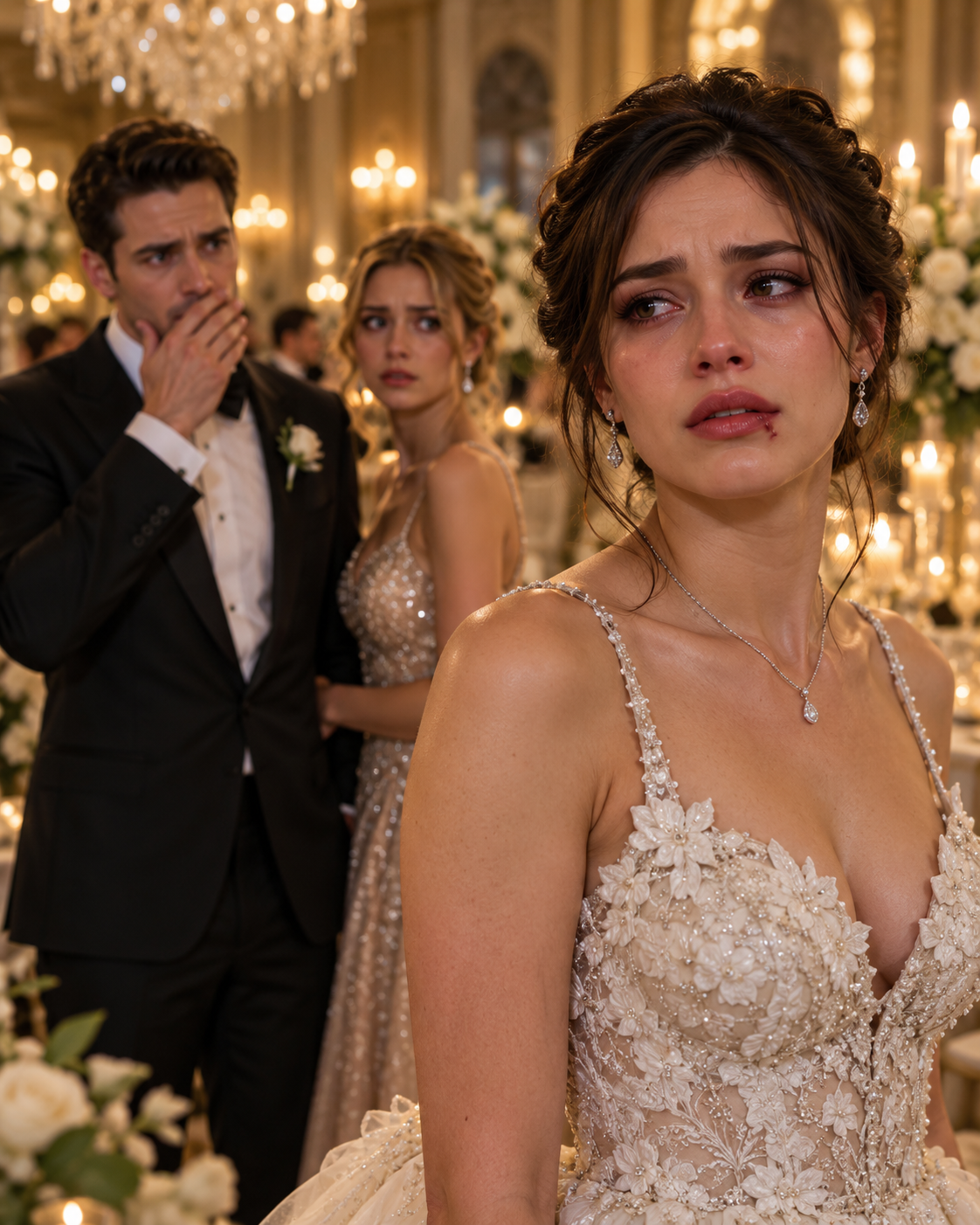
The ballroom went silent when my husband struck me beside our anniversary cake, then turned to shield the woman
The photograph showed the Lockhart ballroom seven years earlier, long before our wedding, before Toby, before Nerissa returned, before I had any reason to distrust the man I loved.
I held it beneath the reception light and studied every face.
Garrick was there.
Nerissa was there.
And standing between them was Garrick’s grandfather, Charles Lockhart.
I recognized the room immediately.
It was Charles’s private library.
But what made my fingers go numb was the fourth person in the photograph.
It was my father.
He had been dead for eight years.
I turned the photograph over.
A date was written in blue ink.
Three days before Garrick proposed.
Beneath it, someone had written, “They had already made the agreement.”
For several minutes, I could hear nothing except the faint hum of my studio.
Soren found me standing at the desk with the photograph in my hand.
“What happened?”
I handed it to him.
He studied it without speaking.
Then he looked at me.
“Camille, you don’t have to open that door.”
I stared at my father’s face.
“Yes, I do.”
Not because I wanted revenge.
Because I needed to know whether the life I had mourned was ever the life I thought I had lived.
I called Eleanor.
She answered on the second ring.
When I described the photograph, there was a long silence.
Then she said, “I was afraid this would come back.”
My heart tightened.
“What does that mean?”
“I need to tell you everything.”
She came to Savannah three days later.
She brought no assistant, no jewelry, and no carefully guarded Lockhart dignity.
Just an old leather folder.
We sat at my kitchen table while Toby played upstairs.
Eleanor placed the folder in front of me.
“Your father and Charles were business partners once.”
I nodded.
“I knew that.”
“Not like this.”
She opened the folder.
Inside were letters, contracts, and copies of financial statements.
Years before I met Garrick, my father had developed a small network of independent bridal ateliers.
Charles admired what he had built.
Then the business suffered a devastating downturn.
My father borrowed money from Charles to keep it alive.
The debt was eventually repaid, but the friendship remained.
Then my father died.
That was when Charles learned how ambitious I was.
“He wanted to protect your company,” Eleanor said.
I frowned.
“Why?”
“Because he believed you were the only person capable of turning it into something larger.”
She paused.
“And he believed Garrick needed someone like you.”
I felt a chill.
“That doesn’t explain the photograph.”
“No.”
Eleanor lowered her eyes.
“It explains why Charles wrote the will.”
The condition was not simply marriage.
Charles had threatened to cut Garrick out of the family trust unless Garrick married someone capable of running a serious business with him.
He had chosen me.
Not because I was powerless.
Because I was competent.
Because I was independent.
Because my father’s work had convinced him that I possessed something Garrick lacked.
The realization should have made me feel flattered.
Instead, it made me sick.
“So Garrick knew?”
Eleanor nodded.
“He knew before he proposed.”
I looked at the photograph again.
“What about Nerissa?”
Eleanor’s face hardened.
“She knew too.”
The room went silent.
Nerissa had been Garrick’s first love, but their relationship had collapsed after Charles made his condition clear.
Garrick believed marrying me would secure his inheritance while allowing him to return to Nerissa later.
That was the original plan.
A marriage for appearances.
A future divorce once the trust was secure.
A wife who would build the business while he enjoyed the benefits.
I closed my eyes.
Seven years of birthdays.
Seven years of anniversaries.
Seven years of lying beside a man who had apparently treated our marriage as a temporary arrangement before our wedding even happened.
“What about Toby?”
Eleanor inhaled sharply.
“That changed things.”
When I became pregnant, Garrick began to panic.
He worried that divorcing me would threaten his standing with Charles.
So he stayed.
Not because he suddenly loved me.
Because the arrival of an heir made the arrangement harder to dismantle.
I felt bile rise in my throat.
“Did Charles know?”
“He suspected Garrick’s feelings were wrong.”
“Suspected?”
“He confronted him once.”
Eleanor reached into the folder and pulled out another letter.
It was from Charles to Garrick.
The handwriting was firm and old-fashioned.
“Your wife is not a bridge to my money,” it said.
I read the sentence twice.
Then again.
There was more.
“Build a life worthy of the person who has chosen to build beside you, or lose both.”
My chest tightened.
Charles had seen something Garrick refused to see.
And yet Charles died before he could force his grandson to understand.
I looked at Eleanor.
“Why didn’t anyone tell me?”
Her eyes filled.
“Because I was afraid.”
“Of Garrick?”
“Of the family.”
She admitted she had confronted him years earlier.
He told her I was happy.
He told her the marriage was stable.
He told her I knew exactly what I had signed up for.
“I should have believed my instincts,” she whispered.
I reached across the table.
For the first time, I saw not a wealthy woman defending her son, but a mother carrying shame for things she had failed to stop.
“You helped me leave.”
“I should have helped you leave years earlier.”
We sat in silence.
Then I asked the question that had haunted me since the photograph arrived.
“Why did Nerissa come back?”
Eleanor opened the last document.
It was a message printed from an old email account.
Nerissa had contacted Garrick six months before the gala.
She told him her family was in financial trouble.
She knew Garrick would soon receive control of the trust.
She wanted back in.
But there was a problem.
I was still married to him.
So they began discussing ways to make me look unstable, jealous, or violent enough that Garrick could claim the marriage had become unbearable.
The wine was not an impulsive stunt.
It was rehearsed.
The broken heel.
The accusation.
The public confrontation.
Everything had been designed to create a scene.
And Garrick’s slap had not been in the plan.
That was the moment something in the story changed.
Nerissa wanted me discredited.
Garrick wanted me frightened.
But the violence exposed them both.
I sat back.
The room seemed colder.
“All those years,” I whispered.
Soren took my hand.
“You survived them.”
I looked at him.
“I don’t want survival to be the best word for my life.”
“It isn’t.”
He smiled gently.
“You built something better.”
That night, I couldn’t sleep.
I walked through the studio and touched gowns I had designed after leaving Garrick.
Every stitch carried a memory.
Not of him.
Of me learning who I was without him.
I had designed my first collection in Savannah with borrowed equipment and six hundred dollars.
I had sold dresses from a carriage house.
I had cried over unpaid invoices.
I had celebrated every order as though it were a wedding.
Then the orders multiplied.
One boutique became four.
Four became twenty.
A magazine feature became an international invitation.
People began asking about the designer behind the label.
For years, I had answered, “Camille Mercer.”
Not “Mrs. Lockhart.”
Just Camille.
The name felt different now.
It felt earned.
The next morning, Eleanor made a public statement.
She did not mention every private detail.
She simply confirmed that I had been wrongfully treated, that the Lockhart family had failed to protect me, and that she supported the dissolution of Garrick’s control over several family ventures.
The board reacted immediately.
Some members resigned.
Others demanded independent oversight.
Eleanor stepped in.
Not to preserve Garrick.
To preserve what could still be saved.
Garrick’s empire began unraveling under the weight of lawsuits, broken partnerships, and financial obligations.
He blamed everyone.
Me.
Nerissa.
His mother.
The board.
Even Charles.
He never blamed the person whose decisions had started everything.
Himself.
Then came the strangest message.
A lawyer contacted Nathan, who had been helping Eleanor handle several family matters.
Garrick wanted one final meeting with me.
Nathan advised against it.
I agreed.
But I asked to see what Garrick had sent.
There was a handwritten letter.
Only one page.
“Camille,
I don’t know whether I deserve your attention.
I don’t know whether I deserve forgiveness.
I only know that I finally understand what I destroyed.
You were never a contract.
You were the person who stood beside me when nobody believed I could become anything.
I spent years trying to prove I was important enough for you to need me.
I should have been trying to become good enough to stand beside you.
I am sorry.”
I folded the letter.
Soren watched my face.
“Does it change anything?”
“No.”
I thought for a moment.
“But I believe him.”
That surprised him.
“It doesn’t make him innocent.”
“No.”
“It means he finally understands.”
“Maybe that’s all some people get.”
The chance to understand too late.
I never answered the letter.
I didn’t need to.
A month later, Soren and I married in a garden behind our Savannah studio.
There were no chandeliers.
No corporate speeches.
No people pretending to know what our marriage was worth.
There were strings of warm lights, white roses, old friends, Eleanor, and a little boy in a navy suit carrying two rings that kept slipping sideways on the pillow.
Toby stood beneath the oak tree and grinned at me.
“Mom, are you crying?”
“Yes.”
“Happy crying?”
“The happiest.”
Soren took my hands.
“I don’t promise you a perfect life.”
“I don’t want one.”
“I promise you I will never make you earn the right to be loved.”
That was the sentence that broke me.
Not because it was grand.
Because it was simple.
And because I finally understood how rare simple kindness can feel after years of emotional starvation.
We kissed beneath the branches.
Toby cheered loudly enough to make everyone laugh.
Eleanor cried through the entire ceremony.
Afterward, she gave me my grandmother’s silver sewing scissors, which had somehow survived every move.
“I found these in an old Lockhart storage room,” she said.
“They were meant for you.”
I held them against my palm.
For years, I had believed the Lockhart name represented the life I had lost.
Standing there, I realized the name meant almost nothing.
The life was mine now.
The work was mine.
The home was mine.
The love was mine.
Months passed.
My company expanded into New York, Los Angeles, London, and Paris.
I still returned to Savannah every night.
I still helped Toby with homework.
I still woke early enough to watch the sunrise with Soren when our schedules allowed.
The studio became the kind of place I had once dreamed about as a student.
Young designers came through the doors carrying portfolios and nervous smiles.
I recognized that look.
The fear of not being enough.
So I told them what nobody had told me.
“Your work does not become valuable because someone important approves of it.”
“It becomes valuable because you refuse to stop becoming better.”
One afternoon, I looked through the front window and saw Garrick sitting in the same coffee shop across the street.
He had lost weight.
His hair had gone gray at the temples.
He looked older than he was.
He never approached.
He never called.
He simply watched.
Soren came up behind me.
“Do you want me to ask him to leave?”
I shook my head.
“No.”
“Why?”
I watched Garrick raise his cup.
“Because he isn’t hurting me anymore.”
That was the truth.
His existence no longer had authority over my peace.
He could regret.
He could mourn.
He could spend the rest of his life remembering what he had done.
None of that belonged to me.
Then one rainy afternoon, a messenger arrived with another envelope.
This one was from an attorney in New York.
Inside was a copy of an old trust document.
At the bottom was Charles Lockhart’s final handwritten amendment.
I read it slowly.
He had added a clause after meeting me for the first time.
The clause had nothing to do with money.
It said Garrick would retain his full inheritance only if he remained married to a person who could independently walk away from him.
I stared at the sentence.
Soren read it and smiled sadly.
“He knew.”
“Yes.”
“About you?”
“About what marriage should be.”
That night, I placed the trust document beside my grandmother’s sewing scissors.
Two old objects.
Two inheritances.
One taught me where I came from.
The other reminded me never to surrender myself for a place at someone else’s table.
Years later, people would ask me why I left the Lockhart fortune behind.
They assumed it had been an act of pride.
It wasn’t.
It was the first financial decision I had ever made entirely for myself.
I didn’t need their money to prove I had value.
I needed my freedom to remember it.
And sometimes, when the studio was empty and the last lights were going out, I would stand by the window and see the coffee shop across the street.
Garrick had stopped coming eventually.
I never learned when.
Maybe he moved away.
Maybe he simply realized that watching from a distance was the only boundary I had ever asked him to respect.
I never looked for him.
I had no reason to.
My life was full.
Not perfect.
Not untouched by grief.
But full.
One morning, Toby, now older and taller than me, walked into the studio carrying a box.
“I found this in the attic.”
I opened it.
Inside was the old phone from the airport.
The one with the SIM card gone.
I laughed softly.
“I thought we threw this away.”
“We did.”
He looked puzzled.
“Then why was it here?”
I opened the case.
There was something beneath the battery compartment.
A folded piece of paper.
My breath caught.
The handwriting was Garrick’s.
I unfolded it.
It contained only one sentence.
“I finally understand why you left, but I still don’t know how to forgive myself.”
I sat down.
For a moment, the past felt close enough to touch.
Then Toby placed his hand over mine.
“You don’t have to answer him.”
I looked at my son.
“No.”
I smiled.
“I’m not going to.”
He nodded.
Then he hugged me.
Outside, sunlight spilled across the studio windows.
The gowns caught the light like quiet promises.
And I realized that the greatest revenge was never watching Garrick lose everything.
It was waking up every morning in a life he could no longer reach.
I had once believed love meant being chosen.
Now I knew better.
Love is not a contract you survive.
It is not a debt you repay.
It is not something you prove by tolerating cruelty.
Real love is the place where you remain fully yourself and still feel safe enough to stay.
Garrick had offered me a cage wrapped in diamonds.
Soren had offered me an open door.
And because I finally understood my own worth, I chose the door.
I closed the old phone case and placed it back in the box.
Then I walked toward the studio floor where the new collection was waiting.
There were brides coming.
There were dresses unfinished.
There were dreams still becoming real.
And for the first time, I wasn’t looking over my shoulder to see who was watching.
I was looking ahead.
Because the woman who walked out of that ballroom bleeding was not the same woman who stood there now.
She had lost a marriage.
She had lost a fortune.
She had lost years she could never recover.
But she had found the one thing nobody could ever take from her again.
Herself.