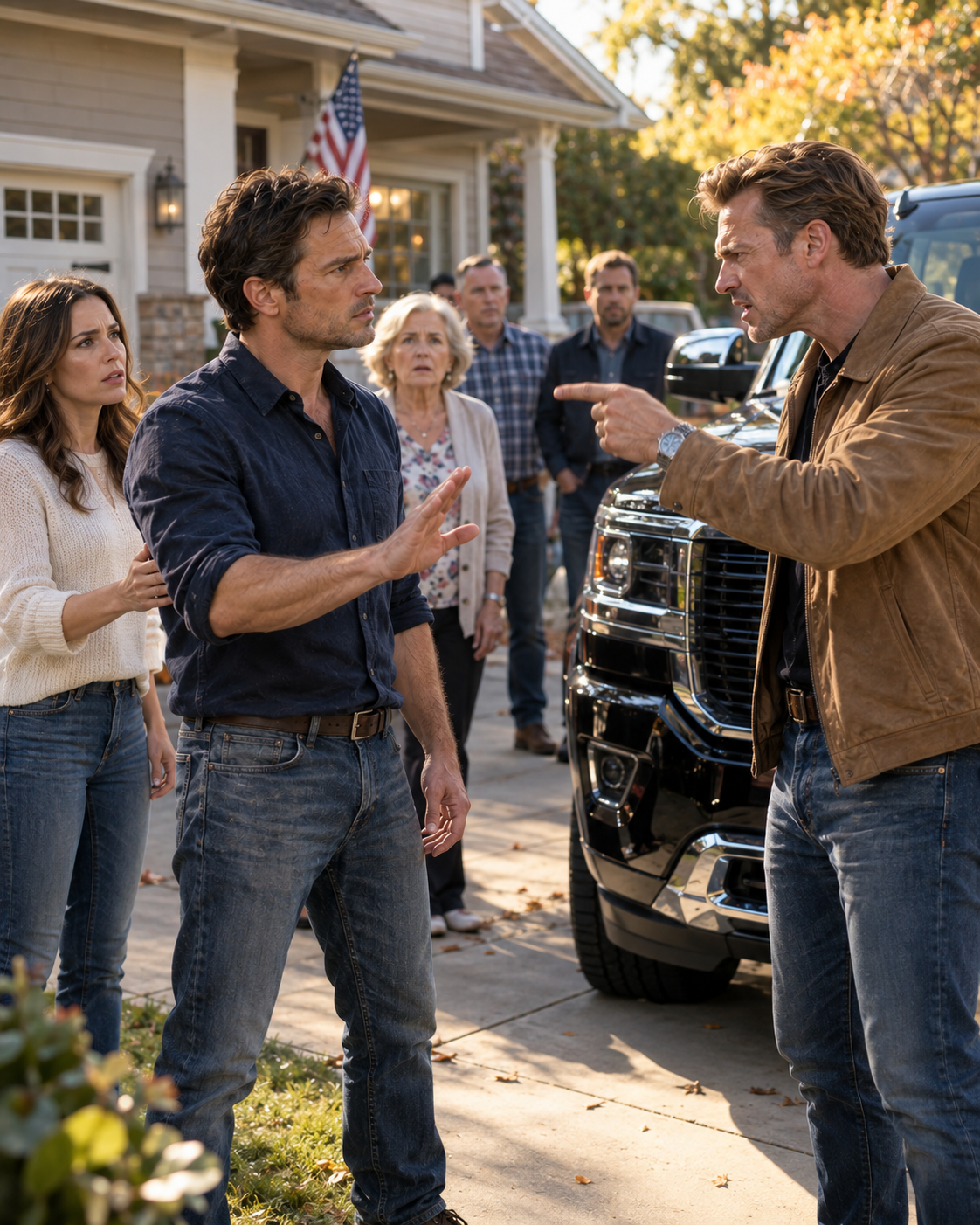
“TAKE OVER MY CHILD SUPPORT OR ADMIT YOU DON’T CARE ABOUT FAMILY,” my brother Julian snapped in our mother’s driveway
The message from Julian arrived at 11:47 p.m., and for several minutes I simply watched the notification glowing on my phone in the dark.
Clara was asleep beside me, and the house was quiet except for the faint ticking of the ceiling fan.
I knew I should have gone back to sleep.
Instead, I opened the email.
“There is something I never told you about the money,” Julian had written.
My stomach tightened before I even reached the next sentence.
He said the child support debt was real, but it wasn’t the whole story.
He said there had been another account.
An account connected to something our father had left behind before he died.
I sat upright in bed.
Our father had been gone for eleven years.
As far as I knew, there had been nothing left except an old toolbox, a handful of photographs, and a small life insurance payment Mom had used to pay off the house.
I kept reading.
Julian claimed Dad had opened a savings account for both of us when we were teenagers.
He said Mom had known about it.
He said the account had eventually been transferred into Julian’s name because I was underage when Dad died.
According to Julian, there should have been money left in it.
A lot more than either of us had ever discussed.
I felt the room tilt beneath me.
I woke Clara.
She read the email twice.
Then she looked at me.
“Did your dad ever tell you about an account?”
“No.”
“Did your mom?”
“No.”
We sat there in silence.
For the first time, the old story of my family began to feel different.
The next morning, I called Mom.
I didn’t accuse her.
I didn’t mention the email.
I simply asked if Dad had ever created a savings account for Julian and me.
There was a long pause.
Then she said, “Why would you ask me that?”
My heart sank.
Because she didn’t say no.
I drove to her house that afternoon.
Mom was sitting at the kitchen table when I arrived, holding an old metal box I hadn’t seen since childhood.
She looked exhausted.
“I hoped this day would never come,” she whispered.
Inside the box were old bank statements, insurance documents, tax papers, and a faded photograph of Dad standing beside two teenage boys.
There were also two letters.
One had my name.
The other had Julian’s.
Dad had written them shortly before his final hospitalization.
I opened mine with shaking hands.
He had written that he wanted us to have something to fall back on as adults.
He wanted the money divided equally.
He wanted neither brother to control the other’s share.
Then I found the statement.
There had indeed been an account.
But it wasn’t what Julian had claimed.
The account had been closed years earlier.
My portion had been transferred to an account in my name when I turned eighteen.
I had completely forgotten it because the amount was small and I had used it for college expenses.
Julian’s portion had also been transferred.
But according to the records, he had withdrawn nearly all of his money within months.
Mom lowered her eyes.
“He told me he was investing it,” she said.
I felt a strange mixture of anger and sadness.
“How much was left?”
“Nothing.”
I looked at the old statement again.
There was no hidden fortune.
No family inheritance waiting to rescue anyone.
Julian had simply remembered an old account and turned it into another story.
But there was something else.
One of the papers showed a withdrawal I didn’t recognize.
It had been made after Dad’s death.
The amount wasn’t enormous, but it was enough to matter.
The signature appeared to be Julian’s.
Mom saw me staring.
“He said your father had given him permission before he died.”
“Did Dad?”
“I don’t know.”
That answer stayed with me.
I took photographs of every document and left.
I didn’t call Julian.
I wanted him to explain it himself.
He didn’t.
Instead, three days later, he showed up at my house.
He looked different.
The expensive truck was gone.
He had traded it for an older work vehicle with rust around the wheel wells.
For once, I didn’t feel satisfaction when I saw it.
I felt tired.
“You talked to Mom,” he said.
“Yes.”
He looked at the ground.
“So you know.”
“I know about the account.”
His jaw tightened.
“And?”
“And I know you spent your share.”
He nodded slowly.
“I did.”
“Why didn’t you tell me?”
“Because I knew what you’d say.”
“What would I say?”
“That I should have handled my life better.”
I stared at him.
“You should have.”
He gave a small, bitter smile.
“That’s why I couldn’t tell you.”
For a moment, neither of us spoke.
Then he admitted the truth about the child support.
He hadn’t simply fallen behind because of bad luck.
He had ignored notices.
He had postponed payments.
He had convinced himself that because he was working, the state would eventually “work with him.”
When the warnings became serious, he panicked.
Then he looked at me.
“You were the first person I thought of.”
I almost laughed.
Not because it was funny.
Because it hurt.
“Why?”
“Because you’ve always been responsible.”
That sentence stayed between us like an accusation.
I realized something painful that day.
My responsibility had become part of his survival plan.
Every time I rescued him, I had taught him that consequences could be transferred.
He didn’t see my help as kindness anymore.
He saw it as infrastructure.
Something permanent.
Something he could build his life on.
“I need you to understand something,” I told him.
“You can ask me for help.”
“But you cannot demand it.”
He nodded.
“And you cannot make Mom feel guilty until I give in.”
He looked away.
“I know.”
“You cannot tell relatives that I promised something I never promised.”
“I know.”
“And you cannot come to my house angry when I say no.”
His eyes filled with tears.
“I know.”
It was the first conversation we’d had in years where Julian didn’t fight back.
But forgiveness did not arrive with it.
Forgiveness was slower.
It came in pieces.
First, he started paying his support regularly.
Then he sold several pieces of equipment he rarely used.
He picked up overtime.
He stopped eating at expensive restaurants.
He moved into a smaller place.
He canceled subscriptions.
He even sold the truck that had started the entire argument.
The first time I saw him driving the old work vehicle, I realized he had finally stopped trying to look successful and started trying to become stable.
Brenda confirmed that the payments were arriving.
That mattered more to me than anything Julian could say.
One evening, he called.
“I paid another month,” he said.
“I know.”
“How did you know?”
“Brenda told me.”
He laughed quietly.
“Fair enough.”
Then he became serious.
“I thought you were trying to embarrass me.”
“I wasn’t.”
“I thought you wanted everyone to see me fail.”
“I wanted you to stop asking me to make your failures disappear.”
There was silence.
Then he said something I wasn’t expecting.
“I was jealous of you.”
I leaned back in my chair.
“Why?”
“Because you struggled and somehow became steady.”
He paused.
“I kept thinking you had gotten lucky.”
That sentence explained more than his excuses ever had.
He hadn’t wanted my money because he was simply desperate.
Part of him wanted the stability he believed I had been handed.
He didn’t see the nights I worked until sunrise.
He didn’t see Clara and me postponing vacations.
He didn’t see the years we spent saving a little at a time.
He saw the finished house.
The repaired car.
The emergency fund.
He saw the result without seeing the sacrifice.
I didn’t tell him that his jealousy wasn’t my burden.
I didn’t need to.
He seemed to understand.
Months later, Mom invited us both to dinner.
I almost refused.
Old family dinners had become battlegrounds.
Someone would mention money.
Someone would defend Julian.
Someone would bring up the couch he had let me sleep on.
Someone would remind me that brothers were supposed to help brothers.
But this time, Mom called ahead.
“No financial discussions,” she said.
I smiled.
“Deal.”
When Julian arrived, he brought a pie from the grocery store.
He stood awkwardly in the doorway.
“Peace offering,” he said.
Clara laughed.
“It looks expensive.”
“It was six dollars.”
We all laughed.
For the first time in months, the laughter didn’t feel forced.
Dinner was almost normal.
Then Mom placed an old photograph on the table.
It was Dad, sitting between Julian and me when we were kids.
I looked at his face and felt something crack open inside me.
We had spent years arguing over money that was never the real problem.
The real problem was what money represented.
Security.
Love.
Failure.
Pride.
Fear.
And the terrible belief that if one person in a family was drowning, another person had to climb into the water with them.
After dinner, Julian and I stood outside beneath the porch light.
He looked at me.
“I owe you more than money.”
“You don’t owe me anything.”
“I do.”
“No,” I said.
“You owe your kids.”
His face changed.
He nodded.
“That’s true.”
Then he said, “And I owe myself a life I can actually afford.”
That was the first time I heard him say something that sounded like freedom.
Our relationship never returned to what it had been.
In some ways, it became better.
We stopped pretending.
I stopped being his emergency account.
He stopped treating my boundaries as rejection.
We could talk about work, Mom, old memories, sports, even our father.
But money stayed out of the middle.
If he needed advice, I gave it.
If he needed a ride, sometimes I gave him one.
If he needed cash, I told him to call someone else.
That boundary saved us.
A year later, the roof on our house was finally repaired.
Clara and I stood in the driveway watching the workers finish the last section.
I thought about the day Julian had stood there with his new truck and demanded the same money.
The same driveway.
The same house.
Two completely different lives.
My phone buzzed.
It was Julian.
“You home?”
I typed back.
“Yeah.”
A minute later, headlights appeared at the end of the street.
His old work truck pulled into the driveway.
He stepped out carrying a small box.
“What’s that?” I asked.
He handed it to me.
Inside was the old photograph of Dad.
“I think you should have it.”
I looked at him.
“Why?”
“Because I spent years thinking Dad left us money.”
He swallowed.
“But what he actually left us was a chance.”
I couldn’t speak for a moment.
Julian looked toward the new roof.
“You were right.”
I shook my head.
“I wasn’t trying to be right.”
“I know.”
He smiled faintly.
“You were trying to make sure you didn’t drown with me.”
That sentence stayed with me long after he drove away.
For years, I had believed loving someone meant stepping in whenever they fell.
I finally understood that sometimes love means standing close enough to help them stand, but far enough away that they still have to use their own legs.
Family should be a place where we can ask for help without shame.
But family should never become a place where guilt replaces responsibility.
I still think about the money sometimes.
I think about the roof.
I think about that ridiculous spreadsheet Julian handed me.
I think about how easily I could have emptied our savings just to make everyone stop looking at me like the villain.
And I wonder what would have happened if I had said yes.
Maybe the truck would have stayed.
Maybe the payments would have continued.
Maybe the next emergency would have arrived six months later.
Maybe I would have spent years rescuing a man who never learned how to save himself.
Instead, I said no.
It was one of the hardest words I had ever spoken to my brother.
It was also the word that finally forced both of us to grow up.
But there was one thing I never told Julian.
The night before I gave Mom those old documents, I had found another envelope hidden inside Dad’s metal box.
It was sealed.
My name was written across the front in my father’s handwriting.
I still haven’t opened it.
Sometimes I hold it in my hands and wonder why Dad kept it hidden for so many years.
Because if there is one thing this family has taught me, it is that the truth rarely arrives alone.
It usually brings another question with it.
And lately, I’ve started wondering whether the money was never the secret at all.