Six trained Belgian Malinois had been barking hard enough to shake the kennel doors, but the instant I stumbled through the wrong
The question landed harder than the metallic click had.
I stared at Briggs.
“I was never dead.”
She nodded once.
“I know that now.”
Vance looked between us.
“You two want to explain what is happening?”
Briggs’ expression stayed fixed on me.
“Not here.”
That irritated me more than it frightened me.
“Actually, this is exactly where I don’t want to explain anything.”
The radio on Vance’s shoulder crackled.
“EOD team is inbound.”
He turned to me.
“Until they arrive, nobody moves.”
“I agree.”
He seemed surprised.
Then again, everyone in that corridor seemed surprised whenever I agreed with them.
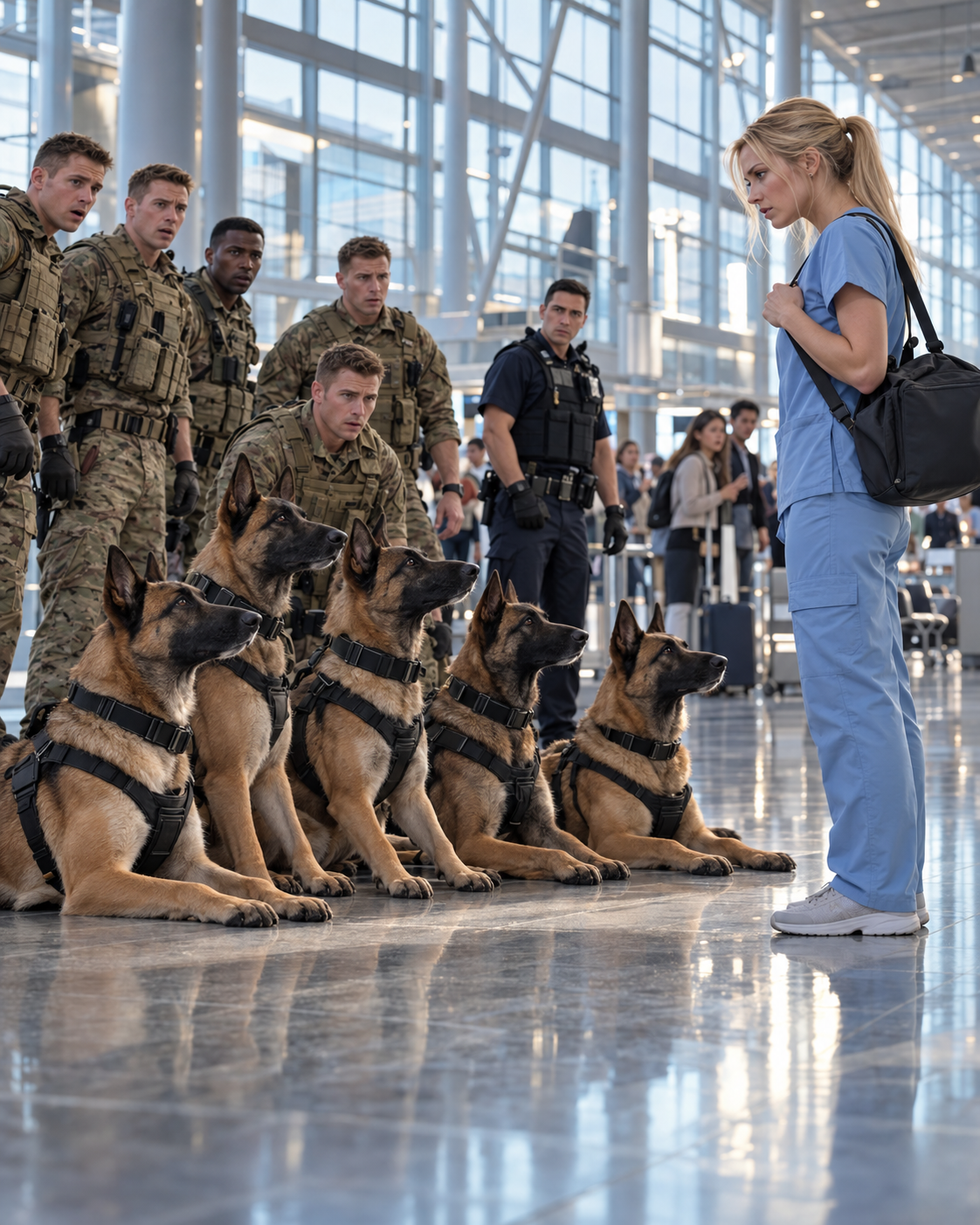
Brutus was still sitting in front of me.
His handler hadn’t moved.
The other five dogs remained tense, their attention split between the ceiling and me.
I looked at Brutus.
His breathing was shallow again.
“Can you get him farther from the vent?”
The handler nodded.
“Slowly.”
He moved the leash without pulling.
Brutus followed.
That small obedience told me something.
The dogs weren’t calm.
They were holding themselves together.
There was a difference.
I had learned that in another life.
Four years earlier, I had worn a different uniform.
Not scrubs.
Not a nurse’s badge.
A gray tactical medical kit.
I had been twenty-nine, working as a combat medic attached to a specialized unit that didn’t appear on ordinary deployment records.
Program Cerberus had never been what movies made it sound like.
There were no super-dogs jumping through flames.
No secret commandos whispering into headsets.
The program existed because working dogs behaved differently under extreme conditions, and the military needed medics who understood that behavior well enough to keep handlers and animals alive during chaotic operations.
We learned trauma medicine.
We learned scent stress.
We learned canine body mechanics.
We learned how fear traveled through a team.
And eventually, we learned that some dogs trusted the medic before they trusted anyone else.
The medic was supposed to represent the one person who would never force the animal to do something it physically couldn’t do.
That was the theory.
In practice, Cerberus had become something much darker.
The dogs were pushed too hard.
The medics were pushed harder.
And when a mission went wrong, everyone involved learned the oldest military lesson there is.
Keep your mouth shut and survive.
I had left after a deployment in which three people died.
Two handlers.
One medic.
A dog named Atlas.
I still dreamed about Atlas sometimes.
Not because he died.
Because he didn’t.
He survived long enough for me to hold his head in my lap while everyone around us kept shouting.
He looked at me as if he expected me to fix something I couldn’t fix.
I had never forgiven myself for that.
So I disappeared.
I went to nursing school.
I became an emergency-room nurse.
I learned how to care about ordinary things.
Broken wrists.
Kidney stones.
Asthma attacks.
Old men who were scared of IVs.
Teenagers who pretended they weren’t scared at all.
I liked those problems.
They were honest.
A fever was a fever.
A wound was a wound.
Nobody asked me to be a weapon.
Until that afternoon.
The EOD team arrived six minutes later.
They moved with controlled urgency.
Briggs ordered everyone back.
A specialist inspected the ventilation system from a distance before approaching the grille.
He found the device behind a second panel, disguised well enough that a tired maintenance worker could have missed it.
I won’t describe what it looked like.
What mattered was what it meant.
Someone had placed it there deliberately.
It had been positioned where the dogs would detect the anomaly long before a human would.
Vance stared at the EOD team.
Then at me.
“Could the dogs have found it without you?”
“Yes.”
“But would they have reacted like that?”
“No.”
He rubbed his jaw.
“How?”
“Because they’re trained to trust their environment through the handler. When something doesn’t fit, they look for the person who represents safety.”
Briggs said quietly, “The medical tier.”
I nodded.
Vance looked confused.
Briggs explained.
“Cerberus medics were taught to establish themselves as an authority tier above ordinary command in a mass-casualty event.”
“Above command?”
“Only with the animals.”
Vance looked at me.
“And they remembered?”
“Maybe not me.”
Brutus had stood again.
I watched him.
“Maybe what I represented.”
That distinction stayed with me.
The bomb scare shut down the corridor.
The flight gates around us continued operating as if nothing unusual had happened.
Passengers bought pretzels.
Families argued over boarding groups.
Someone laughed loudly near the coffee kiosk.
I stood behind a security barrier in wrinkled scrubs and watched an airport continue being an airport.
My flight to Portland was boarding in thirty-five minutes.
My mother was expecting me that evening.
She had been asking me to visit for months.
I hadn’t told her anything about Cerberus.
I hadn’t told anyone.
My mother knew I had served.
She knew I had come home different.
She didn’t know why.
I had always said the same thing.
“It was a long time ago.”
Now, standing beneath the departures screen, I wondered whether four years was long enough for a past to become a past.
My phone buzzed.
Unknown encrypted channel.
I knew the protocol before I opened it.
My heart started pounding.
The message contained one line.
CLAIRE MERCER. IF YOU ARE RECEIVING THIS, CERBERUS COHORTS 3, 5, AND 7 ARE ACTIVE.
A second line appeared.
MEDICAL OVERSIGHT COMPROMISED.
Then:
WE NEED YOU.
I read it twice.
Then a third time.
There was no signature.
There didn’t need to be.
I knew the encryption.
Dr. Astrid Lind.
My former supervisor.
The woman who had once told me that a medic’s most important instrument was not a medical kit.
It was judgment.
I called her.
She answered immediately.
“Where are you?”
“Garfield Rowan.”
“Are you safe?”
“Yes.”
“Did you encounter dogs?”
I closed my eyes.
“Yes.”
A pause.
“How many?”
“Six.”
“Then they’re still there.”
“What does that mean?”
“It means they were transferred through Rowan before we could reach them.”
I looked toward the restricted corridor.
“Why are you calling me?”
“I didn’t.”
My stomach tightened.
“What?”
“I sent the message.”
“I know.”
“No, Claire. I mean I didn’t initiate the request. Someone used my authorization.”
The terminal suddenly seemed much colder.
“Who has access?”
“Three people.”
“Names.”
“I can’t give them over the phone.”
“Then why contact me?”
“Because you’re already involved.”
“I am not involved.”
Astrid went silent.
Then she said, “You were never supposed to be.”
That was the first moment I understood that the airport device might not have been the mission.
It might have been a warning.
I looked back toward the corridor.
Briggs was standing behind the security doors.
She was watching me.
I walked over.
“What do you know about Cohorts Three, Five, and Seven?”
Her face changed.
“You received the message.”
“Yes.”
“From Lind?”
“Yes.”
She exhaled.
“I hoped you wouldn’t.”
“Why?”
“Because if she contacted you, something has gone very wrong.”
“What?”
Briggs looked toward Vance.
“Not here.”
That phrase again.
I hated it.
We moved into a small airport operations office.
Vance joined us.
Briggs closed the door.
“Four years ago, after Cerberus was shut down, the dogs were supposed to be retired or transferred through standard working-dog programs.”
“Supposed to be?”
“They weren’t.”
My pulse quickened.
“Where did they go?”
“Some were reassigned.”
“To whom?”
“Private contractors.”
That answer made my skin crawl.
Briggs explained that several specialized canine teams had continued operating under a new umbrella, with pieces of the old Cerberus methodology quietly incorporated into training.
The problem wasn’t that the dogs were active.
The problem was that many of the original medical handlers were gone.
Some had left.
Some had been reassigned.
One had died.
Others had been told they were no longer necessary.
“Why?”
“Because somebody decided the medical tier was inefficient.”
I thought about the dogs in the corridor.
“Who?”
Briggs didn’t answer.
Vance did.
“Command restructuring.”
“That means nothing.”
“It means people made decisions above our pay grade.”
I looked at him.
“That’s how people die.”
He held my gaze.
“I know.”
That was the first thing he’d said to me that didn’t sound like a challenge.
A knock came at the door.
Colonel Richard Sterling entered.
I knew him.
Not personally.
But I knew his face.
He had been the officer who signed my final Cerberus evaluation.
The one that stated I was medically cleared for civilian separation.
The one that said I had no ongoing operational obligations.
He stopped when he saw me.
For several seconds, neither of us spoke.
Then he said, “Claire.”
I felt something inside me go cold.
“Colonel.”
Briggs watched us.
Sterling closed the door.
“I hoped you’d never have to come back.”
“So did I.”
He nodded.
“Your clearance remains active.”
“I don’t care.”
“You should.”
“No.”
I stood.
“I built a life.”
“I know.”
“I became a nurse.”
“I know.”
“My mother is waiting for me in Portland.”
“I know that too.”
I stared at him.
“How?”
He didn’t answer.
That was the moment I understood how much of my civilian life had never really belonged only to me.
Not because they had followed me.
Because they had never stopped knowing where I was.
“You monitored me?”
“Not routinely.”
“That’s not the same as no.”
Sterling looked tired.
“You were one of the best medics we had.”
“I don’t want that title.”
“This isn’t about titles.”
“Then what is it about?”
He put a tablet on the table.
The screen showed three canine teams.
Three locations.
Three dates.
All recent.
Every dog was exhibiting stress behaviors.
Two handlers had been injured.
One operation had been aborted.
And in each case, the reports contained the same phrase:
UNABLE TO ESTABLISH MEDICAL OVERSIGHT.
I stared at the screen.
“What happened to the medics?”
Sterling looked away.
“Funding.”
“That isn’t an answer.”
“No.”
He sighed.
“It’s the answer people use when they don’t want to say someone made a choice.”
Briggs stepped forward.
“Claire, we don’t need you to return to Cerberus.”
I laughed softly.
“Then what do you need?”
“Help us understand what’s happening to the dogs.”
I looked at the screen again.
The animals weren’t the weapons.
They were the witnesses.
They were telling people something was wrong, and the people responsible had decided the easiest solution was to remove the person capable of listening.
My flight boarding announcement sounded faintly through the office wall.
Portland.
Gate 42.
Final boarding in twelve minutes.
My mother.
Her little house outside Eugene.
The spare room she’d cleaned for me.
The dinner she had probably started preparing.
A normal life waiting on the other side of one airport gate.
I picked up my phone.
“I can’t stay forever.”
Sterling nodded.
“Nobody’s asking you to.”
“That’s not what your face says.”
He almost smiled.
“No.”
I turned to Briggs.
“What do the dogs need?”
She answered without hesitation.
“Someone who doesn’t treat fear as disobedience.”
I nodded.
“And the teams?”
“Someone who remembers that a handler isn’t a machine either.”
That one hurt.
Because I remembered.
I remembered the young men and women who had stood beside their dogs after missions and pretended their hands weren’t shaking.
I remembered medics patching everyone except themselves.
I remembered the silence afterward.
For four years, I had believed leaving meant I had abandoned them.
Maybe leaving had simply been the only way I knew how to survive.
I picked up my duffel.
Sterling looked at me.
“Where are you going?”
I glanced at the departure board through the office window.
My flight number was flashing.
FINAL BOARDING.
I walked to the terminal.
Gate 42 was less than a minute away.
The agent was holding the microphone.
I could hear the announcement beginning.
“Final boarding for Flight 817 to Portland…”
My feet kept moving.
Then stopped.
I stood in the middle of the concourse while hundreds of strangers passed around me.
My mother’s voice came to me in memory.
You don’t always have to be the strong one, Claire.
I had spent four years trying to prove she was right.
I had learned how to sleep without listening for alarms.
I had learned how to drink coffee slowly.
I had learned how to care for people without calculating exits.
I had learned how to be ordinary.
And suddenly I understood something I had avoided admitting.
Ordinary was never the same thing as healed.
My phone buzzed again.
Another message.
Not encrypted.
Just a photograph.
Brutus.
The image showed him sitting beside a handler in a dark room.
Underneath it was a timestamp.
Twenty minutes earlier.
Then another line:
HE HAS NOT EATEN SINCE THE INCIDENT.
I stared at the photograph.
Brutus wasn’t looking at the camera.
He was looking at the person standing just outside the frame.
Waiting.
I turned around.
Briggs was still at the restricted corridor entrance.
She didn’t wave.
She didn’t call my name.
She simply waited.
That was the first time I understood what she was offering me.
Not an order.
A choice.
I walked back.
When I reached her, I handed her my boarding pass.
She glanced at it.
“Portland?”
“Yes.”
“You’ll want to call your mother.”
“I know.”
“She’s going to be angry.”
“She usually is when she’s worried.”
Briggs smiled faintly.
“That hasn’t changed, then.”
“No.”
I took a breath.
“Take me to Brutus.”
We walked back through the security doors.
This time, nobody stopped me.
The corridor was quieter.
The EOD team had cleared the area.
The broken latch on kennel two had been replaced.
Brutus was inside.
He lifted his head when I approached.
For a few seconds, neither of us moved.
Then I crouched outside the kennel.
“You remember me?”
His ears shifted.
I didn’t know whether he remembered my face.
Maybe he remembered something deeper.
A posture.
A rhythm.
The expectation that the person in front of him would not punish him for being afraid.
I rested my hands on my knees.
Brutus stood.
He walked to the kennel door.
Then he sat.
Behind me, Briggs let out a slow breath.
I smiled despite myself.
“Yeah,” I whispered.
“I remember you too.”
For the first time in four years, the old scar on my forearm didn’t feel like evidence of a life I’d lost.
It felt like a door.
And when Brutus lowered his head against the kennel bars, waiting for me to stay, I finally stopped pretending that walking away had been the same thing as letting go.
I stayed.
Not because the military ordered me to.
Not because Cerberus had a claim on me.
And not because I suddenly wanted the life I had escaped.
I stayed because there were still people and animals who had learned to trust someone in the worst moments of their lives, and I had finally understood that trust could be honored without surrendering yourself to the past.
The next morning, I called my mother.
I told her I wouldn’t make Portland.
She was silent for a long time.
Then she asked, “Are you safe?”
I looked through the glass at Brutus sleeping on his side, one paw twitching in a dream.
“For the first time in a while,” I said, “I think I might be.”
She didn’t understand.
Not yet.
But she didn’t ask me to explain.
She only said, “Then call me when you can.”
I promised I would.
And for once, I believed myself.
Weeks later, when the first group of former Cerberus handlers returned for evaluation, I recognized the same look in their eyes that I had once seen in mine.
Exhaustion.
Guilt.
The quiet terror of having been useful for so long that you no longer knew who you were when nobody needed you.
I didn’t fix them.
Nobody could.
But I taught them what someone had once taught me.
A frightened animal was not a failed animal.
A frightened medic was not a failed medic.
And walking away from a dangerous life did not make you a coward.
Sometimes it meant you were finally choosing what came next.
I never returned to Cerberus in the way it had once existed.
The program was formally dismantled, its remaining operations reorganized under new oversight.
The dogs were evaluated individually.
Handlers were retrained.
Medical authority was restored where it belonged.
And when questions arose about why those changes had taken so long, nobody could hide behind the old language anymore.
There were reports.
Names.
Dates.
Records.
People had to answer for choices that had once disappeared into bureaucracy.
As for me, I kept my nursing license.
I kept my apartment.
I kept visiting my mother.
And I still flew to Portland when I could.
But sometimes, after a night shift, I would stop by the training facility before going home.
Brutus would hear my footsteps before anyone else did.
He would lift his head.
And if he was tired, he wouldn’t move.
He’d just watch me come through the door.
That was enough.
I had once believed leaving that world was the bravest thing I had ever done.
It wasn’t.
The harder thing was returning without letting it own me.
The hardest thing was learning that I could care deeply about something without giving it every piece of myself.
Brutus taught me that.
My mother taught me that.
And, strangely enough, the silence of six dogs in an airport corridor taught me too.
Because sometimes the thing that frightens us most isn’t the alarm.
It’s the moment the alarm goes quiet.
That silence asks whether you’re willing to listen.
This time, I was.