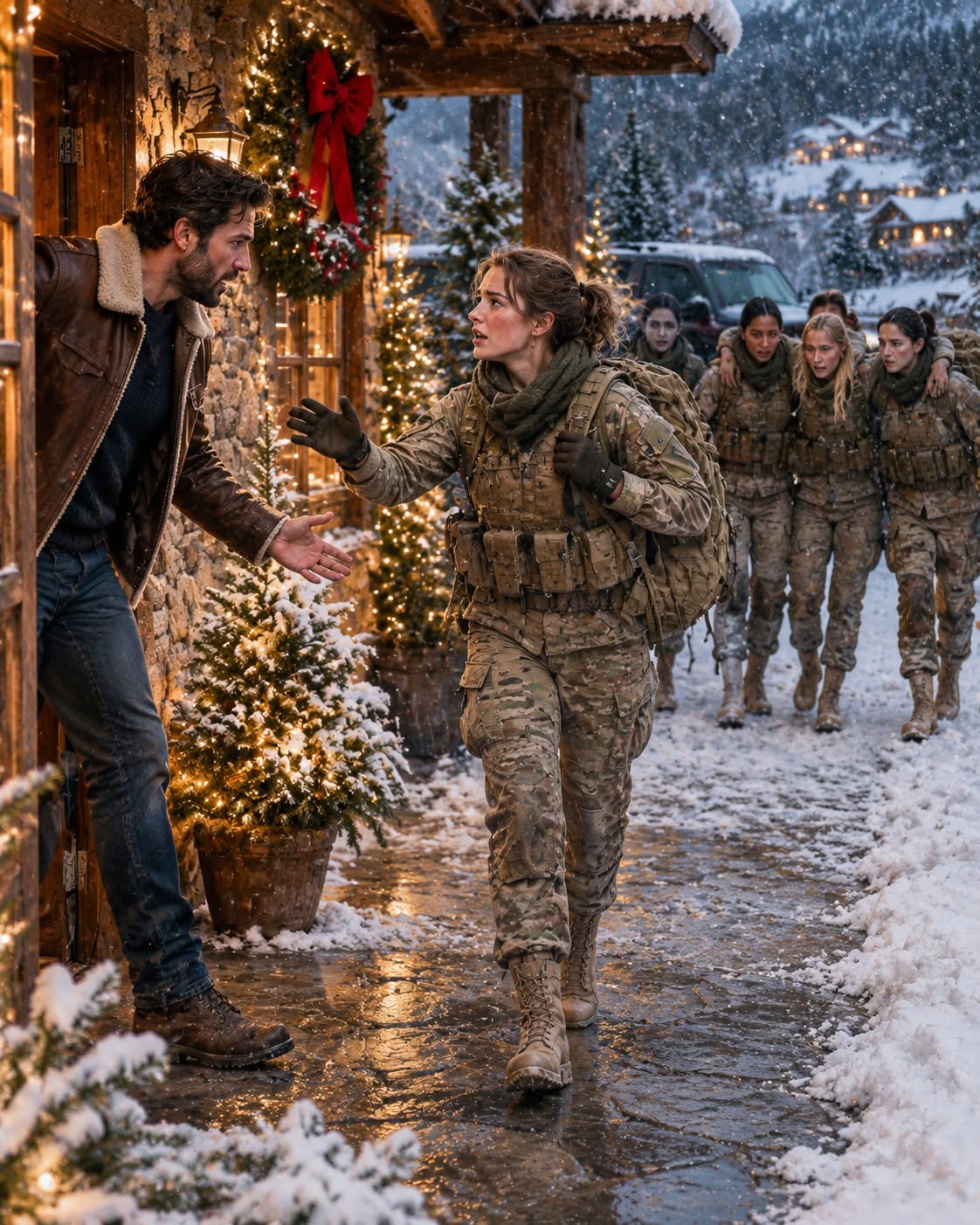
Six freezing female Marines knocked on my garage door in the middle of a snowstorm. I had no idea that letting them inside would reconnect me with a man I hadn’t seen in years.
“If you hadn’t carried me out of there, I might never have gotten to hold my daughter the day she was born. I never would have walked my son to his first day of school. I never would have grown old beside the woman I love.”
Ethan stopped speaking. His eyes glistened on the little phone screen.
“And the hardest part is knowing that while I was living all those years, you were somewhere out there, and I didn’t even know if you were okay.”
I stood in my garage with a wrench in one hand and grease on my sleeves, unable to find a single word.
Outside, the wind rattled the windows. Snow piled against the garage door, and the old heater hummed behind us.
Finally, I cleared my throat.
“You don’t owe me anything, Ethan. You would’ve done the same for me.”
He shook his head.
“Maybe. But I didn’t get the chance. You did.”
Then he leaned closer to the camera.
“There’s something else I need to tell you, Jack. Something about that night you never knew.”
My stomach tightened.
For fifteen years, I’d tried to forget what happened in that valley. Some nights, I almost succeeded.
But there was one memory that never left me.
A young Marine named Daniel Mercer, lying motionless beside a burning vehicle.
Daniel had been twenty-two years old. He had a wife back home and a baby boy he’d never met.
And for fifteen years, I’d believed I was the reason he never came home.
“Ethan,” I said quietly, “I don’t think this is the time.”
“It has to be,” he answered. “I’ve waited too long already.”
Claire glanced between us.
“Jack, what is he talking about?”
Before I could answer, the lights flickered.
Once.
Twice.
Then the garage went dark.
Maya screamed from the kitchen.
I dropped the wrench and hurried toward her.
“It’s okay, sweetheart. I’m right here.”
The heater died, leaving only the howl of the storm outside.
Claire switched on her flashlight. The other Marines immediately began checking the doors and windows.
One of them, a young corporal named Torres, looked at her phone.
“Sergeant, the weather alert just changed. They’re calling for another eighteen inches overnight.”
Another Marine, Bennett, glanced outside.
“The road’s disappearing.”
I looked at the six women standing in my house, then at my daughter clutching my arm.
“Looks like everybody’s staying here tonight.”
Claire started to protest.
“Sir, we don’t want to impose.”
“First, stop calling me sir. My name’s Jack. Second, I’ve got enough blankets and canned soup to feed a small army.”
Maya tugged my sleeve.
“Dad, you always say Marines are family.”
I looked down at her.
“That’s right.”
“Then they’re not strangers anymore.”
Nobody argued with that.
Claire smiled, but her expression changed when she looked back at her phone.
Ethan was still there, waiting.
“Jack,” he said, “please don’t hang up. I need to tell you the truth.”
I stared at his face.
Then I nodded.
“Give me a minute.”
I led Maya into the living room, wrapped her in a blanket, and lit the fireplace. The women helped bring in firewood from the covered porch.
Within twenty minutes, the house had become a makeshift shelter.
But my thoughts were fifteen years away.
Back in Afghanistan.
Back in the valley where everything had changed.
I returned to the garage and sat on an overturned bucket.
Claire stood nearby, holding her phone.
“All right, Ethan,” I said. “I’m listening.”
He took a slow breath.
“Do you remember the second explosion?”
I closed my eyes.
Of course I remembered.
Our convoy had been moving through a narrow mountain pass when the first blast tore apart the lead vehicle.
Gunfire erupted from the ridgeline.
Ethan had been thrown against a wall of rock, his leg badly injured.
I remembered dragging him behind a disabled truck while bullets struck the dirt around us.
I remembered the smell of burning rubber.
And I remembered Daniel Mercer shouting that he was going back for the radio.
“Daniel died because I sent him toward that vehicle,” I said.
Ethan’s expression hardened.
“No, Jack. He didn’t.”
I opened my eyes.
“What?”
“Daniel wasn’t going back for the radio.”
I stared at him.
“He told me he was.”
“That’s what he wanted you to believe.”
Ethan looked away for a moment.
Then he said something that made the room feel suddenly smaller.
“Daniel went back because he saw a little girl trapped behind the wreckage.”
I couldn’t speak.
“A little girl?”
“She was from the village near the pass. She’d been caught in the fighting. Daniel saw her trying to pull her younger brother away from the road.”
I shook my head.
“No. I would’ve seen them.”
“You were carrying me. You were bleeding from your shoulder, and you could barely stand.”
I remembered that part.
I remembered Ethan’s weight across my back.
I remembered stumbling over rocks, hearing Daniel shout something behind me.
But I’d never understood his final words.
Ethan continued.
“Daniel got both children behind cover. Then the second explosion hit.”
My hands began trembling.
For years, I’d believed Daniel had died trying to retrieve equipment because of an order I’d given.
I’d carried that guilt through every sleepless night, every failed attempt to return to ordinary life.
“How do you know?” I whispered.
“Because the girl survived.”
I stared at the phone.
Ethan nodded.
“Her name is Leila Rahmani. And she’s been looking for you, too.”
For several seconds, the only sound was the wind outside.
Then I stood up so quickly the bucket tipped over.
“Why didn’t anyone tell me?”
“We tried. Jack, after you were evacuated, you disappeared. Your old phone number stopped working. Your address changed. You wouldn’t answer letters.”
I turned away.
He was right.
After my medical discharge, I’d wanted nothing to do with the past.
I’d moved to this little town, opened a repair shop, and tried to build a life that didn’t involve uniforms, funerals, or memories.
Then I met Sarah.
She’d been a schoolteacher with a laugh that could fill an entire room.
She never demanded that I talk about the war.
She simply sat beside me on the difficult nights and reminded me that I was still allowed to be happy.
When Maya was born, I finally began believing her.
Then, three years ago, cancer took Sarah.
And I retreated into silence all over again.
“Jack?” Ethan said.
I rubbed my face.
“Where is Leila now?”
“She’s in Virginia. She’s twenty-four years old. She’s studying to become a trauma surgeon.”
I leaned against the workbench.
“She became a doctor?”
“She says she wants to spend her life giving people the second chances Daniel gave her.”
Something inside my chest seemed to crack.
Ethan’s voice softened.
“She wrote you a letter. Years ago. I still have a copy.”
I swallowed.
“Can you send it?”
“I can. But there’s something I need to ask first.”
“What?”
“Would you consider coming to Virginia next month? We’re holding a memorial for Daniel. His son will be there.”
My knees suddenly felt weak.
“His son?”
“His name is Noah. He’s fifteen now.”
I looked at the old photograph above my workbench.
Daniel stood near the edge, grinning like a kid who’d just gotten away with something.
He’d been the youngest man in our squad.
And he’d never stopped talking about the baby waiting for him back home.
“I don’t know if I can face him,” I admitted.
Ethan was quiet for a moment.
“Jack, maybe you should let him decide that.”
Before I could respond, a sharp pounding came from the front door.
Not the gentle knocking we’d heard earlier.
This was frantic.
Three heavy blows, followed by a voice shouting through the storm.
“Help! Somebody, please!”
Claire immediately moved toward the hallway.
I grabbed my flashlight and opened the door.
A man stumbled inside, nearly collapsing against me.
He wore a thick hunting jacket covered in snow. His beard was frozen, and his lips had turned an alarming shade of blue.
“There’s been an accident,” he gasped. “Down by Miller’s Bridge.”
Claire stepped forward.
“How many people?”
“School van. Driver and some kids. It slid off the road.”
My heart dropped.
Miller’s Bridge was less than four miles away.
The road curved sharply beside a frozen creek, with a steep embankment leading down to the water.
“Did you call 911?” I asked.
“Can’t get a signal. I walked almost two miles. I saw your garage light before the power went out.”
Claire looked at her Marines.
Every one of them was already moving.
“Torres, grab the medical kits. Bennett, ropes and blankets. Kim, check communications.”
I caught Claire’s arm.
“Your vehicle isn’t running.”
She looked at me.
“Then we need another one.”
I glanced toward the old pickup I’d been repairing.
A 1987 Ford F-250 with four-wheel drive and a stubborn diesel engine.
It wasn’t pretty.
But I’d kept that truck running through winters worse than this one.
“Give me five minutes.”
I rushed into the garage.
The pickup’s battery was connected to a charger, and the fuel system had finally been repaired earlier that afternoon.
I turned the key.
The engine cranked.
Once.
Twice.
Nothing.
“Come on,” I muttered.
I tried again.
The engine coughed, shuddered, and finally roared to life.
Claire appeared beside the driver’s door.
“Jack, you don’t have to come. We can take the truck.”
I shook my head.
“That road’s dangerous even in good weather. You need somebody who knows it.”
Then Maya appeared in the doorway, wrapped in Sarah’s old blue blanket.
“Daddy?”
I turned.
Her eyes were wide with fear.
“Are you leaving?”
I knelt in front of her.
“Some kids need help, sweetheart.”
She looked past me at the snow.
“But what if you don’t come back?”
Those words struck harder than anything Ethan had said.
Sarah had asked me to promise one thing before she died.
“Whatever happens, Jack, don’t let grief make our little girl lose both parents.”
I’d kept that promise by staying close to home.
By avoiding danger.
By never taking chances.
And now my daughter was standing in front of me, terrified that I was about to break it.
I held her shoulders.
“Listen to me. I’m going to be careful. And I’m going to do everything I can to come home.”
Maya pressed her face against my jacket.
“Mom would want you to help them.”
I closed my eyes.
“Yeah,” I whispered. “She would.”
One of the Marines, Private Ellis, volunteered to stay with Maya and the exhausted man who’d brought the warning.
The rest of us loaded the truck.
We packed blankets, flashlights, tow straps, medical supplies, and a heavy recovery winch.
Then we drove into the storm.
The road was almost invisible.
Snow blew sideways across the windshield, and the tires struggled for traction.
Claire sat beside me, studying the dark shapes ahead.
“Your daughter is brave,” she said.
“She gets that from her mother.”
Claire glanced at me.
“She gets some of it from you.”
I didn’t answer.
We reached Miller’s Bridge twenty minutes later.
What we found made my blood run cold.
A yellow school activity van had broken through the wooden guardrail and slid halfway down the embankment.
Its rear wheels were caught against a fallen tree.
The front end hung over the frozen creek.
Through the blowing snow, I could see movement inside.
A child was banging on a window.
Claire grabbed her radio.
“Kim, try emergency services again. Torres, with me. Bennett, secure the rope.”
I backed the truck toward a sturdy tree and positioned it where we could use the winch.
The wind nearly knocked me sideways when I climbed out.
We approached the van carefully.
Inside were four children, ranging from about seven to twelve, and an older woman behind the wheel.
The driver was conscious but injured.
A little boy pressed his palms against the glass.
“Please hurry! My sister can’t wake up!”
Claire’s face changed.
She was no longer the woman who’d been smiling over cookies in my kitchen.
She was a Marine facing an emergency.
“Everybody listen!” she shouted. “We’re getting you out!”
We secured a line around the rear axle and connected it to the truck.
Then Bennett carefully approached the side door.
The van shifted.
A terrible cracking sound came from beneath it.
“Stop!” I shouted.
Everyone froze.
The fallen tree supporting the van had begun splitting under the weight.
We had minutes.
Maybe less.
I looked at the angle of the vehicle, the position of the tree, and the narrow stretch of ground between us.
Then I saw a way.
“Claire, I can hold it with the winch. You get the kids out through the rear door.”
“What about the driver?”
“We’ll get her last.”
Claire studied me for half a second.
Then she nodded.
“Do it.”
I ran back to the truck, engaged the winch, and slowly tightened the cable.
Metal groaned.
The van lifted just enough to take pressure off the tree.
“Go!” I shouted.
Bennett forced the rear door open.
The first child crawled out.
Then the second.
Torres carried a little girl up the slope, wrapping her in a thermal blanket.
The third child was crying uncontrollably.
“My brother! He’s still inside!”
Claire climbed into the van.
I watched her flashlight disappear into the darkness.
A moment later, she shouted.
“Jack! One child’s unconscious! I need help!”
I looked at the winch.
The cable was holding, but the truck had begun sliding backward on the icy road.
I secured the parking brake, wedged a steel chock behind the rear tire, and ran down the embankment.
Inside the van, Claire was kneeling beside a small boy.
He couldn’t have been older than eight.
Blood ran down his forehead.
His breathing was shallow.
I slid my arms beneath him.
“I’ve got you, buddy.”
The words sounded painfully familiar.
For one terrible instant, I wasn’t in a school van.
I was back in that valley.
Smoke.
Gunfire.
Ethan bleeding against the rocks.
Daniel shouting from behind me.
My chest tightened.
I couldn’t move.
“Jack!”
Claire’s voice cut through the memory.
“Look at me!”
I blinked.
“You’re here,” she said firmly. “You’re with us. Now help me get him out.”
I took a breath.
Then another.
And lifted the boy.
We carried him toward the rear door.
Suddenly, the cable snapped taut with a violent metallic shriek.
The van lurched.
Claire shoved me toward the opening.
“Move!”
I pushed the child into Bennett’s waiting arms.
Then I turned back.
The driver was still trapped behind the steering wheel.
Her leg was pinned beneath the dashboard.
The tree cracked again.
Claire grabbed my jacket.
“We have to go!”
I looked at the woman.
She was staring at us, terrified.
“Please,” she whispered. “I have grandchildren.”
I knew what Claire was thinking.
I knew what the risk was.
But I also remembered a young Marine who had gone back for two children nobody else had seen.
“Get outside,” I told Claire.
“Jack—”
“Help Bennett with the kids. I’ll get her.”
She hesitated.
Then she reached into her medical pouch, handed me a compact rescue tool, and climbed out.
I crawled toward the driver’s seat.
The dashboard had collapsed against the woman’s knee.
I used the tool to cut her seat belt, then braced my shoulder beneath the damaged steering column.
“What’s your name?” I asked.
“Margaret.”
“Okay, Margaret. On three, we’re going to move your leg.”
She nodded, crying.
“One.”
I adjusted my grip.
“Two.”
The van shifted again.
“Three!”
I heaved upward.
Margaret screamed, but her leg came free.
I pulled her toward the rear.
Then the fallen tree gave way.
The van dropped several inches.
The front windshield shattered against the rocks.
I shoved Margaret toward the open door.
Bennett and Claire grabbed her arms and dragged her clear.
I tried to follow.
But my boot caught beneath a twisted seat frame.
The van lurched again.
And suddenly I was sliding toward the creek.
“JACK!”
Claire’s scream barely reached me over the cracking ice.
I grabbed the edge of a seat, struggling to free my foot.
Cold water rushed through the broken windshield.
The van had broken through the ice.
The water rose around my boots.
Then my knees.
I pulled desperately against the trapped metal.
Nothing.
I thought of Maya.
Her little hands offering cookies.
Her face pressed against my jacket.
Her question.
What if you don’t come back?
I wasn’t afraid of dying.
I’d made peace with that possibility years ago.
But I was terrified of leaving my daughter alone.
Above me, I heard someone shouting.
Then a rope dropped through the rear doorway.
Claire appeared.
“Grab it!”
“My foot’s stuck!”
She climbed back inside.
I shouted at her.
“Get out! That’s an order!”
She gave me a look I would never forget.
“With all due respect, Jack, you’re not my commanding officer.”
She dropped beside me, reached beneath the seat, and pulled a folding knife from her pocket.
The water reached my waist.
“Claire, listen to me—”
“No. You listen.”
Her voice shook, but her hands stayed steady.
“My brother told me about a Marine who wouldn’t leave him behind.”
She cut through the torn fabric and tangled strap holding my boot.
“Well, apparently, that runs in the family.”
My foot came free.
We scrambled toward the rear door as the van sank farther.
Bennett pulled Claire out first.
Then Torres grabbed my arm.
The entire vehicle shifted beneath me.
For one breathless second, I hung above the black water.
Then three Marines pulled together.
I landed hard on the snowy bank.
Behind us, the van slid into the creek with a deafening crash.
Nobody spoke.
We simply lay there, breathing.
Then Claire started laughing.
Not because anything was funny.
Because sometimes, when you’re scared enough, laughter is the only thing your body remembers how to do.
I laughed with her.
Soon Bennett and Torres were laughing, too.
Five minutes later, Kim finally reached emergency dispatch through a brief opening in the storm interference.
Rescue crews were already searching for the missing van.
They arrived shortly afterward with an ambulance and a county snowplow.
The unconscious boy was breathing more steadily after receiving emergency care.
Margaret had a broken leg, but she was alive.
All four children were alive.
As the paramedics loaded the last child into the ambulance, a little girl ran toward me.
She couldn’t have been much older than Maya.
She threw her arms around my waist.
“Thank you for saving my brother.”
I knelt in the snow.
“What’s his name?”
“Oliver.”
I smiled.
“Well, you tell Oliver he owes me a cookie when he’s feeling better.”
She nodded seriously.
“Chocolate chip?”
“Those are my favorite.”
She hugged me again.
And something inside me, something that had been frozen for fifteen years, began to thaw.
By the time we returned home, it was nearly dawn.
Maya was asleep on the couch beneath Sarah’s blue blanket.
Private Ellis sat nearby, keeping watch over the fire.
When the front door opened, Maya stirred.
She saw me.
“Daddy!”
She ran so fast she nearly tripped over the rug.
I caught her in my arms and held her tighter than I ever had before.
“You’re home,” she whispered.
“Yeah, baby. I’m home.”
She touched the small cut above my eyebrow.
“Did you get hurt?”
“Just a scratch.”
She looked past me at the Marines.
“Did you save the kids?”
I nodded.
“All of them.”
Maya smiled.
“Mom would be proud.”
I couldn’t answer.
I simply held her until my arms began to ache.
Later that morning, the county restored our electricity.
The Marines’ transport vehicle was recovered and towed to my garage, where I replaced the damaged hose and belt using parts from my shelves.
By noon, it was running again.
But none of the women seemed eager to leave.
Claire stood beside my workbench, studying the old photograph.
“Jack, there’s something I haven’t told you.”
I looked up from tightening a clamp.
“What now?”
She smiled nervously.
“When I recognized you yesterday, I didn’t just recognize you from Ethan’s stories.”
I waited.
She reached into her jacket and pulled out a folded photograph.
It showed Ethan standing beside a young woman at a graduation ceremony.
Claire.
And beside them was another man.
A man with dark hair, a crooked grin, and a familiar face.
Daniel Mercer.
I stared at the picture.
“Where did you get this?”
“Daniel was my brother’s best friend. He visited our family before that deployment.”
She swallowed.
“He taught me how to change a tire when I was sixteen.”
I ran my thumb along the edge of the photograph.
Claire continued.
“When Daniel died, I promised myself I’d become the kind of Marine he was.”
I looked at her.
“Last night, you did.”
Her eyes filled.
“So did you.”
A few hours later, Ethan called again.
This time, I didn’t hesitate to answer.
He had already heard about the rescue.
Apparently, Claire had sent him a short message from the ambulance staging area.
“Six Marines stranded in a blizzard,” Ethan said, shaking his head. “And somehow you still managed to find trouble.”
I laughed.
“Your sister’s the one who climbed into a sinking van.”
“That sounds like Claire.”
Then his expression grew serious.
“Jack, did you think about what I asked?”
I looked toward the living room.
Maya was sitting on the floor with Torres, drawing pictures of snowmen.
For years, I’d told myself that staying away from my past was the only way to protect my family.
But the past had found me anyway.
And instead of destroying what remained of my life, it had brought six extraordinary women into my home.
It had given me back an old friend.
It had shown me that Daniel’s final act had saved two children.
Maybe it was time to stop hiding.
“Send me the details,” I said.
Ethan smiled.
“You’re coming?”
“Yeah. And I’m bringing Maya.”
Four weeks later, we flew to Virginia.
It was Maya’s first airplane ride.
She spent most of the flight staring out the window, asking questions about clouds and whether her mother could see us from heaven.
I told her I didn’t know exactly how heaven worked.
But I liked to believe Sarah was watching.
At the airport, Ethan was waiting.
He stood beside his wife and two teenage children.
For a moment, neither of us moved.
Then he stepped forward.
We embraced like brothers.
Not the polite hug of two old acquaintances.
The kind of embrace that carries fifteen years of grief, gratitude, and things left unsaid.
“You got old,” I muttered.
He laughed against my shoulder.
“Look who’s talking.”
The memorial was held the following afternoon at a small veterans’ center.
There were photographs of Daniel on the walls.
Daniel in uniform.
Daniel holding a fishing rod.
Daniel laughing with his wife on their wedding day.
And Daniel standing beside our squad in that dusty valley, just weeks before he died.
I stood near the entrance, suddenly unsure whether I belonged there.
Then a teenage boy approached me.
He had Daniel’s eyes.
“Are you Jack?”
I nodded.
The boy held out his hand.
“I’m Noah Mercer.”
I shook it, but my throat tightened.
“Your dad was a good man.”
Noah looked at me for a long moment.
Then he said, “I know.”
He reached into his jacket and pulled out a small envelope.
“My mom wanted me to give you this.”
Inside was a photograph of Daniel holding a tiny pair of baby shoes.
On the back, he’d written a message before deploying.
“Tell my boy that being brave doesn’t mean you’re never scared. It means doing what’s right even when you are.”
I read the words twice.
Then Noah spoke again.
“For a long time, I was angry that my dad never came home.”
I nodded.
“You had every right to be.”
“But when I found out what happened, I started thinking about those two kids.”
He looked toward the front of the room.
“If my dad hadn’t helped them, their families would’ve lost them, too.”
My eyes burned.
Noah stepped closer.
“I don’t want you to feel guilty anymore, Mr. Jack. My dad made his choice.”
I covered my mouth with one hand.
The boy continued.
“And I think he’d be glad you kept helping people.”
I couldn’t hold back the tears.
For fifteen years, I’d imagined meeting Daniel’s son.
In every version, he blamed me.
In every version, I deserved it.
But here he was, offering me something I hadn’t known how to ask for.
Forgiveness.
Noah hugged me.
And for the first time since that terrible night, I let myself grieve Daniel without blaming myself for his death.
Then a young woman approached.
She had dark eyes and wore a simple navy-blue dress.
“Mr. Jack?”
I turned.
“My name is Leila Rahmani.”
I stared at her.
She smiled gently.
“I was the little girl Daniel saved.”
Beside her stood a tall young man.
“My brother, Sami.”
I shook their hands, overwhelmed.
Leila reached into her purse and removed a worn piece of paper.
“I wrote this when I was fourteen. Captain Vance told me you never received it.”
She unfolded the letter.
“I wanted to read it to you myself.”
The room grew quiet.
Her voice trembled as she began.
“When I was nine years old, I thought the world was ending. There was fire everywhere, and I couldn’t find my mother. My little brother was crying, and I was too frightened to move.”
She paused.
“Then a soldier came through the smoke. He carried my brother and took my hand. He told me to keep running and never look back.”
Tears slid down her cheeks.
“I never learned his name until years later. But I learned something from him that day. Sometimes the bravest thing a person can do is help someone they will never meet again.”
She looked directly at me.
“Captain Vance told me that another Marine carried him to safety that same night. He said the two of you were the reason he came home.”
Her voice softened.
“I wanted you to know that Daniel’s sacrifice didn’t end in that valley. My brother is an engineer now. I’m training to become a surgeon. One day, I hope to save lives the way he saved ours.”
She folded the letter.
“And when I do, a part of what Daniel gave us will keep living.”
I couldn’t speak.
Maya slipped her small hand into mine.
Leila knelt in front of her.
“Your father is a very special man.”
Maya smiled.
“I know. He fixes things.”
The room erupted in gentle laughter.
But Maya wasn’t finished.
“Sometimes he fixes cars. Sometimes he fixes people.”
I looked down at my daughter.
And suddenly, I understood something Sarah had tried to teach me for years.
Healing wasn’t about forgetting what hurt.
It was about learning that the hurt didn’t have to be the end of the story.
After the memorial, Ethan invited everyone to his home.
There were more than thirty people gathered around the dinner table and in the backyard.
Marines.
Families.
Children.
People whose lives had been connected by one terrible night and the choices made during it.
At one point, I stepped outside for some fresh air.
Ethan followed me.
We stood quietly beneath the porch light.
“There’s one more thing,” he said.
I laughed.
“Every time you say that, my life changes.”
He smiled.
“This one’s good. I promise.”
He handed me a folder.
Inside were documents from a nonprofit organization that helped veterans transition into civilian careers.
“We’re opening a training program for young veterans who want to learn automotive repair,” he explained.
I looked through the papers.
“We need someone who knows engines. Someone who understands what it’s like to come home and feel like you don’t belong anywhere.”
I glanced at him.
“Ethan…”
“Not asking you to move. We can start something in your town. Your garage already has most of the equipment.”
I looked down at the proposal.
For years, that garage had been my hiding place.
The one room where I could work alone and keep the world outside.
Now Ethan was asking me to open its doors.
To people who might be carrying the same invisible wounds I’d carried.
“I don’t know if I’m qualified to teach anybody,” I said.
Ethan grinned.
“Jack, you rebuilt a diesel engine with parts older than my children. I think you can manage.”
I laughed.
Then I looked through the window.
Maya was sitting beside Noah, showing him photographs of her mother.
Claire was helping Leila serve dessert.
And for the first time in years, I didn’t feel like a man standing outside his own life.
“I’ll do it,” I said.
Six months later, the sign went up above my garage.
MERCER’S SECOND CHANCE AUTO WORKSHOP.
I’d named it after Daniel.
Underneath, in smaller letters, were the words:
“No One Gets Left Behind.”
We started with three veterans.
Then six.
Then twelve.
Some came to learn a trade.
Others came because they needed somewhere to go in the mornings.
A place where nobody asked them to explain every scar.
We repaired engines, rebuilt transmissions, and shared coffee around the same old workbench where Claire had discovered my photograph.
Sometimes we talked about the war.
Sometimes we talked about baseball.
Sometimes we didn’t talk at all.
And that was okay.
Claire visited whenever she could.
Ethan came down with his family twice that year.
Leila sent photographs from medical school.
Noah spent part of his summer vacation learning to rebuild a carburetor.
He turned out to have his father’s crooked grin and an impressive talent for getting grease on absolutely everything.
One Saturday afternoon, I found him standing beneath Daniel’s photograph.
“You think he’d like this place?” Noah asked.
I looked around the garage.
A young veteran was teaching another how to replace a water pump.
Maya sat at a little desk near the office, finishing her homework.
Someone had brought donuts.
Someone else had turned on an old country music station.
I thought about Daniel.
About the way he’d always made sure the youngest Marines ate first.
About how he’d shared his last bottle of water with a frightened village boy.
About how he’d run toward danger when two children needed him.
“Yeah,” I said quietly. “I think he’d love it.”
Noah nodded.
Then he picked up a wrench and returned to work.
That evening, after everyone had gone home, Maya and I sat on the front steps of the garage.
The sun was setting behind the trees.
She leaned against my shoulder.
“Dad?”
“Yeah, sweetheart?”
“Do you remember when those Marines came during the snowstorm?”
I smiled.
“Pretty hard to forget.”
“Do you think Mom sent them?”
I looked at the sky.
I couldn’t answer that question with certainty.
But I thought about the timing.
The storm.
The broken vehicle.
The photograph.
The phone call.
The children at the bridge.
All the unlikely things that had brought us to this moment.
“Maybe,” I said.
Maya considered that.
Then she smiled.
“I think she did.”
I kissed the top of her head.
“Why’s that?”
“Because she knew you were lonely.”
My throat tightened.
“And she knew you needed friends again.”
I wrapped my arm around her.
For a long time, we watched the last sunlight disappear.
Then Maya stood up.
“Come on, Dad. We have to make dinner.”
I followed her inside.
But before closing the garage door, I turned back toward the old photograph.
I looked at Daniel’s smiling face.
For fifteen years, that picture had reminded me of everything I’d lost.
Now it reminded me of everything that had survived.
Ethan’s children.
Leila and Sami.
Noah.
The four children rescued from the creek.
The veterans finding their footing in my workshop.
And my own little girl, growing up in a house that was finally filled with laughter again.
I realized then that a single act of courage doesn’t always end when the danger passes.
Sometimes it keeps traveling through the world, touching people the person who made that choice will never know.
Daniel had saved two children.
Those children had grown up to help others.
Ethan had survived to raise a family.
Claire had become the kind of Marine her brother admired.
And six freezing women knocking on my door had given me a second chance at living.
I reached up and straightened the photograph.
“Thank you, brother,” I whispered.
Then I turned off the lights.
Inside the house, Maya was singing one of Sarah’s favorite songs while setting the table.
I could smell dinner warming on the stove.
For the first time in a very long time, I wasn’t thinking about the people I couldn’t bring home.
I was thinking about the people who were waiting for me.
And I finally understood that we don’t honor those we’ve lost by refusing to live without them.
We honor them by carrying forward the love, courage, and kindness they left behind.
That winter, six strangers had knocked on my garage door asking for a little warmth.
I thought I was simply letting them out of the cold.
But somehow, they had opened a door inside me that grief had kept locked for years.
And behind that door, I found something I thought I’d lost forever.
Hope.
Because sometimes, the person who needs rescuing isn’t the one standing outside in the storm.
Sometimes, it’s the one who opens the door.