Six doctors had cleared my twelve-year-old daughter for discharge, but as I reached for her sneaker in the pediatric ward
The stretcher rolled toward Vascular, and Megan kept one hand wrapped around the edge of Emily’s sleeve.
“You’re coming, right?”
Emily looked down at her.
“Yes.”
Megan nodded, but she didn’t let go.
The hallway seemed different now.
A few minutes earlier, Emily had been trying to convince herself that she hadn’t overreacted.
Now the discharge had been canceled, the wheelchair was gone, and a vascular team was waiting upstairs.
Still, Emily knew something important.
She hadn’t diagnosed Megan.
She had only noticed a pattern.
Pain increased when the knee approached extension.
The right foot became cooler.
The distal pulse became weaker.
Then everything improved when the knee returned to a flexed position.
That was all she knew.
But sometimes all you need is one fact that refuses to disappear.
At the vascular bay, a technician looked at Megan’s chart and then at Emily.
“What position are we protecting?”
“Flexed,” Emily said.
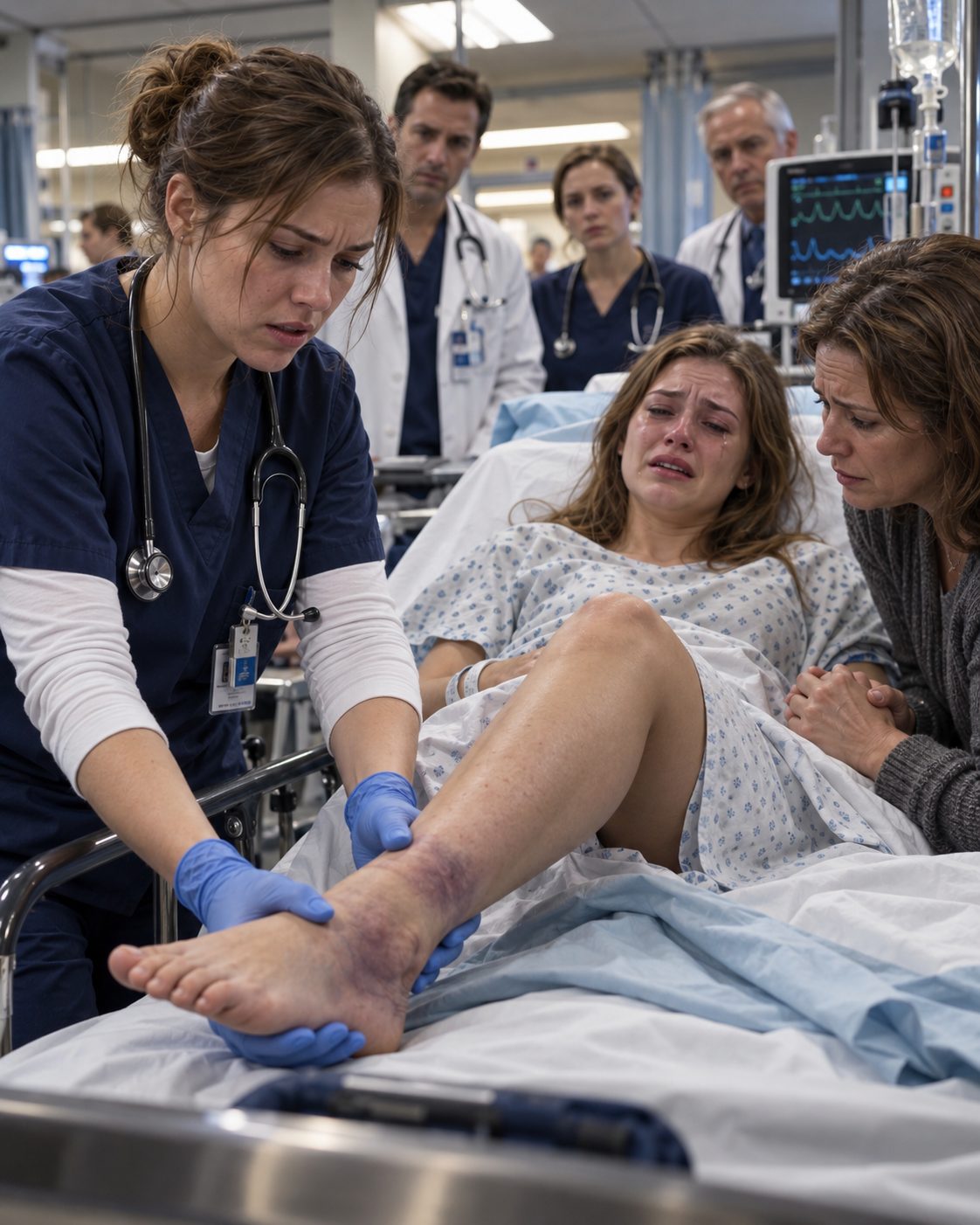
“Pain increases with extension, and the distal pulse weakens after.”
The technician nodded.
“Then we start there.”
He placed a support beneath Megan’s knee before beginning.
Megan watched him carefully.
“Are you going to straighten it?”
“No.”
“Promise?”
“I’ll only change the position enough to get the information we need.”
Megan looked at Emily.
Emily nodded.
“Tell him if it hurts.”
Megan took a breath.
“Okay.”
The probe moved across the back of her knee.
The screen filled with shifting images.
The technician adjusted the angle.
“Where does the pain start?”
Megan answered before Emily could.
“Behind my knee.”
“And where does it go?”
“It burns down my calf.”
The technician entered something into the record.
“Anything else?”
Megan hesitated.
“Sometimes my foot feels numb.”
Emily looked up.
That was new.
Not entirely new.
Megan had mentioned discomfort before, but this was the first time she had described numbness clearly.
“When?”
Megan looked toward her mother.
“Before the worst pain.”
The technician stopped typing.
“That’s important.”
He made another note.
Then he looked at Emily.
“Did anyone document that?”
“Not until now.”
Megan stared at the screen.
“What are you looking for?”
“Something that explains why your symptoms change with your knee position.”
The technician made one small adjustment.
Megan’s shoulders tightened.
“Stop.”
He stopped immediately.
The signal changed.
He saved the image.
Then he returned the knee to the supported position.
“That’s enough.”
Megan blinked.
“That’s it?”
“That’s it.”
No one forced her to repeat the movement.
No one told her to be brave.
No one told her that the pain was probably nothing.
They had gotten the information they needed.
Emily’s phone vibrated.
Room four.
Then room seven.
Two other patients were still listed under her name.
She looked through the glass toward the hallway.
Her assignment hadn’t changed just because Megan had.
Daniel was covering two of her rooms already.
Emily stepped outside.
“I need rooms four and seven reassigned.”
The charge nurse looked surprised.
“Both?”
“Both.”
“Daniel said he’d cover until you came back.”
“I’m not coming back yet.”
The charge nurse studied her for a moment.
“Are you sure?”
Emily looked through the glass at Megan.
“I can’t be responsible for patients I’m not physically there to care for.”
A minute later, her name disappeared from both rooms.
It was a small thing.
Almost invisible.
But Emily felt the weight of it.
She had spent her first week believing a good nurse was the person who could carry everything without complaining.
Now she understood something different.
Sometimes being responsible meant admitting when you couldn’t safely carry one more thing.
When she returned, Megan was watching her.
“You stayed.”
“Of course.”
“What if they don’t listen to me upstairs?”
Emily pulled a chair closer.
“Then you tell them again.”
“What if they think I’m making it up?”
“Then you tell them exactly what changes.”
Megan looked confused.
“Like what?”
Emily pointed gently toward her leg.
“Tell them where the pain begins.”
“Behind my knee.”
“Then where?”
“My calf.”
“What happens after that?”
“My foot gets cold.”
“And?”
“Numb.”
Emily nodded.
“And what makes it better?”
“Bending my knee.”
“Good.”
Megan looked at her.
“Will they believe me?”
Emily paused.
“I’ll make sure they know what you told me.”
“But what if you’re not there?”
Emily took a breath.
“Then you tell them yourself.”
Megan looked frightened.
Emily continued.
“You don’t need to know what’s causing it to know what you’re feeling.”
Megan looked down at her hands.
“Okay.”
A few minutes later, Dr. Aaron Blake arrived with a portable Doppler.
He reviewed the chart, then looked at Emily.
“You’re the nurse who caught the positional change?”
“Yes.”
Before he could ask another question, Megan spoke.
“It starts behind my knee.”
Aaron pulled a stool beside the bed.
“Tell me more.”
“It burns down my calf.”
“And then?”
“My foot gets cold.”
“Anything else?”
“Numb.”
Aaron looked at Emily.
She said nothing.
He turned back to Megan.
“What makes it better?”
“Bending my knee.”
“Okay.”
He placed the Doppler beside her.
“I need one small position change.”
Megan immediately grabbed Emily’s sleeve.
“No more.”
Aaron stopped.
Rachel leaned forward.
“She’s had enough.”
Nobody argued.
Emily looked at Megan.
“Ask him what he needs.”
Megan looked at Aaron.
“Do you have to make it hurt again?”
“No.”
“Then what do you need?”
“The smallest movement that gives me useful information.”
“And if I say stop?”
“I stop.”
“Right away?”
“Right away.”
Megan looked at Emily.
Emily didn’t tell her what to do.
That decision belonged to Megan.
Finally, she nodded.
“Okay.”
Aaron placed the probe against her foot.
The machine produced a steady rhythmic signal.
“Ready?”
Megan swallowed.
“Ready.”
He lowered the knee slightly.
“Stop.”
He stopped immediately.
The signal had changed.
Aaron saved the reading.
Then he returned the knee to its supported position.
The signal strengthened again.
Megan stared at the machine.
“That’s what happens?”
Aaron nodded.
“That’s what we’re seeing.”
Rachel’s eyes filled with tears.
“So the screaming was telling us something.”
Aaron looked at her.
“Her pain changes with the position, and the blood-flow reading changes with it.”
Megan looked at Emily.
“They thought I was being dramatic.”
Emily shook her head.
“They were looking at an injured knee.”
“But you believed me.”
Emily chose her words carefully.
“I believed something was happening.”
Megan smiled faintly.
“That’s different.”
“Yes.”
Aaron studied the readings.
Then his phone rang.
He listened for several seconds.
“Vascular wants her upstairs.”
Daniel appeared at the doorway.
“What changed?”
Emily answered.
“Small extension produced a measurable drop in the Doppler signal, and it improved again with flexion.”
Daniel looked at Aaron.
“What does that mean?”
“Enough concern to transfer her now.”
Rachel’s face tightened.
“Does that mean surgery?”
“Possibly,” Aaron said.
“But nobody is asking you to agree to anything before we explain what we know.”
Megan looked at the foam support beneath her knee.
“Are they going to straighten it again?”
“No.”
Aaron entered the restriction into the transfer order.
“Knee flexed and supported.”
He paused.
“No provocative extension unless clinically necessary.”
Emily watched him save the order.
That mattered.
The information was no longer trapped inside her memory.
It was now part of Megan’s plan.
A transport nurse named Sarah arrived with a stretcher.
“How do you want the leg?”
“Flexed and supported,” Aaron said.
“No full extension.”
Sarah adjusted the stretcher around Megan’s position instead of moving Megan to fit the stretcher.
Rachel noticed.
She looked at Emily.
“Thank you.”
Emily nodded.
“We’ll hand off together.”
She moved beside Megan.
“Listen closely.”
Megan looked at her.
“If I miss something, you correct me.”
Megan nodded.
Emily began the handoff.
“Right knee injury during soccer.”
“X-rays negative for fracture.”
“Pain starts behind the knee with extension.”
“It burns down the calf.”
“Right foot becomes cooler.”
“Distal pulse weakens toward extension.”
“Flexion improves it.”
Sarah wrote quickly.
Then she looked directly at Megan.
“What did she miss?”
Megan thought.
“My foot gets numb.”
“When?”
Megan looked at Emily.
“Before the worst pain.”
Sarah added it immediately.
“Good.”
Megan watched her write.
She looked almost surprised.
Someone had heard her.
Someone had written it down.
Someone had made it part of the plan.
At the elevator, Megan lifted her call button.
Sarah noticed.
“Keep it.”
The doors opened.
Megan looked back at Emily.
“You’re not coming?”
Emily smiled.
“Sarah is taking you.”
Megan frowned.
“But I want you.”
Emily crouched slightly beside the stretcher.
“I know.”
Megan looked at Sarah.
“She knows what happened.”
Sarah nodded.
“I do.”
Megan looked back at Emily.
“And you know what to tell her.”
“Yes.”
The doors began to close.
Megan’s hand slowly released Emily’s sleeve.
“Okay.”
The elevator disappeared.
Emily stood there for a moment.
Daniel was beside her.
He handed her another chart.
“Room eleven.”
She took it.
“Okay.”
A call light sounded.
Emily turned toward it.
Behind her, Megan was going upstairs with the protected position, the original timeline, a nurse who knew what to listen for, and her own voice.
Emily realized something then.
She hadn’t saved Megan by being the smartest person in the hospital.
She had saved the discharge from happening because she had been willing to stay uncomfortable when everyone else was ready to move on.
She had been willing to say, “I don’t know.”
That was the part people often misunderstood about courage.
It wasn’t knowing you were right.
It was being willing to say you might be wrong and still look one more time.
Emily had barely reached the nurse’s station when the phone rang.
“Emily?”
It was Sarah.
“Vascular wants your original timeline before they finalize the plan.”
Daniel looked up.
“Go.”
“I have room eleven.”
“I’ll cover it.”
Emily handed him the chart.
Then she ran for the elevator.
When she reached the vascular bay, Megan was still lying with her knee supported.
Sarah stood beside her.
Aaron was at the monitor with Dr. Karen Whitmore, the vascular attending.
Daniel arrived behind Emily with the orthopedic consultant and two physicians who had examined Megan earlier.
Six doctors stood around one bed.
Karen opened Emily’s timeline.
“Walk me through it.”
Emily did.
“Pain changed with extension first.”
“Then the right foot became cooler.”
“The distal pulse weakened after that.”
“Flexion improved both.”
One of the earlier physicians looked at his tablet.
“Her pulse was present when I examined her.”
“It was present when I first checked too,” Emily said.
“The difference was positional.”
Karen looked at Megan.
“What happens before the pain gets really bad?”
Megan answered without looking at Emily.
“It starts behind my knee.”
“Then?”
“It burns down my calf.”
“And after that?”
“My foot gets numb.”
Sarah tapped her note.
“She told me that during handoff.”
Karen nodded.
Then she turned the monitor toward the room.
“Look here.”
Everyone moved closer.
She traced the vessel behind Megan’s knee.
“Supported here, flow improves.”
She advanced the image.
“As the knee approaches extension, the vessel is compressed and flow drops.”
One of the physicians leaned closer.
“That quickly?”
“Fast enough to match the sequence.”
Megan stared at the screen.
“So when I screamed…”
Karen turned toward her.
“Your pain was changing when your circulation changed.”
Megan looked around the room.
“So I wasn’t being dramatic?”
Karen shook her head.
“No.”
She paused.
“You were telling us something.”
Rachel covered her mouth.
Tears slipped down her cheeks.
Megan looked at Emily.
Emily smiled.
Just a little.
Karen entered the restriction into the plan.
“Knee flexed and supported.”
“No full extension for positioning or transport.”
The orthopedic consultant nodded.
“I’ll revise the injury plan around it.”
One of the earlier physicians looked uncomfortable.
“Do we need to reproduce the drop ourselves?”
Daniel answered before Karen could.
“No.”
Everyone looked at him.
He looked at Megan.
“We have the images.”
“We have the timeline.”
“She doesn’t need to hurt again just to prove what we’ve already seen.”
Megan’s shoulders relaxed.
The physician closed the examination window.
“Agreed.”
Emily looked at Daniel.
He didn’t look back at her.
He was reading the updated chart.
But she noticed something.
He wasn’t trying to defend the original discharge.
He was trying to make sure the new information was carried forward.
That mattered.
Not because it erased what had happened.
It didn’t.
But because a mistake becomes more dangerous when people protect their pride instead of protecting the patient.
Karen pulled a chair beside Megan.
“First we protect the circulation.”
“Then we treat what’s causing the compression.”
“I’ll explain the options before you and your mother decide anything.”
Megan nodded.
“Can you do that without straightening my leg again?”
Karen smiled.
“Yes.”
“We have enough information.”
Emily stepped back.
For the first time since the afternoon began, Megan didn’t reach for her sleeve.
She was talking directly to the physician.
Asking questions.
Getting answers.
Finding her voice.
And Emily realized that was the real victory.
Not that Megan trusted her.
But that Megan had learned she could speak and expect someone to listen.
One of the physicians who had signed the original discharge approached Emily.
“Your first temperature difference was at 2:36?”
Emily checked the timeline.
“Yes.”
“First documented pulse comparison?”
“2:41.”
He corrected his note.
“Got it.”
No argument.
No excuse.
Just a changed record.
A technician entered and reached toward Megan’s leg.
Sarah stopped him.
“Vascular restriction.”
The technician froze.
“Flexed and supported?”
“Correct.”
He moved the equipment around Megan instead of moving Megan.
Emily watched.
That small moment affected her more than she expected.
Earlier, she had needed twenty minutes to convince everyone that Megan’s position mattered.
Now the entire room was working around the finding without her saying a word.
The information had become bigger than the person who noticed it.
Megan pointed at the monitor.
“Can you show me where it gets squeezed?”
Karen turned the screen toward her.
“Right here.”
Megan studied it.
“That’s why my foot changed?”
“Yes.”
Six physicians had looked at the same injured knee.
The difference was not that they were careless.
The difference was that Megan’s most important clue hadn’t been visible in a still image or a stable vital sign.
It appeared only when the body moved.
Megan looked at the room.
“Can I ask something?”
Karen nodded.
“Of course.”
“If something hurts, do I always have to prove it?”
The room became quiet.
Emily looked down.
Karen answered first.
“No.”
Megan waited.
“You should be able to tell us what you’re feeling without hurting yourself just to convince us.”
Megan nodded.
“Okay.”
She looked at Emily.
Emily gave her a small smile.
The stretcher was prepared for transfer.
Sarah checked the order.
“Flexed and supported.”
“Correct.”
Megan looked at Emily.
“You’re staying?”
“I said I would.”
Rachel touched Emily’s arm.
“Thank you.”
Emily shook her head.
“You listened to her too.”
Rachel smiled through her tears.
“I almost didn’t.”
Emily understood.
That was the frightening part.
Not because Rachel was a bad mother.
Because fear makes people want certainty.
And sometimes the most dangerous thing in a hospital is false certainty.
The belief that because six people have already looked, there is nothing left to see.
The belief that because the numbers are stable, the patient must be fine.
The belief that because someone is young, new, or inexperienced, they must be the person least likely to notice something important.
Megan was taken upstairs for further evaluation.
Emily returned to the pediatric floor.
The hallway was exactly as she had left it.
A printer was running.
A monitor chirped.
Someone was asking for a blanket.
A mother was crying softly near the family room.
A nurse was laughing at something someone said.
The hospital had no idea that one child’s discharge had nearly gone one direction and then another.
Emily reached the nurse’s station.
Daniel was finishing a note.
He looked up.
“She’s upstairs.”
“Yes.”
“They have the timeline?”
“Yes.”
“Good.”
Emily expected something else.
An apology.
An explanation.
Maybe even congratulations.
Instead, Daniel looked at the next chart.
“Room six needs discharge teaching.”
Emily nodded.
“Okay.”
She walked toward the room.
Then stopped.
“Daniel.”
He looked up.
“Thank you.”
“For what?”
“For letting me hold the discharge.”
He shook his head.
“You gave me a reason to.”
Emily smiled.
Then she entered room six.
The family looked up.
The mother was holding a folder against her chest.
Her son sat beside her, swinging his feet.
Emily pulled the discharge instructions from the chart and sat down.
“Before we go through these,” she said, “tell me what questions you still have.”
The mother started talking.
Emily listened.
She didn’t rush.
She didn’t assume.
She didn’t look at the clock.
Outside, the pediatric floor kept moving.
And somewhere upstairs, Megan was still asking questions too.
Four days later, Emily was finishing morning handoff when she heard a familiar voice.
“I told Mom I don’t need the wheelchair.”
Emily looked up.
Megan was walking toward the clinic with Rachel beside her.
A small brace supported her right knee.
Rachel carried the follow-up paperwork.
Megan carried herself.
Four days earlier, a sneaker had been sitting beneath a hospital bed while Megan cried every time someone tried to straighten her leg.
Now both feet were planted on the floor.
“How does it feel?” Emily asked.
Megan thought about it.
“Sore.”
Then she smiled.
“But normal sore.”
Rachel laughed softly.
The medical assistant came through the clinic door.
“Before we take you back, tell me what still bothers you.”
Megan answered without looking at Emily.
“Bending it all the way still pulls behind my knee.”
“Any burning down the calf?”
“No.”
“Numbness?”
“No.”
“Anything else?”
Megan thought.
“No.”
The assistant entered everything.
Then she looked at Rachel.
“Anything you want to add?”
Rachel shook her head.
“That’s exactly what she’s been telling me.”
“Okay.”
The assistant opened the door.
Megan took two careful steps.
Then she stopped.
“Emily?”
“Yeah?”
“Thanks for not sending me home.”
Emily smiled.
“You gave us the information.”
“I just made sure someone answered it.”
Megan smiled back.
“You did.”
She started toward the clinic.
Then she looked over her shoulder.
“I’m still asking questions.”
Emily nodded.
“Good.”
Megan disappeared through the door.
Rachel stayed behind for one second.
“She’ll remember you.”
Emily looked toward the closed door.
“I hope she remembers to listen to herself.”
Rachel smiled.
“She will.”
Then she followed her daughter.
Emily returned to the nurse’s station.
Daniel was finishing a note while another nurse gave him an update.
He listened until she finished.
Then he asked one question.
“What changed?”
The nurse answered.
He nodded.
“Let’s look again.”
Emily heard him from across the station.
She didn’t turn around.
She didn’t need to.
Something had changed in him too.
Not everything.
Not enough to erase the afternoon.
But enough to matter.
Later that morning, Emily passed room eleven.
The same boy from the previous day was sitting with his mother.
His numbers were stable.
His mother was worried.
Daniel sat beside the bed instead of standing at the doorway.
“What makes it worse?”
“Jumping.”
“Anything else?”
“Bumps in the car.”
“Where does it start?”
The boy pointed.
Daniel waited until he finished.
Then he wrote down the child’s exact words.
Emily watched from the hallway.
She didn’t smile.
She didn’t need to.
She simply kept walking.
Because the lesson Megan had accidentally taught the entire floor wasn’t that one nurse had been right and six physicians had been wrong.
It was much harder than that.
It was that listening is not the same as waiting for someone to confirm what you already believe.
Sometimes the truth arrives as a frightened child’s sentence.
Sometimes it arrives as a pulse that changes by a few beats.
Sometimes it is nothing more than a foot that feels slightly colder than the other.
And sometimes the difference between “cleared” and “not yet” is one person being willing to say, “I know the tests are normal, but something has changed.”
Emily never forgot Megan.
Not because Megan became a dramatic medical mystery.
Not because Emily became a hero.
She remembered her because Megan taught her the most important lesson of her first year on the pediatric floor.
You don’t have to know exactly what is wrong to know that something is wrong.
And you don’t have to be the most experienced person in the room to notice something everyone else missed.
You just have to care enough to look again.
Years later, Emily would still remember the sound of that Doppler.
The thin, changing signal.
The silence after Megan said, “Stop.”
The moment the doctor stopped moving her leg.
And most of all, she remembered the little girl asking, “So I wasn’t being dramatic?”
Emily’s answer stayed with her.
“No.”
“You were telling us something.”
Because sometimes a patient doesn’t need someone to speak for them.
They need someone willing to listen long enough for their own voice to become impossible to ignore.
And on that afternoon, Megan’s voice had been the first warning.
The nurse had simply been the person who refused to walk away before hearing it.