Security dragged me away from the Helix Dynamics control room while our CEO called me an embarrassment in front of the Navy delegation
I read the message three times before I moved.
The coffee shop suddenly felt too warm, even though rain tapped softly against the windows.
The barista looked at me from behind the counter.
“Everything okay?”
I slipped my phone into my pocket.
“No.”
Across the street, the Helix building was surrounded by security vehicles.
People were running through the lobby.
The demonstration had collapsed exactly the way I had predicted.
Only faster.
I finished my tea.
Then I stood.
The strange thing was that I wasn’t angry anymore.
I had been angry when Evelyn ordered security to remove me.
I had been embarrassed when people stared at my stained jacket.
But now, watching the company panic, I felt something much heavier.
Responsibility.
I had seen the failure coming.
I had warned them.
And somewhere inside that building were hundreds of people who had nothing to do with Evelyn’s arrogance.
I left the coffee shop.
The moment I stepped onto the sidewalk, two security officers approached.
“Mr. Mercer?”
“Yes.”
“We need you back inside.”
I almost smiled.
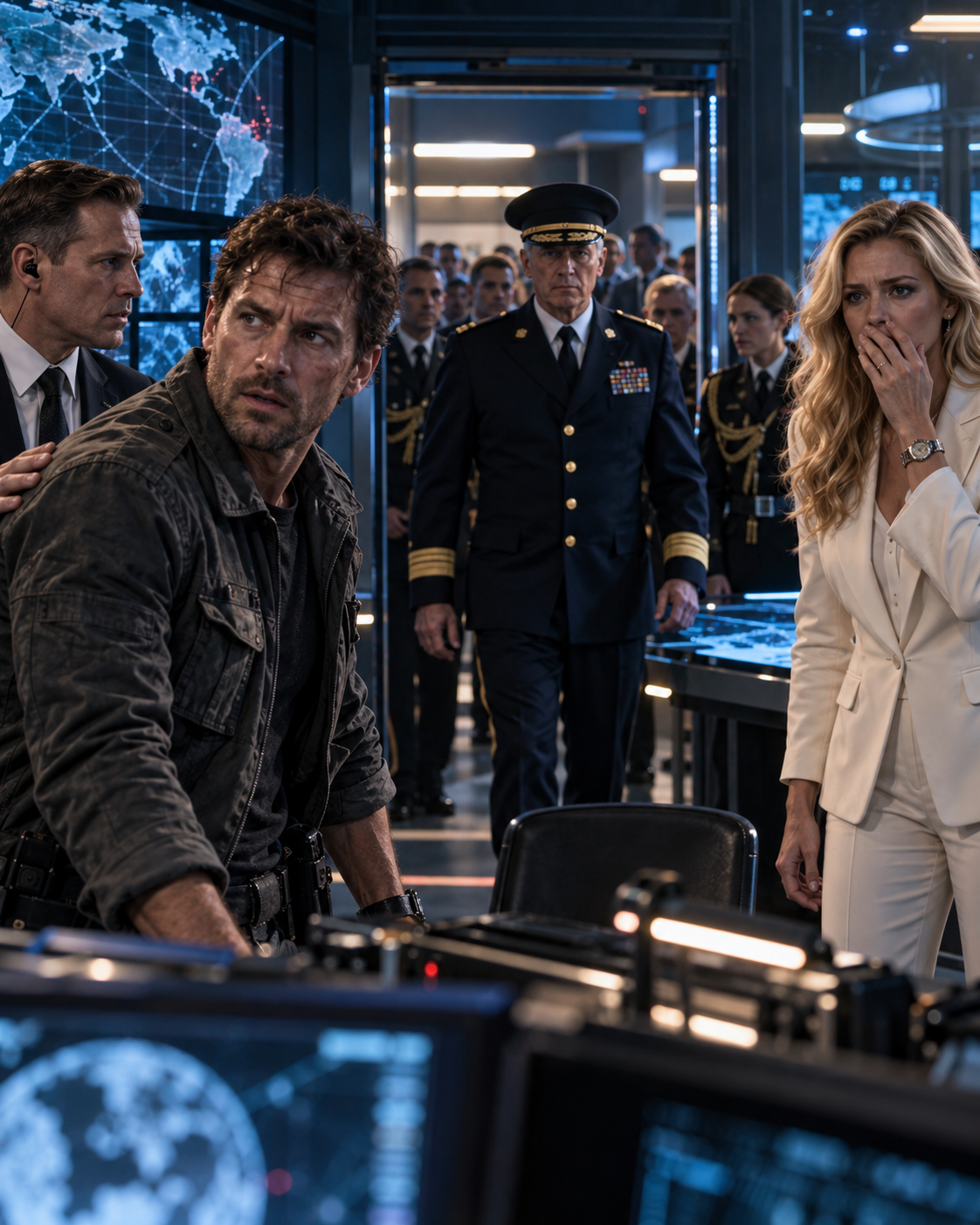
“Now I’m Mr. Mercer?”
Neither man understood the remark.
Before they could say anything else, a black government sedan stopped beside the curb.
The rear door opened.
Admiral Nathan Cross stepped out.
He was older than I remembered, but his eyes were exactly the same.
Sharp.
Calm.
Impossible to fool.
He looked at me for several seconds.
Then he said, “Commander.”
I hadn’t heard anyone call me that in almost two years.
Something tightened inside my chest.
“Admiral.”
He shook my hand.
Then he looked at the gray jacket.
“You still hate suits.”
I smiled faintly.
“More than ever.”
His expression changed.
“Come on.”
We crossed the street together.
Inside Helix, the atmosphere had transformed.
The polished showroom was gone.
The carefully rehearsed smiles were gone.
Engineers stood frozen around dead monitors.
Technicians shouted numbers across the room.
Someone was crying near the server racks.
Evelyn stood in the center of it all.
Her face was pale.
When she saw me beside Admiral Cross, she seemed unable to breathe.
“Commander Mercer?”
I didn’t answer.
Admiral Cross did.
“Yes.”
Evelyn looked at my jacket.
Then at my badge.
Then at the console.
“I didn’t know.”
“No,” I said quietly.
“You didn’t ask.”
The words landed harder than shouting would have.
She lowered her eyes.
“I was wrong.”
“Yes.”
“I need your help.”
I looked at the dead screens.
“How long has it been down?”
“Nine minutes.”
“Backup?”
“Failed.”
“Manual isolation?”
“Locked.”
I walked toward the console.
Derek stepped aside.
For the first time since I’d known him, he looked frightened.
“What do you need?”
I pointed toward the secondary diagnostic station.
“Pull the raw telemetry.”
He hesitated.
“That’s encrypted.”
“I know.”
I looked at him.
“You built the encryption layer.”
He nodded.
“Then you know where the blind spot is.”
He stared at me.
Then he moved.
We worked without another word.
The room slowly became quieter.
Not because the problem was solved.
Because everyone had realized something uncomfortable.
The man they had dismissed as a contractor was now the only person in the building who seemed to understand what was happening.
I pulled the corrupted data into an isolated buffer.
The synchronization error had spread farther than expected.
It was eating its way through the tactical processing chain.
If it reached the primary server, the entire system could become permanently corrupted.
“How long?”
Derek asked.
“Twenty minutes.”
“Until what?”
“Until we lose it.”
His face drained of color.
I started typing.
The old architecture came back to me in fragments.
Not from documentation.
From memory.
I had designed its foundation years earlier when Helix was still a small contractor with two floors and a handful of engineers.
Back then, we weren’t building something to impress admirals.
We were building something sailors could trust with their lives.
That distinction mattered.
A screen flickered.
Then another.
The system was fighting me.
I isolated the damaged stream and manually rebuilt the synchronization table.
Derek watched.
“Where did you get that sequence?”
“I wrote it.”
He looked at me.
“You wrote the original framework?”
“Most of it.”
Silence spread across the room.
Evelyn stood behind me.
“Why didn’t anyone tell me?”
I kept working.
“Because nobody thought to ask.”
The server temperature climbed.
A warning appeared.
PRIMARY MEMORY INTEGRITY: 18%.
Someone whispered, “We’re losing it.”
I ignored them.
I stripped away the corrupted layer and bypassed the safeguards that were preventing recovery.
It was dangerous.
One wrong move could erase everything.
My hands were steady.
Inside, however, I was thinking about my wife.
She used to tell me that I always became calm when everything around me was falling apart.
I once told her it was because panic never fixed anything.
She laughed.
“You only say that because you like pretending you’re made of steel.”
I wished I could hear her laugh again.
The memory nearly broke my concentration.
I closed my eyes for half a second.
Then I heard her voice in my head.
Keep going.
I opened my eyes.
“Come on.”
The system responded.
One monitor came alive.
Then two.
Radar data returned.
Telemetry stabilized.
The primary server stopped losing memory.
Someone gasped.
Derek stared at the numbers.
“That’s impossible.”
“No.”
I leaned back.
“It’s engineering.”
The room remained silent for another few seconds.
Then every screen came back.
The system was fully operational.
Twenty-two minutes had passed.
Admiral Cross walked toward me.
He didn’t congratulate me.
Instead, he looked around the room.
“Do you all know who just saved this demonstration?”
Nobody answered.
He continued.
“Commander Jonathan Mercer designed the baseline tactical integration architecture this system was built upon.”
Evelyn’s eyes filled with shame.
“He retired from the Navy as one of our most respected technical commanders.”
Admiral Cross looked at her.
“And then his wife died.”
The room became completely still.
I lowered my eyes.
I hated this part.
I had spent two years trying not to be defined by that loss.
Cross continued anyway.
“She was sick for months.”
I stared at the console.
“Jonathan left the Navy to care for her.”
Nobody moved.
“He turned down consulting positions, corporate offers, and senior leadership roles because he wanted to spend her last year with her.”
Evelyn whispered, “I didn’t know.”
“No,” I said.
“You didn’t.”
The admiral’s voice softened.
“After she died, he could have returned to a six-figure defense career.”
He looked at me.
“Instead, he asked for a small contract position because he wanted to work without becoming somebody’s photograph on a wall.”
My throat tightened.
I hadn’t wanted anyone to know.
Not because I was ashamed.
Because grief had become the only thing in my life that still felt private.
Evelyn stepped forward.
“I’m sorry.”
I believed her.
That surprised me.
Maybe because her voice no longer carried authority.
Only regret.
The Navy delegation arrived minutes later.
The demonstration was restarted.
This time, every radar simulation ran perfectly.
The contract wasn’t awarded that afternoon.
That would have been too easy.
Instead, the Navy suspended the final decision pending an investigation into the failure.
And that investigation uncovered something nobody expected.
The synchronization error wasn’t simply a software mistake.
Someone had deliberately inserted the corrupted timing routine six weeks earlier.
Derek discovered it while reviewing the audit trail.
His face went white.
“Jonathan.”
I walked over.
“What?”
He pointed at the screen.
“The code was inserted using my credentials.”
The room fell silent.
Evelyn immediately called security.
But I stopped her.
“Don’t.”
She looked at me.
“Why?”
“Because if Derek did it, he’ll know we found it.”
“And if he didn’t?”
“Then whoever did it will know we’re looking.”
That changed everything.
We quietly duplicated the logs.
We secured the system.
And for the first time, I began wondering whether my dismissal had been more than arrogance.
Someone had known I was investigating the buffer.
Someone had wanted me away from the console.
And someone had timed the attack for the Navy demonstration.
The following evening, Evelyn called me into her office.
The woman sitting behind the desk looked completely different from the CEO who had thrown me out.
She had removed her jacket.
Her hair was loose.
There were dark circles beneath her eyes.
“I owe you more than an apology.”
I sat across from her.
“Then don’t give me one.”
She looked confused.
“Fix what happened.”
She nodded.
“I will.”
She called an emergency board meeting the next morning.
Every director attended.
Evelyn stood at the head of the room and told them exactly what she had done.
She admitted that she had removed me without checking my credentials.
She admitted that she had allowed appearance and hierarchy to influence a decision involving national security.
She accepted responsibility.
Then she said something I hadn’t expected.
“Jonathan Mercer will not be fired.”
A director objected.
“This is a corporate failure.”
“No,” Evelyn replied.
“This is my failure.”
Nobody spoke.
She turned toward me.
“Jonathan, what do you want?”
I thought about it.
For years, I had believed justice meant making people feel the same humiliation they had caused.
But grief had taught me something different.
Pain multiplied when people used it as permission to hurt others.
“I want the engineers who made honest mistakes protected.”
The board stared at me.
“And the people who deliberately compromised the system?”
I answered carefully.
“Hold them accountable.”
That afternoon, the investigation expanded.
The person behind the corrupted code was eventually identified.
It wasn’t Derek.
It was a senior program manager named Colin Reeves, who had secretly accepted money from a competitor trying to sabotage Helix’s Navy contract.
He had assumed the failure would be blamed on the engineering team.
He never imagined the discarded contractor would be the one capable of reconstructing the system.
When federal agents escorted him from the building, he looked at me.
“You ruined everything.”
I shook my head.
“No.”
I looked at the frightened engineers standing behind him.
“You did.”
The Navy eventually approved the contract.
But something inside Helix changed before the signature was ever made.
Evelyn created an independent technical review board.
Contractors were given the same authority to report safety concerns as senior engineers.
No one could be removed from a critical system simply because they looked unimportant.
And every morning, when I entered the control room, I still wore the same faded gray jacket.
The coffee stain never came out.
I kept it anyway.
Months later, Evelyn found me sitting alone beside the console.
She held two cups of coffee.
“Tea?”
I smiled.
“You remembered.”
She handed me one.
“I remember more now.”
We stood quietly together.
Then she asked, “Do you ever regret retiring?”
I looked at the screens.
“No.”
“Not even a little?”
I thought about my wife.
About the evenings beside her hospital bed.
About the quiet conversations.
About the life I had chosen when nobody was watching.
“No.”
I took a sip.
“I learned something after she died.”
“What?”
“Your title tells people what you were trusted to do.”
I looked at Evelyn.
“Your character tells them what you’ll do when nobody is watching.”
She smiled sadly.
“She must have been a remarkable woman.”
“She was.”
I looked toward the window.
For a moment, sunlight touched the empty chair beside me.
I imagined my wife’s hand resting there.
Then the console beeped.
A new message had arrived from the Navy.
I opened it.
The subject line was simple.
CLASSIFIED TECHNICAL REVIEW.
Beneath it was a request for a private meeting with me regarding a second system.
A system I had never heard of.
I looked at Evelyn.
She noticed my expression.
“What is it?”
I closed the message.
“I’m not sure yet.”
She waited.
I stood and picked up my old jacket.
“Apparently, someone else has been building something using my original architecture.”
“And they want you?”
I looked at the screen again.
The final sentence of the message was still glowing.
WE BELIEVE THE ORIGINAL DESIGNER IS THE ONLY PERSON WHO CAN TELL US WHAT THEY CHANGED.
For the first time in years, I felt something I thought grief had taken from me forever.
Curiosity.
I reached for the door.
Behind me, Evelyn called my name.
I stopped.
“Jonathan?”
I turned.
She held up my old badge.
The one she had watched me surrender that morning.
“I think this belongs to you.”
I took it from her.
The plastic was scratched.
The photograph was faded.
But my name was still there.
Jonathan Mercer.
Not Commander.
Not CEO.
Not genius.
Not hero.
Just my name.
And somehow, that felt like enough.
I stepped into the hallway as the control room lights hummed behind me.
I had spent years believing that walking away from power meant becoming invisible.
Now I understood the truth.
Sometimes stepping away from the spotlight is how you finally discover who you are when nobody is looking.
And somewhere beyond that hallway, another system was waiting.
Another secret.
Another test.
This time, I intended to find out who had built it before someone decided I didn’t belong in the room.