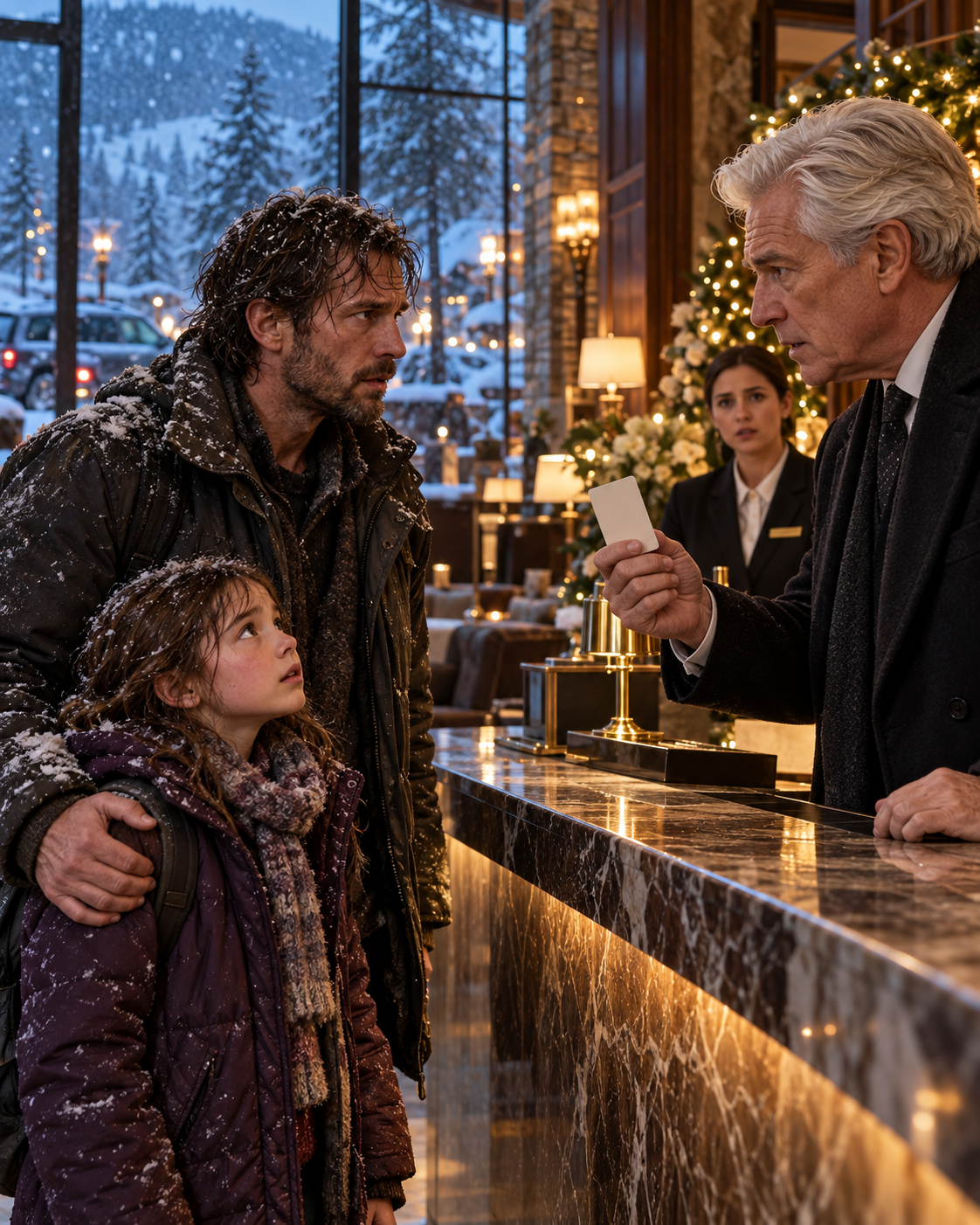
Please don’t make my daughter sleep in the car,” I whispered, while the clerk kept his hand over the last room key
The photograph stayed on my phone while I sat at the kitchen table until the screen went dark.
I turned it back on.
Zoomed in.
Turned it sideways.
Zoomed in again.
It didn’t matter.
There he was.
Julian.
Not a ghost. Not a trick of light. Not a face assembled by my guilty mind from snow and memory.
A living man standing six or seven feet behind Owen Ross.
His face was thinner than I remembered, but it was unmistakable.
The scar above his right eyebrow.
The crooked nose he’d gotten playing baseball in high school.
The same dark eyes.
The same expression he used to wear when someone had said something stupid and he was deciding whether to laugh.
I whispered his name.
“Julian.”
Chloe came into the kitchen carrying a bowl of cereal.
“Mom?”
I locked the phone.
Too quickly.
She noticed.
Children always notice the movement adults make when they’re trying to hide something.
“What?”
“You look weird.”
“Thanks.”
“Are you sick?”
“No.”
She sat across from me.
“Is it about the hotel?”
“No.”
“Then what is it?”
I looked at her.
For fourteen years, I’d believed keeping the past away from her was protection.
That morning, for the first time, I wondered if silence could become another kind of danger.
“Someone I knew a long time ago might be alive.”
Her spoon stopped halfway to her mouth.
“Like a zombie?”
I almost laughed.
“Not like a zombie.”
“Oh.”
She lowered the spoon.
“That’s worse.”
I couldn’t argue with that.
The unknown number texted again.
This time there were four words.
Don’t call the police.
I stared at the message.
Then another appeared.
Meet me where it started.
There was an address beneath it.
A roadside maintenance station outside Silver Creek.
My stomach dropped.
I didn’t tell Chloe.
I told her we were going to visit Arthur.
It wasn’t entirely a lie.
Arthur was the first person I called.
He answered on the second ring.
“Claire?”
“I need to ask you something.”
His voice changed immediately.
“What’s wrong?”
“Did Julian have a friend named Owen Ross?”
Silence.
Then:
“Yes.”
“Did Owen die?”
“No.”
“Where is he?”
“I don’t know.”
“Arthur.”
“I haven’t heard his name in fourteen years.”
I swallowed.
“I have.”
I told him about the photograph.
When I finished, he didn’t speak for several seconds.
Then he said, very quietly, “Come back to Pinecrest.”
“I can’t.”
“Why?”
“Because whoever sent this wants me somewhere else.”
“Then don’t go alone.”
“I won’t.”
I looked at Chloe.
Her cereal had gone soggy.
I had never seen her listen so carefully.
“I’ll bring someone.”
Arthur understood.
“Bring me.”
The maintenance station sat at the edge of the old highway, half-buried beneath a late-season snowbank.
Arthur arrived twenty minutes after us in a black pickup.
He got out slowly.
I held the photograph between two fingers.
“This is real.”
“I know.”
“How?”
Arthur pointed to the corner.
There was a date stamp.
The date was three days after the ambush.
My throat tightened.
“Julian was alive for three days?”
“Maybe longer.”
“Why didn’t anyone tell me?”
Arthur looked at me.
“I don’t know.”
That answer frightened me more than anything else.
We found Owen in the abandoned maintenance garage.
He looked older than his fifty years.
His beard had gone almost completely gray.
He stood beside a woodstove with his hands wrapped around a chipped mug.
When he saw me, he didn’t smile.
He just whispered,
“You really don’t remember.”
I took a step forward.
“Remember what?”
“That you weren’t the one who carried Julian out.”
The room went silent.
My mind rejected the sentence before I could understand it.
“I carried him.”
“I know what you remember.”
“I was there.”
“So was I.”
“You disappeared.”
“I was ordered to.”
“By who?”
Owen looked at Arthur.
Arthur’s face hardened.
“Tell her.”
Owen set down his mug.
“The convoy was hit harder than the official report says.”
I knew that much.
Three vehicles disabled.
Two killed.
One missing.
One injured.
That was the story I had lived with.
Owen shook his head.
“There were more men involved.”
“Who?”
“Contractors. Local guides. Someone had leaked our route.”
Arthur stepped closer.
“Julian?”
Owen nodded.
“Julian was the target.”
My mouth went dry.
“Why?”
“Because he had found out someone in our command was selling convoy schedules.”
I stared at him.
“Then why was none of that in the report?”
“Because the investigation would have exposed people who were still useful.”
Arthur swore softly.
I barely heard him.
My mind was racing back through the snow.
The overturned vehicle.
The radio that wouldn’t work.
Julian’s blood on my gloves.
The fire.
Owen shouting.
A second explosion.
Then nothing.
“I remember carrying him.”
Owen’s eyes softened.
“You carried him out of the wreck.”
“Yes.”
“But he was alive.”
“I know.”
“No, Claire.”
He took a breath.
“You carried him out. Then you went back for me.”
The room seemed to tilt.
“I don’t remember.”
“You were hit by shrapnel.”
He pointed to my left temple.
The scar was still there.
“You collapsed.”
I touched it without thinking.
“Owen, I saw him die.”
“You saw him bleeding.”
“That isn’t the same thing.”
“No.”
He looked toward the window.
“Because Julian didn’t die there.”
Arthur grabbed the back of a chair.
“Then where did my son go?”
Owen didn’t answer immediately.
That hesitation told me there was more.
Finally he said, “A medical team arrived.”
“American?”
“Not officially.”
“What does that mean?”
“They were attached to a field hospital outside the main route. Julian had a pulse. Barely.”
I felt the blood drain from my face.
“Why wasn’t he evacuated with us?”
“Because you were unconscious.”
“And Julian?”
“He was moved.”
“Where?”
“I don’t know.”
“You don’t know?”
“I was ordered to forget him.”
Arthur slammed his palm onto the table.
“By whom?”
Owen’s eyes met his.
“Colonel Mercer.”
My heart stopped.
My father.
Not because he had been involved.
Because my father had been dead for nine years.
And I had spent fourteen years believing he was one of the people who had signed the report saying Julian had died.
Owen saw my expression.
“Your father wasn’t the one who gave the order.”
“Then why say his name?”
“Because the order came through his office.”
I sat down.
The room blurred.
For years, I had blamed myself.
I’d thought I’d failed Julian.
I’d thought I’d been too slow.
Too weak.
Too afraid.
I had built my entire adult life around a death that might never have happened.
But Owen wasn’t finished.
“There was another problem.”
“What?”
“Julian remembered who betrayed the convoy.”
Arthur stared at him.
“Who?”
Owen shook his head.
“I don’t know.”
“You said he survived.”
“He did.”
“Then where is he?”
Owen reached into his coat.
He pulled out a second envelope.
“I was supposed to give you this fourteen years ago.”
My hands shook as I opened it.
Inside was a letter.
The paper was stained and folded.
The handwriting was Julian’s.
Claire—
If this reaches you, something went wrong.
Don’t trust the report.
Don’t trust anyone who tells you I died.
And don’t blame yourself.
You did exactly what I asked.
I read the last sentence twice.
“What did you ask me to do?”
Owen answered.
“Go home.”
I looked at him.
“What?”
“Julian knew you were going back for him.”
A memory surfaced.
Not the whole thing.
Just a voice through smoke.
My name.
Then:
“Go.”
I had thought it was a hallucination.
Owen continued.
“He knew the second blast was coming. He pushed you away from the vehicle.”
I shook my head.
“No.”
“You don’t remember because the concussion took the memory.”
“And he?”
“He was extracted.”
Arthur was crying silently now.
I handed him the letter.
He read it.
His shoulders folded inward.
At the bottom, Julian had written:
Tell Dad the boat was never the point.
He’ll understand someday.
Arthur closed his eyes.
“I don’t understand.”
Owen looked at him.
“The boat was a code.”
Arthur opened his eyes.
“For what?”
“A place.”
“Where?”
“British Columbia.”
My head snapped up.
“Why?”
“Julian had arranged a safe identity before the convoy. If he survived, he was supposed to disappear there.”
“Then why didn’t he contact you?”
“He tried.”
“When?”
“Six years ago.”
I stood.
“And?”
Owen looked at me with something like shame.
“He found out someone was still looking for him.”
“Who?”
“The same people who wanted him dead.”
The drive back to Pinecrest was silent.
Arthur sat in the passenger seat.
Chloe was asleep in the back.
Snow drifted across the road in thin white sheets.
I kept thinking about the photograph.
Julian standing behind us.
Alive.
Watching.
For fourteen years, I had pictured his last moments as a lonely death in the dark.
Now I couldn’t stop wondering whether he had spent fourteen years believing I’d abandoned him.
At Pinecrest, Arthur led me upstairs.
He opened a locked office drawer.
Inside were dozens of letters.
All addressed to Julian.
Never sent.
“I wrote to him every year,” Arthur said.
“Why didn’t you send them?”
“I didn’t know where.”
He handed me one.
“After you came here, I realized something.”
“What?”
“You told me Julian talked about the boat.”
“Yes.”
“I never told you about the boat.”
I stared at him.
“No.”
Arthur’s eyes filled.
“You couldn’t have known.”
I looked at the photograph.
The blue boat.
The message.
The strange note.
My stomach tightened.
“Then Julian must have told you.”
Arthur nodded.
“Not directly.”
He reached beneath the letters and pulled out a small cassette tape.
“He sent this to me six years ago.”
I stared at it.
“Why didn’t you play it?”
“I was afraid.”
That was the first time I understood how much fear could resemble grief.
Arthur found an old player.
The tape hissed.
Then a man’s voice filled the office.
Older.
Rougher.
But unmistakable.
“Dad?”
Arthur covered his mouth.
I couldn’t breathe.
Julian continued.
“If you ever hear this, I’m sorry.”
A pause.
“I didn’t come home because coming home would have put you in danger.”
Arthur began to cry.
“And Claire—if she’s with you, tell her none of this was her fault.”
My knees nearly gave out.
The tape crackled.
Then Julian said something that made the entire room go cold.
“Tell her Owen doesn’t know the whole story.”
The tape stopped.
Nobody moved.
I turned toward Owen.
He was standing in the doorway.
His face had gone white.
Arthur whispered, “What does that mean?”
Owen didn’t answer.
I stepped toward him.
“You said you didn’t know where Julian was.”
“I don’t.”
“You said you didn’t know who betrayed the convoy.”
“I don’t.”
“Then why did Julian say you didn’t know the whole story?”
Owen looked at me.
“Because I didn’t.”
He reached into his pocket and pulled out his phone.
“There was someone else there that night.”
“Who?”
He turned the screen toward me.
The photograph showed the wreckage.
Julian.
Me.
Owen.
And a fourth figure standing beside the medical truck.
I recognized the uniform.
Not American.
Not Afghan.
Canadian.
But that wasn’t what made my stomach drop.
It was the face.
I knew that face.
I had seen it every time I looked in the mirror.
It was my father.
Alive.
The room seemed to lose all sound.
“My father died in 2017.”
Owen nodded.
“I know.”
“That photograph was from fourteen years ago.”
“I know.”
“Then how is he there?”
Owen’s voice was barely audible.
“Because the man in the photograph isn’t your father.”
I stared at him.
He zoomed in.
The face sharpened.
Same eyes.
Same jaw.
Same scar near the chin.
But not my father.
Someone who looked enough like him to fool me at first glance.
Someone who had been standing beside the men who took Julian.
Owen swallowed.
“Your father had a brother.”
I shook my head.
“No.”
Arthur stared at me.
Owen said,
“His name was Daniel Mercer.”
The name meant nothing.
Then Chloe stirred behind us.
“Mom?”
I turned.
She was standing in the doorway, rubbing sleep from her eyes.
I forced my voice steady.
“Go back to bed, sweetheart.”
She looked past me at Owen.
Then at the photograph.
Her face changed.
“Mom.”
“What?”
“That man.”
She pointed at the screen.
“I’ve seen him.”
Every hair on my arms lifted.
“Where?”
Chloe frowned, trying to remember.
“At the hotel.”
Arthur stood.
“What hotel?”
“The Pinecrest.”
She pointed toward the hallway.
“He was downstairs.”
I looked at Arthur.
He looked at me.
Neither of us spoke.
Because the lobby camera system had been recording for the entire three days we were snowed in.
And suddenly the question wasn’t whether Julian Vance had survived fourteen years ago.
It was whether someone had followed him to Pinecrest Lodge three months ago.
Arthur grabbed his keys.
“We’re going downstairs.”
We found the security office locked.
Samuel Pratt was inside.
He looked up when we entered.
His expression changed the moment he saw the photograph.
Not surprise.
Recognition.
That was the moment I knew.
“Samuel,” I said quietly.
He didn’t answer.
Arthur stepped forward.
“You know this man.”
Samuel’s shoulders dropped.
“I know the name.”
“What name?”
He looked at me.
“Daniel Mercer.”
My heart hammered.
“Where is he?”
Samuel glanced toward the cameras.
Then he whispered,
“He’s been staying at Pinecrest for six weeks.”
Arthur went still.
“Where?”
Samuel pointed upward.
“Room 514.”
The penthouse.
Our penthouse.
The room Chloe and I had slept in.
The room Arthur had given us because he thought we were safe.
I ran.
Arthur shouted my name behind me.
The elevator doors opened.
I stepped inside.
The numbers began climbing.
Fourth floor.
Fifth.
The doors opened.
The hallway was empty.
Our room stood at the end.
The door was slightly open.
I pushed it inward.
The fireplace was cold.
The bed untouched.
But on the table sat a single object.
A blue fishing-boat keychain.
Beside it was a folded piece of paper.
My hands shook as I opened it.
There were only five words.
I never stopped looking for you.
Underneath was a second line.
Julian.
I didn’t cry.
Not then.
I just stood there, staring at the handwriting, while Chloe clung to my coat and Arthur stood behind us breathing hard.
For fourteen years, I had believed my worst memory was the night I couldn’t save a man.
Now I understood the crueler possibility.
He had survived.
He had remembered me.
And somehow, after all these years, he had finally found his way back.
We didn’t find Julian that night.
We found the trail he had left behind.
A storage locker in town.
A Canadian phone number.
Three photographs.
A passport under another name.
And one final recording.
Arthur wanted to hear it immediately.
I didn’t.
For the first time in fourteen years, I wanted one moment that belonged only to me.
So I took the recording home.
I waited until Chloe was asleep.
Then I sat alone at the kitchen table and pressed play.
Julian’s voice came through the darkness.
“Claire, if you’re hearing this, it means I finally got brave enough to come home.”
I closed my eyes.
“I don’t know if you’ll forgive me for disappearing.”
His voice broke slightly.
“But I need you to understand something.”
A long pause.
“You saved my life that night.”
I pressed my fist against my mouth.
“You carried me through the snow until your legs gave out. You kept calling my name. You told me I was going home.”
I began to cry.
“I didn’t know how to go home without bringing the war with me.”
The recording hissed.
“I’ve spent fourteen years trying to become somebody who could.”
Then came the words I had never imagined hearing.
“I’ll be at the blue boat tomorrow morning.”
The recording ended.
The next morning, before sunrise, Arthur drove us to the lake.
The old blue fishing boat was still there.
Older.
More faded.
But still floating.
Chloe sat beside me on the dock.
Arthur stood several yards away, giving me the privacy he knew I needed.
The lake was almost perfectly still.
Then I heard footsteps behind us.
I turned.
A man stood at the end of the dock.
Gray threaded through his dark hair.
A scar crossed his eyebrow.
He was thinner than the lieutenant I remembered.
Older.
Alive.
He looked at me.
For several seconds, neither of us moved.
Then he smiled.
That crooked little smile.
“Hey, Claire.”
My knees nearly gave out.
I laughed and cried at the same time.
“You’re supposed to be dead.”
“I know.”
“You took your time.”
“I know.”
Chloe looked between us.
“Is this Julian?”
He smiled at her.
“Yeah.”
She studied him.
Then looked at me.
“Mom?”
“Yeah?”
“Can I hug him?”
Julian’s face crumpled.
He nodded.
Chloe ran to him.
He caught her carefully, like someone who had forgotten what it felt like to hold something that wasn’t a weapon, a wound, or a memory.
Arthur stayed where he was.
Julian looked over Chloe’s shoulder.
Their eyes met.
Neither man spoke.
Arthur finally whispered,
“The boat?”
Julian laughed through his tears.
“Still not worth fixing.”
Arthur shook his head.
“You always were wrong.”
Julian smiled.
“Maybe.”
I watched them embrace.
And for the first time since Afghanistan, the memory inside me changed.
The mountain was still there.
The wreckage.
The snow.
The blood.
The fear.
None of it disappeared.
But the memory no longer ended with me kneeling beside a dying man.
It ended with a hand reaching back through fourteen years of darkness.
Julian had survived.
Arthur had found his son.
Chloe had met the ghost I’d carried for most of her childhood.
And I finally understood that surviving something doesn’t mean you have to spend the rest of your life proving you deserved to.
Sometimes the person you think you failed is the very person who has been trying to tell you that you didn’t.
We stayed at the lake until the sun came up.
The blue boat rocked gently against the dock.
And when Julian finally asked me whether I still remembered what he’d said that night, I smiled through my tears.
“About the boat?”
He shook his head.
“No.”
He reached for my hand.
“About going home.”
I squeezed his fingers.
“I remember.”
And this time, neither of us had to wonder whether the other made it there.