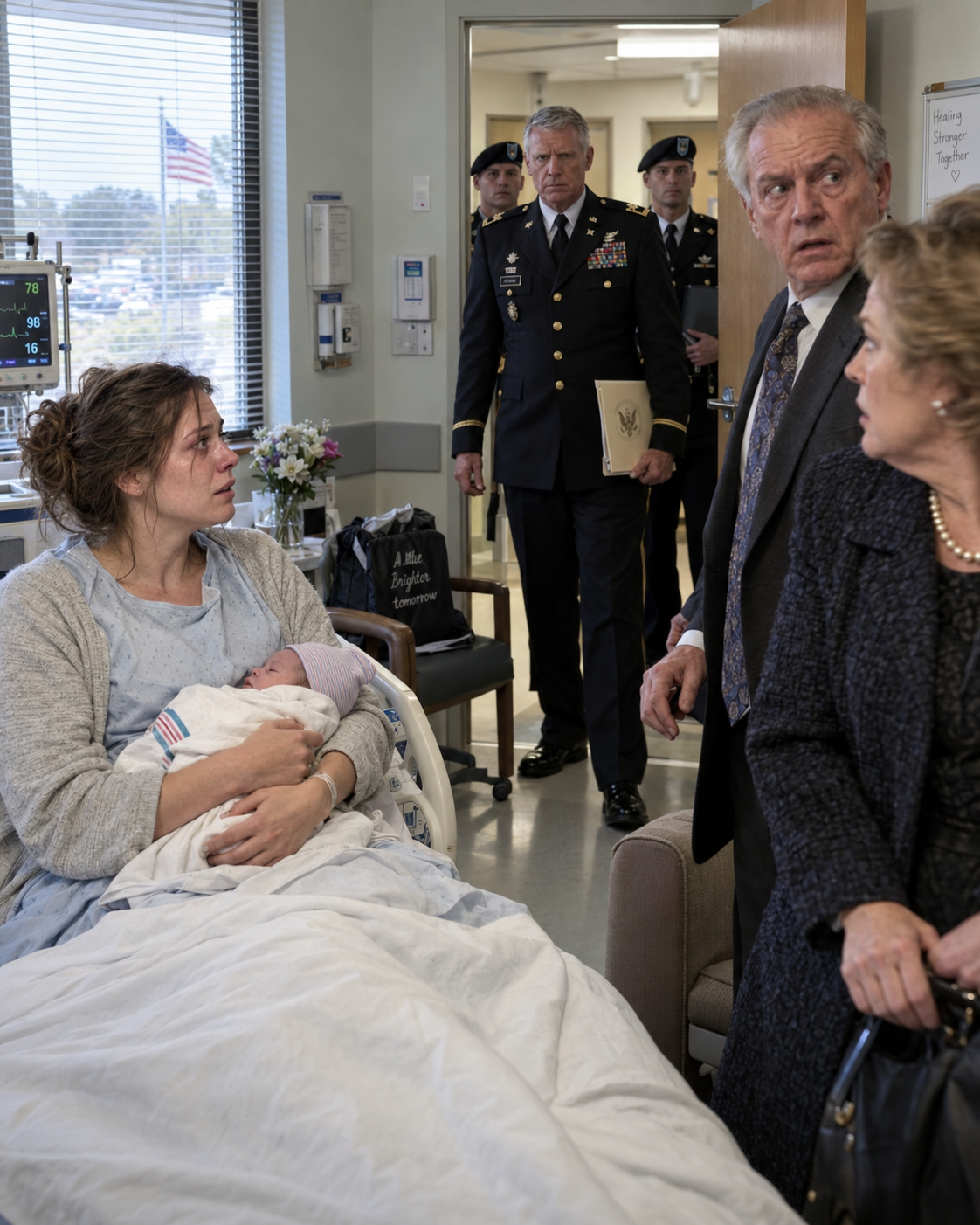
“Please don’t make me take my baby home alone,” I whispered to the nurse, gripping her hand
The officer’s name was Sergeant Ruiz. He didn’t raise his voice. He didn’t need to.
“Mr. Foster, did you contact the casualty assistance office regarding Staff Sergeant Logan Foster’s death?”
My father rubbed his thumb against the side of his index finger, a nervous habit I’d seen since childhood.
“I made a call, yes.”
“Under what authority?”
“I was trying to help my daughter.”
I almost laughed.
Not because anything was funny.
Because twenty minutes earlier he’d told me I wasn’t his responsibility anymore.
Colonel Mercer pulled a chair closer to my bed and sat down. He didn’t crowd me. He didn’t perform authority for the sake of it.
He simply looked tired.
“Brenda, there’s something Logan put in writing before he died.”
My heart stumbled.
“About me?”
“About you and Laurel.”
I looked at the folder.
For a moment, I was afraid to touch it.
I’d spent three days receiving condolences, forms, phone calls, flowers, casseroles, and questions I couldn’t answer. I had learned that grief came with paperwork. Death didn’t pause long enough for a person to understand it.
Mercer continued quietly.
“Six weeks before the accident, Logan updated his emergency directives and beneficiary-related instructions. He also left a written concern with his command.”
My father scoffed.
“That’s absurd.”
Mercer looked at him.
“I’m not discussing your opinion of it, Mr. Foster.”
Then he turned back to me.
“Logan specifically asked that command personnel be alert to possible interference from your parents.”
My throat tightened.
“Why?”
Mercer hesitated.
“He didn’t accuse them of a crime. He said he didn’t trust them with your financial interests if something happened to him.”
I looked at my mother.
She had gone pale.
“He said that?”
“He did.”
My mind immediately searched backward through our life.
The argument at Thanksgiving.
My father’s questions about Logan’s life insurance.
The strange conversation three months earlier when Harold had asked how military survivor benefits worked.
I had forgotten it because Logan had changed the subject.
Now I remembered.
My father had said, “The Army takes care of its own, right?”
Logan had replied, “That’s the idea.”
I had thought nothing of it.
Until then.
Sergeant Ruiz opened another document.
“There was a second issue.”
He slid a photocopy onto the table.
My father didn’t look at it.
I did.
It was a casualty assistance form.
My father’s name was on it.
Under relationship to the deceased, he had written: Father-in-law.
Under authorization, there was another designation that made my stomach drop.
He had represented himself as my legal guardian for purposes of directing certain payments while I was incapacitated by childbirth.
I looked up slowly.
“I wasn’t incapacitated.”
Ruiz nodded.
“We know.”
My father finally spoke.
“You were in labor.”
“For eleven hours.”
“You were medicated.”
“I signed my own admission paperwork.”
“Brenda—”
“No.”
My voice surprised me.
It sounded steadier than I felt.
Ruiz continued.
“The Army received a request to redirect the federal death gratuity, approximately one hundred thousand dollars, into an account controlled by Mr. Foster.”
Evelyn stepped forward.
“That money was being held temporarily.”
“By whom?” I asked.
“For you.”
“You said I was not your burden.”
She didn’t answer.
My father finally snapped.
“I was trying to prevent you from making reckless decisions!”
I stared at him.
“You told them I couldn’t manage my own money.”
“You’re twenty-eight.”
“I’ve been twenty-eight for eight years.”
Mercer looked down at the folder.
“Mr. Foster, your daughter’s marital status did not make her legally incompetent.”
“I was protecting her.”
“No,” I said.
My father’s eyes came back to mine.
“You were protecting the money.”
He opened his mouth.
Nothing came out.
And suddenly the whole thing became painfully clear.
The hospital bags.
The rejection.
The insistence that I couldn’t come home.
The questions about Logan’s benefits.
They hadn’t come here simply to abandon me.
They had come expecting me to have nowhere else to go.
My father thought if he could make himself the only person willing to “help,” he could control the money.
Maybe he had convinced himself it was practical.
Maybe he even believed some of it.
But belief didn’t make the paperwork disappear.
Sergeant Ruiz said, “The request was stopped before funds were transferred.”
I closed my eyes.
For one second, relief moved through me.
Then another thought came.
“What about the rest?”
Ruiz looked at Mercer.
Mercer nodded.
“Your husband’s life insurance and survivor benefits are being processed separately. We have already flagged your account for additional protection.”
My mother whispered, “David, this is getting out of hand.”
Mercer stood.
“No, ma’am. It’s getting documented.”
The military police officers asked my parents to step into the hallway.
My father didn’t move.
He looked at me.
“Brenda, listen to me. Your mother and I were trying to help.”
I thought about being nine years old and waiting by the window after school because he had promised to come to my spelling bee.
I thought about being seventeen and hearing him tell me that crying never solved anything.
I thought about Logan, who had never once told me to stop crying.
He’d simply sat beside me until I was done.
“I believe you thought you were helping,” I said.
My father’s face softened, almost hopefully.
“But you don’t get to call something help after you remove my choices from it.”
The officers escorted them out.
Evelyn cried in the hallway.
Harold kept saying my name.
I didn’t answer.
The door closed.
For the first time in days, the room became quiet.
I expected to feel victorious.
I didn’t.
I felt hollow.
Mercer sat again.
“Brenda.”
I looked at him.
“Logan talked about you constantly.”
A broken laugh escaped me.
“He did?”
“More than he probably should have.”
That made me smile.
Only a little.
Mercer leaned back.
“He told us Laurel was going to have your stubbornness and his inability to leave a project unfinished.”
I wiped my cheek.
“That sounds about right.”
“He also told me something else.”
“What?”
“He said if he died, you would probably try to convince everyone you were fine because you wouldn’t want to be a burden.”
My smile disappeared.
“That sounds like him.”
“He said we weren’t allowed to let you do that.”
I looked down at Laurel.
She was awake now, staring at nothing in particular with the solemn expression newborns sometimes have.
“I don’t know how to do this,” I whispered.
Mercer didn’t tell me I could.
He didn’t tell me everything would be okay.
He said, “You don’t have to know yet.”
That was the first useful thing anyone had said to me all week.
Then he added, “My wife is downstairs.”
I blinked.
“Why?”
“She heard you were here.”
“Colonel, you don’t have to—”
“I know.”
He smiled faintly.
“She insisted.”
His wife, Eleanor, arrived carrying a covered casserole dish in one hand and a brand-new infant car seat in the other.
She was in her late fifties, with silver beginning at her temples and the kind of face that looked as though it had spent years listening to other people’s troubles without making them feel ashamed for having them.
She kissed my forehead before I could protest.
“You look exhausted.”
“I am.”
“Good. That means you’re telling the truth.”
I laughed.
It was the first real laugh I’d had since Logan died.
Eleanor looked at Laurel.
“Oh, she’s beautiful.”
“She has Logan’s nose.”
“I can see that.”
Then Eleanor did something nobody had done since the funeral.
She asked, “Do you want to tell me about him?”
I started crying again.
She pulled up a chair.
“I’ll listen.”
So I told her.
Not the polished version people tell at memorial services.
The real Logan.
The man who burned pancakes because he forgot he had put them on the stove.
The man who folded towels badly enough that I would refold them when he wasn’t looking.
The man who once drove forty minutes back toward home because he’d forgotten to kiss me goodbye.
The man who pretended not to be afraid before every deployment.
The man who talked to Laurel through my stomach.
Eleanor listened.
Sometimes she laughed.
Sometimes she cried.
And somewhere around midnight, she told me stories I had never heard.
Logan had once stayed after a training exercise to help a younger soldier who was terrified of disappointing his unit.
He had written letters home for a soldier whose English wasn’t strong enough.
He had kept a photograph of Laurel’s ultrasound inside his locker.
“He carried it everywhere,” Eleanor said.
I covered my mouth.
“I thought he kept it in his desk.”
“He did.”
She smiled.
“He had two copies.”
That tiny detail broke something open in me.
Not in a painful way.
In a way that finally allowed love to exist beside grief.
The next morning, I was discharged.
Eleanor brought the car seat.
Mercer arrived in uniform.
And one of the military police officers returned with a sealed envelope.
My father’s case had been referred for formal investigation.
I signed what I needed to sign.
I didn’t feel triumphant.
I felt tired.
Very, very tired.
Before leaving the room, Mercer handed me a folded cloth bag.
I knew what it was before I opened it.
The burial flag.
I’d left it in my car because I hadn’t known what to do with it.
Now I unfolded it carefully.
The red stripes caught against my fingers.
The blue field rested over my knees.
Laurel slept against my chest.
I pressed the flag to my heart.
And for the first time since Logan’s death, I let myself say the words I had been avoiding.
“Goodbye, Logan.”
My voice cracked.
“But I’m taking her home.”
Not to my parents’ house.
Not to some place where I had to earn the right to be loved.
Eleanor’s house was waiting.
There was a spare bedroom upstairs, a bassinet beside the bed, food in the refrigerator, and a woman who had known my husband long enough to understand that sometimes grief needed silence more than advice.
I stayed there for six weeks.
During that time, my parents called constantly.
At first, their messages were defensive.
Then apologetic.
Then frightened.
My father said he had made a mistake.
My mother said she had been under pressure.
They both said they loved me.
I believed that they believed it.
That wasn’t the same as trusting them.
One afternoon, while Laurel slept against my shoulder, I listened to a voicemail from my father all the way through.
He said he was sorry.
He said he had panicked.
He said the money had frightened him because he thought I would waste it.
Then he said something that made me close my eyes.
“I know you’re angry, but we’re still your parents.”
I deleted the message.
Not because I hated him.
Because I finally understood that being someone’s daughter didn’t require me to surrender my boundaries.
A month later, the investigation confirmed what the documents had already suggested.
The attempted diversion had been unauthorized.
The matter was referred for federal review.
My parents were never charged in a way that made for dramatic headlines, but the legal consequences were real enough: attorneys, interviews, financial scrutiny, and the permanent loss of trust that neither apology nor time could easily repair.
I never attended their church again.
I never moved back home.
I found a small apartment near the base.
The survivor benefits were placed under my control, and I used part of them for a college savings account for Laurel.
The rest stayed untouched for a while.
I couldn’t spend Logan’s money without feeling as though I was spending pieces of him.
Eventually, Eleanor told me something that changed my mind.
“Brenda, he didn’t leave you money so you could preserve it like a memorial.”
“What did he leave it for?”
She smiled.
“To live.”
So I bought Laurel a crib.
Then a winter coat.
Then groceries.
Normal things.
Beautiful things.
Things Logan would have considered proof that life was continuing.
Months later, I returned to the base for a memorial event.
I carried Laurel in my arms.
She was big enough by then to grab at everything, including the medals on Mercer’s uniform.
He laughed.
“She has his hands.”
“I know.”
The ceremony was simple.
Names were read.
Flags moved in the wind.
People stood quietly.
When Logan’s name was spoken, I didn’t collapse.
I didn’t feel healed.
I simply stood there with my daughter against my chest and let the grief come without fighting it.
Afterward, Mercer approached me.
“You doing all right?”
I looked at Laurel.
Then at the rows of people who had known her father.
“Not always.”
He nodded.
“That’s all right.”
I smiled.
“I think I’m learning that.”
That evening, I drove home with the folded burial flag beside me instead of hidden in the trunk.
For a long time, I had thought keeping it there meant I wasn’t ready to say goodbye.
But I’d been wrong.
I wasn’t carrying it because I couldn’t let Logan go.
I was carrying it because he was part of where Laurel and I had come from.
My parents’ calls eventually stopped.
Then, years later, one came again.
I didn’t answer.
I watched the screen until it went dark.
Laurel was five by then, sitting at the kitchen table coloring a picture of a tree with enormous green branches.
“What kind of tree is that?” I asked.
She looked up.
“A strong one.”
I smiled.
“Who told you that?”
“Daddy.”
I froze.
She had never met him.
For a moment, I couldn’t speak.
Then she pointed to the picture.
“Daddy says trees bend when the wind comes.”
My eyes filled.
I crouched beside her chair.
“He was right.”
She leaned against me.
“Mommy?”
“Yeah?”
“Are you sad?”
“Sometimes.”
“Why?”
I looked at the little tree she’d drawn, its branches bent but still reaching upward.
“Because I loved someone very much.”
She thought about that.
Then she wrapped both arms around my neck.
“I think that’s okay.”
And it was.
Not easy.
Not fair.
Not finished.
But okay.
I had spent months believing strength meant never needing anyone.
Logan had known better.
Strength, I eventually learned, wasn’t standing alone.
It was knowing who deserved to stand beside you.
And when I looked at Laurel, I knew exactly what kind of life I wanted to give her—not a life without grief, because no one can promise that, but a life where love never had to be earned by surrendering yourself.
The burial flag still hangs in our living room.
Not hidden.
Not folded away.
Right where the afternoon light reaches it.
And beneath it is a photograph of Logan holding one hand against my pregnant belly, grinning at the camera as if the future were already his to meet.
Sometimes I stand there after Laurel has gone to bed and touch the frame.
I still wish he had made it home.
I always will.
But I no longer confuse missing him with being lost.
I know where I am.
I know who I am.
And I know exactly who I’m protecting now.