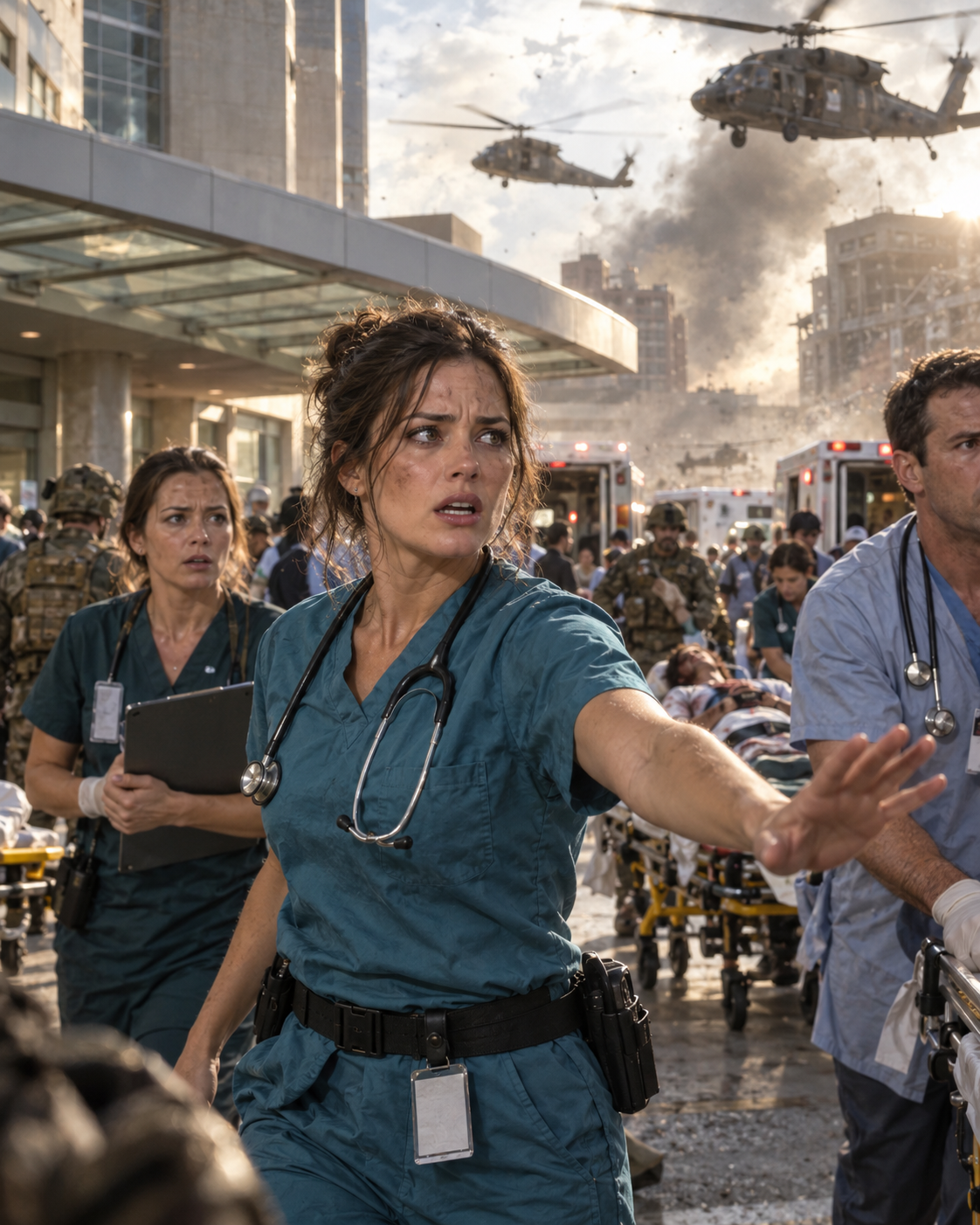
Please don’t let them take my husband,” the young nurse whispered as the first aircraft screamed over the clinic roof
The first cut opened the fabric from sternum to abdomen.
The second freed the ruined shirt.
By the time I reached the chest, Director Vance had recovered enough to shout.
“Major, step away from him.”
I didn’t.
“His blood pressure?”
“Seventy systolic.”
“Pulse?”
“Rapid.”
“Then he’s already dying.”
The director moved closer.
“You don’t understand what you’re interfering with.”
“I understand a man is dying in front of me.”
“He’s a four-star general.”
“That makes no difference to his heart.”
“It makes every difference to national security.”
I finally looked at him.
“Then national security can wait three minutes.”
He reached for my shoulder.
The operator behind him raised a suppressed rifle.
Not toward me.
Toward him.
“Touch her,” the operator said quietly, “and you’ll have a different problem.”
Director Vance stopped.
I barely noticed.
There was too much blood.
I positioned the shears and opened the chest.
The sound that came from Julian was small and involuntary.
He had assisted with chest tubes, central lines, emergency intubations.
He had never stood over an open beating heart.
The pericardial sac was swollen tight around it.
“Scalpel.”
Julian handed it to me.
“Stay with me,” I said.
His fingers trembled.
“I’m here.”
“Don’t look at the blood. Look at what I’m telling you.”
I cut.
The pressure released.
Blood surged across my gloves.
The general’s heart was beating against my palm, fast and weak.
Then I saw the tear.
Left ventricle.
Small.
Catastrophic.
“Purse-string.”
Julian stared at me.
“I need you to suture around my hand.”
“What?”
“You heard me.”
“I can’t see.”
“You don’t need to. Feel the edge.”
He swallowed.
“Valerie—”
The name stopped both of us.
Nobody at St. Jude had called me that.
Not in years.
Julian’s eyes met mine.
For the first time since I had met him, there was no arrogance in his face.
Only fear.
Not fear of me.
Fear of failing someone who was depending on him.
“Tell me where,” he whispered.
I guided his hand.
“Here.”
He inserted the needle.
The general’s heart jumped beneath my fingers.
Julian flinched.
“Keep going.”
Another stitch.
Then another.
“Now pull.”
He did.
The purse-string tightened around the wound.
The bleeding slowed.
I could feel the rhythm beneath my index finger.
One.
Two.
Three.
A heartbeat.
A man’s life reduced to a fragile muscular contraction under my hand.
“Don’t stop,” I whispered.
Julian tied the knot.
“Pressure?”
The medic checked.
“Coming up.”
I let out a breath I hadn’t realized I was holding.
“Close him enough for transport.”
Julian nodded.
Director Vance had gone silent.
The operators stood around us like a wall.
One of them had tears running down his face.
I didn’t ask why.
We worked.
For several minutes, nobody spoke.
Then General Nathan Vance opened his eyes.
They were cloudy, unfocused.
His lips moved.
I leaned closer.
“Val?”
My hands stopped.
He knew me.
Not the Major.
Not the Valkyrie.
Me.
“I’m here,” I said.
His eyes closed again.
But his pulse held.
The federal surgical team arrived seven minutes later.
They came in expecting a corpse.
Instead they found a four-star general alive on a folding table in a community clinic, his chest temporarily closed by the same woman the government had declared dead four years earlier.
The lead surgeon stared at me.
“Who performed the repair?”
Director Vance answered.
“She did.”
The surgeon looked at my face.
Then at the general.
Then back at me.
“You’re Valerie Thorne.”
It wasn’t a question.
I removed my gloves.
“Yes.”
Word spread through the clinic with the speed of electricity.
Valerie Thorne.
Major.
Combat surgeon.
Valkyrie.
The woman who had supposedly died during Operation Black Meridian after an underground facility collapsed in northern Syria.
The woman whose name had appeared in classified commendations and military journals, then disappeared.
The woman whose remains had never been recovered.
Julian sat down hard on an overturned supply crate.
He looked exhausted.
I couldn’t blame him.
“You’ve been dead for four years.”
“Apparently.”
“You made me think you were incompetent.”
“I was hoping for mediocre.”
“You falsified your credentials.”
“I modified them.”
“That is not better.”
“No.”
For some reason, he laughed.
It was a tired, disbelieving sound.
Then he covered his face with both hands.
Marla came over carrying a stack of blood-pressure cuffs.
She looked at me for a long moment.
“So.”
I waited.
“You really were a major?”
“Yes.”
“A surgeon?”
“Yes.”
“And all those times I told you to stop hovering around Dr. Vance?”
“I deserved at least half of those.”
She snorted.
“You deserved none of them.”
That was the closest Marla came to apologizing.
I appreciated it more than she knew.
Outside, sirens continued through the afternoon.
The blast at the research facility had killed thirty-one people immediately.
Another twenty-three were critically injured.
The underground complex had partially collapsed after an experimental energy-storage system ruptured beneath one of the containment chambers.
At least, that was the official explanation.
The unofficial explanation was that nobody in our clinic was allowed to discuss it.
Within an hour, federal agents had taken control of the parking lot.
Within two hours, they had confiscated our patient records.
Within three, someone had covered the windows of the trauma rooms with opaque plastic.
I was sitting in the break room washing dried blood from beneath my fingernails when Director Vance entered.
He closed the door behind him.
“You’re coming with me.”
I kept scrubbing.
“No.”
He paused.
“You don’t understand.”
“I understand perfectly.”
“You’ve been hiding under an assumed identity.”
“Yes.”
“You’ve committed federal offenses.”
“Probably.”
“You’ve compromised an active national-security investigation.”
“I saved your general.”
“That does not erase what happened before.”
I turned off the faucet.
Water dripped from my hands.
“Then tell me why you came here.”
He said nothing.
That was answer enough.
“The general wasn’t supposed to be at the facility,” I said.
His expression changed.
“Careful.”
“He was there because he knew something.”
“That’s speculation.”
“He called me Val.”
“He may have been delirious.”
“No.”
I dried my hands.
“His pulse was weak, but his speech was clear.”
Director Vance stared at me.
“You’ve been gone a long time.”
“Four years.”
“You should remain gone.”
“Why?”
He didn’t answer immediately.
Instead he placed a thin folder on the table.
My old military photograph was clipped to the front.
I hadn’t seen it in years.
Underneath was a handwritten note.
I recognized the handwriting immediately.
Nathan Vance.
My stomach tightened.
“What does it say?”
Director Vance didn’t touch the folder.
“You tell me.”
I opened it.
The note contained only one sentence.
If Valerie survives, do not let her believe Black Meridian was an accident.
I read it twice.
Then a third time.
The room seemed suddenly too small.
“Where did you get this?”
“It was recovered from General Vance’s personal safe.”
“When?”
“Three months ago.”
I looked up.
“So you knew I might be alive.”
“We suspected.”
“And you still let me live under a fake name?”
“We were trying to find you.”
“Why?”
“Because the people responsible for Black Meridian thought you had something they needed.”
I closed the folder.
“What?”
He hesitated.
“Evidence.”
“Of what?”
“The facility wasn’t destroyed by an equipment failure.”
I waited.
He leaned closer.
“Someone detonated it.”
The words landed softly.
That was somehow worse.
“Inside?”
“Yes.”
“Who?”
“We don’t know.”
“Then why did you come to St. Jude?”
“Because General Vance was following the same lead.”
I stared at the folder.
“Was he supposed to be at the compound?”
“No.”
“Then how did he get there?”
“He went looking for the person who sent the original detonation command.”
I remembered the general’s eyes.
Val?
Not fear.
Recognition.
“Who sent it?”
Director Vance’s jaw tightened.
“We believe the command originated from inside the United States.”
The door opened.
Julian stood there.
“I think you should see this.”
Director Vance turned.
“You were told to stay in the clinical area.”
Julian held up a phone.
“Someone just sent this to me.”
He showed us a photograph.
It had been taken in the clinic hallway ten minutes earlier.
The image showed me kneeling over the general.
Around me stood Julian, Marla, three operators and two federal agents.
Across the bottom was a message.
THE VALKYRIE LIVES.
The next line was worse.
SHE KNOWS WHAT HAPPENED IN BUNKER NINE.
I felt cold all the way down my arms.
Julian lowered the phone.
“What is Bunker Nine?”
I didn’t answer.
Because I knew.
And I had spent four years trying not to remember.
Black Meridian had not happened in Syria.
Not exactly.
The official mission had been to extract a group of scientists from an underground laboratory after a security breach.
But Bunker Nine had been deeper than the rest of the facility.
We had found twelve civilians there.
Not scientists.
Children.
Teenagers.
Their records had been erased.
Their existence denied.
And one of those children had been alive when I left.
A girl named Lena.
Fourteen years old.
She had grabbed my wrist while smoke filled the corridor and whispered, “Please don’t let them put me back.”
I had promised her I wouldn’t.
Then the roof collapsed.
My team was told I died.
I woke three days later in a field hospital under a different name.
I was told Lena had been killed.
I believed them.
Until now.
“Valerie?”
Julian’s voice pulled me back.
“She’s alive,” I whispered.
Director Vance went still.
“Who?”
“Lena.”
He looked at me sharply.
“You’re certain?”
“I heard her.”
“When?”
“Today.”
His face changed.
That was when I understood something I should have understood earlier.
The blast wasn’t simply an attack on a research compound.
It was a message.
Someone had discovered that I was alive.
And they were telling me they knew exactly where I was.
The federal agents wanted me moved before the press arrived.
The operators wanted to remain with General Vance.
Marla wanted everyone to stop bleeding on her clean floors.
Julian wanted answers.
I wanted five minutes alone.
Instead, I got a visitor.
An hour later, a teenage girl in a borrowed sweatshirt walked through the clinic’s rear entrance escorted by two medics.
She had a scar across her eyebrow.
Dark hair.
A slight limp.
She stopped when she saw me.
I couldn’t breathe.
“Lena?”
She smiled.
“You took your time.”
The room disappeared.
I crossed it before I knew I had moved.
She didn’t cry.
Neither did I.
We simply held each other.
She was no longer fourteen.
She was eighteen.
Alive.
Real.
And furious.
“You left me,” she whispered.
My eyes closed.
“I thought you were dead.”
“I thought you were.”
“I came back.”
“You didn’t come back soon enough.”
There was no defense against that.
So I didn’t offer one.
“I know.”
She pulled away.
“I need you to listen.”
“I’m listening.”
“They’re going to kill General Vance.”
“He’s alive.”
“Not the one you saved.”
My stomach dropped.
“What?”
She looked toward Director Vance.
“He knows.”
The director’s face had gone pale.
Lena pointed at him.
“He isn’t the director who brought you here.”
The room went silent.
Director Vance slowly reached for his weapon.
The operators reacted instantly.
“Don’t,” I said.
Everyone froze.
Lena’s voice shook.
“The real Director Vance died at Bunker Nine.”
The man standing across from me smiled.
Not nervously.
Not angrily.
Almost sadly.
Then he removed a small device from his pocket.
“You were always difficult to kill, Major.”
The lights went out.
Someone fired.
I heard Julian shout.
Glass shattered.
A second explosion punched through the hallway.
I hit the floor with Lena beneath me.
The emergency lights came on red.
Marla was dragging an injured orderly behind a desk.
An operator had taken a bullet through his shoulder.
The fake director was gone.
And General Nathan Vance’s bed was empty.
For several seconds, nobody moved.
Then Julian said, “He took the general.”
I was already running.
We found the rear doors open.
A black SUV disappeared down the access road.
Two operators sprinted outside.
“Don’t chase,” I shouted.
They stopped.
One turned.
“Why?”
“Because he wants us to.”
I went back inside.
Lena was standing in the hallway, trembling.
“There’s another way,” she said.
I looked at her.
“You know where he took him.”
She nodded.
“Bunker Nine.”
My heart sank.
The research compound was twenty minutes away.
The place that had killed my team.
The place that had buried my identity.
The place where Lena had survived.
The place where someone had just taken General Vance.
I grabbed a trauma bag.
Julian caught my arm.
“You’re going there.”
“Yes.”
“Then I’m coming.”
“No.”
“I know.”
I blinked.
He tightened his grip.
“I know you don’t want me there.”
“This isn’t a clinic anymore.”
“I know.”
“You could die.”
“So could you.”
“That isn’t an argument.”
“No,” he said quietly. “It’s the reason I’m not letting you go alone.”
I studied him.
Six weeks ago, I had thought he was arrogant.
Now I saw something different.
He was frightened.
But he was moving anyway.
Marla appeared behind him with a shotgun she’d apparently found somewhere.
“I hate both of you.”
Julian glanced at her.
“Marla—”
“Don’t.”
She shoved a bag into my hands.
“Your coffee’s getting cold.”
I almost laughed.
Almost.
We left the clinic with Lena, four operators and two medics.
The road to the compound was blocked at the main gate.
So we went through the old service tunnel.
I remembered every turn.
Every door.
Every place where someone had died.
At the end of the tunnel stood Bunker Nine.
The steel door was open.
Inside, emergency lights flickered.
A speaker crackled.
Then a man’s voice filled the corridor.
“Welcome home, Major.”
I knew that voice.
Not from the military.
From before.
A scientist named Elias Mercer.
He had been the physician assigned to Bunker Nine.
He had been the man who told me Lena was dead.
We found him in the central chamber.
General Vance was strapped to a metal chair.
Blood soaked his uniform.
Mercer stood behind him holding a pistol.
Around the room were monitors showing photographs of the twelve children.
Some alive.
Some dead.
Some missing.
“You lied to me,” I said.
Mercer smiled.
“I saved you.”
“You killed my team.”
“I gave them a chance to survive.”
“You buried their names.”
“Because their names were dangerous.”
Lena stepped forward.
Mercer looked at her.
For the first time, his smile disappeared.
“You shouldn’t be here.”
She stared at him.
“You told me nobody would come back for us.”
“I was trying to protect you.”
“No.”
Her voice was stronger now.
“You were trying to protect yourself.”
Mercer raised the pistol.
I moved.
So did everyone else.
But General Vance spoke first.
“Valerie.”
I looked at him.
His eyes were clear.
“Don’t kill him.”
Mercer laughed.
“Still giving orders, General?”
Vance ignored him.
“He knows where the others are.”
That stopped me.
“The others?”
Lena’s face changed.
“There are more.”
Mercer looked toward the monitors.
“Thirty-seven.”
My chest tightened.
Thirty-seven children.
Still alive.
Still hidden.
Mercer lowered the gun.
“You think Black Meridian was about weapons.”
I said nothing.
“It wasn’t.”
He pointed toward the screens.
“These children were exposed to something beneath the facility.”
“What?”
“An energy field.”
I stared at him.
“The government discovered that certain neurological patterns could interact with it.”
“And you experimented on them.”
“We studied them.”
“You tortured them.”
He looked away.
That was answer enough.
General Vance’s breathing became shallow.
The monitor beside him began to beep.
“His chest,” Julian said.
I turned.
Blood was spreading beneath the dressing.
The ventricular repair was failing.
Mercer watched me.
“You have ten minutes.”
“Untie him.”
“No.”
I looked at him.
“Then you’re going to watch him die.”
“That’s the point.”
I dropped beside the general.
Julian followed.
The room dissolved into movement.
I cut through the dressing.
The repair had partially torn.
I needed better light.
Better instruments.
There were none.
So I used what I had.
My hands.
Julian held the suction.
Lena stood beside me, pale but steady.
General Vance opened his eyes.
“You kept your promise.”
I shook my head.
“I broke it.”
“You came back.”
“Too late.”
“No,” he whispered. “Just in time.”
The bleeding slowed.
Not enough.
I needed another stitch.
My hands were shaking.
I hadn’t realized it until Julian covered one with his.
“Stay with me,” he said.
The phrase was mine.
He had learned it.
I nodded.
Together, we finished the repair.
When the monitors stabilized, the room was quiet.
Then sirens sounded above us.
Hundreds of them.
Mercer looked toward the ceiling.
“You brought them.”
“No,” I said.
Lena smiled faintly.
“I did.”
She held up a tiny transmitter.
The evidence from Bunker Nine had been broadcasting for seventeen minutes.
Every file.
Every photograph.
Every name.
Every command.
Every death.
The truth was already outside.
Mercer lowered his weapon.
The operators took him.
And somewhere above us, reporters were beginning to arrive.
General Vance survived.
So did Lena.
So did the other thirty-seven children.
The investigation lasted nearly two years.
There were hearings, indictments, classified documents that eventually became unclassified, and families who learned terrible things about what had happened to their children.
My name was cleared.
Then it wasn’t.
Then it was again.
That is how government paperwork works when people have spent years pretending you never existed.
I was offered my old rank.
I declined.
I was offered a hospital position.
I declined that too.
St. Jude offered me something much simpler.
A permanent job.
No title.
No ceremony.
Just a badge with my real name.
VALERIE THORNE.
Marla handed it to me on a Monday morning.
“You’re still going to stock your own rooms,” she said.
“Understood.”
“And if you hover around Dr. Vance—”
“Marla.”
She smiled.
“I’m kidding.”
Julian walked past us carrying two coffees.
He handed one to me.
“Break?”
I took it.
“Break.”
Lena eventually went to college.
She called every Sunday.
General Vance retired.
He sent me a Christmas card every year with no words inside, only his signature.
As for Julian, he became a different doctor.
Not because I taught him medicine.
He already knew medicine.
I taught him something harder.
Sometimes the person standing beside you knows more than you do.
Sometimes fear is not weakness.
Sometimes listening is the bravest thing a physician can do.
And sometimes a person spends years trying to disappear because being remembered hurts more than being forgotten.
I still wake up occasionally expecting the sound of rotors.
I still hate the smell of hydraulic fluid.
I still sleep badly when thunderstorms shake the windows.
But I no longer introduce myself as Corinne.
I no longer hide my scars.
And I no longer believe survival means you owe the dead your disappearance.
A few months after Bunker Nine, Daniel Reyes—the construction worker whose spleen injury had exposed my secret in the first place—came back to St. Jude.
He walked into the nurses’ station carrying a paper bag.
“Figured you owed me,” he said.
I frowned.
“For what?”
“For saving me.”
I laughed.
“You were the one who almost died.”
“Exactly.”
He handed me the bag.
Inside was a cinnamon roll.
I looked at it for a long moment.
Something about the ordinary sweetness of it broke through all the classified files, all the blood, all the years of being dead.
I took a bite.
It was terrible.
I told him so.
He laughed.
And for the first time in a very long time, I laughed too.
Then Marla shouted from down the hallway, “Valerie! Room six!”
I stood.
“Coming.”
Julian appeared beside me.
“You’re on break.”
I looked at my coffee.
Then at the hallway.
Then at the people waiting beyond it.
“Apparently not.”
He smiled.
I walked toward the noise.
Not as the Valkyrie.
Not as Major Thorne.
Not as a ghost.
Just Valerie.
Alive.
And finally, after everything, that was enough.