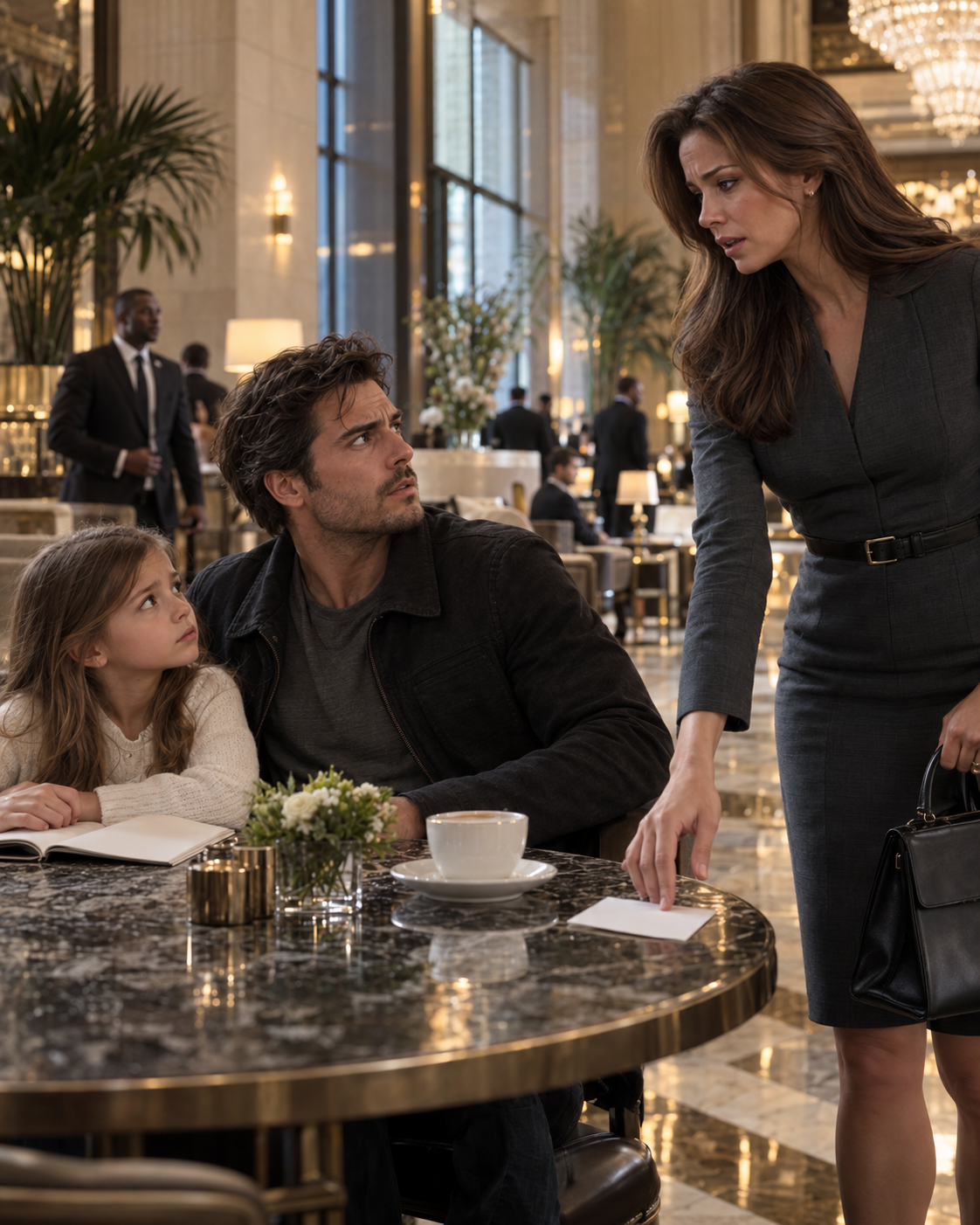
“Please don’t let them send my daughter away,” the woman whispered as she slipped a folded napkin beside my coffee
I stared at the photograph until the pixels blurred.
Chloe was wearing the yellow raincoat she had begged me for in September, even though the forecast had called for nothing more than clouds. Her backpack hung crooked from one shoulder. She was looking down at something in her hands.
A drawing, probably.
The person taking the picture had been close enough to see her face.
That was the part that frightened me.
Not the threat.
The distance.
I called Sylvia.
She answered on the first ring.
“Are you alone?”
“Yes.”
“Where’s Chloe?”
“Asleep.”
A pause.
“Don’t wake her.”
“I wasn’t planning to.”
“I need you to listen carefully.”
Her voice had changed. The polished certainty I’d heard in the ballroom was gone.
“I know what you found.”
“I haven’t told you.”
“You don’t have to.”
“Then tell me who took that picture.”
“I don’t know.”
The answer made me angrier than if she’d lied.
“You’re asking me to help you, and you don’t know who is threatening my daughter?”
“I know the person who sent it wants you to believe the danger is closer than it is.”
“That’s not an answer.”
“No. It’s the truth.”
I pushed away from the table.
“I have a maintenance job, Sylvia. I have a kid. I don’t have private security, lawyers, or people who know how to make problems disappear.”
“I know.”
“Then why me?”
Her silence lasted long enough that I almost thought the call had dropped.
“Because everyone who works for me knows what I expect them to see,” she finally said. “You don’t.”
I closed my eyes.
There was something painfully familiar in that answer.
Years earlier, before Chloe was born, I’d worked for a large industrial contractor. I’d been good at systems because machines didn’t care about status. A pressure valve didn’t open because someone had a title. A circuit didn’t carry current because someone was important.
Then my wife died.
Not dramatically. Not in a way that made strangers gather around us.
A car accident on a wet road.
After that, I stopped taking jobs that kept me traveling. I wanted to be there when Chloe lost a tooth, when she had nightmares, when she forgot her lunch. My career narrowed.
I told myself it was a choice.
Most days, it was.
Some days, it felt like surrender.
“I’ll move Chloe,” I said.
“Where?”
“My sister’s.”
“Good.”
“And after that, I’m done.”
Sylvia didn’t argue.
She simply said, “I understand.”
The next morning, I drove Chloe to my sister’s before sunrise.
She complained because I hadn’t let her finish her cereal.
“You’re acting weird,” she said from the back seat.
“I’m tired.”
“You always say that when you’re worried.”
I glanced at her in the rearview mirror.
Kids notice the things adults work hardest to hide.
“I’ll pick you up soon.”
“Promise?”
I almost said yes.
Instead, I said, “I promise I’ll call.”
She frowned.
“That isn’t the same thing.”
“No,” I admitted. “It isn’t.”
My sister opened the door wearing sweatpants and an old college sweatshirt. One look at my face and she stopped joking.
“What happened?”
“Keep her here today.”
“How long?”
“I don’t know.”
She didn’t ask for more.
That was one of the reasons I trusted her.
By eight that morning, I was back at the Grand Sovereign.
The hotel looked exactly as it had the day before.
That was almost insulting.
Guests wheeled suitcases through the lobby. A wedding party took pictures near the fountain. Someone complained that the coffee machine wasn’t hot enough.
The ordinary world had continued while mine had tilted sideways.
I found the equipment room.
The black adapter was gone.
Not misplaced.
Gone.
The panel had been cleaned, the cables restored, and the security log showed no authorized maintenance entry.
I called the hotel’s security director.
“Can you pull camera footage from yesterday?”
He stared at me.
“Why?”
“Equipment tampering.”
He hesitated.
Then he lowered his voice.
“Your badge was used after midnight.”
“My badge?”
“At 12:43.”
“I was home.”
He pulled up the access record.
My badge had entered the executive service corridor.
Then the ballroom.
Then the underground loading area.
At 12:58, it left.
I felt a chill crawl up my back.
Someone hadn’t just photographed Chloe.
Someone had access to my identity.
“Can you show me the footage?”
“We’ll need corporate approval.”
“Call whoever you need.”
He didn’t.
Instead, he closed the screen.
“Your badge has been suspended.”
I looked at him.
“Why?”
“Someone from Thorne Nexus complained.”
I didn’t need to ask who.
I found Sylvia in a private conference room an hour later.
She looked exhausted.
“I didn’t suspend your badge.”
“I know.”
She stared at me.
“You know?”
“Because the person who did it wanted me to believe you did.”
She sat down.
For several seconds neither of us spoke.
Then she said, “My father used to say that when a system fails in two places at once, you should stop treating them as separate failures.”
“Your father sounds annoying.”
A faint smile touched her face.
“He was.”
That was the first time she’d smiled around me.
It vanished quickly.
“My father founded Thorne Nexus with Julian Drake.”
I recognized the name.
Most people in logistics did.
Julian Drake had been a legendary systems architect before disappearing from the industry fifteen years earlier. Rumors said he’d suffered a breakdown. Others said he’d fled after a legal dispute.
“You said he was dead.”
“My father told me he was.”
She looked at the table.
“I never met Julian. Not really. He left before I was old enough to remember him.”
“Then why bring him up?”
“Because the shell company connected to the manipulated shipments is called Borealis.”
I felt something click.
“Borealis?”
She nodded.
“And Borealis is tied to Julian Drake.”
“According to what?”
“Corporate registry documents. Old ones.”
I leaned back.
“That doesn’t mean he’s alive.”
“No.”
She looked at me.
“But it means somebody wanted his name buried.”
We spent the next six hours in the hotel’s unused business center, pulling public records and archived filings.
We found Borealis registered through three intermediary companies.
The paperwork was deliberately dull.
That was what made it frightening.
Nobody builds a shell structure with flashing warning signs. They make it look like bookkeeping.
By late afternoon, we had found a pattern.
Every fraudulent shipment originated from a record associated with an old Thorne Nexus database.
A database Sylvia’s father had ordered destroyed.
Except it hadn’t been destroyed.
It had been copied.
And every altered transaction carried the same hidden identifier.
Sylvia stared at the screen.
“My father used 814.”
“For what?”
“Internal authentication.”
“Why?”
She shook her head.
“I don’t know.”
“Then who does?”
Her phone rang.
She looked at the screen.
Alistair Vance.
She answered.
“Where are you?”
His voice was calm.
Too calm.
“Working.”
“With him?”
Sylvia glanced at me.
“Yes.”
A pause.
“You shouldn’t.”
“Why?”
“Because he doesn’t understand what he’s involved in.”
I reached for the phone.
Sylvia pulled it away.
“Tell me what you mean.”
“You’ll find out.”
The line went dead.
She stared at the phone.
I said, “He’s scared.”
“No.”
“You heard him.”
“I’ve known Alistair for nine years.”
“And?”
“He doesn’t scare easily.”
“Then maybe he’s not the person we think he is.”
She looked at me.
“What does that mean?”
“It means someone can be guilty and frightened at the same time.”
The next break came that evening.
We found an encrypted access trail leading to Alistair’s office.
Not his computer.
A physical archive system.
The old kind.
I knew where his office was because I’d serviced the ventilation system there several times.
We waited until the executive floor emptied.
Sylvia hesitated outside his door.
“We shouldn’t be doing this.”
“No.”
“We could be crossing a line.”
“Yes.”
She looked at me.
“Then why are you opening the door?”
“Because you already crossed it when you asked me to help.”
She gave a tired laugh.
“That isn’t comforting.”
“It wasn’t meant to be.”
Inside, the office smelled faintly of cedar and expensive coffee.
We searched carefully.
Nothing.
Then I noticed the bookcase.
One shelf was slightly deeper than the others.
Behind a row of financial reports was a small metal compartment.
Locked.
Sylvia pulled a paperclip from her desk.
I stared at her.
“CEO?”
“Don’t look so surprised.”
She bent it.
“You’d be amazed what people leave accessible because they assume nobody will question them.”
The lock clicked.
Inside was a flash drive.
Black.
No label.
Just four tiny engraved digits.
We took it.
And almost immediately, the office lights came on.
Alistair stood in the doorway.
He looked at Sylvia.
Then me.
His face was pale.
“You shouldn’t have come here.”
Sylvia held the drive behind her.
“Tell me what Borealis is.”
Alistair closed the door.
For a moment, I expected anger.
Instead, he looked tired.
“Borealis was never supposed to hurt the company.”
Sylvia went still.
“What?”
“It was leverage.”
“Against me?”
“Against the board.”
He rubbed his forehead.
“I thought the objective was to make the board believe you were losing control. I didn’t know they were going to manufacture the entire insolvency.”
“Who?”
He didn’t answer.
I stepped closer.
“Who?”
His eyes moved toward the window.
“Someone who has been waiting fifteen years.”
A noise came from the hallway.
Alistair flinched.
Then he whispered, “You need to leave.”
The door handle moved.
We froze.
Someone tried the door.
Once.
Twice.
Then stopped.
Footsteps disappeared.
Alistair sank into his chair.
“I never sent those photographs.”
Sylvia stared at him.
“You knew about them.”
“Yes.”
“Why didn’t you tell me?”
“Because I thought whoever was behind this would kill me.”
That was the first time I believed him.
Not because his story made sense.
Because his fear did.
We left through the service stairs.
Back at my apartment, I plugged the flash drive into an isolated laptop.
The files were encrypted.
The password prompt contained one clue.
Fourteen characters.
I tried 814.
Nothing.
Sylvia tried her father’s birth date.
Nothing.
His company founding date.
Nothing.
Then I remembered something she’d said earlier.
“My father used 814 for internal authentication.”
“What else did he use?”
She stared at the screen.
“Names.”
“Whose?”
She thought.
“Mine.”
She typed Sylvia.
Nothing.
Then she tried the name she had been given at birth.
Sylvia Elise Thorne.
The files opened.
Neither of us spoke.
There were contracts.
Bank transfers.
Internal messages.
And a document titled LEGACY TEST.
I read it twice.
Then I looked at Sylvia.
“What is this?”
“I don’t know.”
We opened the document.
It described a contingency program created fifteen years earlier by her father.
A test.
Not of financial performance.
Of leadership.
The language was clinical, almost cruel.
He had feared that after his death, Sylvia would inherit a company she had never truly learned to defend. He believed the executives around her would either control her or flatter her into becoming dependent on them.
So he created a hidden network capable of manufacturing a corporate crisis.
Borealis.
The document ended with a sentence that made Sylvia’s face drain of color.
“The test concludes only when Sylvia Thorne identifies the architect without sacrificing her judgment to suspicion.”
I read it again.
“Your father did this?”
“He’s dead.”
“You said he was.”
She stood.
“I saw the funeral.”
“Then who wrote this?”
Her hands began to shake.
I noticed something else.
The file metadata had been modified three days earlier.
Not fifteen years ago.
Three days.
Someone had opened this document recently.
Someone alive.
Sylvia backed away from the computer.
“No.”
“What?”
She pointed at the screen.
“That’s impossible.”
“What is?”
“The authorization key.”
I looked.
At the bottom of the document was a digital signature.
Julian Drake.
Not an old copy.
A current cryptographic signature.
Sylvia whispered, “Julian was my father’s partner.”
“I know.”
“He died in 2011.”
I looked at her.
“Did you ever see a death certificate?”
She didn’t answer.
That silence was enough.
The following morning, the board meeting began at nine.
Sylvia had less than an hour to decide whether to expose the files.
Alistair was already in the room.
So were twelve directors, three attorneys, and a wall of television cameras.
I stood outside with the flash drive in my pocket.
Sylvia came toward me.
“I need you to leave.”
I thought I’d misheard her.
“What?”
“If this goes wrong, I don’t want you near it.”
“That’s not why you brought me here.”
“I know.”
“Then why?”
She looked at me.
“For the first time, I need to do something without someone standing beside me.”
There was no accusation in her voice.
Only resolve.
I nodded.
“Okay.”
She reached for the door.
Then stopped.
“You were right about one thing.”
“What?”
“You said someone can be guilty and frightened at the same time.”
She looked through the glass.
“I’m beginning to think we have more than one person like that.”
She entered.
I stayed outside.
For ten minutes.
Then I heard raised voices.
A lawyer hurried through the corridor.
Another followed.
Then a security officer appeared.
“Mr. Mercer?”
“Yes?”
“You need to come inside.”
“Why?”
He swallowed.
“Ms. Thorne says you’re the only person who can explain what we’re seeing.”
I entered the boardroom.
The presentation screen showed the black adapter from the hotel.
Beside it were access records.
My badge.
My name.
My face.
The timestamp showed 12:43 a.m.
But this time, there was video.
Grainy security footage.
A man in a maintenance uniform entered the ballroom.
He had my height.
My build.
My badge.
He leaned over the control panel and connected the black adapter.
The directors stared at me.
One of them whispered, “This is your man.”
I stepped closer.
“No.”
Alistair said nothing.
Sylvia looked at me.
“Then tell us who it is.”
I watched the footage again.
The man turned sideways.
For half a second, his face caught the light.
It wasn’t mine.
But something about him bothered me.
Not his face.
His hands.
His left wrist.
A silver watch.
The same watch I’d seen on Sylvia’s wrist in the ballroom.
Except this one had an engraving on the underside.
I looked at Sylvia.
“Where did you get your watch?”
She glanced down.
“My father gave it to me.”
“When?”
“Before he died.”
I pointed at the screen.
“That watch belongs to whoever staged the sabotage.”
She removed hers slowly.
The engraving was there.
Her eyes widened.
Then the boardroom doors opened.
An older man walked in.
Gray hair.
Lean face.
No security escort.
No hesitation.
Alistair stood.
The color left his face.
Sylvia whispered one word.
“Julian.”
The man stopped three feet from her.
Then he placed a signed confession on the table.
“I suppose,” he said quietly, “we’ve finally reached the part where you ask why.”
And Sylvia, who had spent two days believing she was fighting to save her company, looked at the man she’d believed dead for fifteen years and asked the only question that mattered.
“Why did you make me afraid of everyone?”
Julian looked at her for a long moment.
“Because,” he said, “I wanted to find out whether you could become the person your father hoped you would be without becoming the person he feared.”
Nobody moved.
Then the truth came out slowly.
Julian Drake had not died.
He had disappeared.
He and Sylvia’s father had built Thorne Nexus together, then split after a bitter dispute over how the company should be governed. Sylvia’s father wanted control concentrated in the executive office. Julian believed the company would survive only if its leaders were forced to confront the people around them rather than trust titles and loyalties.
When Sylvia’s father died, Julian returned quietly.
He had designed Borealis years earlier as an emergency mechanism.
Alistair had discovered part of it.
Instead of exposing it, he tried to use it to force Sylvia out and position himself as the person capable of stabilizing the company.
He had manipulated records.
He had participated in the staged sabotage.
But he had not created the entire operation.
The photographs of Chloe had been Julian’s escalation.
That was the part that made my anger rise.
“You threatened my daughter.”
Julian looked at me.
“No.”
I stepped toward him.
“You sent the photograph.”
“I arranged for you to know she was being watched.”
“That isn’t different.”
His expression tightened.
“No. It isn’t.”
For the first time, he looked ashamed.
Sylvia turned toward him.
“You used him.”
“Yes.”
“You used Alistair.”
“Yes.”
“You used me.”
Julian’s voice softened.
“Yes.”
She stared at him.
“Then what exactly was the test?”
He answered carefully.
“To see whether you would become dependent on certainty.”
Sylvia’s eyes narrowed.
“You mean whether I’d become paranoid.”
“No.”
“Then what?”
“Whether you’d make decisions while afraid.”
The room went quiet.
I thought about the napkin.
Two words.
Help me.
Sylvia had written them because she couldn’t ask anyone else.
And somewhere along the way, she had stopped asking.
She had started looking.
At the machinery.
The records.
The contradictions.
The people.
At herself.
The board did not remove her.
Not that day.
Instead, Sylvia ordered an independent forensic investigation, froze every Borealis-linked account, and voluntarily gave regulators access to the company’s records.
Alistair resigned before the formal investigation was complete.
Julian stayed long enough to give testimony, then spent the following months buried under lawsuits he had somehow convinced himself were worth the cost.
Sylvia didn’t forgive him.
Not immediately.
Maybe she never fully did.
But she refused to turn the company into a monument to his fear.
Three weeks later, she called me.
“I have a job for you.”
“I already have one.”
“I know.”
“Does it involve fixing hotel air-conditioning?”
“No.”
“Then I’m listening.”
She offered me a position as Head of Systems Integrity.
The title made me laugh.
The salary made me stop laughing.
More importantly, the schedule was flexible.
I could still get Chloe to school.
I could still take her to appointments.
I could still be there.
“I don’t want you because you saved my presentation,” Sylvia said.
“Good.”
“I want you because you asked questions when everyone else was busy defending themselves.”
I thought about that.
Then I accepted.
On my first morning, Sylvia met me in the lobby of the Grand Sovereign.
She handed me the original napkin.
I’d forgotten she had kept it.
She had folded it carefully inside a small plastic sleeve.
“Why are you giving this back to me?”
“Because you were the one who wrote it.”
She smiled.
“No. I think you need it more.”
I shook my head.
“You should keep it.”
“Why?”
“Because one day you’ll be tempted to forget what you were afraid of.”
She looked down at the two blue words.
HELP ME!
Then she folded the napkin again.
“Maybe.”
Outside, Chloe was waiting beside my sister’s car.
The moment she saw me, she ran across the sidewalk.
“Daddy!”
I crouched just in time to catch her.
She wrapped both arms around my neck.
“You’re late.”
“I’m sorry.”
“You said you’d call.”
“I know.”
She pulled back and looked at me suspiciously.
“Did you fix something?”
I glanced through the hotel windows.
Sylvia stood inside, watching us.
“Yeah,” I said.
“Was it hard?”
“Very.”
“Did you do it yourself?”
I smiled.
“No.”
She seemed satisfied by that answer.
As we walked toward the car, she slipped her hand into mine.
Behind us, inside the hotel lobby, Sylvia unfolded the napkin one last time.
I didn’t see what she did with it.
I didn’t need to.
For the first time since I’d met her, she wasn’t looking for someone to tell her what was broken.
She was learning how to look closer herself.