Please don’t give Caleb the microphone,” Maya whispered under the table, her fingers closing around mine as my mother
I called Grandpa immediately.
He didn’t answer.
For ten minutes, I paced around our apartment while Maya watched me from the kitchen.
Then my phone rang.
It was Grandpa.
“Come over,” he said. “Both of you.”
Maeve arrived twenty minutes later.
Grandpa lived in the same brick ranch house where he’d raised my father, and every room smelled faintly of coffee, old books, and the cedar chest Agnes insisted on keeping polished.
He took us into the den and closed the door.
On his desk was a stack of bank statements.
I recognized the account number at the top.
It was the joint account my parents had used for the mortgage.
Grandpa tapped the papers.
“Your father didn’t tell me this.”
“Tell you what?” Maeve asked.
“That the payments stopped being covered by your parents months ago.”
I frowned.
“They haven’t stopped.”
“Not the mortgage.”
He slid the statements toward us.
“Your parents’ account was receiving money from Caleb.”
Maeve and I stared at each other.
“What?”
Grandpa turned another page.
The deposits were small but regular.
$500.
$750.
$1,000.
Not enough to cover the mortgage, but enough to tell a different story.
“Where would Caleb get that money?” I asked.
Grandpa’s expression was grim.
“That’s what I don’t know.”
For the first time, I wondered whether we’d misunderstood part of the family story.
Maybe Caleb wasn’t simply reckless.
Maybe there was something we hadn’t been told.
Then Grandpa handed me a folder.
Inside were copies of texts between Mom and Caleb.
The first was dated nearly a year earlier.
Mom: “Your sisters think they’re the only ones keeping us afloat.”
Caleb: “Let them.”
Mom: “Don’t make this worse.”
Caleb: “They’re paying anyway.”
I read the exchange twice.
Then I reached the final message.
Caleb: “Once the house is clear, I’ll take care of everything.”
My stomach tightened.
Maeve whispered, “What does that mean?”
Grandpa didn’t know.
Neither did I.
But suddenly the $43,000 we’d paid didn’t feel like the whole story.
It felt like a piece of one.
The next morning, I confronted Mom.
She cried before I finished the first sentence.
“Why was Caleb sending money to you?”
She wiped her face.
“Because he felt guilty.”
“Since when?”
“He knows what he’s done.”
“Then why didn’t you tell us?”
She hesitated.
That hesitation answered more than her words.
“Because you would have stopped helping.”
I laughed softly.
“Exactly.”
She looked wounded.
“You don’t understand.”
“Then help me.”
She sat down.
“Caleb owes people money.”
“What people?”
“I don’t know.”
“Mom.”
“Private lenders. Friends. People from his old business.”
My anger shifted into something colder.
“Did he use the house as collateral again?”
“No.”
“Then what?”
She wouldn’t answer.
Maeve stepped forward.
“Mom, if Caleb has debts, we need to know whether any of them involve Dad.”
Mom finally whispered, “He took out loans using Dad’s identity.”
The room went still.
Dad had trusted Caleb enough to leave financial paperwork in a desk drawer.
Caleb had used it.
Not for the delivery app.
For cryptocurrency speculation, sports betting, and a failed attempt to flip luxury electronics.
Grandpa had found evidence of it after noticing strange notices arriving at the house.
The deposits from Caleb were not repayments.
They were partial transfers meant to keep creditors away from him.
Our parents had been hiding the problem.
Again.
And we’d been unknowingly subsidizing the house while Caleb used their accounts as a shield.
I left feeling sick.
Not because Caleb had disappointed me.
He had been doing that since childhood.
I was sick because I finally understood how thoroughly everyone had participated.
Mom lied to protect him.
Dad stayed silent to avoid conflict.
Agnes rewrote every consequence as persecution.
Caleb learned that apology was optional if someone else could pay.
And Maeve and I had helped maintain the machine because we were terrified of what would happen if we didn’t.
Wedding week arrived.
Maya became frighteningly efficient.
Every vendor received a password.
The venue manager had Caleb’s photograph.
Security knew his name.
The microphone was kept locked when it wasn’t being used.
I hated that we had to treat my own brother like a security risk at my wedding.
But Chloe had asked us for help.
That mattered.
Maeve called her two days before the ceremony.
I only heard my sister’s side of the conversation.
“You don’t owe him a yes.”
Pause.
“No, not because he’s bad. Because you get to decide.”
Another pause.
“Even if everyone is watching.”
Maeve closed her eyes.
“You can leave.”
On the wedding day, I barely saw Caleb.
He arrived in a dark suit and behaved almost normally.
That frightened me more than if he’d been loud.
He hugged Mom.
He shook Dad’s hand.
He even congratulated me.
“Big day, little brother.”
I looked at him.
“Don’t call me that.”
His smile faded.
For once, he didn’t argue.
The ceremony was beautiful.
Maya cried when she saw me.
I cried when I saw her.
Maeve gave a speech that somehow managed to be funny without mentioning our family drama.
Grandpa Arthur stood near the back, smiling like he’d been waiting his whole life to see us take up space.
Then the reception began.
Dinner.
Toasts.
Laughter.
Dancing.
For a while, I forgot about Caleb.
Then the best man finished his toast.
The room applauded.
The DJ reached for the microphone.
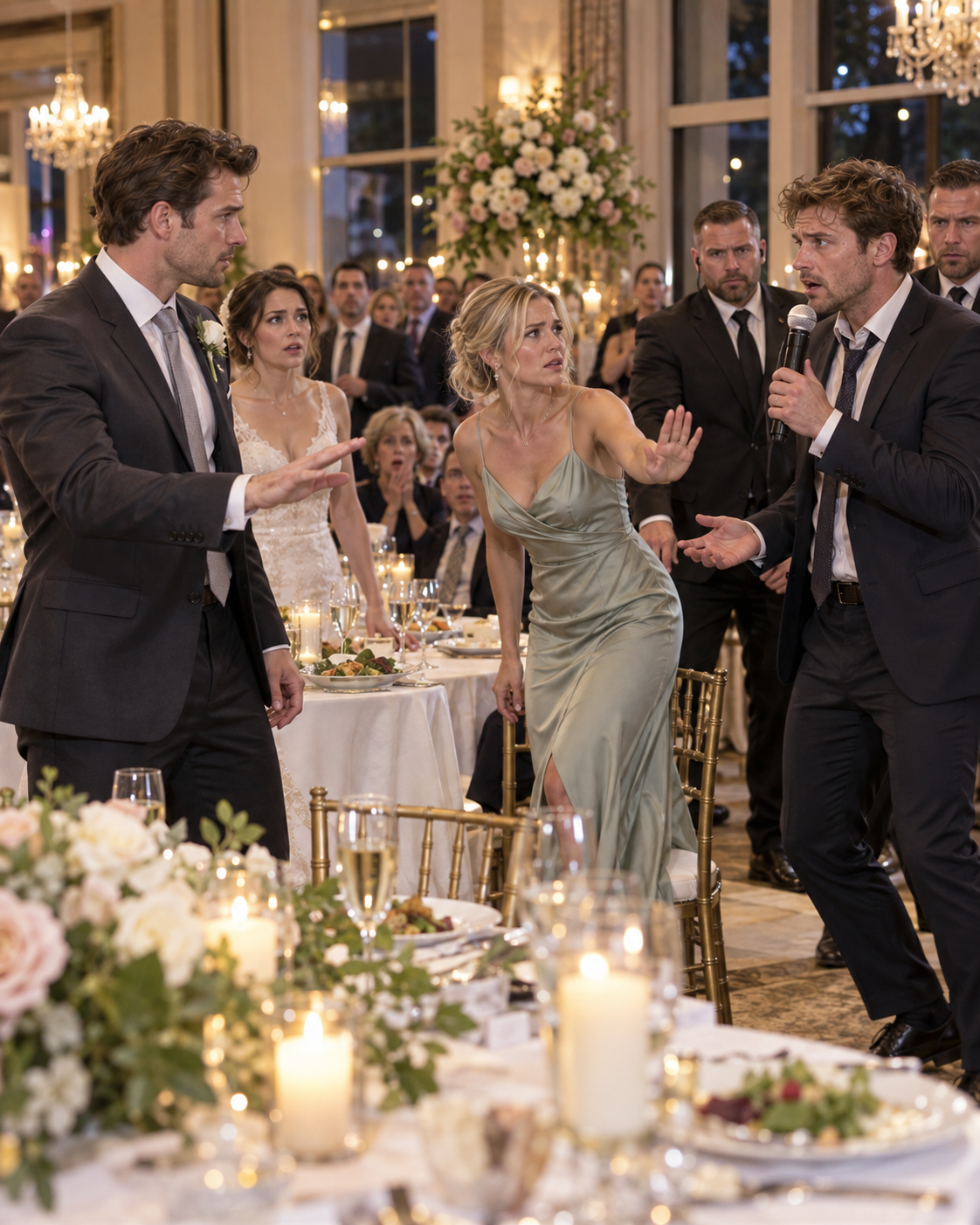
Caleb stood.
Security moved.
He pushed past the first guard.
The room quieted.
He grabbed the microphone before anyone could stop him.
Chloe froze at her table.
Caleb smiled.
“I know this isn’t technically scheduled—”
I walked toward him.
“Caleb.”
He ignored me.
“Chloe, we’ve been through a lot—”
I took the second microphone from the DJ.
“This isn’t an open mic night.”
A few people laughed nervously.
Caleb’s face reddened.
“Just give me five minutes.”
“No.”
He stared at me.
“You’re really doing this?”
“Yes.”
Chloe stood.
Everyone turned toward her.
She looked terrified.
Then something changed in her face.
She walked toward Caleb.
Not quickly.
Not dramatically.
Just steadily.
She stopped several feet away.
“I told you I didn’t want you to do this.”
Caleb lowered the microphone.
“Chloe—”
“I told you in the car.”
“I thought you were nervous.”
“I said no.”
His face collapsed.
The room went silent.
Chloe looked at the guests.
Then back at him.
“I don’t want to be your proposal story.”
She handed him the ring he’d apparently been carrying.
“I want to go home.”
She walked out.
Her sister followed her.
Caleb stood alone with the microphone.
Security escorted him outside.
Agnes began shouting.
She called me cruel.
She called Chloe ungrateful.
She accused Maya of poisoning me against my family.
One of the guards asked her to leave.
She refused.
So they walked her out too.
Then the doors closed.
For several seconds, nobody moved.
Maya came to me.
“You okay?”
I looked around at the flowers, the half-empty champagne glasses, the people who had just witnessed my family fracture in public.
“No,” I said.
She took my hand.
“But I’m here.”
That was enough.
We danced.
We laughed.
We stayed until the last guest left.
The next morning, I woke up to nineteen missed calls.
Caleb had been arrested.
He had driven drunk after leaving the reception, run a red light, and struck another car.
A woman and her six-year-old daughter were injured.
The woman suffered a broken wrist.
The little girl had a concussion and a fractured collarbone.
Caleb hadn’t stayed.
He’d driven to a service station and hidden behind the building until police found him.
Mom called me crying.
“He’s scared.”
I sat on the edge of our bed.
“So am I.”
“You have to help him.”
“With what?”
“Bail.”
I closed my eyes.
“Mom, no.”
“He’s your brother.”
“He injured a child.”
“It was an accident.”
“He was drunk.”
“He didn’t mean for it to happen.”
“That doesn’t erase what he did.”
Her voice broke.
“Please. I’ll lose everything.”
I thought of the mortgage.
The $43,000.
The wedding.
The messages.
The years.
“What do you want me to do?”
“Pay his bail. Get him a lawyer. Please.”
I whispered, “No.”
She stopped crying.
“How can you say that?”
“Because someone needs to stop pretending consequences are cruelty.”
She hung up.
Maeve called an hour later.
“Are you ready?”
“For what?”
“To tell the family the truth.”
She had compiled everything.
Bank statements.
Mortgage transfers.
The police report.
The arrest record.
Caleb’s messages.
The wedding incident.
The financial records showing how much Maeve and I had paid.
She wanted to send it to everyone.
I hesitated.
Not because it wasn’t true.
Because once it was out, there would be no taking it back.
“What if Mom never forgives us?”
Maeve was quiet.
Then she said, “What if we spend another ten years trying to earn forgiveness for refusing to ruin ourselves?”
I had no answer.
So I told her to send it.
She did.
The family group chat exploded.
Agnes called us liars.
An aunt asked why we’d humiliated Mom.
A cousin sent a private message saying he had always suspected Caleb was being protected.
Then an uncle forwarded an old email from Caleb asking him for money.
Another relative admitted Mom had called her years earlier to “smooth over” one of Caleb’s debts.
The story we’d grown up inside began unraveling.
Not because Maeve and I invented a new version.
Because people finally compared notes.
The police report was blunt.
Caleb had been intoxicated.
He had fled.
He had been found hiding.
There was no ambiguity about that.
The injured mother eventually released a statement through her attorney asking people to stop harassing her family.
That shut down the last of the online speculation.
There was nothing left to debate.
Caleb had made a terrible decision.
Two innocent people paid for it.
And this time, nobody could turn the consequence into a family fundraiser.
Our parents sold the house six months later.
The market had shifted, and because of the debts attached to it, they took a crushing loss.
I expected to feel vindicated.
I didn’t.
I felt sad.
That house had been my childhood.
The kitchen where Maeve and I made boxed macaroni.
The hallway where Caleb had ridden a skateboard indoors and knocked over a lamp.
The bedroom where Mom used to braid my hair before school.
All of it was gone.
But so was the obligation.
Caleb accepted a plea deal.
Eighteen months in county jail, followed by probation and restitution requirements.
He wrote me one letter.
I didn’t answer.
He wrote Maeve two.
She answered once.
“Take responsibility for what happened,” she wrote. “Not for what everyone else did before you.”
Months passed.
One rainy afternoon, Mom asked if I’d meet her for coffee.
I almost said no.
Instead, I went.
She looked smaller than I remembered.
Not physically.
Something else.
Without Agnes beside her, without Caleb demanding attention, without a house to rescue, she seemed unsure where to put her hands.
“I failed you,” she said.
I didn’t rescue her from the sentence.
She continued.
“I thought keeping Caleb safe was the same as being a good mother.”
I stared into my coffee.
“I thought if I loved him enough, he’d become responsible.”
She wiped her eyes.
“And when you and Maeve became capable, I mistook that for proof you didn’t need me.”
That hurt.
Because it was probably the first completely honest thing she’d ever said about us.
“I needed you,” I told her.
She nodded.
“I know that now.”
There was no dramatic reconciliation.
No perfect speech.
She paid for her coffee.
I paid for mine.
Before we left, she asked whether I’d ever forgive her.
“I don’t know,” I said.
She nodded again.
“That’s fair.”
It was the first time my mother had allowed me to give an answer she couldn’t control.
Dad came to our new house a few weeks later.
Maya had bought a ridiculous welcome mat.
Maeve said it looked like something from a beach rental.
Dad laughed when he saw it.
Then he walked into the kitchen and stood there silently.
“I should have defended you,” he said.
I didn’t ask which moment he meant.
There were too many.
“The mortgage.”
“The wedding.”
“Caleb.”
He nodded.
“All of it.”
He looked around the house.
“You built this without me.”
I smiled faintly.
“With Maya.”
“Right.”
He swallowed.
“I am proud of you.”
For years, I had wanted those words so badly that I thought hearing them would fix something.
They didn’t.
But they mattered.
I hugged him anyway.
Maeve and I still talk almost every day.
Sometimes about serious things.
Sometimes about nothing.
She sends me photographs from the clinic.
I send her ridiculous claims stories from work.
We don’t discuss Caleb every time his name comes up.
That’s another thing I learned.
Leaving a family pattern doesn’t mean pretending the family never existed.
It means refusing to let it dictate every decision afterward.
Caleb eventually came home.
I heard through Dad.
He had a job lined up.
He had restitution payments.
He was attending counseling.
Whether any of that lasted was no longer something I needed to monitor.
That was his work.
Not mine.
Our wedding photograph hangs above the fireplace now.
Maya and I are standing beneath a string of warm lights, laughing at something outside the frame.
Maeve is beside us.
Grandpa Arthur is behind us, one hand resting on Maeve’s shoulder.
There is no Caleb in the picture.
No Agnes.
No parents.
Just the people who were actually there when the moment mattered.
Sometimes I still think about that microphone.
For years, I believed Caleb taking the center of the room meant he had won something.
Now I understand that the most important thing I did that night wasn’t taking the microphone away from him.
It was handing it back to the person whose voice had been ignored.
Chloe said no.
Maeve said no.
Maya said no.
Eventually, I learned how to say it too.
And somewhere between the canceled mortgage payment and the little house we bought with the money we’d finally stopped giving away, I discovered that becoming invisible had never made me kind.
It had only made me available.
These days, when I walk through our front door after work, Maya usually calls from the kitchen, “How was your day?”
And I answer honestly.
Sometimes it’s good.
Sometimes it’s awful.
Sometimes I don’t know yet.
But the answer belongs to me.
For the first time in my life, nobody is waiting behind it for me to make their life easier.
And that quiet, ordinary freedom turned out to be worth far more than the $43,000 we spent trying to keep a house standing.