Outside courtroom 4B, my father-in-law laughed at my cheap briefcase and asked where my lawyer was
The question followed me all the way home.
What had Marcus known?
I didn’t say it aloud in the car because Liam was driving, and I could see the tension in his jaw.
For the first time since we had married, neither of us spoke.
The courthouse had taken only a few hours, but it felt like we had stepped out of one life and into another.
Liam finally broke the silence.
“You knew the judge.”
“Yes.”
“You were a JAG prosecutor.”
“Yes.”
“And your father knows none of this?”
I looked out the window at the passing trees.
“He knew I worked in the military.”
“That’s not what I asked.”
I sighed.
“No, he didn’t know.”
Liam pulled into our driveway and turned off the engine.
He didn’t move.
Neither did I.
“I wish you’d told me.”
That hurt more than I expected.
“I wasn’t hiding it from you.”
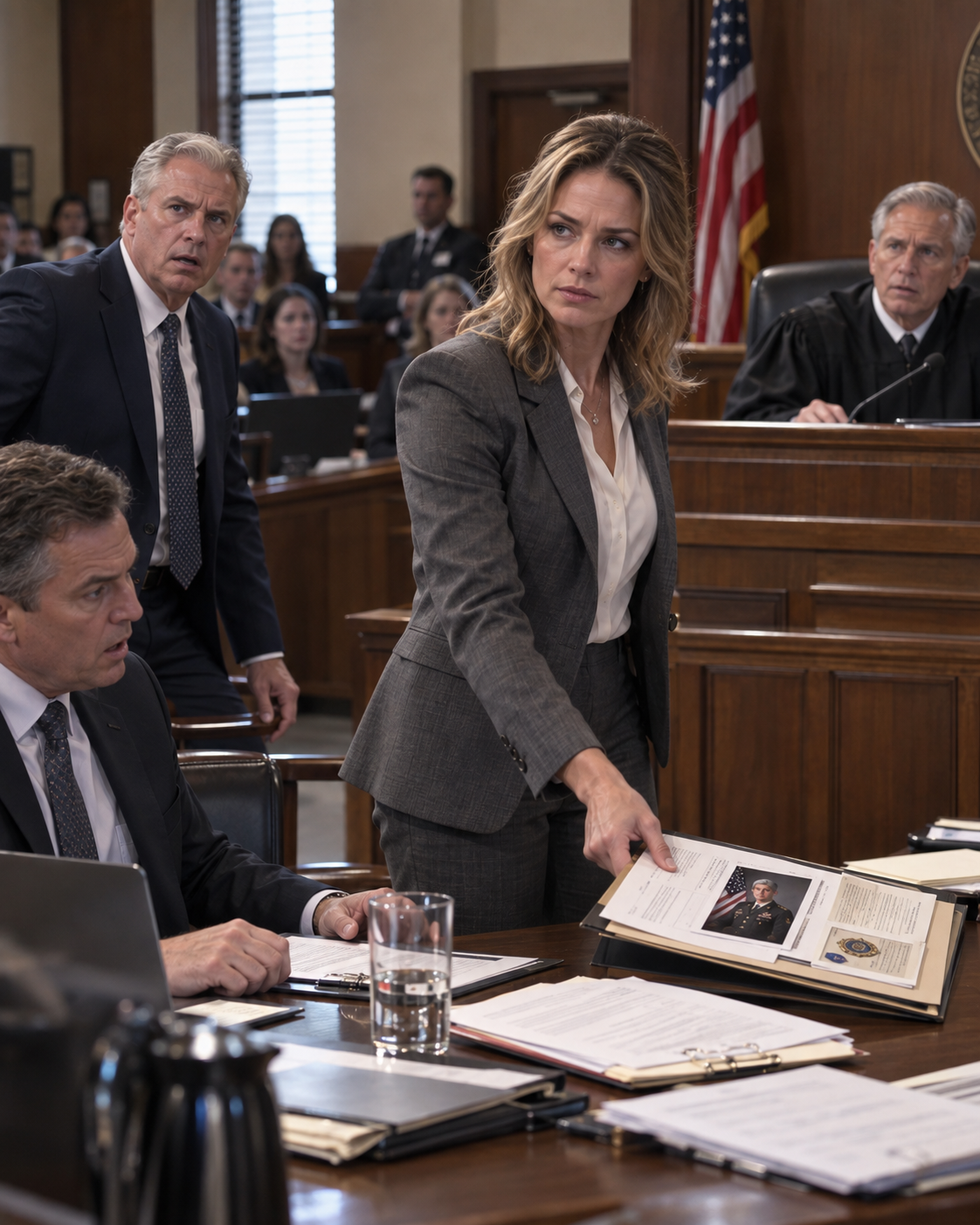
“Then what were you doing?”
I thought about it.
“Trying to have one part of my life that wasn’t a title, a courtroom, or a uniform.”
His expression softened.
“I understand.”
Then he looked at me.
“But I need to understand everything now.”
I nodded.
“Then we start tonight.”
We sat at the kitchen table until after midnight.
I told him about military courtrooms, deployments, long nights preparing cases, and the pressure of standing in front of people whose futures could change with a verdict.
I told him why I had left.
I wanted a life where nobody introduced me by rank before they introduced me by name.
I wanted mornings with coffee.
I wanted weekends that belonged to me.
I wanted to marry a man who loved Evelyn, not Captain Reed.
Liam listened quietly.
When I finished, he reached across the table.
“I loved you before I knew any of that.”
“I know.”
“Now I just understand you better.”
I smiled.
But the next morning, the phone rang.
It was Judge Harrison’s clerk.
They had found something else in the case file.
A supplemental exhibit had been accidentally attached to the original filing.
The document was old.
Very old.
It was a private memorandum from one of Marcus’s former business associates.
The memorandum mentioned my grandmother by name.
And beside her name was a date.
The date was eight months before her death.
I read it twice.
Then a third time.
The memorandum described a proposed acquisition of her property and included a sentence that made my stomach turn.
“Vance intends to secure control upon inheritance.”
I called Liam.
“Come home.”
He knew from my voice that something was wrong.
When he arrived, I placed the document on the table.
His face changed.
“That’s before your grandmother died.”
“Exactly.”
“How did your father know you’d inherit?”
“He didn’t.”
“Then why was he preparing?”
I didn’t have an answer.
We spent the afternoon reconstructing the timeline.
My grandmother had refused every development proposal she received.
She had been fiercely protective of the coastline.
She once told me that people didn’t see land anymore.
They saw numbers.
That was why she had spent years fighting developers who wanted to build hotels, private homes, and marinas along the cliffs.
She knew Marcus.
She had met him twice.
Apparently, that had been enough.
My grandmother had written me a letter shortly before she died.
I had kept it in a wooden box.
I had never opened it because she told me to read it only when I was ready to understand what she was leaving behind.
That night, I finally opened it.
Her handwriting was shaky.
“Evelyn, if you’re reading this, the land is yours.”
I stopped.
Liam sat beside me.
I continued.
“Do not sell it because someone makes you afraid.”
My eyes burned.
“People have approached me again, and one of them has become increasingly aggressive.”
I looked at Liam.
“She knew.”
The letter continued.
“I have kept records of every offer, every threat, and every strange visit.”
Then came the sentence that changed everything.
“If Marcus Vance contacts you after my death, do not meet him alone.”
For a long moment, neither of us spoke.
Liam stood up.
“I need to call my father.”
“No.”
He turned.
“What?”
“Not yet.”
I had learned long ago that emotion was a poor substitute for evidence.
“We need to know exactly what he did.”
So we hired a forensic investigator.
Not because I wanted revenge.
Because I wanted the truth.
Over the next several weeks, the investigation uncovered a web of transactions that made the lawsuit look almost insignificant.
Marcus’s firm had created a shell company.
The shell company had purchased an alleged debt tied to my grandmother’s property.
Then someone had attempted to create a fraudulent lien using documents that appeared legitimate at first glance.
The plan was simple.
Make me believe the property was legally compromised.
Offer me an easy way out.
Transfer the land to Marcus’s firm.
Walk away.
What Marcus hadn’t anticipated was that my grandmother had kept copies of everything.
Receipts.
Letters.
Emails.
Property records.
Even handwritten notes about conversations with developers.
She had built her own archive because she didn’t trust people who spoke too smoothly.
The investigator found one more thing.
A payment from Marcus’s firm to a document-processing company.
The payment had been made two days before the fraudulent lien appeared.
We sent everything to the district attorney.
Then we waited.
Marcus didn’t call.
He sent lawyers.
Three different attorneys contacted us over six weeks.
Each offered some version of the same message.
Settlement.
Confidentiality.
No admission of wrongdoing.
I rejected every proposal.
Then Marcus finally called me himself.
His voice sounded different.
Less arrogant.
More tired.
“You’ve made your point.”
“No, Marcus.”
I stared through the window.
“The evidence made the point.”
“You don’t understand what this investigation will do to my employees.”
“You should have thought about that before forging documents.”
He went silent.
Then he said something I never expected.
“Your grandmother ruined my first development deal.”
I closed my eyes.
“There it is.”
“What?”
“The reason.”
He laughed bitterly.
“You think this was about greed?”
“I think greed was part of it.”
“You have no idea how much money she cost me.”
“That doesn’t justify what you did.”
“You weren’t there.”
“No.”
My voice stayed calm.
“But I was there when you tried to steal the property.”
He hung up.
Three weeks later, investigators executed search warrants at Vance Coastal Development.
News crews gathered outside the building.
Employees walked out carrying boxes.
Banks froze several accounts connected to the investigation.
Marcus was not arrested that day.
But the illusion of invincibility was gone.
For years, he had built his identity around being the man who could make problems disappear.
Now his own paperwork was creating problems he couldn’t buy away.
Liam struggled with it more than I did.
That’s the part people don’t understand about betrayal inside a family.
You can be furious with someone and still love them.
You can know they did something unforgivable and still remember teaching them how to ride a bike.
Liam told me one night that he hadn’t spoken to his father in two months.
“I feel guilty.”
“You didn’t do this.”
“I know.”
“But?”
He looked down.
“But he’s still my dad.”
I reached for his hand.
“Then grieve the father you thought you had.”
His eyes filled with tears.
“You make that sound easy.”
“It isn’t.”
I squeezed his hand.
“You don’t owe anyone forgiveness before you’re ready.”
Eventually, Marcus requested a private meeting.
I almost refused.
Then I agreed, but only in the presence of counsel.
He arrived looking twenty years older.
No expensive suit.
No confident smile.
Just a tired man carrying a folder.
He placed it on the table.
“I found this in my personal files.”
I opened it.
Inside was a photograph of my grandmother standing beside the coastline.
Behind the photograph was a handwritten note.
Marcus watched my face.
“She sent that to me years ago.”
“What did she say?”
He swallowed.
“She said I could make all the money in the world and still never own what mattered.”
I looked at him.
“Why didn’t you listen?”
His eyes dropped.
“Because I thought she was wrong.”
For the first time, Marcus looked less like an enemy and more like a man confronting the wreckage he had created.
“I thought if I controlled the land, I’d prove she had underestimated me.”
“You didn’t want the land.”
He looked up.
“You wanted to defeat her.”
He said nothing.
That silence was an answer.
The criminal investigation continued.
Victor Cross eventually faced disciplinary proceedings, and the sanctions from the civil case were only the beginning of his professional problems.
Marcus’s company lost major contracts.
Several partners distanced themselves.
People who had spent years laughing at his jokes suddenly stopped returning his calls.
Power is strange that way.
When people think you have it, everyone wants to stand beside you.
When they realize you don’t, they suddenly remember they have somewhere else to be.
Through all of it, Liam and I kept the property.
But we didn’t build a mansion there.
We didn’t sell it.
We didn’t turn it into a luxury resort.
We created something my grandmother would have recognized.
A protected ecological conservancy.
The cliffs remained untouched.
The wetlands stayed wild.
Sea birds returned to areas where developers had once planned roads.
We opened parts of the property for controlled conservation research and local educational programs.
On the first anniversary of the court hearing, Liam and I stood near the water at sunset.
He held the original deed.
I held my grandmother’s letter.
“I think she’d be proud,” he said.
I looked across the ocean.
“I think she’d tell us not to get sentimental.”
He laughed.
“Definitely.”
The wind moved through the grass.
For a while, we simply stood there.
Then Liam said, “Do you ever wonder what would have happened if you hadn’t been a lawyer?”
I thought about the question.
“All the time.”
“What do you think?”
“I think I would still have fought.”
He smiled.
“That’s my wife.”
I shook my head.
“No.”
He looked at me.
“That’s my grandmother’s granddaughter.”
We both laughed.
Years later, I realized the courtroom had never really been the most important part of the story.
The judge recognizing me was satisfying.
Watching Marcus lose his arrogance was satisfying.
Seeing the fraudulent lawsuit dismissed was satisfying.
But none of those things were the victory.
The victory was refusing to become cruel simply because someone had treated me cruelly.
I could have used my experience to humiliate Marcus.
Instead, I used it to protect what my grandmother had entrusted to me.
That distinction mattered.
Because power without discipline becomes another form of arrogance.
My grandmother understood that.
She never needed a title.
She never needed a courtroom.
She simply knew what was hers to protect.
And she taught me that sometimes the strongest person in the room is the one who doesn’t need everyone else to know it.
Marcus had spent four years assuming silence meant weakness.
He had mistaken kindness for ignorance.
He had mistaken a quiet wife for an incapable woman.
And eventually, he learned that the people you underestimate can be the people who remember every detail.
There was one final surprise, though.
Months after the criminal investigation began, the district attorney contacted us again.
There was another name appearing repeatedly in the financial records.
Someone outside Marcus’s company.
Someone who had helped arrange several meetings with developers before my grandmother died.
Someone whose identity had never appeared in the original lawsuit.
The investigator wouldn’t tell me much over the phone.
He only said, “Captain Reed, you may want your attorney present when you see the next file.”
I remember standing there in my office, staring at the ocean beyond the window.
For a moment, the old instinct returned.
The same cold focus.
The same feeling I had before walking into courtroom 4B.
Another hidden door.
Another truth waiting behind it.
I closed my grandmother’s letter and placed it back inside its wooden box.
Then I looked at Liam.
He knew immediately.
“Something else?”
I nodded.
“Something else.”
He took my hand.
Whatever waited inside that file, I knew one thing now.
We would face it together.
Because the greatest inheritance my grandmother left me wasn’t twenty acres of coastline.
It wasn’t the deed.
It wasn’t even the evidence that saved the property.
It was the understanding that a life built on quiet discipline can withstand storms that arrogance never sees coming.
And somewhere beneath the sound of the waves, I could almost hear her voice again, reminding me that land remembers every footprint.
So do people.
And apparently, so did one more person whose name was about to change everything.