On my eighteenth birthday, my mother handed me a one-way plane ticket and said, without looking at me
The heater in Martha’s truck rattled like a handful of coins in a tin can. I sat with my hands tucked beneath my thighs, staring through the windshield at the dark Vermont woods sliding past us.
Neither of us spoke for several miles.
Finally, I asked, “What did you mean when you said my mother never told me something?”
Martha kept both hands on the wheel.
“I think Arthur should tell you.”
“Who is Arthur?”
“Your grandfather.”
“You already said that.”
“I know.”
“Then why have I never heard of him?”
She took a breath.
“Because he wasn’t allowed to be part of your life.”
There was something about the phrase that made my chest tighten.
“By whom?”
Martha didn’t answer immediately.
Then she said, “By your mother.”
The truck turned onto a narrow road lined with maples stripped nearly bare by November. The farther we drove, the quieter everything became. No traffic. No stores. Just old barns, stone walls, and houses set back behind fields.
I pressed my forehead against the cold window.
My mother had never mentioned Vermont.
She had never mentioned a grandfather.
She had never mentioned anyone named Arthur.
And yet Martha knew my first name.
She knew my birthday.
She had been waiting at the airport.
“How did you know what flight I was on?”
Martha’s fingers tightened slightly around the steering wheel.
“Because Arthur was told.”
“By whom?”
“A lawyer.”
That answer made no sense.
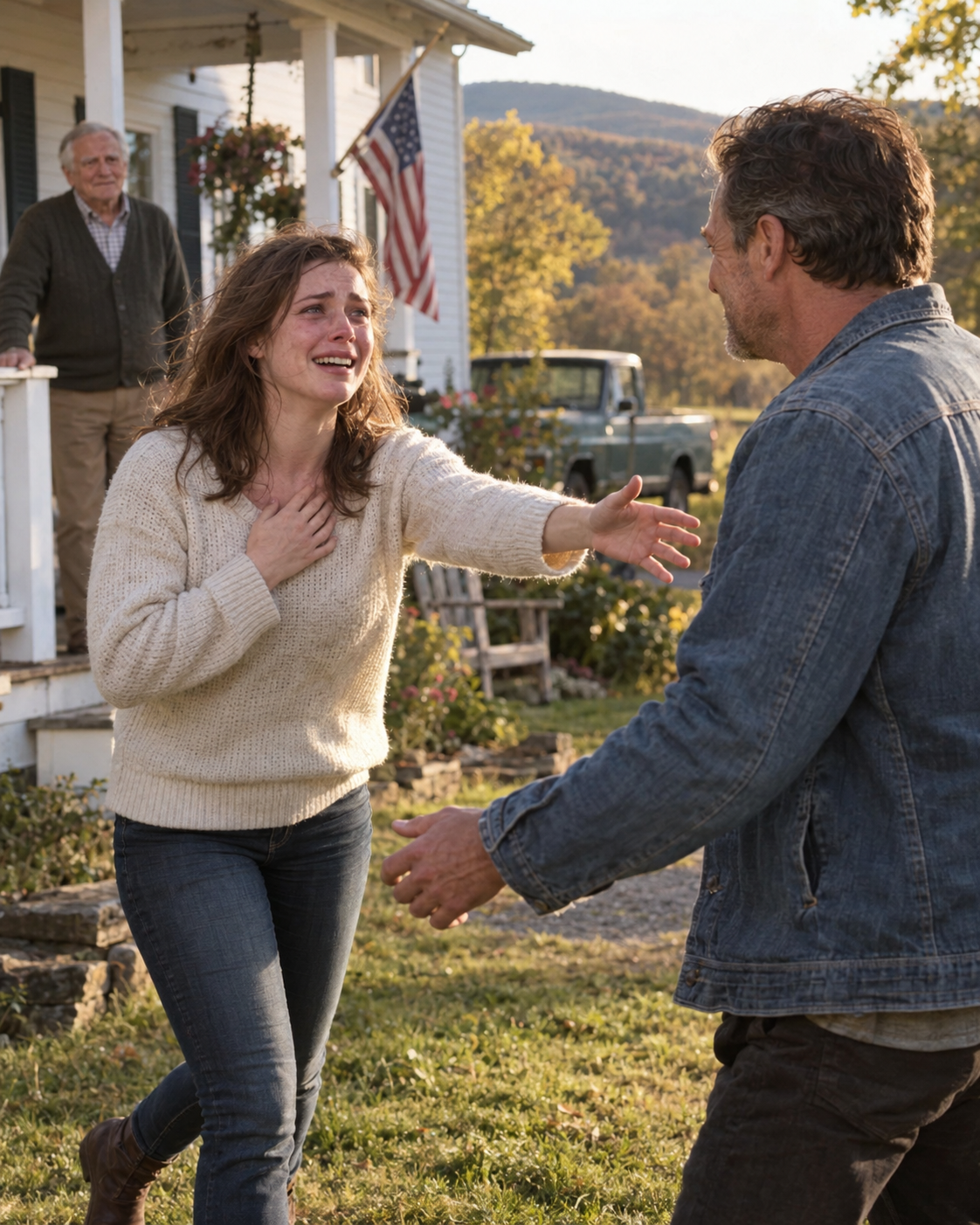
I almost asked another question, but we rounded a bend and the house appeared.
It was white with dark green shutters, modest and beautifully kept, with a wraparound porch and a porch swing hanging beneath two old lanterns.
An elderly man stood waiting beside the front door.
He wore a navy cardigan over a white shirt. His silver hair was thin, and he held one hand against his chest as if steadying himself.
When Martha parked, he didn’t come down the steps.
He simply waited.
I opened the door.
The man looked at me.
His eyes filled with tears.
“Clara,” he whispered.
Nobody had ever said my name that way.
Not like they had been carrying it for years.
I stood frozen beside the truck.
He took one slow step forward.
“I’ve imagined this moment so many times that I was afraid I’d ruin it.”
My throat tightened.
“Who are you?”
He smiled sadly.
“I’m Arthur Vance.”
My grandfather.
The word still felt borrowed.
He gestured toward the house.
“Come inside. You’re freezing.”
I followed him because I didn’t know what else to do.
Inside smelled like cedar, cinnamon, and old books. There was a stone fireplace in the living room, family photographs along the mantel, and a quilt folded over the back of an armchair.
I stopped in front of one photograph.
A young woman stood beside a teenage boy in front of what looked like the same house.
The girl had my mother’s face.
But the boy was a stranger.
Arthur noticed me staring.
“That was your mother,” he said.
“When?”
“She was nineteen.”
I looked at him.
“And the boy?”
Arthur sat down slowly.
“Julian Mercer.”
The name meant nothing.
“Who was he?”
Arthur’s eyes dropped to his hands.
“Your father.”
I laughed once.
Not because it was funny.
Because my mind didn’t know what else to do with the sentence.
“No.”
Arthur didn’t correct me.
“My mother told me my biological father was dead.”
His expression changed.
“She told you that?”
“Yes.”
“She was wrong.”
I sat down.
For a moment, neither of us spoke.
Then Arthur began telling me the story of the person I had apparently been before I became the daughter of Daniel and Margaret Vance.
My mother had grown up in Mil Haven.
Julian Mercer had been her childhood sweetheart. They had known each other since they were children, gone to the same high school, worked summer jobs together, and planned to leave Vermont eventually.
Then my mother became pregnant.
She was nineteen.
Julian was twenty.
Arthur had been furious at first—not because of Julian, but because he was frightened. He remembered his daughter crying at the kitchen table, insisting she could raise me.
According to him, Julian never hesitated.
“I’ll work,” he’d said. “We’ll figure it out.”
They were poor, young, and terrified.
But they loved each other.
Then Daniel entered my mother’s life.
He was older, wealthy, and living in Boston. He offered my mother something Julian couldn’t: security.
A house.
A future.
A promise that she would never struggle.
There was only one condition.
Julian had to disappear.
And so did Arthur.
I sat quietly as my grandfather explained that my mother had eventually agreed.
When I was three months old, she married Daniel.
A legal agreement followed.
There would be no contact with Julian.
No contact with Arthur.
No mention of Mil Haven.
No explanation of where I had come from.
“Why would she agree to that?” I asked.
Arthur’s face tightened.
“Because she was nineteen.”
It was the first time he defended her.
“She was scared. She made a decision she spent years pretending wasn’t a decision.”
I stared at the fire.
“What about me?”
Arthur looked toward a wooden chest beside the fireplace.
“I never stopped writing to you.”
He opened it.
Inside were envelopes.
Dozens of them.
Thirty-seven, he told me.
Each one had my name on it.
Some were yellowed at the edges.
Some were sealed.
One had a child’s birthday sticker on the corner.
I picked it up.
The handwriting was careful and old-fashioned.
Clara.
My hands began shaking.
“You wrote these?”
“Every year.”
“Why didn’t you send them?”
“Because I was told I’d lose any legal opportunity to see you if I tried.”
I looked at the pile.
Thirty-seven letters.
One for every birthday he had expected to share with me.
I couldn’t speak.
Then I noticed something.
The most recent envelope wasn’t old.
It had been written only two weeks earlier.
I looked up.
“Why now?”
Arthur hesitated.
“Because you’re eighteen.”
He closed the chest.
“You’re legally an adult. Julian and I wanted to give you the truth before anyone else could decide what you were allowed to know.”
“Julian.”
I hadn’t expected the name to hurt.
“Where is he?”
Arthur looked at me.
“About forty minutes from here.”
My heart began beating faster.
“You mean he’s alive?”
“Yes.”
“And he knows I’m here?”
“He knows you’re here.”
I stood abruptly.
“Does he want to see me?”
Arthur’s eyes filled again.
“He has wanted to see you for eighteen years.”
I walked to the window.
Outside, the yard was covered in pale frost.
I imagined a man somewhere in Vermont who had spent half his life wondering what kind of person his daughter had become.
“What if he doesn’t like me?”
Arthur stared at me in disbelief.
“Clara.”
I laughed through my tears.
“I don’t know him.”
“He knows that.”
“And what if I disappoint him?”
“He isn’t waiting for a perfect daughter.”
I turned around.
“What is he waiting for?”
Arthur answered quietly.
“You.”
That night, I slept in a guest room with a handmade quilt tucked beneath my chin.
I didn’t sleep much.
Every few hours I woke and remembered another piece of my life had apparently been built on a story that wasn’t true.
At six in the morning, I found myself standing in the kitchen making coffee with Martha.
She didn’t ask how I felt.
I was grateful.
Instead, she said, “Arthur snores.”
I laughed.
It surprised me how good it felt.
“He does?”
“Like a tractor trying to start in January.”
That was the first ordinary thing anyone had said to me since I arrived.
And somehow, it helped.
Over breakfast, Arthur gave me the first birthday letter.
I didn’t open it.
Not yet.
I carried it upstairs and placed it beside the bed.
For the next two days, I wandered through the house.
I learned which floorboards creaked. I found an old piano in the parlor. I discovered that Arthur kept peppermint candies in every drawer because, according to Martha, he had the soul of an eighty-year-old pharmacist even before he became one.
I also learned that my mother had once loved this place.
There were photographs of her everywhere.
Not the woman I knew.
A girl.
Barefoot in summer grass.
Laughing beside Julian.
Holding a fishing rod.
Sitting on the porch with Arthur.
She looked happy.
That was the hardest part.
Because I had spent eighteen years believing she had simply been cold.
Now I had to consider something more complicated.
Maybe she had once been warm.
Maybe fear had taught her how to hide it.
On the fourth morning, Arthur asked if I wanted to meet Julian.
I almost said no.
Then I remembered the airport.
The one-way ticket.
The empty space in my mother’s car after she drove away.
“Yes,” I said.
Arthur nodded.
“He’ll come here.”
I spent an hour pretending I wasn’t nervous.
Then a dark blue pickup appeared at the end of the driveway.
A man stepped out.
He was fifty-six.
Tall.
Gray at the temples.
Wearing a work jacket and muddy boots.
He stood beside the truck for several seconds before walking toward the house.
When he saw me on the porch, he stopped.
Neither of us moved.
I had expected some dramatic recognition.
I didn’t get it.
He looked at my face.
Then at my hands.
Then back at my face.
His eyes filled.
“Hi, Clara.”
My voice barely worked.
“Hi.”
He smiled.
“You look like your grandmother.”
I didn’t know whether to laugh or cry.
“I never met her.”
“I know.”
He looked down.
“I missed a lot.”
The sentence broke something open inside me.
I stepped off the porch.
He didn’t reach for me.
He waited.
That mattered.
I walked toward him.
When I was close enough, I said, “Why didn’t you find me?”
His face tightened.
“I tried.”
Arthur came outside behind me.
Julian continued.
“Private investigators. Lawyers. Records. I spent years looking for a way that wouldn’t make your mother fear losing you.”
“Did you stop?”
“No.”
“Why?”
He swallowed.
“Because stopping would have meant accepting that I had abandoned you.”
I stared at him.
“You didn’t.”
His eyes met mine.
“I wasn’t there.”
“You didn’t choose that.”
“I still wasn’t there.”
There was no argument I could make against that.
So I stepped forward and hugged him.
He froze.
Then his arms came around me.
He held me like someone holding something fragile, not like someone claiming something that belonged to him.
For several minutes, neither of us spoke.
When we finally separated, he wiped his face with the heel of his hand.
“I brought something.”
From his truck, he retrieved a small cardboard box.
Inside was a faded yellow baby blanket.
“I made this with my mother,” he said.
“She never got to give it to you.”
I touched the blanket.
The fabric was worn soft from years of being handled.
And suddenly I was angry.
Not at him.
Not even at my mother.
At time.
At all the ordinary mornings we had lost.
At birthdays.
At school concerts.
At scraped knees.
At every moment when I had needed someone and never understood why nobody came.
That afternoon, Julian stayed for lunch.
Then dinner.
He told me about his work repairing farm equipment. He told me about the diner he still visited every Thursday. He showed me photographs of a dog named Hank who had died three years earlier.
It wasn’t a grand reunion.
It was awkward.
Funny.
Painful.
Real.
And that made it more meaningful than anything I had imagined.
But on the sixth day, I found another letter.
It wasn’t from Arthur.
It was from my mother.
It was tucked inside the wooden chest beneath the birthday envelopes.
The handwriting was unmistakable.
My hands went cold.
Arthur hadn’t hidden it from me.
He hadn’t known it was there.
The letter was addressed to him.
I read it standing beside the fireplace.
It was dated seven years earlier.
My mother had written that she regretted what she’d done.
She wrote that Daniel’s conditions had grown stricter over the years and that she had become afraid he would discover she’d kept any connection to her old life.
She wrote that she had once driven past Arthur’s house.
She had parked across the road.
She had watched the porch light for twenty minutes.
Then she had driven away.
But the final paragraph changed everything.
She wrote that she had never told Daniel the full truth about me.
He knew I was adopted.
He knew Julian was my biological father.
But he did not know Arthur had continued writing.
And, according to her, there was something else she had been too ashamed to admit.
I read the sentence twice.
Then a third time.
My mother wrote:
I did not send Clara away because I stopped loving her. I sent her away because Daniel finally found out that she was entitled to know about the Mercer family, and he told me he would make sure she received nothing from me if I let her stay.
I sat down hard.
Arthur came into the room.
“What is it?”
I handed him the letter.
He read it.
His face changed.
“Daniel knew?”
“Apparently.”
Arthur lowered himself into the chair opposite me.
“Then why would your mother send you here?”
“I don’t know.”
He looked at the final page.
“There may be another letter.”
We searched the chest.
Nothing.
Then Martha came in carrying a basket of laundry.
She saw our faces.
“What happened?”
Arthur handed her the letter.
She read it silently.
Then she sat down.
“There’s something neither of you knows.”
The room went still.
Martha folded the letter carefully.
“Your mother called me three months ago.”
My heart stopped.
“What?”
“She asked whether Arthur was still willing to meet you.”
Arthur stared at her.
“Why didn’t you tell me?”
“She asked me not to.”
“Why?”
Martha looked at me.
“Because she said she was afraid Daniel would follow you.”
The words didn’t make sense.
“Follow me where?”
“Here.”
A chill moved through me.
I thought about the airport.
The ticket.
The way Daniel had avoided my eyes.
The strange precision of the arrangement.
My mother hadn’t simply dumped me somewhere.
She had sent me to the only place where someone could legally and safely tell me the truth.
Maybe the cruelty had been deliberate.
Maybe it had been the only form of protection she believed she had left.
Or maybe I was desperate to believe that because the alternative was too painful.
That night, I called my mother.
She answered on the third ring.
For several seconds, neither of us spoke.
Then she said, “You’re with Arthur.”
“Yes.”
Her breath caught.
“Are you safe?”
The question angered me.
“Was I ever?”
Silence.
Then, very quietly, she said, “No.”
I closed my eyes.
“Why didn’t you tell me?”
“Because every time I tried, I got scared.”
“You let me think you hated me.”
“I know.”
“You let Daniel treat me like I was something he had bought.”
“I know.”
“Why the ticket?”
Her voice broke.
“Because he found the letters.”
I stopped breathing.
“What letters?”
“Your grandfather’s.”
I looked toward the wooden chest.
My mother continued.
“He found one of them hidden in my closet. He told me if I contacted Arthur, he’d cut you off completely. He said he would make sure you left with nothing.”
“Then why send me here?”
“Because you were eighteen.”
She began crying.
“And because I couldn’t keep choosing fear for you.”
I sat in the dark kitchen, listening to the woman who had been my mother for eighteen years cry on the other end of the phone.
I wanted to forgive her.
I wanted to hate her.
I wanted her to give me one clean explanation that would make everything fit.
She couldn’t.
Neither could I.
Finally, I asked, “Did you ever love me?”
She answered immediately.
“Yes.”
That hurt more than if she had hesitated.
“I loved you before I knew how to love myself,” she whispered. “And then I spent eighteen years proving that love without courage can still destroy a person.”
I cried after we hung up.
Julian found me.
He didn’t ask what happened.
He simply sat beside me.
After a while, he said, “You don’t have to decide what you feel about her tonight.”
“I don’t know what I feel.”
“You don’t have to.”
I leaned my head against his shoulder.
It was strange how quickly a stranger could become familiar when you discovered you had been missing him your entire life.
Over the next several weeks, I stayed in Mil Haven.
Two weeks became a month.
A month became a season.
I finished my first semester of community college remotely and found a part-time job at the local bookstore.
Arthur taught me how to split kindling.
Julian taught me how to change a tire.
Martha taught me to make apple pie without measuring anything.
I began opening the birthday letters.
Some were only a page.
Others were several.
Arthur wrote about weather, family stories, books he thought I might like, and tiny things no one had ever thought to record about me.
In one letter, he wrote that he hoped I would become someone who knew she was worth waiting for.
I hated that sentence at first.
Then I kept it.
My mother and I spoke occasionally.
The conversations were difficult.
Sometimes we went weeks without talking.
I eventually learned that forgiveness wasn’t something I owed her simply because she had finally told the truth.
It was something I could approach only when I wanted to.
And sometimes I didn’t want to.
That was allowed too.
Daniel never contacted me directly.
A lawyer did.
There were documents to review.
Accounts.
Property.
Old agreements.
Things I had no interest in discussing immediately.
For the first time in my life, I discovered that I could say, “Not yet.”
Nobody could punish me for it.
That may have been the most important thing I learned at eighteen.
Three years later, on a warm June afternoon, I stood on Arthur’s porch with a suitcase.
I was leaving for college in Burlington.
Julian was helping load the car.
Martha was crying into a dish towel.
Arthur pretended he had something in his eye.
I hugged him.
“You’re going to write,” he said.
“I’ll call.”
“Write.”
“Okay.”
He pressed a small envelope into my hand.
“For your twenty-first birthday.”
I laughed.
“You’re giving it to me three years early?”
“I’ve become impatient.”
I opened it that night in my apartment.
Inside was one sentence.
You were never the thing we lost, Clara. You were the person we found again.
I kept that letter.
I’m twenty-seven now.
I still have the canvas bag from the airport.
I still have the yellow baby blanket.
I still have thirty-seven envelopes in a wooden chest, though there are more now because Arthur kept writing even after I moved away.
My relationship with my mother is complicated.
Some days we are close.
Some days we aren’t.
I no longer need to turn her into a monster to explain what happened to me.
She made choices born from fear, and those choices hurt me deeply.
That truth can coexist with another one.
She did eventually choose to let me know.
And I chose what to do with that truth.
As for Julian, he comes to visit every few months.
We still have awkward moments.
We still occasionally argue about politics, money, and whether I’m capable of driving through a snowstorm.
He is still learning how to be my father.
I am still learning how to let him.
Maybe that’s what family actually is.
Not a perfect history.
Not a clean beginning.
Just people deciding, sometimes clumsily, to keep showing up.
I used to think my eighteenth birthday was the day my family threw me away.
Now I understand it differently.
It was the day one family finally admitted they had failed me, another family opened a door, and I was given something I had never known how to ask for.
A choice.
My mother thought sending me away was the only way she could stop deciding my future for me.
Arthur spent eighteen years waiting for me to decide whether I wanted him.
Julian spent eighteen years hoping I might someday decide I wanted to know him.
And I spent eighteen years believing that being unwanted was the same thing as being unworthy.
It wasn’t.
I know that now.
The strange thing is, I don’t remember the exact moment I stopped feeling abandoned.
There wasn’t one.
It happened slowly.
In cups of tea.
In letters.
In awkward conversations.
In a man waiting at the end of a driveway who never once demanded that I call him Dad.
It happened when I learned that love can arrive late and still be real.
And sometimes, when November comes and the trees outside my apartment turn gold and bare, I think about that airport bench.
The girl sitting there with one bag and a one-way ticket.
I wish I could sit beside her.
I wish I could tell her not to be ashamed of crying in public.
I wish I could tell her that the life she thought had ended was only the life other people had chosen for her.
But mostly, I would tell her this:
Get on the plane.
Not because they deserve to send you away.
Because there is someone on the other side who has been waiting to give you back your own name.