On Christmas Eve, my husband stood in our kitchen demanding I prepare a $6,000 Lake Tahoe chalet
Part 2
The first call came at 1:17 p.m.
I didn’t answer.
The second came at 1:26.
Then another.
By two o’clock, my phone had become a vibrating object on the table beside me.
I didn’t need to check the screen.
I knew something had gone wrong.
What I didn’t know was how quickly everything had unraveled.
Later, I learned that David arrived at the Tahoe chalet expecting the manager to hand him the keys.
Instead, the manager asked for identification and the final payment.
David gave her the card.
She tried it.
Declined.
He gave her another.
Declined.
The manager looked at him.
“I’m sorry, sir.”
David called me.
My phone remained silent beside the fireplace.
He called again.
Then Beatrice called.
Then Simon.
Apparently, the reservation had been tied to payment credentials that were no longer authorized.
The catering company arrived shortly afterward.
The truck was loaded with food.
The final payment failed.
The driver waited.
Then left.
Fourteen relatives stood inside a cold chalet without food, without access to the expected arrangements, and without the financial cushion they had assumed would always be there.
Simon eventually used an emergency credit line.
Two roadside motel rooms became the Christmas Eve solution.
Fourteen relatives.
Two rooms.
Cheap takeout.
Coats still on because the heating wasn’t working properly.
Meanwhile, I sat in front of an ocean view with my feet tucked under a blanket.
I listened to the waves.
I watched the fire.
And I felt something I hadn’t felt in years.
Nothing.
Not guilt.
Not panic.
Not responsibility.
Just peace.
On Christmas morning, I woke to gray light over the Pacific.
I made coffee.
I walked down to the beach.
The wind was cold enough to sting my cheeks.
For fifteen years, I had thought peace was something you earned after taking care of everyone else.
I was beginning to understand that peace could also be something you protected.
David finally returned home on December 26.
I was sitting at the dining table when he came through the door.
His face was red.
His voice was already raised.
“What the hell did you do?”
I looked at him.
“Good morning, David.”
“Don’t do that.”
“Do what?”
“Act like you don’t know what happened.”
I closed my laptop.
“I know the trip didn’t go as planned.”
“Didn’t go as planned?”
He laughed bitterly.
“My mother was humiliated.”
“She was disappointed.”
“My entire family was stranded.”
“I heard.”
“You destroyed Christmas.”
I looked at him for several seconds.
“No.”
His anger faltered.
“You did that yourself.”
He stepped toward me.
“You knew about the cards.”
“I knew about the cards you were using.”
“And you just canceled everything?”
“I revoked access to accounts that were mine.”
He stared at me.
“What are you talking about?”
I reached beside my chair.
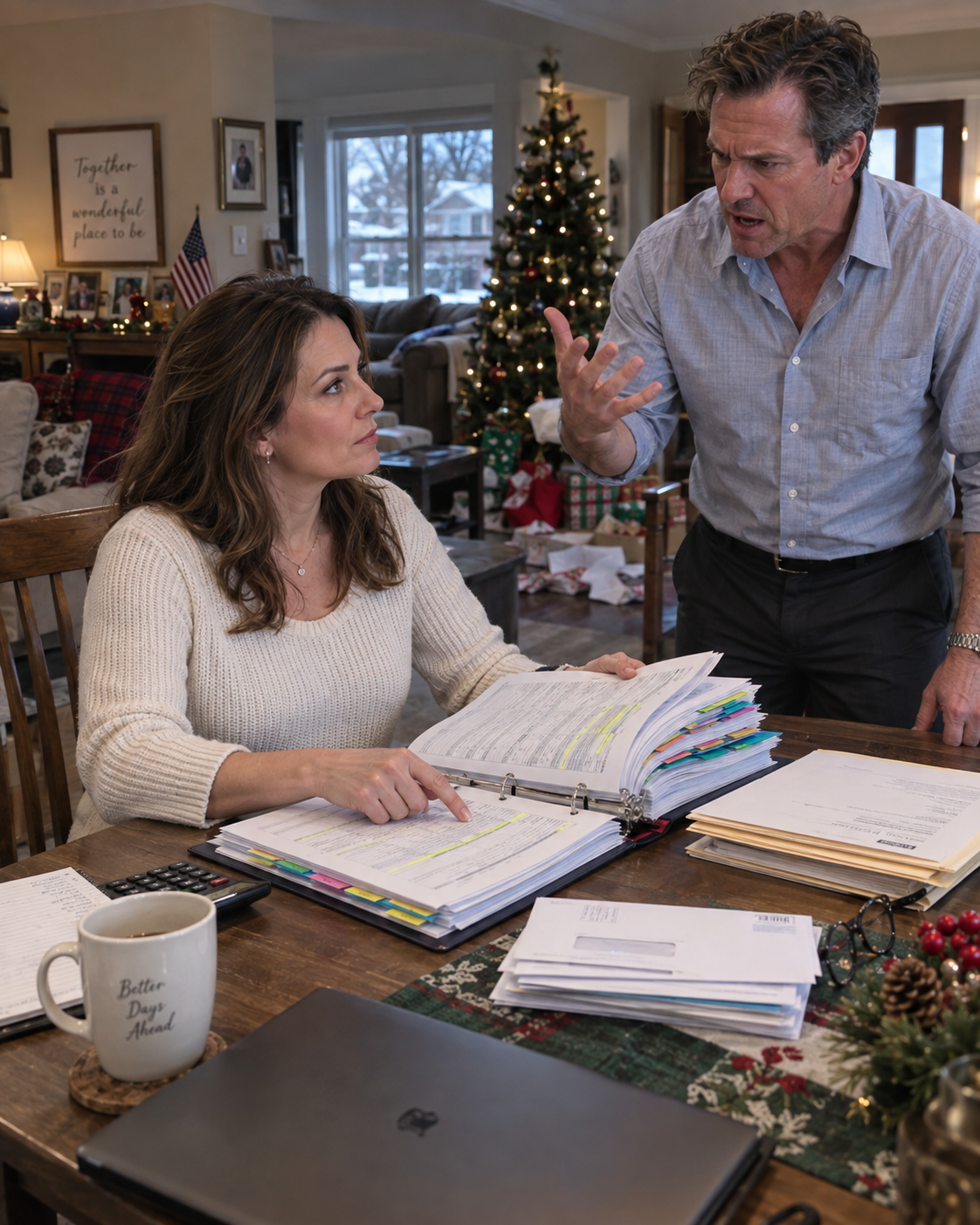
Then I placed a thick binder on the table.
It landed with a heavy sound.
David looked at it.
“What is that?”
“My records.”
I opened the cover.
Inside were fifteen years of color-coded financial audits.
Christmas expenses.
Household contributions.
Credit-card charges.
Transfers.
Account movements.
Dates.
Amounts.
Notes.
Everything I had spent years pretending not to see.
His expression changed.
I turned to another section.
“These are the transfers from our joint reserves.”
I placed my finger on the first page.
“Four years.”
He said nothing.
“These are the personal accounts you funded.”
Silence.
“And these are the credit lines where you added yourself.”
His face went pale.
“Where did you get this?”
“I’m a bookkeeper.”
I closed the binder.
“You taught me to trust numbers.”
He sat down.
For the first time since I had known him, David looked completely lost.
“You were spying on me?”
“No.”
I slid another document across the table.
“I was auditing our finances.”
He looked at it.
“This is…”
“My accounting of the money that belongs to me.”
He swallowed.
“I was going to put things back.”
“When?”
He didn’t answer.
“When the children were older?”
There were no children.
“When your mother needed another trip?”
Still nothing.
“When you thought I would never find out?”
He lowered his eyes.
That silence answered everything.
I took a breath.
“I have also spoken with an attorney.”
His head snapped up.
“What?”
I placed the legal documents on the table.
“Petition for legal separation.”
He stared at the pages.
“You can’t be serious.”
“I am.”
“You’d leave over money?”
“No.”
I shook my head.
“I’m leaving because you turned my trust into a resource.”
His eyes filled with anger again.
“What about our marriage?”
I looked at him.
“What about it?”
He had no answer.
For years, he had assumed my tolerance meant devotion.
Now he was discovering that devotion without respect eventually becomes exhaustion.
The next weeks were difficult.
There were lawyers.
Documents.
Meetings.
Arguments over property.
Questions about accounts.
There were moments when I wanted to burn the entire binder and forget everything.
But I didn’t.
Because the binder wasn’t revenge.
It was proof.
It was the record of every time I had been told I was imagining things.
Every time I had been called difficult for asking about money.
Every time I had been expected to pay without being consulted.
Four months later, our divorce was finalized.
The settlement required David to reimburse assets determined to be mine under the legal process.
Our suburban house was sold.
David moved into a cramped one-bedroom apartment.
The luxury Christmas tradition disappeared.
There was no longer an endless pool of money waiting behind my name.
Beatrice stopped receiving private chalets.
Simon stopped joking about the ATM.
The elaborate family holidays simply became impossible.
And I realized something I hadn’t expected.
I wasn’t celebrating their loss.
I was grieving my own years.
Years I couldn’t get back.
Years spent trying to become good enough for people who had decided my usefulness was more valuable than my presence.
One afternoon, while packing the last box from the house, I found an old Christmas photograph.
Everyone was smiling.
I was standing behind them.
Half hidden.
Holding a tray.
I stared at that picture for a long time.
Then I put it in the box.
Not because I wanted to forget.
Because I finally understood that remembering did not require returning.