Nine days after my divorce, Clint stood in my apartment doorway with his mother beside him
Part 2
Clint sat at my kitchen table as though he still lived there.
Opal lowered herself into the chair beside him.
Neither of them asked whether I wanted them there.
Clint folded his hands.
“I’m not here to fight.”
I almost smiled.
“Then why are you here?”
He took a breath.
“Because seventeen years is seventeen years.”
I waited.
He continued.
“We built a life together.”
“We raised two kids.”
“We struggled together.”
“And now you have twenty-two million dollars.”
His eyes stayed on mine.
“It only seems fair that some of it comes to me.”
I poured myself another cup of coffee.
I didn’t offer them any.
“Your share of our marriage was settled nine days ago.”
“That’s not what I’m talking about.”
“Then what are you talking about?”
“Rita, twenty million dollars changes your life.”
“Yes.”
“It could change mine too.”
There it was.
Not love.
Not regret.
Not even an apology.
Need.
He needed something.
And, as always, he had decided I was the solution.
Opal leaned forward.
“Don’t make this about paperwork.”
I looked at her.
“The divorce decree is paperwork.”
“Paper is paper,” she said.
“Seventeen years of building a family doesn’t disappear because of a date.”
I felt something inside me go completely still.
I remembered another date.
A Tuesday night three years earlier.
My mother in a hospital bed.
Twenty-one hundred dollars.
Clint telling me her problems were not ours.
So I said, “That’s interesting.”
Opal frowned.
I opened the drawer beside me and pulled out a folder.
“I remember when my mother needed surgery.”
Clint’s eyes dropped to the folder.
“I remember asking you for twenty-one hundred dollars from our joint savings.”
He shifted in his chair.
“You told me my family was my responsibility.”
“Rita—”
“I remember Kurt’s eighteen-thousand-dollar down payment.”
I placed the bank record on the table.
“I remember Heidi’s twelve-thousand-dollar debt.”
Another document.
“And I remember the fifty thousand dollars you transferred to Kurt without telling me.”
Clint looked away.
Opal said, “Those were family matters.”
“Exactly.”
I opened the final folder.
“The difference is that you only called it family when the money was leaving me.”
Clint’s jaw tightened.
“I made mistakes.”
“I know.”
“I was trying to help my family.”
“I know.”
“Then you understand why I need you to help me now.”
I looked at him for a long moment.
“No.”
He stared at me.
Not because he didn’t hear me.
Because he wasn’t used to hearing it.
“No?”
“No.”
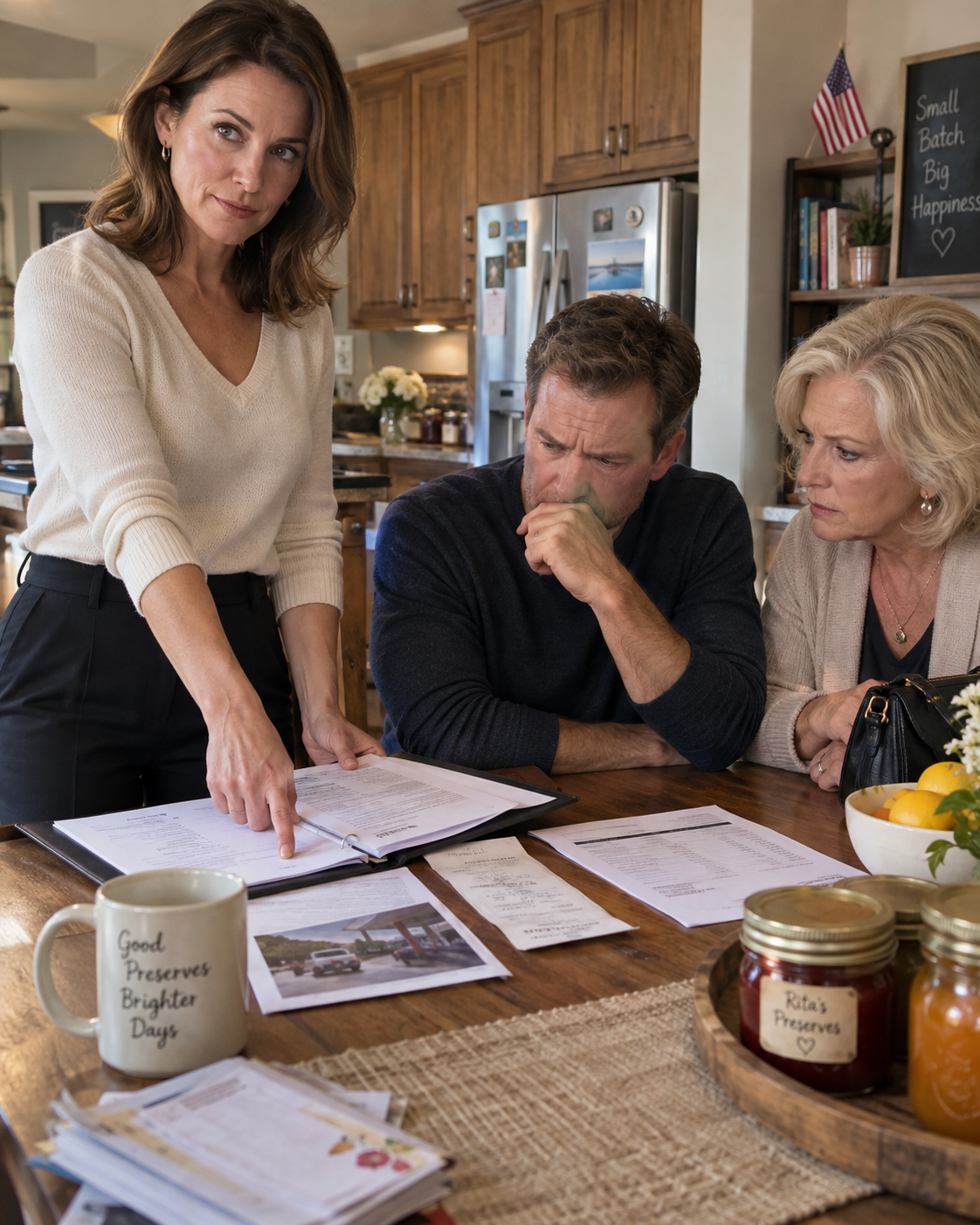
I slid another document across the table.
The divorce decree.
March 8.
Then the gas station receipt.
March 17.
Then the transaction record.
Then the security-camera image.
Clint looked at the dates.
His expression changed.
The arrogance disappeared first.
Then the confidence.
Then something that almost looked like fear.
“I bought the tickets nine days after we were divorced.”
He said nothing.
“I have the receipt.”
Nothing.
“The bank record.”
Nothing.
“The security footage.”
Opal picked up the image.
“This is cold, Rita.”
I looked at her.
“You want to know what was cold?”
She slowly lowered the paper.
“Watching my mother recover from surgery while I couldn’t touch our joint savings for twenty-one hundred dollars.”
My voice shook.
“But knowing that fifty thousand dollars had already left that same account for Kurt.”
Nobody spoke.
“That was cold.”
Clint rubbed his face.
“I was desperate.”
“For what?”
“Kurt needed money.”
I said nothing.
“My shop was slowing down.”
Still nothing.
“I thought if you were reasonable, you would help.”
I leaned back.
“Then you should have asked.”
He looked at me.
“If you had knocked on my door and said, ‘Rita, I’m struggling. Can I borrow money? Here’s how I’ll pay you back,’ I might have listened.”
I paused.
“But you didn’t.”
“You showed up with your mother and told me my winnings were yours.”
His shoulders dropped.
“There is a difference.”
He didn’t answer.
After a minute, he stood.
Opal stood with him.
At the doorway, Clint turned around.
“I never thought you’d become this hard.”
I looked at him.
“I didn’t become hard.”
I opened the door.
“I became clear.”
They left.
The next morning, the phone calls began.
A cousin I barely knew.
An uncle of Clint’s.
One of Opal’s friends who reminded me that she had always considered me a daughter.
They all said different versions of the same thing.
Family.
Loyalty.
Seventeen years.
Fairness.
I gave every one of them the same answer.
“If Clint believes he has a legal claim, he can take it to court.”
He never did.
His attorney apparently told him what mine had already told me.
The divorce came first.
The ticket came later.
The timeline was simple.
There was nothing left to argue.
A week after the confrontation, Jared came to my condo.
He sat at the kitchen table with both hands wrapped around a mug.
“I’m sorry, Mom.”
“You don’t need to be.”
“I shouldn’t have told Dad.”
“You’re twenty.”
He looked down.
“I thought he was just asking how you were.”
“I know.”
“I should have kept my mouth shut.”
“You should have.”
He winced.
Then I smiled.
“But what he did with that information is on him.”
Jared nodded.
After a while, he asked, “Did you ever think about giving him anything?”
I smiled into my coffee.
“I thought about giving him exactly twenty-one hundred dollars.”
He looked up.
“Why?”
“Half of what he wouldn’t let me take from our joint savings for your grandmother’s surgery.”
Jared stared at me.
Then he laughed.
It was the first real laugh I had heard from him in days.
“Mom, that’s ruthless.”
I shook my head.
“Strategic.”
I didn’t give Clint a dollar.
Not because I wanted revenge.
Because there was nothing left to prove.
I had already spent seventeen years giving people what they called family.
Now I was finally learning what it meant to give myself something too.
Part 3
I paid off my mother’s remaining debts.
I replaced her ancient water heater.
Then I booked her a trip to Savannah to visit her sister.
She had been postponing that trip for eleven years.
I put money into trusts for Jared and Riley.
Not because I wanted to buy their futures.
Because I wanted them to have something I had spent too many years believing women were not allowed to have.
A door they could walk through alone.
I expanded Rita’s Reserve.
I hired two full-time employees.
I launched a seasonal line.
Then three regional grocery chains agreed to carry my products.
One morning, six months after Clint and Opal stood in my doorway, I woke before sunrise.
The kitchen was quiet.
A pot of apple butter was simmering on the stove.
The smell filled the condo.
For a moment, I stood there with my hands resting on the counter.
I thought about the woman I had been at twenty-four.
The girl holding an envelope with two thousand dollars from her mother.
The girl who believed marriage meant becoming part of another family.
The woman who spent years saying yes because she thought saying no meant she was selfish.
I thought about the Tuesday night when my mother needed twenty-one hundred dollars.
I thought about Kurt’s eighteen thousand.
Heidi’s twelve thousand.
The fifty thousand.
The divorce.
The lottery ticket.
The knock on my door.
And finally, the word no.
It hadn’t ruined my life.
It had given me one.
Riley came into the kitchen wearing pajamas.
“You’re up already?”
“I’ve always been up early.”
She smiled.
She opened the refrigerator.
“Can I have some of that apple butter?”
“Of course.”
She grabbed a spoon.
I watched her taste it.
“Still the best thing you make.”
I laughed.
“That’s what you said when you were eight.”
“It was true then too.”
She leaned against the counter.
For a moment, neither of us spoke.
Then she said, “Mom?”
“Yeah?”
“Are you happy?”
I looked toward the window.
The sky was beginning to brighten.
I thought about the money.
The business.
The condo.
The freedom.
But none of those were the answer.
“I think I’m peaceful,” I said.
She nodded as though she understood.
Peace had taken me seventeen years to recognize.
It wasn’t a giant house.
It wasn’t twenty-two million dollars.
It wasn’t proving Clint wrong.
It was waking up without wondering whether someone else had decided what I owed them.
It was helping my mother because I wanted to.
It was giving my children a future without making them carry my past.
It was opening my own front door and knowing nobody could walk through it demanding a piece of me simply because they had once loved me.
Months later, I heard Clint had sold his truck and downsized the detailing shop.
Kurt had sold some equipment to cover his loans.
Neither of them lost everything.
They simply had to live without my resources beneath them.
I didn’t celebrate.
I didn’t feel victorious.
I felt sad.
Not for the money.
Not even for Clint.
I felt sad for the seventeen years I had spent trying to earn a place in a family that had already decided where I belonged.
But I no longer hated those years.
They gave me Jared.
They gave me Riley.
They gave me lessons I never would have chosen but would never forget.
And they taught me something my mother had tried to tell me on my wedding day.
A woman always needs a door she can walk through alone.
For years, I thought she meant money.
She didn’t.
She meant dignity.
She meant the courage to leave.
She meant knowing that love should never require you to disappear inside somebody else’s definition of family.
The lottery didn’t make me free.
I was free nine days before I won it.
The money simply made it impossible for anyone to pretend otherwise.
And if there is one thing I carry with me now, it isn’t the winning ticket.
It is that old handwritten note from my mother.
The paper is worn.
The ink has faded.
But I can still read every word.
“Start something of your own, baby.”
I did.
And this time, nobody gets to tell me what it is worth.