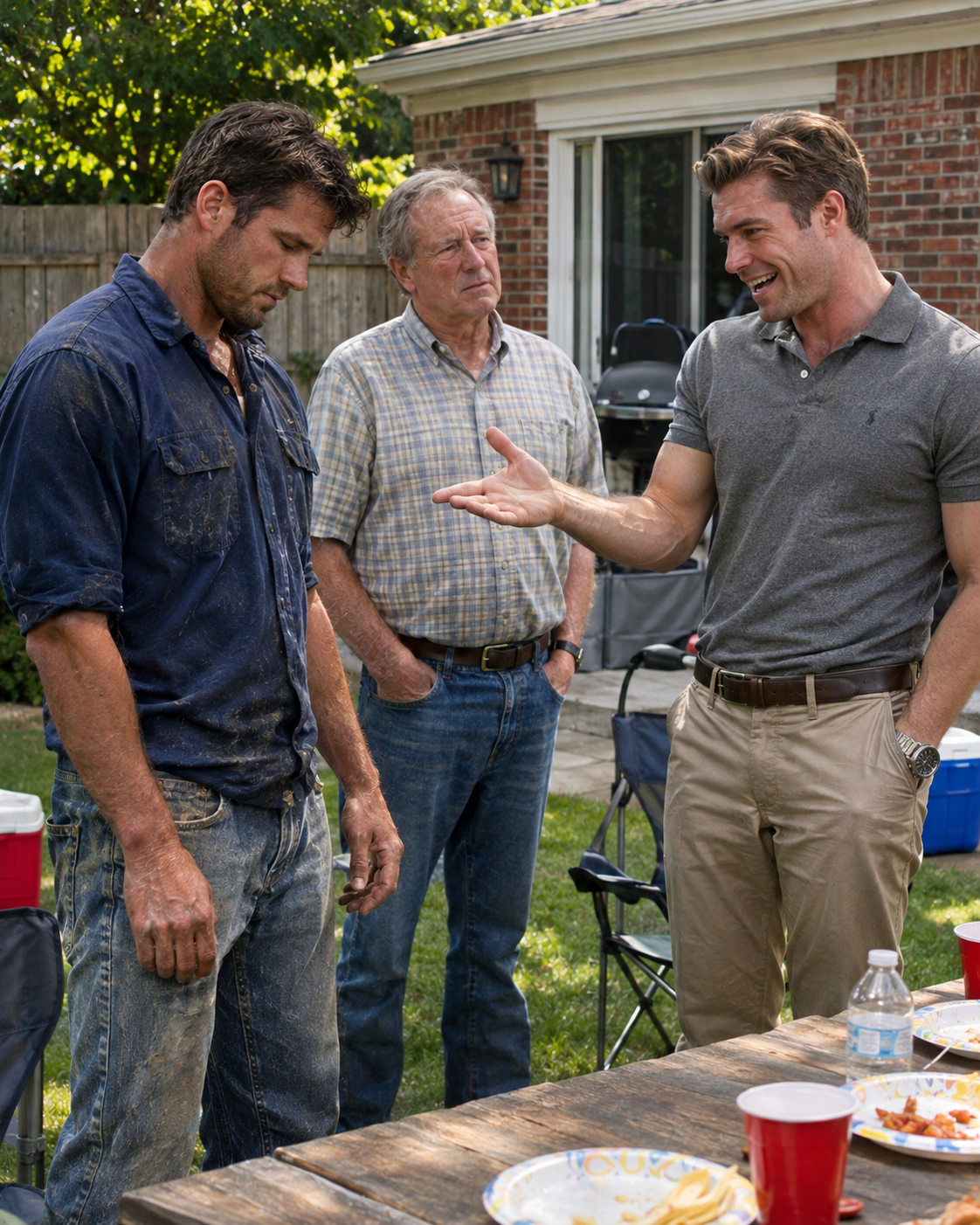
My younger brother Grant raised his glass at our family reunion and laughed, “Some people build careers.
Then Grant got involved.
At first, Tessa said, he seemed genuinely interested in helping her turn the idea into something real.
He knew people with money. He understood how to pitch investors. And he had the kind of confidence that could make an empty room sound like a promising opportunity.
But somewhere along the way, the project stopped being about neighborhood businesses.
It became about beating me.
“He was obsessed with those buildings,” Tessa admitted, staring into her coffee. “Every time someone mentioned downtown, he’d bring up your name.”
I leaned back against the booth.
“What does that have to do with me?”
“More than I wanted to admit.”
She opened her purse and pulled out a manila envelope.
Inside were printed emails, preliminary investor presentations, and copies of several letters.
I recognized the photographs immediately.
They showed our storefronts before Arthur and I had restored them.
The broken windows. The damaged brickwork. The water stains running down the walls.
Those same photographs had appeared in the anonymous complaints that nearly destroyed our business.
My stomach tightened.
“Where did you get these?”
“Grant kept copies of everything.”
I looked at her.
“Are you telling me he filed those complaints?”
“I’m telling you he knew about them before they were submitted.”
She pointed to an email.
Grant had forwarded the old photographs to a consultant, asking whether they could be used to raise questions about our renovation work.
The consultant’s response was cautious. He warned that outdated photographs couldn’t establish current violations.
Grant replied anyway.
The message was short.
“Sometimes questions are enough to slow things down.”
I read it three times.
For months, I’d suspected my brother was involved.
But suspicion was different from seeing his words on paper.
“Did you know?” I asked.
Tessa didn’t look away.
“Not at first.”
“And later?”
She swallowed.
“I knew he wanted to interfere with your projects. I told myself it was business competition.”
“Business competition?”
My voice came out louder than I’d intended.
“We spent our roof repair money defending ourselves against accusations that weren’t true. We almost lost a tenant.”
“I know.”
“No, you don’t.”
A waitress approached with a coffee pot, took one look at us, and quietly moved to another table.
Tessa folded her hands.
“You’re right. I don’t know what that felt like. But I know what happened after the board meeting.”
I waited.
“Grant started telling people you’d manipulated the land bank. He said Ruth favored you because your uncle knew someone on the board.”
“That isn’t true.”
“I know. But he’s angry, and he’s looking for another way to hurt you.”
I stared at the envelope.
“Why are you bringing this to me?”
“Because I helped him build something dishonest. And because I don’t want to spend the rest of my life pretending I didn’t see what was happening.”
I wanted to believe her.
I also remembered how confidently she’d sat beside Grant while he tried to take control of the lot.
“Did you bring me everything?”
“Everything I still have.”
She pushed the envelope toward me.
Then she said something I hadn’t expected.
“You should talk to a lawyer before you do anything with it.”
For once, I agreed with her.
I took the envelope straight to our attorney, a woman named Margaret Ellis who had already spent too many hours helping us survive the earlier complaints.
She studied the documents while I sat across from her desk.
When she finished, she removed her glasses.
“This is useful,” she said. “But don’t confuse useful with conclusive.”
“What does that mean?”
“It means these emails show troubling behavior. They don’t prove Grant personally submitted every complaint or caused every delay.”
“So what can we do?”
“We can preserve the records, verify their authenticity, and evaluate whether there’s a legitimate claim. But you need to decide what you’re trying to accomplish.”
I didn’t answer immediately.
Margaret leaned forward.
“Do you want compensation? Do you want accountability? Or do you want to punish your brother?”
I hated that question.
Mostly because I couldn’t honestly say punishment hadn’t crossed my mind.
“I want him to stop.”
“Then let’s start there.”
She advised me not to confront Grant with the documents, at least not yet.
We needed to establish what could be verified and make sure our own business was protected.
Meanwhile, the courtyard project was still struggling.
Arthur and I had no choice but to return to work.
The next morning, I arrived downtown before sunrise.
Arthur was already there, sitting on an overturned bucket with two paper cups of coffee.
“You look terrible,” he said.
“Good morning to you, too.”
He handed me a cup.
I told him everything.
He listened without interrupting.
When I finished, he stared across the vacant lot.
“Your grandfather used to say something about bad mortar,” he said.
I smiled faintly.
“He said plenty about bad mortar.”
“He said you can cover a weak joint with a pretty finish, but eventually the weather finds it.”
I looked at him.
“You think Grant’s going to get what’s coming to him?”
Arthur shook his head.
“I think we ought to make sure we don’t become like him while we’re waiting.”
That stayed with me.
Over the next month, Margaret investigated what she could, while Arthur and I tried to solve our financing problem.
We met with contractors, reviewed engineering reports, and eliminated every expense that wasn’t essential.
Even after the cuts, the numbers were tight.
Then another problem surfaced.
During excavation planning, our engineer identified an old stormwater line crossing part of the lot.
The city records showed it had been installed decades earlier, when the surrounding buildings were used for warehouses.
Its condition was uncertain.
Before construction could continue, we needed to determine whether it was still functioning and whether the proposed foundation would interfere with it.
The inspection wasn’t cheap.
Neither was the possibility of replacing it.
Arthur stood beside me as the engineer explained the situation.
When the man left, Arthur looked at the ground.
“Well,” he said, “that complicates things.”
I kicked a loose pebble across the dirt.
“We could sell the lot.”
Arthur didn’t answer.
“We’d probably recover most of what we’ve put into it.”
Still nothing.
I turned toward him.
“You think I’m quitting?”
“I think you’re tired.”
“I’m being realistic.”
“Then be realistic about what selling would mean.”
I looked toward the bookstore.
A woman was helping her daughter carry a stack of used books through the front door.
Across the street, the nonprofit coffee shop had just opened for the morning.
People were beginning to use downtown again.
Arthur followed my gaze.
“We didn’t buy this lot to prove anything to Grant,” he said. “Remember that.”
“I know.”
“Then don’t let him decide whether we finish.”
That evening, I drove to my grandfather’s old house.
My uncle had inherited it after Grandpa died, but he still kept the workshop behind the garage almost exactly as it had been.
The same wooden shelves.
The same rusted toolboxes.
The same old workbench with pencil marks along the edge.
I sat there for nearly an hour.
When I was a kid, Grandpa would take me to construction sites on Saturday mornings.
He’d show me buildings that had stood for a hundred years and explain why some survived while others crumbled.
He never talked much about money.
He talked about foundations, patience, and doing work that would outlast the person doing it.
I finally understood something.
I’d spent years believing that if I built enough, accomplished enough, and worked hard enough, my family would eventually see me differently.
But even after winning the land bank vote, I was still waiting for Grant to acknowledge that I mattered.
And I was exhausted from waiting.
The next morning, I called Arthur.
“I don’t want to sell.”
He laughed softly.
“Good. Because I already called the engineer about a cheaper inspection approach.”
For the first time in weeks, I felt hopeful.
We arranged a targeted inspection of the old line and worked with the city to clarify responsibility for any repairs.
The results were better than we’d feared.
The pipe needed maintenance, but it didn’t require complete replacement.
We revised the courtyard layout slightly and reduced the amount of excavation.
It saved us thousands.
Not enough to solve everything, but enough to keep the project alive.
Then something happened that neither Arthur nor I had planned.
The bookstore owner, a woman named Linda, asked if she could organize a small fundraiser.
I told her that wasn’t necessary.
She gave me the kind of look teachers give children who haven’t listened.
“You gave me a chance when nobody else wanted to rent to a used bookstore,” she said. “Let people decide whether they want to help.”
Within two weeks, she’d organized a neighborhood gathering.
The coffee shop donated drinks.
A local bakery brought pastries.
A musician who rented rehearsal space nearby volunteered to perform.
Arthur and I set up folding tables in the unfinished courtyard.
I expected maybe thirty people.
More than a hundred showed up throughout the afternoon.
Some brought donations.
Others offered materials, labor, or professional services.
A landscape designer volunteered to help simplify our planting plan.
A local electrician offered discounted installation work.
One retired teacher handed me a twenty-dollar bill and said she hoped the courtyard would have somewhere comfortable to sit and read.
I tried to give it back.
She wouldn’t take it.
“Your grandfather fixed my front steps forty years ago,” she told me. “Never charged me a dime.”
I stood there holding the money long after she’d walked away.
By the end of the day, we hadn’t raised enough to finish the courtyard.
But we’d raised something almost as valuable.
We had proof that people wanted it.
And for the first time, the project felt bigger than Arthur and me.
That night, my mother called.
“I heard about your event.”
“News travels fast.”
“Your father and I wanted to come.”
“You could have.”
There was a pause.
“We weren’t sure we’d be welcome.”
I closed my eyes.
“Mom, you don’t need an invitation to support your son.”
She was quiet for a long moment.
Then she said, “Grant’s having a difficult time.”
I almost laughed.
Of course.
Even now, the conversation somehow found its way back to him.
“What happened?”
“His business isn’t doing well. He’s been staying with us.”
I sat down.
Grant was thirty-five years old. He’d spent most of his adult life presenting himself as someone who had everything figured out.
I couldn’t imagine him moving back into our parents’ house.
“I’m sorry to hear that,” I said.
“He thinks you turned people against him.”
I stared at the wall.
“Mom, I didn’t make his investors withdraw. I didn’t create his company. And I didn’t ask him to come after my properties.”
“He says you embarrassed him.”
“He embarrassed himself.”
She sighed.
“I just wish you boys could stop fighting.”
Something in me finally snapped.
“We’re not two kids fighting over a toy, Mom.”
“I didn’t mean—”
“He tried to pressure me into signing away access to property I own. And before that, someone used false accusations to interfere with our business. I have reasons to believe he knew about it.”
She didn’t speak.
“I’ve spent my whole life being told to understand Grant. When is anyone going to ask him to understand me?”
My voice cracked on the last word.
I hated that.
But I didn’t take it back.
Mom started crying.
Normally, that would have been enough to make me apologize.
This time, I stayed quiet.
Finally, she whispered, “I didn’t realize you felt that way.”
“That’s part of the problem.”
We ended the call without resolving anything.
Two days later, Grant showed up at the courtyard.
I was laying out a section of brick edging when his truck pulled into the alley.
He got out wearing a button-down shirt and jeans.
No expensive watch.
No polished shoes.
He looked thinner than I remembered.
Arthur glanced at him, then at me.
“I’ll check the measurements on the other side,” he said.
Grant walked toward me.
“Mom said you were upset.”
I set down my trowel.
“That’s one way to describe it.”
He looked around the lot.
“So you’re really doing this.”
“That’s the plan.”
He nodded.
For a moment, I thought he might apologize.
Instead, he said, “You know, you didn’t have to make me look stupid in front of the board.”
I stared at him.
“You asked me to sign an easement in front of the board.”
“Because I thought you’d help.”
“Help you do what, Grant?”
He folded his arms.
“Build something.”
“Then why didn’t you come talk to me before submitting your proposal?”
He looked away.
I took a breath.
“Why did you need the lot beside my buildings?”
“Because it was available.”
“There were other lots.”
“This one made sense.”
“Or you wanted something I had.”
His face hardened.
“You always think everything’s about you.”
I almost smiled at the irony.
“Actually, I spent most of my life thinking nothing was about me.”
He didn’t respond.
I reached into my truck and took out a copy of the email Margaret had verified.
I held it out.
Grant read it.
His expression changed.
Not dramatically.
Just enough.
“Where did you get this?”
“Does it matter?”
“Tessa gave it to you, didn’t she?”
“Did you encourage someone to file complaints against our buildings?”
He looked at the paper again.
“I asked questions.”
“That’s not what I asked.”
“I wanted people to look into your permits.”
“Why?”
“Because you were acting like some kind of local hero.”
I felt my hands tighten.
“I was fixing buildings.”
“You were making everybody talk about you.”
There it was.
Not the entire truth, perhaps, but enough of it.
Grant looked toward the storefronts.
“Do you know what it was like hearing Dad tell his friends about your properties? Every conversation became about what you’d accomplished.”
I couldn’t believe what I was hearing.
“That happened for about three months, Grant.”
He looked back at me.
“For thirty years, every conversation in our house was about you.”
His mouth opened, then closed.
I continued.
“You got praised for showing up. I got told to work harder. You got help with your first apartment. I paid for my own tools. You made mistakes, and everybody called them learning experiences.”
“That’s not fair.”
“Maybe not. But it’s how I remember it.”
He stared at the ground.
I waited.
Finally, he said, “I didn’t think those complaints would cost you that much.”
The words landed harder than I expected.
Because they weren’t a denial.
“You knew they could hurt us.”
“I thought the city would just ask for more inspections.”
“We lost months. We spent money we didn’t have.”
He rubbed his forehead.
“I didn’t know it would go that far.”
“You didn’t care enough to find out.”
He had no answer.
For several seconds, all I could hear was traffic on the next street.
Then he said, “What do you want me to do?”
I thought about telling him exactly what I wanted.
An apology.
Repayment.
A public admission.
Thirty years of being treated like the lesser son somehow undone.
But none of those things could give me back the time I’d lost.
“I want you to tell the truth,” I said.
He looked at me.
“To our parents. To anyone you misled. And to Margaret, if she needs a statement.”
His expression tightened.
“You want me to admit everything in writing?”
“I want you to stop pretending you did nothing.”
He shook his head.
“You’re trying to ruin me.”
“No, Grant. I’m trying to protect what I’ve built.”
He walked away without another word.
I watched his truck disappear.
Arthur came back a few minutes later.
“How’d it go?”
“About as well as you’d expect.”
He looked at the unfinished brick edging.
“Want to take the afternoon off?”
I picked up my trowel.
“No. I want to finish this section.”
A week later, Margaret called.
Grant had contacted her.
Not to apologize.
To ask whether there was a way to resolve the matter without litigation.
I listened as she explained the proposal.
He was willing to acknowledge his role in encouraging scrutiny of our projects, provide the remaining correspondence in his possession, and contribute toward some of our documented legal expenses.
In exchange, he wanted a negotiated resolution that would avoid a civil lawsuit over the interference.
“Is that reasonable?” I asked.
“It could be,” Margaret said. “But only after we review everything. You don’t have to accept it.”
I spent the evening talking it over with Arthur.
He listened carefully.
Then he asked, “If you sue him, what happens to the courtyard?”
“We might recover more money.”
“Eventually.”
“Maybe.”
“And how many years of your life are you willing to spend fighting him?”
I didn’t have an answer.
We negotiated for several weeks.
Grant eventually provided a signed statement acknowledging that he’d circulated outdated photographs and encouraged complaints questioning our work without having current evidence of violations.
He didn’t admit responsibility for every anonymous accusation, and Margaret made sure the agreement didn’t claim more than the records supported.
He also agreed to repay a portion of our legal expenses over time.
It wasn’t perfect.
The amount wouldn’t cover everything we’d lost.
But it established something I’d wanted for years.
He could no longer pretend he’d done nothing wrong.
Our parents learned the details when Grant told them about the agreement.
My father called that evening.
“I owe you an apology,” he said.
I sat on the back steps of my house, listening.
“I should’ve asked more questions before taking Grant’s side.”
“Yes,” I said.
He cleared his throat.
“And I should’ve treated you differently when you were growing up.”
That one caught me off guard.
I looked across my backyard.
“Why didn’t you?”
He was quiet.
Then he said, “Grant was always demanding attention. You were the easy one. You worked hard, stayed out of trouble, and never asked for much.”
I swallowed.
“So you figured I didn’t need anything.”
“I guess we did.”
For years, I’d imagined having this conversation.
In my imagination, Dad always had some explanation that made everything make sense.
Instead, the truth was painfully ordinary.
They’d overlooked me because I’d made it easy.
“I did need things, Dad,” I said.
“I know that now.”
We stayed on the phone for another twenty minutes.
It didn’t fix our relationship.
But it was the first conversation I could remember where he listened without bringing Grant into it.
By spring, the courtyard project had found its footing.
We secured revised financing, finalized the utility work, and began construction in earnest.
Arthur supervised the masonry.
I handled most of the site coordination.
The volunteers who’d offered help at the fundraiser kept showing up.
Some weekends, we had more people than we knew what to do with.
Linda brought sandwiches.
The coffee shop supplied drinks.
The retired teacher who’d donated twenty dollars came by every Friday to inspect our progress.
She insisted she wasn’t supervising.
Arthur insisted she absolutely was.
For the first time in a long while, I was enjoying the work again.
Then, in late May, Arthur collapsed.
We were unloading materials when he suddenly grabbed the side of the truck.
I caught him before he hit the pavement.
His face had gone pale.
“Arthur?”
He tried to answer, but his words came out slurred.
I called 911.
The ambulance arrived within minutes.
I rode behind it to the hospital, gripping the steering wheel so tightly my fingers hurt.
Arthur had suffered a stroke.
The doctors said we’d gotten help quickly, which improved his chances.
But recovery would take time.
Possibly a long time.
I sat beside his hospital bed that evening.
His wife, Helen, held his hand.
He was awake, but exhausted.
When he saw me, he tried to smile.
“Courtyard,” he managed.
I leaned closer.
“Don’t worry about the courtyard.”
He frowned.
Even lying in a hospital bed, he could still give me that look.
I laughed despite myself.
“We’ll finish it. I promise.”
For the next several weeks, I tried to do everything.
Manage the construction.
Keep the existing buildings operating.
Visit Arthur.
Handle invoices.
Answer questions from tenants.
I slept badly and ate whatever I could grab between jobs.
One afternoon, I made a mistake on a materials order that cost us nearly two thousand dollars.
Nothing dangerous.
Just the wrong brick quantity for a section of the courtyard.
But it was enough to push me over the edge.
I sat alone in my truck and cried.
Not because of the money.
Because I was terrified Arthur wouldn’t recover enough to return.
He’d become more than a business partner.
He was the closest thing I’d had to a second father.
And suddenly, the person who always knew what to do wasn’t there.
That evening, I went to see him.
He was sitting upright, working with a therapist on simple hand movements.
His speech was improving.
I told him about the ordering mistake.
He listened, then slowly raised one eyebrow.
“Measure,” he said.
I laughed.
“Yeah. Twice. I know.”
He reached for my hand.
“Not alone.”
I looked at him.
He repeated it.
“Not alone.”
The next morning, I called a meeting with our contractors and volunteers.
I told them the truth.
I was overwhelmed.
I needed help.
And I couldn’t keep pretending otherwise.
Nobody seemed surprised.
The electrician offered to coordinate subcontractor schedules.
Our engineer agreed to handle more communication with the city.
Linda organized a volunteer calendar.
Helen helped us stay updated on Arthur’s recovery.
For years, I’d thought being dependable meant never needing anyone.
Now I was learning that sometimes it meant trusting other people enough to let them carry part of the load.
The courtyard slowly took shape.
The brick walkways came first.
Then the drainage improvements.
Then the planting beds and benches.
We kept the storefront construction modest, using durable materials and simple designs that small businesses could afford to maintain.
One afternoon in August, I was checking the alignment of a low brick wall when a familiar voice spoke behind me.
“You’re still using Grandpa’s old level?”
I turned.
Grant stood a few feet away.
He looked uncomfortable.
“Yeah,” I said.
He nodded toward the tool.
“I remember him making you carry that thing around.”
“He said if I dropped it, I’d be buying him a new one.”
Grant smiled faintly.
Then he looked at the courtyard.
“Mom told me about Arthur.”
“He’s improving.”
“That’s good.”
We stood there awkwardly.
Finally, Grant said, “I came to ask if you needed help.”
I stared at him.
“With what?”
“Anything. Carrying materials. Cleaning up.”
I didn’t answer immediately.
Part of me wanted to tell him to leave.
Another part wondered whether this was the first genuine offer he’d ever made without expecting something in return.
“Why?” I asked.
He looked down.
“Because I owe you more than money.”
I waited.
He took a breath.
“I was jealous of you.”
I almost laughed.
Of all the things I’d expected him to say, that wasn’t one.
“You were jealous of me?”
“Not when we were kids,” he admitted. “Back then, I liked being the favorite.”
He glanced toward the storefronts.
“But when you started building all this, I realized you had something I didn’t.”
“What?”
“People trusted you.”
I said nothing.
“I thought money and connections were enough. I thought if I looked successful, people would treat me like I was successful.”
He rubbed his hands together.
“Then I watched people support you without you even asking. And I couldn’t stand it.”
I looked at him for a long time.
“Grant, you didn’t just hurt my feelings.”
“I know.”
“You put people’s jobs at risk.”
“I know.”
“And I can’t pretend that disappears because you feel bad now.”
He nodded.
“I don’t expect you to.”
For once, he didn’t argue.
I glanced at the pile of bricks beside the walkway.
“You ever laid brick before?”
“No.”
“It’s harder than it looks.”
“I figured.”
I considered him for another moment.
Then I pointed toward the cleanup area.
“You can start by stacking those unused pallets and clearing the debris. Stay out of the active work zones.”
He nodded.
“Okay.”
“And Grant?”
He stopped.
“This doesn’t mean everything’s fixed.”
“I understand.”
He spent four hours cleaning that afternoon.
He didn’t complain.
He didn’t take pictures.
He didn’t tell anyone he was helping.
When he finished, he asked if there was anything else.
I told him we were done for the day.
He left quietly.
Over the next few months, Grant came back occasionally.
Not every week.
Not consistently enough for me to call it a transformation.
But he showed up.
He carried supplies, cleaned work areas, and followed directions.
Once, he tried to explain a faster way to organize our deliveries.
I reminded him that our site manager already had a system.
He looked irritated for about ten seconds.
Then he said, “Fair enough.”
It wasn’t much.
But it was new.
By October, Arthur was walking with a cane.
His speech had improved, though he still tired easily.
The first time he returned to the courtyard, I helped him out of Helen’s car.
He stood at the entrance for a long time.
The walkways were finished.
The benches were installed.
Young trees lined the courtyard.
Two small storefronts were nearly ready for tenants.
Arthur looked at the brickwork, then at me.
“You did good,” he said.
I shook my head.
“We did.”
He smiled.
“Your grandfather would’ve liked it.”
That nearly broke me.
We held the courtyard opening on a cool Saturday morning in November.
There was no ribbon-cutting ceremony with politicians or expensive decorations.
Just folding chairs, coffee, homemade cookies, and a few short speeches.
Linda spoke about the bookstore.
The coffee shop director talked about the people they’d trained and employed.
A young woman who planned to open a small repair shop in one of the new spaces thanked us for offering a lease she could actually afford.
Then Arthur stood.
Helen helped him to the microphone.
He looked out at the crowd.
“Buildings,” he said slowly, “aren’t just walls.”
He paused to gather his words.
“They’re places where people get a chance.”
The crowd applauded.
Arthur turned toward me.
“This man understood that.”
I couldn’t speak.
I just put my arm around his shoulders.
Later, after most people had left, I found Grant standing near the courtyard entrance.
Our parents were talking with Helen a few yards away.
Grant looked at the finished brickwork.
“You really did it.”
“Yeah.”
He nodded.
“It’s beautiful.”
I watched a little boy race across the courtyard while his grandmother called for him to slow down.
“Arthur deserves most of the credit.”
Grant shook his head.
“You always do that.”
“Do what?”
“Give everybody else the credit.”
I looked at him.
He hesitated.
“Maybe that’s part of why people trust you.”
We stood together for a while.
Then he asked, “Do you think we’ll ever be normal?”
I considered the question.
For most of our lives, normal had meant him being praised while I stayed quiet.
I didn’t want to go back to that.
“I don’t think we should try to be normal,” I said.
He looked confused.
“I think we should try to be better.”
He nodded slowly.
“Okay.”
It wasn’t forgiveness.
Not completely.
I still remembered the legal bills, the sleepless nights, and the way he’d smiled when he thought he could pressure me into giving up access to our property.
But I also remembered the afternoons he’d spent hauling debris without asking for anything.
Both things were true.
And I was beginning to understand that rebuilding trust wasn’t the same as pretending the damage had never happened.
A few weeks later, my father invited me to dinner.
Just the two of us.
We went to a small restaurant outside town.
Halfway through the meal, he reached into his jacket and handed me a photograph.
It showed my grandfather standing in front of a brick house he’d built decades earlier.
Beside him was a little boy holding a trowel.
Me.
“I found this while cleaning out the garage,” Dad said.
I studied the picture.
Grandpa had one hand resting on my shoulder.
I looked impossibly proud.
“Your grandfather used to talk about you all the time,” Dad continued.
I smiled.
“He was a good man.”
“He told me once that you had his patience.”
I looked up.
Dad’s eyes were wet.
“I wish I’d listened.”
For once, I didn’t feel the need to explain how much that had hurt.
I simply said, “Me too.”
We finished dinner talking about the buildings, Arthur’s recovery, and the new tenants.
Dad asked questions.
Real questions.
He listened to the answers.
It was a small thing.
But after thirty-eight years, small things mattered.
The following spring, I installed a modest bronze plaque near the courtyard entrance.
It wasn’t named after me.
It wasn’t named after Arthur.
And it certainly wasn’t named after Grant.
The plaque read:
“Built with care. Shared with neighbors. Made to last.”
Underneath, in smaller letters, we included the names of the volunteers, local businesses, and tradespeople who had helped make the project possible.
Arthur insisted that my grandfather’s name be included among those honored.
I argued that Grandpa hadn’t worked on the courtyard.
Arthur looked at me like I’d said something ridiculous.
“He taught the man who built it.”
I couldn’t argue with that.
On the day we installed the plaque, Grant stopped by.
He read it quietly.
Then he looked at me.
“Grandpa would’ve been proud.”
I nodded.
“I hope so.”
Grant put his hands in his pockets.
“I’ve been thinking about what you said. About being better.”
I waited.
“I started working for a small construction supply company. Sales, mostly. Nothing impressive.”
“Sounds like honest work.”
He smiled.
“Yeah. I’m trying to remember that.”
He hesitated.
“I know I can’t undo what I did.”
“No.”
“But I’d like to keep trying.”
I looked across the courtyard.
A woman sat reading on one of the benches.
Two teenagers were sharing lunch beneath a young maple tree.
The repair shop had its front door open, and someone inside was laughing.
Everything around us had started as a neglected piece of property that most people had written off.
Now it was becoming something useful.
I thought about telling Grant that we were fine.
That I forgave him completely.
That the past no longer mattered.
But that wouldn’t have been true.
So I told him something smaller.
Something I could actually mean.
“You can keep trying.”
He nodded.
“Thanks.”
Then he asked whether I wanted to get coffee sometime.
I thought about it.
“Maybe next Saturday.”
He smiled.
“I’d like that.”
After he left, I stayed in the courtyard for a while.
I ran my hand along the brick wall beside the entrance.
The joints were straight.
The corners were clean.
There were a few imperfections, the kind only another mason would notice.
But the wall was solid.
I thought about Grandpa knocking down my crooked work when I was twelve.
Back then, I’d thought he was teaching me how to lay bricks.
Now I understood he’d been teaching me something else.
You can’t build anything lasting by pretending the foundation doesn’t matter.
Not a building.
Not a business.
Not a family.
Sometimes you have to tear out what’s damaged.
Sometimes you can repair it.
And sometimes the wisest thing you can do is stop trying to make an old structure carry weight it was never strong enough to hold.
I didn’t know what my relationship with Grant would look like ten years from now.
Maybe we’d become close.
Maybe we’d only share occasional coffee and polite conversations.
I could live with either.
Because I no longer needed his approval to know what my work was worth.
I didn’t need my parents to compare us.
And I didn’t need to win another argument to prove that I belonged.
The courtyard was full of people who had never cared which brother was the favorite.
They cared that the bookstore stayed open.
That the coffee shop gave people opportunities.
That a young business owner could afford her first storefront.
That there was somewhere downtown to sit, talk, read, and feel welcome.
Arthur joined me a few minutes later, moving slowly with his cane.
He looked at the wall I’d been inspecting.
“Find something wrong?”
I smiled.
“Just checking the joints.”
He leaned closer.
“Looks good to me.”
We stood together as the afternoon sunlight moved across the brick.
Then Arthur said, “You know what the best part is?”
“What?”
He pointed toward the courtyard.
“Someday, people will forget who built this.”
I looked at him.
He smiled.
“They’ll just know it’s a good place to be.”
For most of my life, I’d wanted someone to notice me.
To see what I’d accomplished.
To finally say I was enough.
But standing there beside Arthur, watching people enjoy something we’d made with our own hands, I realized I didn’t need my name on every brick.
I just needed the work to stand.
And for the first time in my life, that was enough.