My younger brother Grant raised his glass at our family reunion and laughed, “Some people build careers. Others just stack bricks.”
THE THINGS WE BUILD
My father stood beside the vacant lot, his hands buried in the pockets of his coat, waiting for an answer I wasn’t sure I wanted to give.
“Do you think you and Grant could ever work things out?”
Across the lot, Arthur was measuring the distance between two foundation markers. The late afternoon sun caught the silver in his hair, and for a moment I remembered my grandfather standing in almost the same position, watching me struggle to lay my first row of bricks.
“I don’t know, Dad,” I finally said. “But if we ever do, it won’t be because everyone decides to pretend nothing happened.”
My father nodded slowly.
“Your mother thinks you should be the bigger person.”
I almost laughed.
“That’s what people usually say when they want the person who got hurt to make everyone comfortable again.”
He looked down at his shoes.
For once, he didn’t have an answer.
I thought that conversation was finished.
I was wrong.
Three days later, Grant called.
I almost let it go to voicemail. His name on my phone brought back the reunion, the complaints, the meetings, and the way he’d looked at me when the board voted against his proposal.
But something made me answer.
“Hey.”
There was a pause.
“We need to talk.”
His voice sounded different. Not angry exactly. More tired than anything.
“About what?”
“Dad said you’re still holding a grudge.”
I leaned against the kitchen counter.
“That’s an interesting way to describe it.”
“Look, I know things got complicated. But we’re brothers. We shouldn’t let a business disagreement destroy the family.”
“A business disagreement?”
He exhaled sharply.
“Are you going to make everything difficult?”
I stared at the three framed photographs hanging above my kitchen table. One showed my grandfather in front of a brick house he’d built. Another showed Arthur and me standing outside our first restored storefront. The last was a picture of the bookstore on opening day, with children gathered around a table inside.
“No, Grant,” I said. “I’m going to make things honest.”
He went quiet.
Then he said something I hadn’t expected.
“Can we meet? Just you and me. No parents. No Arthur. Somewhere private.”
I agreed, but I chose a diner halfway between our towns.
I didn’t trust him enough to meet at my property.
The following Saturday, he arrived fifteen minutes late, wearing a jacket that probably cost more than my work boots. He ordered coffee and spent several minutes looking out the window.
Finally, he turned toward me.
“I lost the investors.”
“I heard.”
“They thought the land bank decision made our company look bad.”
I stirred my coffee.
“Maybe you should have shown them what you were actually building.”
He rubbed his forehead.
“You don’t understand how these things work.”
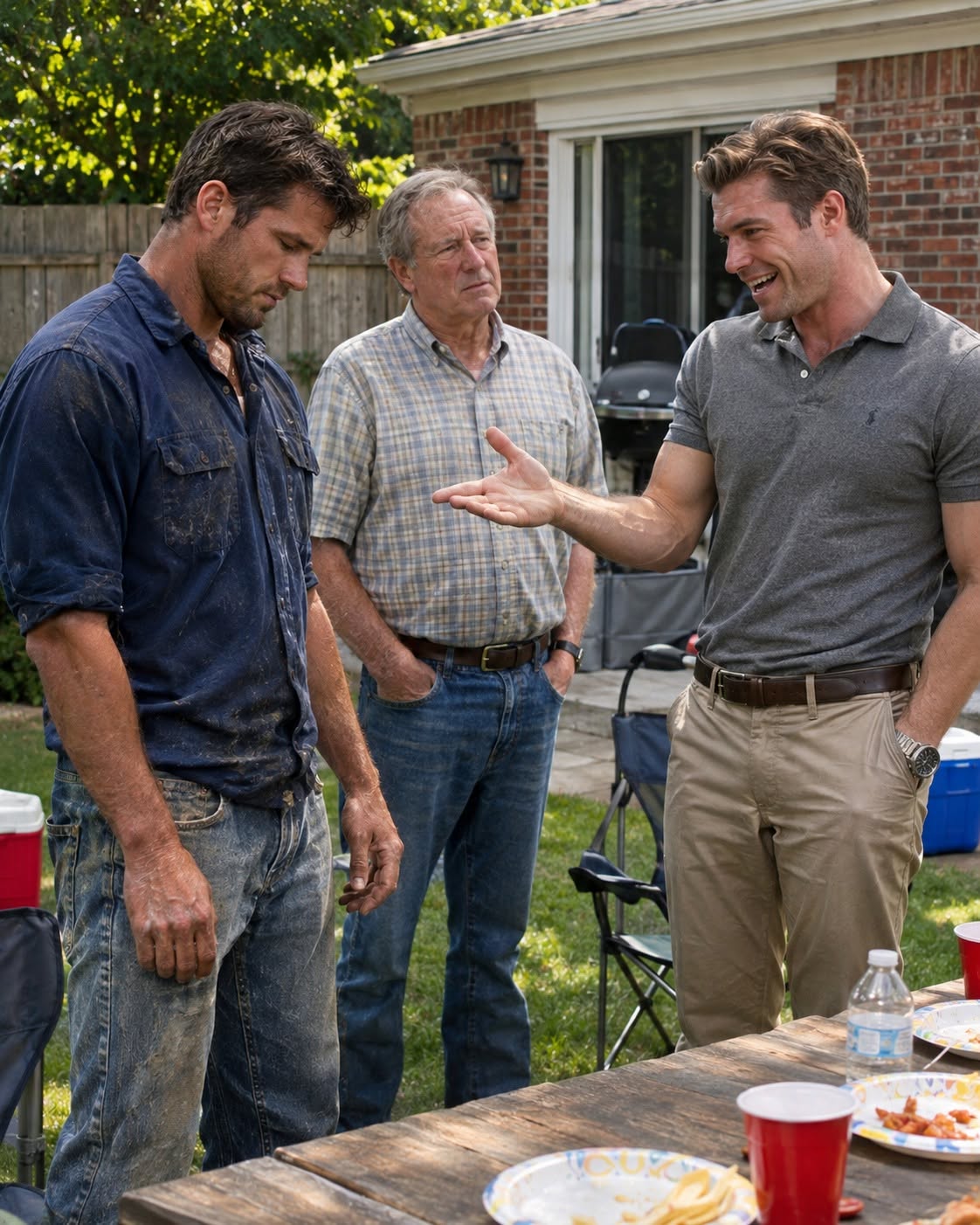
“Then explain it.”
He opened his mouth, then closed it.
For the first time in years, Grant seemed to have difficulty finding the right words.
He eventually admitted that the company had been created to pursue redevelopment opportunities. Tessa had connections with a few investors, and they’d planned to secure inexpensive properties, obtain public development incentives, and bring in contractors later.
There was nothing inherently illegal about that.
But they had been selling a vision they hadn’t yet demonstrated they could deliver.
“What about the complaints against our buildings?” I asked.
He looked down.
“I didn’t send those.”
I held his gaze.
“Did Tessa?”
His jaw tightened.
“I don’t know.”
“That isn’t an answer.”
He took a long drink of coffee.
“She was angry after the reunion. She thought you embarrassed me.”
I felt something cold settle in my stomach.
“Did you know she was contacting the city?”
“No.”
“Did you know she was circulating those old photographs?”
He didn’t answer immediately.
That silence told me more than his denial.
“Grant.”
“I knew she was talking to someone. I didn’t know exactly what she was doing.”
I pushed my coffee aside.
“And you let it happen.”
He looked genuinely uncomfortable.
“I thought it would blow over.”
There it was.
Not an apology. Not even an attempt to understand what it had cost us.
Just the casual expectation that trouble would eventually disappear if he ignored it long enough.
“Do you know what those complaints did?” I asked. “We had to delay repairs. We paid attorneys to answer accusations that weren’t true. Arthur spent nights worrying that we’d lose everything he’d helped build. And our tenants wondered whether they were going to be forced out.”
Grant stared at the table.
“I didn’t realize it was that serious.”
“You never asked.”
He swallowed.
Then he said, almost quietly, “I’m sorry.”
I waited.
He looked up.
“I really am.”
I wanted those words to fix something.
They didn’t.
But they were the first honest words I’d heard from him in a long time.
“I appreciate you saying that,” I replied. “But an apology doesn’t automatically give you back someone’s trust.”
“I know.”
We sat there for another twenty minutes.
Before leaving, Grant asked whether there might be a way for him to become involved in the courtyard project.
I shook my head.
“Not right now.”
His expression hardened.
“Even after I apologized?”
“Especially because I want the apology to mean something. I don’t want to turn it into another business arrangement.”
He stood, leaving cash beneath his cup.
“Maybe someday you’ll stop treating me like the enemy.”
I watched him walk to his car.
I wondered whether he understood that I had never wanted an enemy.
I had wanted a brother.
And those were two very different things.
The courtyard project began the following spring.
Arthur and I received a modest development grant, secured a local bank loan, and raised additional money through a community fundraising campaign.
We hired three local tradesmen and brought in a young architect named Emily Carter, who had grown up two streets away from the property.
Her first design included a large central courtyard, six small commercial spaces, a shared workshop, and a covered area where community organizations could hold meetings.
Arthur studied the plans for nearly an hour.
“Too much glass,” he finally said.
Emily smiled.
“That’s why I brought them to you.”
I liked her immediately.
She wasn’t offended by criticism, and she understood that a beautiful building was worthless if nobody could afford to maintain it.
We made adjustments.
The storefronts would have modest rents, the workshop would be available to local craftspeople, and a portion of the courtyard would be reserved for free community events.
For the first time, our project felt bigger than the two of us.
Then, just as construction was about to begin, we received another surprise.
The city announced that the underground stormwater line beneath the vacant lot had suffered significant damage.
A preliminary inspection suggested the problem might extend beneath the neighboring properties.
Our properties.
If the city required a full replacement before construction, the cost could destroy our budget.
Arthur read the notice twice.
“That’s going to be expensive.”
I called the engineer.
He confirmed the worst possibility.
The old drainage system was made of deteriorating clay pipes. One section had collapsed, and several others were close to failing.
The estimated cost was nearly $180,000.
We had less than half that amount available.
For two days, I barely slept.
We could postpone construction, but our loan approval had a deadline. The grant required us to begin within a certain period.
If we missed it, the money could disappear.
Arthur found me sitting inside the empty bookstore one evening, staring at the numbers.
“You look like a man who’s trying to move a wall by thinking about it.”
“I might have to sell one of the storefronts.”
He pulled out a chair.
“Would that solve the problem?”
“Probably.”
“Would it destroy what we’re trying to build?”
I didn’t answer.
Arthur looked toward the windows.
“Your grandfather once told me something about you.”
I raised an eyebrow.
“You knew my grandfather?”
“Worked with him for a few months when I was younger. He said you were stubborn enough to become a good mason, but only if someone taught you when to stop fighting the wrong battle.”
I smiled despite myself.
“That sounds like him.”
Arthur leaned forward.
“Don’t sell something we’ve spent years restoring just because we haven’t found the right solution yet.”
The next morning, we met with city engineers and asked for a detailed inspection.
We discovered something important.
The damaged drainage system served not only our buildings but also several neighboring properties. The city had maintenance responsibilities that had been neglected for years.
That didn’t mean taxpayers would automatically cover everything.
But it meant we weren’t solely responsible.
We submitted a shared infrastructure proposal and offered to contribute labor, materials, and a portion of the costs.
The city agreed to investigate further.
Then an unexpected person showed up at our office.
It was Grant.
He stood in the doorway holding a thick folder.
“I heard about the drainage problem.”
I didn’t invite him to sit.
“Who told you?”
“Mom.”
I nodded.
He placed the folder on the desk.
“I know a civil engineering firm that handles municipal infrastructure. They might be able to help you.”
Arthur appeared from the back room.
Grant looked uncomfortable seeing him.
“I brought their contact information,” he continued. “They did work for a company I consulted with last year.”
I examined the folder.
The firm was legitimate. Its references were solid, and the engineers had experience with historic downtown properties.
“Why are you helping?” I asked.
Grant shrugged.
“Because it’s a good project.”
I didn’t believe that was the whole story.
But I also didn’t want to reject useful information simply because it came from him.
“Thank you,” I said. “We’ll look into it.”
He nodded.
Then, before leaving, he added, “Tessa and I aren’t together anymore.”
I looked up.
“What happened?”
“She wanted me to keep pursuing development deals. I wanted to slow down and figure out what we were actually doing. We argued. She said I was throwing away my future.”
He gave a humorless laugh.
“Turns out I was pretty good at throwing away other people’s trust, too.”
Arthur looked at him for a long moment.
“Recognizing a problem is a start,” he said. “Fixing it takes longer.”
Grant nodded and left.
I didn’t know what to make of the visit.
But that afternoon, I called the engineering firm.
They agreed to review the site and found a solution that reduced the estimated cost by nearly forty percent.
It wasn’t enough to solve everything.
But it gave us a chance.
Construction began in June.
The first few weeks were difficult.
One contractor quit after discovering the old foundations required additional reinforcement. The architect revised the plans twice. A shipment of reclaimed brick arrived three weeks late.
Then Arthur fell.
It happened on a Tuesday morning while he was inspecting the temporary supports around the courtyard entrance.
He slipped on a wet plank and struck his shoulder against a concrete edge.
By the time I reached the hospital, he was awake but in considerable pain.
The doctors found a fractured shoulder and a small concussion.
He would need surgery and months of rehabilitation.
I sat beside his bed that evening, feeling as though someone had pulled the foundation out from beneath the entire project.
“What happens now?” I asked.
Arthur looked at me.
“Now you build.”
“I can’t do this without you.”
He gave me a tired smile.
“You’ve been doing half of it yourself for years.”
“Not the important half.”
He shook his head.
“Listen to me. A building isn’t one man’s work. It’s a hundred people doing their part and trusting the others to do theirs.”
He closed his eyes.
“And stop acting like everything falls apart if you aren’t standing in the middle of it.”
I stayed until the nurse asked me to leave.
The following morning, I called the crew and explained what had happened.
Everyone offered to help.
Emily took over daily site coordination. One of the older contractors volunteered to supervise the brickwork. The bookstore owner organized meals for the workers.
Even the coffee shop director offered to let us use their back room for project meetings.
I was beginning to understand what Arthur meant.
We hadn’t just restored three buildings.
We’d built relationships.
And those relationships were becoming the strongest part of the project.
Two weeks later, Grant showed up again.
This time he wasn’t carrying a folder.
He had a truck loaded with lumber and construction supplies.
“What are you doing?” I asked.
“Your temporary storage shed got damaged in the storm. I heard you needed replacement materials.”
I crossed my arms.
“Who told you that?”
“Emily.”
He looked past me toward the unfinished courtyard.
“I can help unload.”
I studied his face.
There was no audience. No investors. No family members waiting to applaud him.
Just a brother standing beside a truck.
“Why?” I asked.
He took a breath.
“Because I know how to organize things. I can get materials at a discount. And because I owe you more than an apology.”
I didn’t immediately agree.
Instead, I told him the rules.
He could help with deliveries and scheduling, but he wouldn’t have access to our finances, property documents, or business decisions.
He would work under the same conditions as everyone else.
No special treatment.
No promises of ownership.
No shortcuts.
Grant listened without interrupting.
Then he nodded.
“That’s fair.”
He spent the next four hours unloading lumber.
He didn’t complain once.
Over the next month, something changed between us.
Not dramatically.
There were no tearful speeches or sudden declarations that everything was forgiven.
Grant simply began showing up.
Sometimes he brought materials. Sometimes he helped organize deliveries. Once, he spent an entire afternoon repairing a damaged fence without telling anyone he’d done it.
He wasn’t particularly good at physical labor.
The first time he tried carrying a stack of bricks, he nearly dropped them.
Arthur, watching from his chair near the site entrance, laughed so hard he had to hold his injured shoulder.
“Your brother’s going to need a different profession,” he called.
Grant grinned.
“I’m starting to understand why you don’t complain about your paycheck.”
I laughed.
It was the first time I could remember laughing with him rather than at something he had said.
Still, I kept my boundaries.
When he asked whether he could help negotiate a new loan, I declined.
When he suggested expanding the project to include a larger commercial space, I reminded him that we were committed to affordable rents.
He accepted both decisions.
That mattered more than I expected.
One evening, after the workers had left, I found him sitting on the edge of the unfinished courtyard.
He was holding a brick in his hands.
“Grandpa gave me this when I was a kid,” he said.
I looked closer.
It was an old red brick with a small chip on one corner.
“He told me it came from a house he’d built.”
I sat beside him.
“I didn’t know he gave you one.”
“He did. I think I was about eight.”
Grant turned it over.
“I used to think he liked you more because he taught you masonry.”
I shook my head.
“He taught me because I kept asking.”
Grant stared at the brick.
“I never asked him to teach me anything. I was too busy trying to be impressive.”
I didn’t know what to say.
He continued.
“After the reunion, when everyone started talking about your buildings, I went home and looked at the pictures online. I saw the bookstore. The coffee shop. The people standing outside.”
He paused.
“And I realized you had something I didn’t.”
“What?”
“People who were proud of what you did without needing you to tell them how important you were.”
I looked across the courtyard.
The brick walls were nearly finished. The first wooden benches had arrived, and the outline of the garden was beginning to take shape.
“That’s not something you buy,” I said.
“I know.”
He handed me the brick.
“Do you think Grandpa would have been proud of me?”
The question caught me off guard.
I thought about our grandfather, his rough hands, his quiet voice, and the way he used to inspect every finished wall as though it were a promise.
“I think he would have wanted you to build something worth being proud of.”
Grant nodded.
For a while, neither of us spoke.
Then he stood.
“I’m going to head home.”
“See you tomorrow?”
He looked surprised.
“If you need me.”
“I do.”
He smiled slightly.
“Then I’ll be here.”
The biggest test came just before the courtyard was scheduled to open.
A local newspaper published an article about the development.
Most of it was positive.
But near the bottom was a paragraph about Grant’s former company and the complaints against our properties.
The reporter had discovered that Tessa had previously contacted city officials about alleged safety violations.
She had also submitted photographs of the buildings before restoration.
The article didn’t claim that Grant had personally filed the complaints, but it mentioned that he had been involved in the company pursuing the neighboring lot.
Within hours, the story spread across town.
People started asking questions.
Some wanted to know whether Grant had been involved.
Others wondered whether his sudden appearance at our project was an attempt to repair his reputation.
I was preparing to issue a statement when Grant called.
“I need to tell you something.”
His voice was strained.
“What happened?”
“I just received a letter from an attorney.”
He explained that Tessa’s former business partner had contacted him. Apparently, she had kept copies of internal messages discussing ways to pressure competing property owners.
One message referred to our buildings.
Another discussed making the city question the condition of our structures before the land bank vote.
Grant had been included in the email chain.
He hadn’t written the messages.
But he had read them.
And he had done nothing.
“Why didn’t you tell me?” I asked.
“Because I was ashamed.”
I closed my eyes.
“Grant, did you know what they were planning?”
“I knew they wanted to make your project look bad. I didn’t know how far they would take it.”
“That isn’t good enough.”
“I know.”
He told me that the attorney had advised him to stay quiet until they reviewed the documents.
But he wanted me to know before anyone else contacted me.
I appreciated that.
Still, I told him the truth.
“If there’s evidence you knew more than you’re admitting, I need to see it.”
“You’ll see everything.”
The next day, he brought me the emails.
There were dozens of them.
Some were ordinary business discussions.
Others were deeply troubling.
One message from Tessa described our buildings as an obstacle that needed to be removed before the vacant lot could become profitable.
Another discussed anonymous complaints.
Grant’s name appeared in the recipient list.
But there was something else.
A message from Grant himself, written shortly after the reunion.
He had told Tessa that I was stubborn but that the buildings were structurally sound and that she shouldn’t involve the city.
She had responded that he needed to stop protecting his brother if he wanted to succeed.
Grant had replied:
“Do what you want. Just don’t put my name on it.”
I read the exchange twice.
It didn’t make him innocent.
But it changed the picture.
He had known enough to object.
He had also chosen not to take responsibility.
“Why didn’t you tell me this earlier?” I asked.
He stared at the floor.
“Because I was afraid you’d hate me.”
I handed the papers back.
“I don’t need you to be perfect, Grant. I need you to be honest.”
He nodded.
“I’ll cooperate with whatever investigation they want.”
And he did.
The city reopened its review of the complaints. The documents helped establish that the allegations had been part of a deliberate effort to undermine competing redevelopment interests.
Tessa and her former partner eventually faced civil claims from another business owner who had suffered similar treatment.
I never learned every detail of what happened to them.
I didn’t follow their legal proceedings.
I had a project to finish.
Grant, however, had to live with the consequences of his choices.
He lost several professional contacts.
A consulting firm withdrew an offer to work with him.
His reputation took a serious hit.
He never blamed me.
That was another small change.
For the first time, he was allowing his actions to belong to him.
Arthur returned to the construction site in October.
He walked slowly, his shoulder still stiff, but his eyes were bright.
When he saw the courtyard, he stopped.
The brick walkway curved between the storefronts. Young trees had been planted along the edges, and the benches were positioned beneath a wooden pergola.
At the far end, a small plaque had been mounted on the wall.
It read:
A place is built with bricks. A community is built with people.
Arthur read it twice.
“Who wrote that?”
“Emily.”
He nodded approvingly.
Then he looked at the courtyard.
“Your grandfather would have liked this.”
I smiled.
“I hope so.”
Arthur turned toward me.
“He’d have liked what you learned along the way, too.”
I wasn’t sure what he meant.
Then he glanced at Grant, who was helping two workers install the final outdoor lights.
“You’ve learned that strength isn’t the same as doing everything yourself.”
I watched my brother for a moment.
He had changed.
Not completely. Not magically.
He still liked expensive clothes and talked about opportunities more than most people needed to hear.
But he had begun listening.
And sometimes, when nobody was watching, he worked harder than anyone else.
That evening, our parents came to inspect the finished courtyard.
My mother walked through each storefront, admiring the windows and the restored brickwork.
My father stood near the central walkway.
He looked at the plaque.
Then he turned toward me.
“I owe you an apology.”
I wasn’t expecting that.
“For what?”
“For making you feel like your work wasn’t important because it didn’t look like your brother’s.”
He swallowed.
“I spent years bragging about Grant’s job titles and his promotions. I thought I was encouraging him. But I was also making you feel like you had to prove yourself.”
I looked at the old brick wall behind him.
“You didn’t have to understand masonry, Dad. You just had to ask me about it.”
He nodded.
“I know.”
My mother stepped forward.
“I should have asked, too.”
There were no excuses.
No explanations about how parents sometimes make mistakes.
Just two people finally acknowledging something they’d overlooked for years.
I appreciated it.
But I also understood that an apology couldn’t change the past.
It could only change what happened next.
My father looked toward Grant.
“He’s been coming here quite a bit.”
“He has.”
“Do you think you two are getting closer?”
I considered the question.
“We’re trying.”
He smiled faintly.
“That’s good.”
Then he surprised me by asking whether I could show him how to lay a row of bricks.
I stared at him.
“You want to learn?”
“I’ve spent my whole life talking about things I don’t know much about. Thought it was time I learned something.”
Arthur overheard us.
He immediately handed my father a trowel.
“Good. Start over there. And don’t expect me to accept crooked work.”
For the next hour, my father struggled with mortar.
My mother took photographs.
Grant laughed.
And I found myself thinking about my grandfather.
I wished he could have seen it.
The courtyard opened on a cold Saturday morning in November.
We hadn’t planned a large celebration.
But the entire town seemed to show up.
The bookstore owner arranged a children’s reading corner. The nonprofit coffee shop provided free drinks for the first hundred visitors. Emily organized a small exhibition of photographs showing the buildings before and after restoration.
People walked through the storefronts, talked with the tenants, and sat beneath the new pergola.
A local musician played guitar near the courtyard entrance.
For the first time, the empty lot felt like the place we’d imagined when Arthur and I first stood there with our drawings.
At noon, Ruth, the land bank chair, arrived.
She congratulated us and thanked the community members who had supported the proposal.
Then she invited me to say a few words.
I hadn’t prepared a speech.
I stepped onto the small platform and looked at the faces gathered in front of me.
“I’ve spent most of my life working with bricks,” I began.
“People sometimes see a bricklayer and think the job is simply stacking one piece on top of another. But anyone who’s done this work knows it isn’t that simple.”
A few people laughed.
“Every wall depends on the foundation. Every course depends on the one beneath it. And if you rush something just to make it look finished, sooner or later, the weakness shows.”
I looked toward Arthur.
“This project started with one retired mason who believed an old building deserved another chance. He taught me that restoring something isn’t just about repairing what’s broken. It’s about seeing what it could become.”
Arthur lowered his head, smiling.
I continued.
“These buildings were empty once. People had stopped believing anything good could happen here. But the bookstore, the coffee shop, and this courtyard exist because people decided to invest in something together.”
I paused.
“And I want to thank everyone who helped us prove that a person’s worth isn’t measured by the title on their business card or the money in their account. Sometimes it’s measured by what remains after the work is done.”
The applause was warm and genuine.
When I stepped down, Grant approached.
He was holding something wrapped in brown paper.
“Here,” he said.
I opened it.
Inside was an old framed photograph of our grandfather standing beside a brick house.
On the back, in his handwriting, were four words:
Build something that lasts.
I looked at Grant.
“Where did you get this?”
“Mom had it in a box in the attic.”
I ran my thumb across the frame.
“He gave you that?”
“He gave it to both of us, actually. She found it with some old family papers.”
I looked at the photograph again.
For a moment, the noise of the celebration seemed to fade.
“Thank you,” I said.
Grant nodded.
Then he looked around the courtyard.
“You did a good job.”
“We did.”
He smiled.
“Yeah. We did.”
I didn’t correct him.
Because that day, for the first time, he had earned the right to be included in a small part of the story.
A month later, Grant approached me with an idea.
He had accepted a position with a regional nonprofit that helped small towns develop sustainable business districts.
The salary was lower than his previous consulting work.
The title wasn’t impressive.
But the job involved helping communities find financing, coordinate grants, and support local entrepreneurs.
“I thought it might be something useful,” he said.
I looked at the job description.
“It sounds like it.”
He hesitated.
“They asked whether I had any redevelopment experience. I told them about the lot.”
I raised an eyebrow.
“You told them the whole story?”
“Most of it.”
“And what did they say?”
“They said they’d rather hire someone who understands what happens when a project goes wrong than someone who only knows how to make a presentation look good.”
I laughed.
“That sounds like a decent organization.”
He smiled.
Then he became serious.
“I also wanted to ask you something.”
I waited.
“Would you be willing to let me help with the financial planning for the next phase? Not as a partner. Not as someone who owns anything. Just helping you understand the grants and funding options.”
I considered it.
The old version of me would have said no immediately.
The old version of Grant would have expected a yes.
But neither of us was quite the same person anymore.
“I’ll consider it,” I said. “You’ll have to submit everything in writing, and Arthur will review it.”
“Fair.”
“And if you ever think you’re being treated unfairly, you tell me directly. You don’t go behind my back.”
Grant nodded.
“I can do that.”
It wasn’t a grand reconciliation.
It was a small agreement.
Sometimes, I was beginning to realize, those were the ones worth trusting.
The following spring, we began planning a second phase of the development.
It included a small workshop where young people could learn practical trades.
Bricklaying. Carpentry. Electrical work. Basic restoration.
The idea came from something my grandfather used to say:
“Every town needs people who know how to fix what time has worn down.”
We named the program the Mason’s Workshop.
Arthur insisted on attending the first planning meeting, despite his doctor’s objections about sitting too long.
Emily designed the space.
Grant helped secure a workforce development grant through his new organization.
And my father volunteered to teach a basic woodworking class.
I never expected that.
The first group of students arrived in June.
There were twelve of them, ranging in age from sixteen to twenty-three.
Some had struggled in school. Others had left jobs that offered little opportunity for advancement.
One young man named Caleb stood near the back, looking uncomfortable.
When I asked whether he wanted to try laying bricks, he shook his head.
“I’ve never done anything like that.”
“Neither had I when I was twelve.”
He looked at me.
“Really?”
I smiled.
“First wall I built looked like it was leaning away from a tornado.”
He laughed.
I handed him a trowel.
“Let’s see what you can do.”
He spread too much mortar, placed the brick crookedly, and stepped back.
“That’s terrible.”
“It’s a beginning.”
I showed him how to adjust the line.
He tried again.
Then again.
By the end of the afternoon, he’d laid a small section that was almost perfectly straight.
He stood back and stared at it.
“I actually did that.”
“You did.”
His face changed.
Not dramatically.
Just enough for me to recognize the feeling.
Pride.
Real pride.
The kind that comes from knowing your hands have made something that wasn’t there before.
As the students left, Caleb approached me.
“Do you think I could get a job doing this?”
I looked toward the workshop.
“Not only could you. If you keep showing up and learning, I think you’ll be good at it.”
He smiled.
That evening, I told Arthur about him.
Arthur nodded.
“That’s how it starts.”
“What?”
“Someone gives you a chance to build something. Then you realize you’re capable of building a lot more than you thought.”
I thought about my own life.
My grandfather.
The three storefronts.
The courtyard.
The arguments with Grant.
The people who had helped us when the money was tight and the future uncertain.
For years, I had believed that my family didn’t value me because I wasn’t the successful son they wanted to brag about.
Maybe I had spent too long trying to prove that I deserved their respect.
But standing there, watching a young man discover what he could do with his own hands, I finally understood something.
I didn’t need to win an argument with my family.
I didn’t need Grant to lose his investors.
I didn’t need my parents to announce that I had become successful.
I’d already built something meaningful.
And it had nothing to do with making anyone regret underestimating me.
On the anniversary of the courtyard opening, we held another small gathering.
Arthur brought an old photograph of my grandfather.
My mother brought food.
My father arrived carrying a wooden bench he’d built for the workshop.
Grant came with a group of volunteers from his new organization.
He was doing well.
Not wealthy. Not famous.
But he seemed more comfortable in his own life than I’d ever seen him before.
At one point, he approached me while I was standing near the courtyard entrance.
“You know,” he said, “I used to think you had the easy life.”
I laughed.
“That’s funny. I thought you did.”
He looked toward the buildings.
“I had the job title, the apartment, the nice car. But I was always thinking about what I needed to achieve next.”
He paused.
“You were just building things.”
“Not always happily.”
“I know.”
He glanced at the brick wall.
“I can’t undo what happened. I know that.”
“No, you can’t.”
“But I’d like to keep trying.”
I studied him.
There was no demand in his voice.
No expectation that I would make him feel better.
Just a simple request.
I held out my hand.
“Then keep showing up.”
He shook it.
And for the first time, the gesture didn’t feel like a business agreement.
It felt like a beginning.
Later that afternoon, my father stood beside the old photograph of Grandpa.
He looked at the students working in the workshop, the families sitting in the courtyard, and the businesses operating inside the storefronts.
Then he turned toward me.
“Your grandfather would have been proud.”
I looked at the photograph.
“I think he would have been proud of all of us.”
The sun was beginning to set.
Arthur was arguing with Emily about the placement of another bench. My mother was laughing with the bookstore owner. Grant was helping Caleb carry a box of tools into the workshop.
Nothing about the scene was extraordinary.
No awards.
No headlines.
No expensive cars lined up outside.
Just ordinary people doing useful things together.
I thought about the joke Grant had made at the reunion.
Some people build careers. Others just stack bricks.
For a long time, I had allowed those words to hurt me.
Now I understood how small they were.
A career could be impressive and still leave nothing behind.
A brick could become part of a wall, a home, a school, or a place where strangers became neighbors.
The difference wasn’t in the material.
It was in what someone chose to build with it.
I walked toward the courtyard wall and ran my hand along the finished brickwork.
Every course was straight.
Every joint was clean.
There were still small imperfections if you looked closely.
A chipped corner here. A slightly uneven joint there.
But the wall stood strong.
And that was enough.
Before we left, I noticed Caleb standing near the entrance, studying the brickwork.
“Something wrong?” I asked.
He shook his head.
“Nothing. I just want to build something like this someday.”
I handed him my old measuring tape.
It was the one my grandfather had given me when I was twelve.
“Then start learning how to measure.”
Caleb looked at it as though I’d handed him something valuable.
Because I had.
I watched him walk toward the workshop.
Then I turned back to the courtyard.
For years, I’d thought the greatest satisfaction would come from finally making the people who underestimated me see my worth.
But that wasn’t it.
The greatest satisfaction came from no longer needing them to see it.
My brother and I weren’t suddenly inseparable. My parents couldn’t recover the years they had spent overlooking me. And the buildings still needed repairs, the loans still needed paying, and the future still held plenty of uncertainty.
But we had something worth protecting.
A place where people could work, learn, gather, and begin again.
A place built not on promises, but on things we could prove.
My grandfather had been right about one thing.
Build it right, and you won’t have to explain it.
But I had learned something he never put into words.
The strongest things we build aren’t always made of brick.
Sometimes they’re made of patience.
Sometimes they’re made of second chances.
And sometimes they’re made by people who finally understand that forgiveness doesn’t mean forgetting what happened. It means choosing what kind of person you want to become after it does.
I locked the courtyard gate that evening and slipped the old measuring tape into my pocket.
Behind me, the lights in the bookstore were still glowing.
The coffee shop was full.
And somewhere inside the workshop, a young man was learning how to lay his first straight row of bricks.
I smiled.
There would be more walls to build.
More mistakes to correct.
More people who needed someone to believe in them.
And I knew exactly where I wanted to be.
Not above anyone.
Not ahead of anyone.
Just doing the work.
One brick at a time.