My parents told me I wasn’t worth investing in. Years later, my father stood outside my corner office, desperate for the help he once refused to give me.
I unfolded the paper, and the first sentence made me look up at him.
“Your mother and I knew you had the ability to succeed. We just didn’t want you to leave your brother behind.”
For several seconds, I couldn’t speak.
I read the sentence again, hoping I had misunderstood it. But the words remained exactly where they were, printed in black ink on a sheet of yellowed paper.
“What is this?” I finally asked.
My father rubbed his forehead.
“It’s a letter your mother wrote years ago. I found it while going through some old documents after we lost the house.”
I looked down at the paper.
It wasn’t a letter addressed to me. It was a copy of an email my mother had sent to my aunt shortly after I had been accepted into the mechanical engineering program.
I continued reading.
“Your brother has always needed more encouragement. He’s sensitive, and we don’t want him to feel overshadowed. If we help your daughter pay for college, she’ll become independent and leave. Your brother will be left with nothing. We have to prioritize the child who needs us most.”
I stopped.
My father watched me carefully.
There was more.
My mother had written that I was capable of finding scholarships and working my way through school. She believed I would eventually succeed without their help.
She had even admitted that my brother’s college fund had been partially used to pay for his car, his rent, and several failed business ventures.
I looked at my father.
“You knew?”
He didn’t answer immediately.
“Yes.”
The word landed harder than I expected.
“You knew Mom believed I could manage without you, and you agreed with her?”
He nodded slowly.
“At the time, I thought we were doing the right thing.”
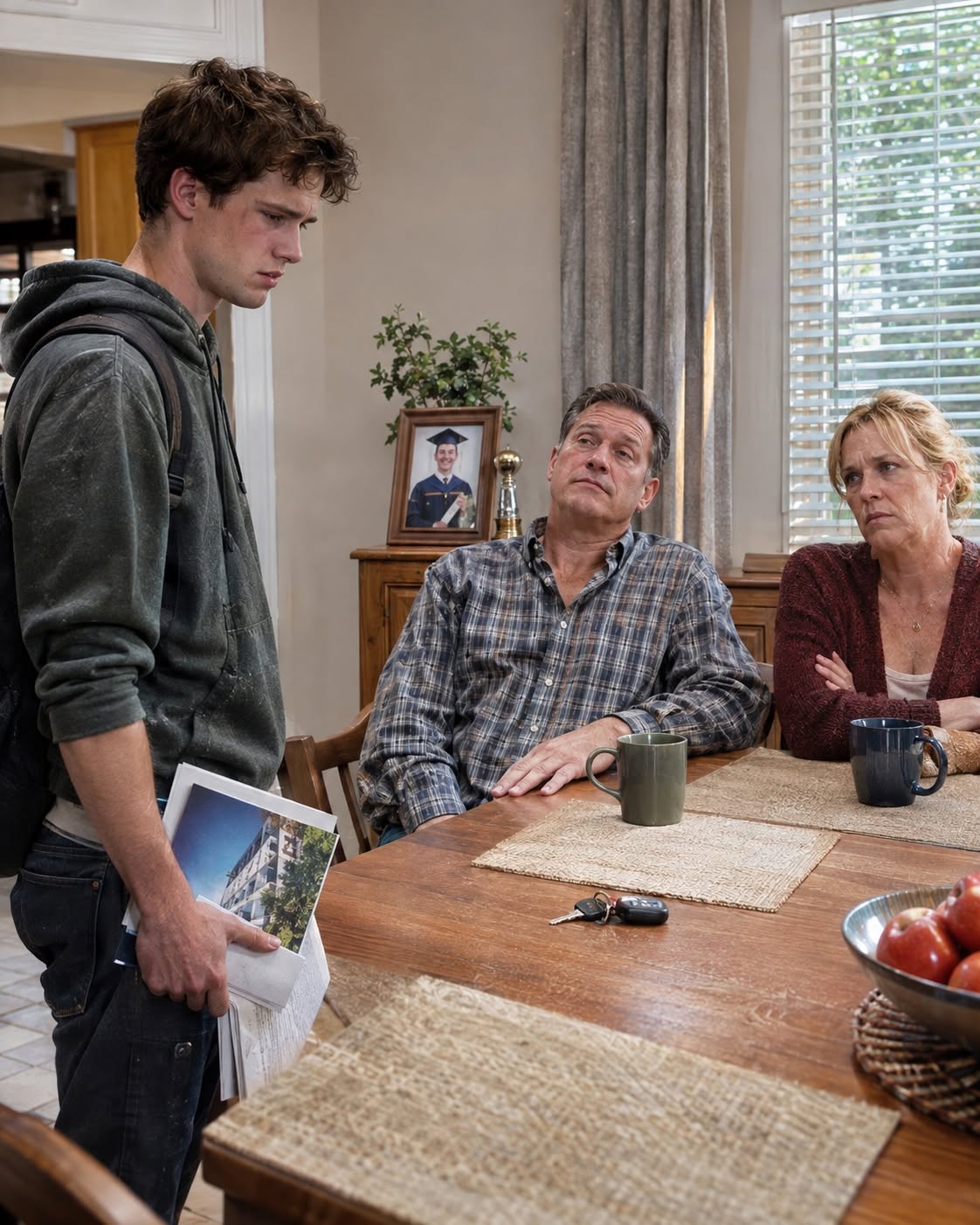
I laughed, but there was no humor in it.
“You thought it was the right thing to tell your daughter she wasn’t worth investing in?”
He looked down.
“I didn’t know how much those words would hurt.”
“Did you ever wonder how I paid for college?”
He swallowed.
“No.”
“Did you ever wonder whether I had enough to eat? Whether I could afford my textbooks? Whether I was sleeping in my car?”
His eyes lifted.
I leaned forward.
“I worked two jobs, Dad. I slept four hours a night. I sold my old laptop during my second semester because I couldn’t afford rent. I built my first engineering software project on a borrowed computer in the university library.”
My voice began to shake.
“And not once did you call to ask if I was okay.”
My father covered his face with both hands.
For the first time since he had entered my office, he looked genuinely ashamed.
“I know,” he whispered. “I know.”
I placed the letter on my desk.
“Why are you showing me this now?”
He hesitated.
“Because there’s something else.”
I felt my stomach tighten.
“What else?”
He reached into his jacket again and pulled out a second envelope.
This one contained several financial documents.
I recognized my mother’s handwriting on the first page.
It was a record of a savings account opened in my name when I was a child.
The balance listed on the statement was more than $38,000.
I stared at it.
“What is this account?”
My father shifted uncomfortably.
“Your grandparents opened it for you. They wanted to make sure you had something for college.”
I looked at him.
“My grandparents?”
He nodded.
“They deposited money into it every year. Your grandmother specifically told us not to touch it.”
I felt a cold sensation spread through my chest.
“Then why didn’t I know about it?”
My father looked toward the window.
“Your mother transferred the money into another account when your brother was having financial trouble.”
I stared at him.
“She took my college savings?”
He nodded.
“She told herself she would replace it when things improved.”
“And did she?”
He didn’t answer.
He didn’t need to.
I sat back in my chair.
For years, I had believed my parents simply hadn’t believed in me. That was painful enough.
Now I was discovering that they had actively taken something that had been meant for my future and given it to the son they claimed needed more help.
“How much is left?” I asked.
“Nothing.”
I closed my eyes.
For a moment, I wasn’t in my office anymore.
I was twenty years old again, sitting at a kitchen table with a stack of tuition bills, trying to calculate how many extra shifts I needed to work.
I remembered calling my mother and asking whether she could lend me two hundred dollars for a textbook.
She had told me to stop making excuses.
And all along, the money had been there.
My money.
My father started speaking again.
“Your mother wants to apologize. She knows what she did was wrong. She wants to see you.”
I looked at him.
“Does she know you brought me these documents?”
“Yes.”
“Does she know you told me the truth?”
He nodded.
“She asked me to explain everything.”
I let out a slow breath.
“Then why didn’t she come herself?”
My father looked uncomfortable.
“She’s afraid you won’t forgive her.”
I almost smiled.
“She’s afraid of being rejected?”
He lowered his head.
“Yes.”
I stood and walked toward the window.
Denver stretched beneath me. Cars moved through the streets, people hurried along the sidewalks, and somewhere below, a delivery truck was backing into an alley.
My life was happening in a city where my parents had never helped me build anything.
I had earned every inch of it.
And now, after all these years, they were asking me to rescue them.
“How much money do you need?” I asked.
My father looked up.
“About sixty thousand dollars would help us get back on our feet. We have debts, medical bills, and nowhere permanent to stay.”
Sixty thousand.
I could have written the check without changing my lifestyle.
That was the strange thing about success. The amount that once seemed impossible to me was now a number I could move between accounts.
But money wasn’t the question.
Trust was.
“Does Mom still have the account records?” I asked.
“Yes.”
“And does she still have the money from my grandparents?”
He shook his head.
“She spent it.”
“On my brother?”
“Mostly.”
I returned to my chair.
“Then I need to ask you something. Where is he?”
My father sighed.
“Your brother?”
“Yes.”
“He’s in Phoenix. He lost his apartment a few months ago, but he’s staying with a friend. He hasn’t been able to find steady work.”
I nodded.
“So the golden child is gone, and now you’re here.”
My father flinched.
“That’s not fair.”
“Isn’t it?”
“He loves us.”
“Then why isn’t he helping you?”
My father had no answer.
I looked at the documents again.
Something about the timing bothered me.
“Did you come here because you miss me, or because your other options ran out?”
He stared at the carpet.
After a long silence, he said something I wasn’t expecting.
“Both.”
It was the first honest answer he had given me.
“I miss you,” he continued. “I miss knowing what you’re doing. I miss hearing about your life. I know I don’t deserve to ask, but I wish I had been there.”
I looked at him for a long moment.
There was a time when I would have given anything to hear those words.
But hearing them now didn’t erase the years that had come before.
“I spent a long time imagining what it would be like if you finally told me you were proud of me,” I said.
He began to cry.
“I am proud of you.”
I nodded.
“I know. But I needed that when I was twenty, not when you needed a place to stay.”
He wiped his eyes.
I picked up the phone and called my assistant.
“Please ask my next meeting to wait fifteen minutes. And could you bring in the financial documents I left with you?”
My father looked confused.
“What are you doing?”
“I’m not writing you a check.”
His expression fell.
“But I am going to make some calls.”
I contacted a financial adviser I trusted and asked him to review the documents. Then I called an attorney who had helped me establish a charitable foundation a few years earlier.
My father watched as I explained the situation.
When I finished, I turned toward him.
“If I help you, there will be conditions.”
He nodded quickly.
“Anything.”
“First, I won’t give you sixty thousand dollars in cash. I’ll help arrange temporary housing and pay essential bills directly.”
“That’s understandable.”
“Second, Mom needs to acknowledge what happened to the money your parents gave me. I want a written account of every transfer. Not because I expect to recover every dollar, but because I won’t pretend it never happened.”
He looked uneasy.
“She might find that difficult.”
“So did I find it difficult to pay tuition without money that belonged to me.”
He nodded.
“Third, I won’t finance my brother’s lifestyle. If he needs work, I’ll help him find legitimate opportunities. But I’m not paying off his debts or funding another business idea.”
My father stared at me.
“You’d really do that?”
“I’ll give him the same opportunity I’d give anyone else. Nothing more.”
He sat silently.
Finally, he asked, “And what about your mother?”
I looked at him.
“She can apologize. Whether I forgive her is something I will decide in my own time.”
He nodded slowly.
For the first time, he seemed to understand that my office wasn’t a place where he could negotiate the past away.
It was simply where I had built a future without him.
Over the next two weeks, things moved faster than I expected.
My attorney confirmed that the account my grandparents had created had been closed years earlier. The money had been transferred through several accounts before being used for my brother’s expenses.
There was no realistic way to recover it.
But the documents revealed something even more disturbing.
My grandmother had written a letter to my mother shortly before she passed away.
She had asked whether I had received the money.
My mother had replied that everything was taken care of and that I was doing well.
She had lied to my grandmother, too.
I read that letter alone in my apartment.
It hurt in a different way.
My grandmother had believed she was protecting my future. She had trusted the people she thought would look after me.
And they had let her die believing I had received something I never got.
I sat on the floor for nearly an hour.
Then I folded the letter and placed it inside a small wooden box where I kept photographs of my grandparents.
I couldn’t change what had happened.
But I could decide what happened next.
I arranged a modest apartment for my parents near a medical clinic and paid the deposit directly. I covered three months of essential expenses while they worked with a financial counselor to create a realistic plan.
My father found temporary work at a warehouse.
It wasn’t glamorous, but he showed up every morning.
My mother called twice before I agreed to meet her.
The first time, she cried and asked me to understand how difficult things had been.
The second time, she apologized.
Not a perfect apology. Not one that magically made everything right.
But she finally said the words I had waited years to hear.
“I was wrong. I treated you as though you needed less because you were stronger. I confused your independence with permission to neglect you.”
I didn’t answer immediately.
Then I said, “I needed a mother, not a lesson in how to survive without one.”
She began crying again.
I let the silence remain.
A week later, I agreed to meet her at a small café downtown.
When she arrived, she looked nervous. Her hands trembled as she placed her purse on the table.
For several minutes, neither of us spoke.
Finally, she said, “You look so much like your grandmother.”
I smiled faintly.
“She was the one person who never made me feel like I had to earn her love.”
My mother’s eyes filled with tears.
“I know.”
We talked for almost an hour.
She told me about her financial struggles, my father’s health, and how my brother had become distant.
I listened, but I didn’t let the conversation turn into another request for money.
Before leaving, she reached across the table.
“Do you think we can ever be a family again?”
I looked at her hand.
“I don’t know. But if we try, it has to be different.”
She nodded.
And for once, she didn’t argue.
Three months later, something unexpected happened.
My brother called.
I hadn’t spoken to him in almost six years.
His voice sounded smaller than I remembered.
“Hey,” he said.
“Hey.”
He cleared his throat.
“Dad told me you helped them.”
“I did.”
“Why?”
I leaned back in my chair.
“Because they needed help.”
He was quiet.
Then he said, “I heard you didn’t give them the money they asked for.”
“No, I didn’t.”
“Mom said you made them sign some kind of agreement.”
“I asked for transparency and a plan.”
He sighed.
“You always make everything complicated.”
I almost laughed.
“That’s an interesting thing to say to the person whose college savings helped pay for your car.”
Silence.
Then he muttered, “I didn’t know about that.”
I believed him.
At least, I believed he hadn’t known the money originally belonged to me.
But he had known our parents were paying his expenses while I struggled.
“Listen,” he said, “I wanted to ask if your company is hiring.”
I glanced at my computer.
“What kind of position?”
“Anything, really. I’ve been doing delivery work, but it’s not enough.”
I considered my answer.
“I can send you a link to our public job listings. You can apply like everyone else. If your qualifications match something, I’ll make sure your application gets reviewed by the appropriate recruiting team.”
He sounded disappointed.
“You can’t just get me in?”
“No.”
“You’re my sister.”
“Exactly. And I don’t want either of us wondering whether you earned the position.”
He was silent for a moment.
Then he said, “I guess that’s fair.”
It was the first time I had ever heard him admit that.
He applied for a technical support role.
He didn’t get it.
But a recruiter recommended him for a customer operations position at another company, where his communication skills were a better fit.
He got the job two months later.
I was happy for him.
Not because he had finally failed enough to understand me, but because he was beginning to build something for himself.
One afternoon, he sent me a message.
I think I understand now why you were so angry. I had people making things easy for me, and I thought that was normal. You had to fight for everything. I’m sorry I never noticed.
I read it twice.
Then I replied:
Thank you for saying that. I hope we can do better from here.
It wasn’t a dramatic reconciliation.
There were no hugs in the rain or emotional speeches in front of the whole family.
There were simply small changes.
My father began calling occasionally, but he stopped asking for money.
My mother started asking about my work instead of comparing me to my brother.
My brother sent me photographs of his new apartment when he finally moved into a place of his own.
And I learned something I had never understood when I was younger.
Being successful doesn’t mean you have to reopen every door that once hurt you.
It means you get to decide which doors deserve to stay open.
About a year after my father first visited my office, I received a package in the mail.
Inside was a small envelope and a photograph.
The photograph showed me at age ten, standing between my grandparents in their backyard. I was holding a toy wrench, grinning at the camera.
On the back, my grandmother had written:
“She’ll build wonderful things one day. Just make sure someone reminds her how special she is.”
I sat at my desk, holding that photograph for a long time.
There was a letter from my father, too.
It was short.
He wrote that he had recently found a part-time job maintaining equipment at a community workshop. The work reminded him of the mechanical engineering program I had once wanted to pursue.
He said he had started volunteering there on weekends, helping teenagers learn basic repair skills.
Then came the final paragraph.
“I used to think investing in a child meant giving them money. Now I understand it also means showing up, paying attention, and believing in them before they have anything to prove. I cannot give you back the years I missed. I can only try not to waste the years I have left.”
I folded the letter carefully.
For a long time, I had believed that the greatest victory would be watching my parents regret what they had done.
But when the moment finally came, their regret wasn’t enough to heal me.
What helped was something else.
I had built a life where their approval was no longer necessary.
I had learned to say no without feeling guilty, to offer help without surrendering my boundaries, and to recognize that love without respect could become another form of control.
A few months later, I established a scholarship through my company for students pursuing engineering and technology degrees who were working their way through school.
I named it the Grandparents’ Promise Scholarship.
The first recipient was a young woman named Elena.
She had excellent grades, a part-time job, and a list of financial worries that sounded painfully familiar.
When I met her, she told me she was considering dropping out because she couldn’t afford another semester.
I handed her the scholarship letter.
She read it once.
Then again.
Her eyes filled with tears.
“Why would you do this for me?” she asked.
I smiled.
“Because someone should have done it for me.”
She hugged me before she left.
That evening, I returned to my corner office.
The city lights were beginning to glow beneath the windows.
My father’s first visit had changed something in my life, but not in the way he had expected.
He had come looking for financial rescue.
Instead, he had been forced to face the consequences of the choices he and my mother had made.
I had given them a chance to rebuild their lives, but I hadn’t given them ownership of mine.
And that was the difference.
I opened the small wooden box on my shelf and placed my grandmother’s photograph beside the scholarship documents.
For years, I had thought my story was about proving my parents wrong.
Now I understood that it was about becoming the person I needed when I was younger.
My parents had once told me I wasn’t worth investing in.
They were wrong.
Not because I had become wealthy, earned a prestigious title, or occupied a beautiful office overlooking Denver.
They were wrong because my worth had never depended on what they were willing to give me.
And the greatest thing I ever built wasn’t my career, my company, or even my financial security.
It was a life in which love no longer required me to make myself smaller.
Sometimes, the people who should have believed in us are the very ones who teach us to believe in ourselves.
But we don’t have to spend the rest of our lives waiting for them to finally understand.
We can take what they refused to give us and become the person who gives it to someone else.
And sometimes, that’s the most powerful kind of success there is.