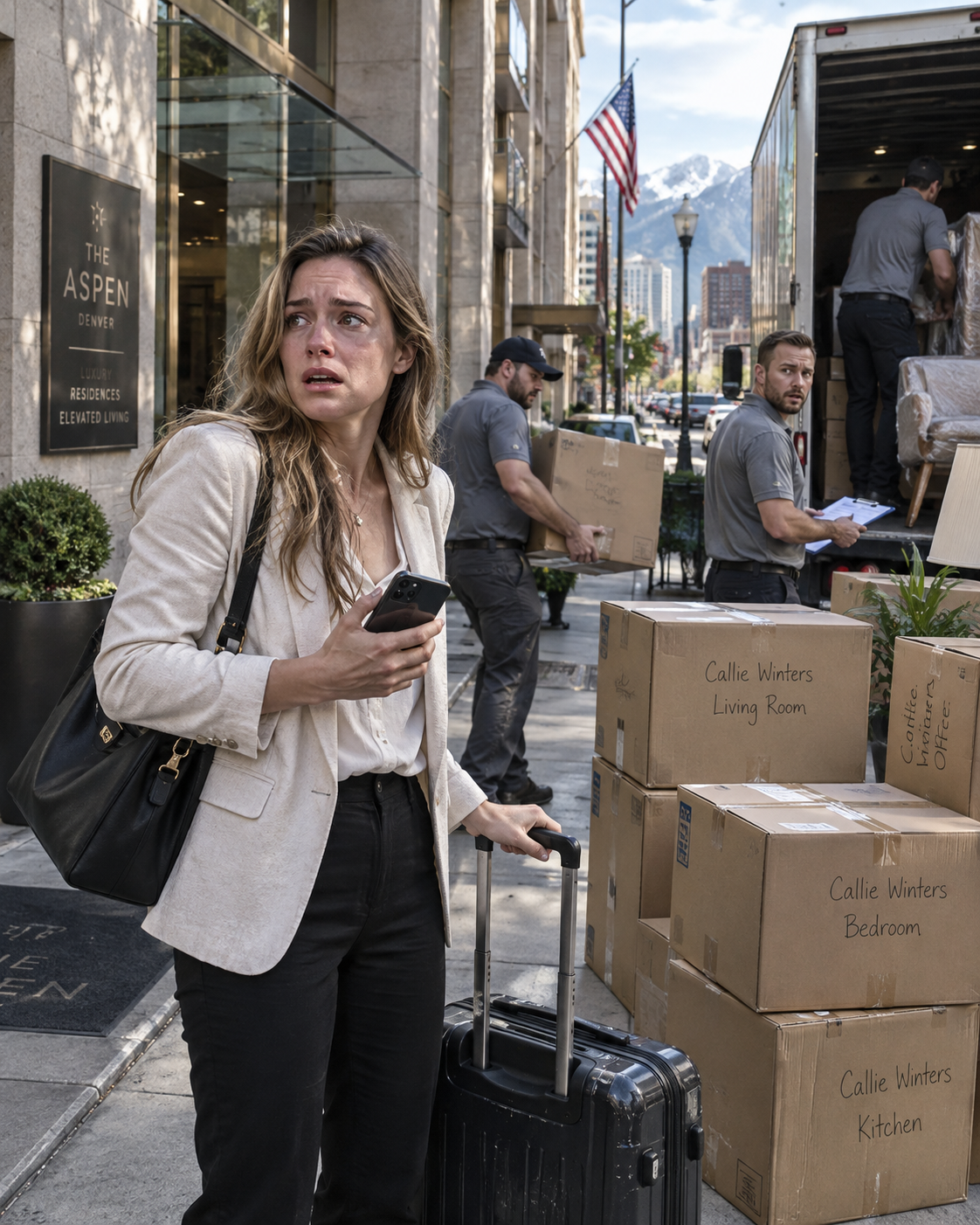
My movers started emptying my Denver penthouse in front of everyone while my mother texted
By sunrise, I was sitting across from Renee with a paper cup of coffee growing cold between my hands.
She had printed the forged sale agreement, the power-of-attorney update, the withdrawal history, and every email exchanged with the real estate agent.
She spread them across the table like pieces of a crime no one in my family wanted to call a crime.
“Look here,” she said.
She pointed to the signature on the property transfer.
“The line pressure is wrong.”
I stared at it.
It looked like my handwriting, but it looked like someone remembering my handwriting instead of writing it.
“What does that prove?”
“It proves someone copied you.”
Renee tapped another page.
“And this proves they planned it.”
The email was from my mother to the agent three weeks before I ever left for Seattle.
Callie is traveling and won’t be available, it said.
She is going through a difficult period and gets overwhelmed easily.
Please communicate through me.
My throat tightened.
“She told them I was unstable.”
“She needed a reason for people to stop asking questions,” Renee said.
I remembered every family gathering where my mother smiled and told relatives I worked too hard, traveled too much, cared too little about family.
At the time, I thought it was ordinary criticism.
Now it looked like preparation.
“What about Chelsea?” I asked.
Renee didn’t answer immediately.
Then she slid another folder toward me.
“Your sister owes approximately eighty-five thousand dollars.”
I frowned.
“For what?”
“Online gambling, short-term loans, and credit accounts.”
I sat back.
Chelsea had always been reckless, but I had imagined reckless meant shopping, late payments, and another rescue from Mom.
I had never imagined casino withdrawals at two in the morning.
“She told them she needed help with rent.”
“That’s what they told you.”
I stared at the bank statement.
The withdrawals from my account stretched across eleven months.
Small amounts.
Never enough to trigger a dramatic alert.
Two thousand six hundred.
Two thousand nine hundred.
One thousand eight hundred.
Always described as family emergencies.
“They were testing how much they could take without me noticing,” I whispered.
Renee nodded.
“They learned you wouldn’t question them.”
My eyes burned.
The worst part was that she was right.
Every time my mother had called crying about groceries, a medical bill, a car repair, or Chelsea’s latest crisis, I had transferred money without asking for receipts.
I thought that was what love looked like.
Apparently, they had been studying the limits of it.
“What about the buyer?”
“He saved every email.”
Renee opened her laptop and played a recorded call.
A male voice said, “Your mother told us you couldn’t attend closing because you were emotionally unwell.”
My stomach turned.
A woman spoke after him.
“She said you wanted the money to go toward your sister’s debts.”
I closed my eyes.
The humiliation was almost worse than the theft.
They had not only taken my home.
They had built a story where I looked too broken to defend myself.
Renee paused the recording.
“Callie, I need you to understand something.”
I looked at her.
“This is bigger than recovering property.”
“What do you mean?”
“They may have committed fraud against the buyer, forgery against you, and misuse of the power of attorney.”
I swallowed.
“Will they go to prison?”
“I’m not predicting that.”
She closed the folder.
“I’m telling you that you need to stop protecting them from the consequences of their own decisions.”
That sentence followed me all the way to court.
At the emergency injunction hearing, my mother arrived wearing the navy suit she saved for funerals and weddings.
My father carried himself like a man who still believed he could walk into any room and make people listen.
Chelsea wouldn’t meet my eyes.
Their attorney, Harold Bryce, asked the judge to treat the dispute as a family disagreement.
Judge Patricia Hollis looked over her glasses.
“Did the defendant sign the property transfer?”
Harold paused.
“They believed they had implied authority.”
The judge’s expression hardened.
“That was not my question.”
Silence.
Then the judge asked again.
“Did she sign it?”
Harold looked toward my parents.
No one answered.
The court froze the sale proceeds and blocked any further transfer of the property pending investigation.
It was not a victory yet.
It was simply the first door opening.
Outside the courthouse, my mother hurried toward me.
“You’ve destroyed your sister.”
I kept walking.
“She was already drowning.”
“We were trying to save her.”
“You were using my name to do it.”
My father stepped in front of me.
“You’re going to ruin this family over a building.”
I looked at him.
“It was never about the building.”
His face changed.
Maybe, for the first time, he understood.
It was about every time they had told me my feelings were excessive.
Every time they had called me selfish for saying no.
Every time they had made my generosity feel like a debt.
Every time they had quietly taught me that being a good daughter meant being available for whatever they decided to take.
Then Chelsea grabbed my sleeve.
“Please.”
I stopped.
She looked terrified.
“I didn’t know it would go this far.”
I pulled my arm away gently.
“You knew enough to sign.”
Her eyes filled with tears.
“I thought Mom said it was legal.”
“Then why did you copy my signature?”
She looked at the pavement.
That answer broke something inside me because silence was an answer too.
Six weeks followed.
The investigator traced the money trail through banks, loan companies, betting sites, and accounts opened under names I barely recognized.
The real estate agent surrendered her messages.
The notary provided appointment records.
The buyer handed over emails and a security recording from the office.
And then Renee called me one afternoon and said, “You need to come see this.”
We sat in a small conference room and watched the video.
My sister was seated at a desk.
My father stood behind her.
The forged transfer lay between them.
Chelsea was holding a pen.
“Sign it cleaner,” my father said.
She hesitated.
“I can’t make it look exactly like hers.”
“You’ve watched her sign a hundred times.”
My breath caught.
Chelsea copied the signature.
My father’s hand rested on her shoulder.
“Again.”
She did it again.
Then again.
Until the final version looked close enough to fool someone who wanted to be fooled.
I had to look away.
Renee shut the video off.
For a long moment, neither of us spoke.
“I’m sorry,” she said.
I nodded.
“I know.”
What hurt most was not seeing Chelsea betray me.
It was realizing she had watched me become the responsible one, the dependable one, the one who always paid, and decided that my strength was a resource she was entitled to consume.
The trial lasted three days.
The handwriting examiner explained why the signature was traced.
The financial investigator mapped the withdrawals.
The buyer described the lies they had been told.
The real estate agent admitted my mother had said I was too emotionally unstable to handle the sale.
My mother cried when she took the stand.
“We just wanted to help Chelsea.”
The prosecutor asked, “Why didn’t you ask Callie for the money?”
My mother looked at me.
“She would have said no.”
The courtroom went completely still.
I felt something inside me settle.
Not anger.
Not satisfaction.
Just certainty.
She was telling the truth for the first time.
I would have helped.
But I would have asked questions.
I would have demanded accountability.
I would have offered a repayment plan.
I might even have said no.
What they wanted was not help.
What they wanted was obedience.
When the judge asked my mother whether she had signed documents in my name, she finally broke.
“I signed them because she wouldn’t help otherwise.”
Chelsea started crying.
My father stared straight ahead.
The ruling came later that afternoon.
The sale was declared invalid.
My ownership of the penthouse was restored.
The court ordered repayment of the money taken from my accounts and additional damages tied to the fraud and legal costs.
The details mattered less to me than one sentence the judge delivered before we left.
“Family relationships do not create permission to take what does not belong to you.”
Outside, my mother caught my wrist.
“Please, Callie.”
I turned toward her.
“We’ll lose our house.”
For a second, I saw the woman who had packed my school lunches, stayed beside my bed when I had surgery, and taught me how to drive.
Then I saw the woman who had signed my name without asking.
“You lost my trust before you lost anything else,” I said.
Her fingers slipped from my wrist.
Two days later, the moving truck came back.
This time, it was carrying my life home.
I walked through the front door and stopped.
My grandmother’s quilt was folded on the sofa.
My books were still stacked beside the window.
A mug I had left in the dishwasher sat on the counter.
Everything looked exactly the same.
Except I wasn’t.
I went to the balcony and watched the Denver skyline turn gold.
For years, I had confused forgiveness with love.
I thought keeping the peace meant swallowing every insult, paying every bill, answering every crisis, and pretending betrayal did not hurt.
Now I understood something I wished I had learned sooner.
A boundary is not a punishment.
It is a line that tells people where your personhood begins.
My mother sent one message several weeks later.
I hope you’re okay.
I read it three times.
Then I put the phone face down.
I did not know whether I would ever answer.
Maybe someday I would.
Maybe someday Chelsea would recover from her debt and understand what she had done.
Maybe my father would finally admit that protecting a family does not mean hiding its worst behavior.
But I stopped waiting for any of that to heal me.
I started therapy.
I changed my passwords.
I moved every account to new institutions.
I removed every shared authorization.
And for the first time, I learned how to say no without writing a paragraph afterward to explain why.
The strangest part was how ordinary life felt after the storm.
I went to work.
I bought groceries.
I watered my plants.
I drank coffee by the same window where I had once spent nights wondering whether I had been too selfish to deserve my own home.
Then one rainy Thursday, nearly three months after the trial, I came home to find an envelope on my kitchen table.
There was no stamp.
No return address.
Only my name.
Callie.
I opened it carefully.
Inside was a single photocopy.
It was another document bearing my signature.
My heart began pounding before I even finished reading the heading.
It was dated two years before the penthouse sale.
And beneath my signature was a handwritten note in my mother’s unmistakable script.
She didn’t want you to know this.
I sat down slowly.
For several seconds, I could not breathe.
I read the note again.
Then I turned the page.
There was one more sentence.
“Ask your father what happened the night you had surgery.”
I stared at the words until the rain against the windows sounded like static.
Two years before they sold my home.
Two years before the first suspicious withdrawal.
Two years before anyone mentioned a power of attorney.
Something had happened while I was unconscious.
And suddenly, the penthouse was no longer the beginning of the story.
It was only the first secret I had discovered.
I reached for my phone and opened my father’s contact.
My thumb hovered over his name.
Then another message appeared from an unknown number.
“Don’t call him.”
A second message followed.
“You’re finally looking in the right place.”
I sat alone in the home they had tried to take from me, staring at those words while the city lights blurred beyond the glass.
For the first time, I realized I had spent my entire life believing my family knew a version of me that I had forgotten.
Maybe the truth was worse.
Maybe they had built that version of me on purpose.
And somewhere in a box I had never opened, there might still be proof of why.
The box was in the back of my bedroom closet, underneath winter coats and an old suitcase I had not touched since college.
I pulled it down and found my grandmother’s name written across the lid.
Inside were photographs, tax records, letters, and a thin folder labeled with the date of my surgery.
My pulse quickened.
The first page was a hospital consent form, but the second page was a financial authorization that had nothing to do with medicine.
My signature appeared at the bottom, yet it did not match the signature on the hospital form.
Someone had taken a legitimate document and attached another page behind it.
I sent photographs to Renee.
She called minutes later.
“The authorization they used may have started with a real document.”
I swallowed.
“And the rest?”
“May have been added afterward.”
I called my father, but he did not answer.
Then Chelsea called.
“Please don’t hang up.”
I almost did.
“I know about the surgery,” she whispered.
“What happened?”
She started crying.
“Dad had debts before you bought the penthouse.”
My hands went cold.
“Your grandmother left you money, and Mom thought they could control it.”
I remembered the strange conversations after the funeral and how quickly my parents had insisted on handling everything while I was grieving.
“They used my inheritance?”
“About seventy thousand dollars.”
The number was old, but the betrayal felt new.
“Why tell me now?”
“Because after what we did, I realized they were never going to stop.”
I asked the question that mattered most.
“Did you know about the penthouse sale?”
“Yes.”
“Did you help?”
Her silence lasted long enough to answer.
“I’m sorry,” she whispered.
“I know.”
I ended the call, not because I forgave her, but because I was tired of letting their choices control my breathing.
The older documents went to the investigators, and the evidence showed that the same pattern had started years before the penthouse sale.
My parents had not become dishonest overnight.
They had learned that secrecy was easier than asking me for permission.
The later settlement addressed the older theft, while Chelsea entered treatment for her gambling addiction and began repaying what she could.
My father sold his business.
My parents moved into a smaller apartment.
None of it felt triumphant.
It felt sad.
I had imagined justice would feel like fireworks.
Instead, freedom arrived quietly.
It came when I stopped checking my phone after every argument.
It came when I could hear the word “family” without automatically hearing “obligation.”
It came when I learned that saying no did not require a paragraph explaining why.
One Sunday morning, I carried my grandmother’s quilt onto the balcony and watched Denver wake beneath a pale sky.
I thought about the woman I had been before the movers came.
She believed love meant being available whenever anyone called.
She believed family deserved access to everything she had.
She believed protecting herself made her selfish.
I don’t believe those things anymore.
Love can be generous without being blind.
Family can matter without becoming entitled.
And forgiveness, when it comes, does not require reopening a door that should remain closed.
I never got the family I thought I had.
But I got something better than their approval.
I got a life that belonged entirely to me.
Weeks later, I found the photocopy from the anonymous envelope and turned it over one last time.
There, in my grandmother’s handwriting, was a sentence I had missed.
“Trust the version of yourself that notices when something feels wrong.”
I cried quietly at the kitchen table.
Not because I was still broken.
Because someone had believed my instincts before I knew how to trust them myself.
I folded the note and placed it inside the quilt.
Then I stood at the window as sunlight spread across the skyline.
For years, my family had called me too sensitive, too dramatic, too difficult.
Maybe I had simply been the first person willing to say, “This is not okay.”
Sometimes that person has to stand alone before they can hear how strong their own voice really is.
I still have the penthouse.
I still carry the scars.
I still have complicated feelings about Chelsea.
And I still grieve the parents I thought I had.
But I no longer carry their version of me.
That belongs to them.
My life belongs to me.
Every morning when I unlock my front door, I remember the moving truck outside my building and the suitcase at my feet.
Then I remember what came after.
The truth.
The boundary.
The choice.
Sometimes losing someone’s approval is the price of finally hearing yourself.
And once you do, there is no going back.
I set the old folder beside my grandmother’s quilt and turned off the light.
Behind me, my phone buzzed.
A message from an unknown number waited on the screen.
“Your grandmother left one more thing for you.”
For the first time, I smiled instead of shaking.
I didn’t know what was inside the next envelope.
But I knew something the old Callie never had.
Whatever the truth was, this time, I would decide what to do with it.