My mother handed me a chore list while everyone else loaded their bags for the lake.
I called my sister the next morning.
Not Dad.
Not Mom.
My sister.
Her name was Megan, and for most of our lives, we’d lived under the same roof without ever really knowing each other.
She answered on the first ring.
“Hey,” she said quietly.
“Hey.”
There was a long silence.
Then she asked, “Can we meet somewhere Mom doesn’t know about?”
Something in her voice made me sit up.
“What’s going on?”
“I found something. And I think you need to see it.”
We agreed to meet at a little diner outside town, the kind of place where the waitress knew everybody’s order and nobody cared if you sat in a booth for two hours.
Claire offered to come.
I told her I needed to do this alone.
She kissed my forehead.
“Just remember,” she said, “you don’t owe anyone forgiveness because they finally decided to tell the truth.”
When I reached the diner, Megan was already there.
She looked exhausted.
There were dark circles under her eyes, and a thick envelope sat beside her coffee.
I slid into the booth.
“Is everything okay?”
She gave a small, humorless laugh.
“No. Actually, I don’t think anything has been okay for a long time.”
Then she pushed the envelope toward me.
Inside were printed screenshots from our family’s group chat.
A group chat I hadn’t known existed.
The name at the top was “Lake Crew.”
I scrolled through messages dating back several years.
There were jokes, pictures, restaurant recommendations, reservations, and endless conversations about what everyone should bring.
Then I saw my name.
Aunt Linda had written, “Are we inviting Eli this year? I can pay for his cabin if money’s the issue.”
Mom had responded, “Don’t worry about Eli. He doesn’t enjoy family trips. He’s happier keeping an eye on the house.”
That message was from six years ago.
Another conversation, three years later, made my stomach tighten.
My cousin had asked whether Claire and I were coming.
Mom replied, “Eli’s working again. You know how he is. Always choosing that truck over family time.”
Dad had reacted with a thumbs-up.
I stared at the screen.
It was one thing to suspect your parents had been making excuses.
It was another to see them doing it casually, as if excluding their own son was just another vacation detail.
“There’s more,” Megan whispered.
She turned to a conversation from the previous summer.
Brett had suggested inviting two of his college friends.
Mom immediately agreed.
Then Megan had written, “What about Eli and Claire?”
Mom’s response appeared beneath it.
“We already have enough people. Besides, Eli knows where he belongs.”
I read that sentence three times.
Where he belongs.
For years, I’d told myself maybe there was a misunderstanding.
Maybe my parents genuinely believed I was too busy.
Maybe nobody realized how much it hurt.
But that sentence destroyed the last excuse I’d been making for them.
Megan wiped her eyes.
“I should’ve said something.”
I looked up.
“Why didn’t you?”
She swallowed.
“Because Mom always made it sound like you were difficult. She said you hated family gatherings and looked down on everyone. After a while, I stopped questioning it.”
“And you believed her?”
“Yes.”
Her answer surprised me.
No excuses.
No attempt to make herself look better.
“That’s why I’m here,” she continued. “I can’t change what I believed. But I’m not going to keep believing it now.”
I folded the papers carefully.
“Thank you for showing me.”
She nodded, but her expression didn’t soften.
“Eli, that’s not the only reason I wanted to meet.”
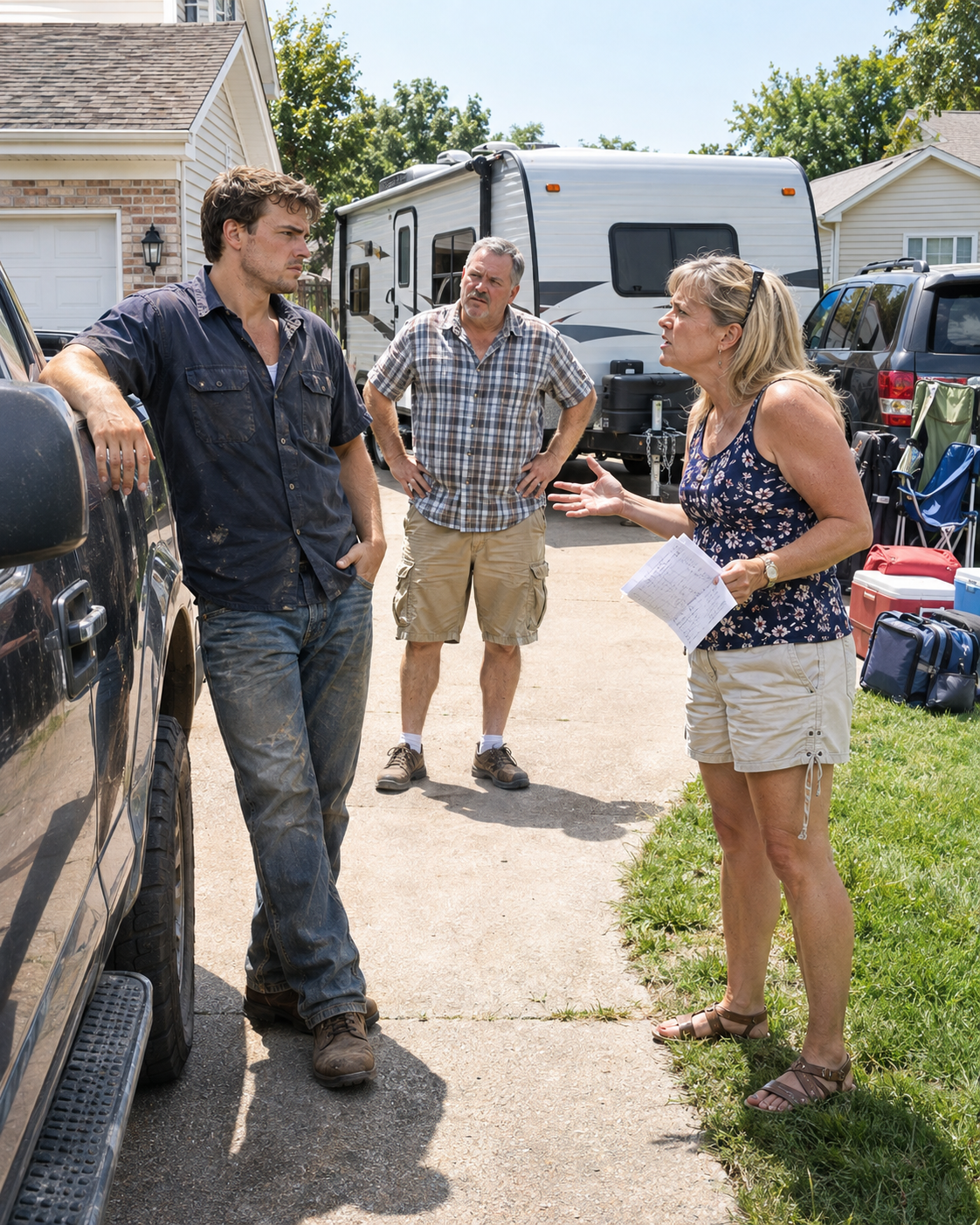
She reached into her purse and pulled out her phone.
“After the accident, Brett and Dad were talking about the insurance claim.”
I felt something cold settle in my stomach.
“What about it?”
“Brett told the adjuster you inspected the trailer before we left and said his SUV could pull it.”
For a moment, I couldn’t speak.
Then I laughed.
Not because it was funny.
Because the lie was so outrageous that my brain needed somewhere to put it.
“I told him the exact opposite.”
“I know,” Megan said. “I heard you.”
She leaned forward.
“And when I told Brett he couldn’t say that, he told me to stay out of men’s business.”
I looked at her.
“What did Dad say?”
“Nothing.”
Of course.
Dad had built an entire life around saying nothing whenever silence benefited him.
Megan continued.
“The insurance company is asking questions because the trailer was too heavy for Brett’s SUV. Brett thinks if he can make it sound like you approved everything, they’ll stop looking at what he did.”
My hands tightened around the envelope.
This wasn’t just a family argument anymore.
They were dragging my professional reputation into their mess.
I paid for our coffees and drove straight to the towing company.
My manager, Ray, had been in the business for thirty years.
He was a big man with a gray beard and the patience of someone who had watched people make incredibly stupid decisions around heavy machinery.
He listened while I explained everything.
Then he sighed.
“Eli, I was wondering when you were going to tell me.”
My chest tightened.
“Tell you what?”
“Your brother-in-law’s already called here.”
“He’s not my brother-in-law.”
“Good. Because I wouldn’t claim him either.”
Ray opened a folder on his desk.
Brett had filed a formal complaint.
According to his version, I had encouraged him to tow the trailer, refused to help the family until they were stranded, and then deliberately overcharged for the recovery.
He even claimed I’d threatened to leave them on the roadside unless they paid immediately.
I read the complaint slowly.
Ray watched me.
“Any truth to that?”
“No.”
“Didn’t think so.”
He turned his computer screen toward me.
“We have your dispatch records, recovery photographs, signed paperwork, and the responding officer’s information. Everything about the recovery was handled correctly.”
I released a breath I hadn’t realized I was holding.
“But the lie about approving the trailer?”
“We’ll deal with that if an investigator contacts us. Don’t speculate, and don’t sign anything that isn’t accurate.”
Then Ray leaned back.
“Son, I’ve watched you work twelve-hour shifts in freezing rain without complaining. Don’t let people who wouldn’t give you a seat at dinner convince you that your integrity is negotiable.”
I nearly cried right there in his office.
Instead, I nodded.
“Thanks, Ray.”
He waved me toward the door.
“And take tomorrow off.”
“I don’t need—”
“That wasn’t a suggestion.”
When I got home, Claire was sitting at the kitchen table.
I laid the screenshots in front of her.
She read them without speaking.
When she reached the message about where I belonged, her face changed.
“She really wrote that?”
I nodded.
Claire put the paper down.
“Then we’re done letting her decide where you belong.”
That evening, Dad called again.
This time, I answered.
“Eli,” he said, sounding relieved. “Thank God. Your mother and I have been worried.”
“About me or the insurance claim?”
Silence.
Then he cleared his throat.
“I think we should talk.”
“I agree.”
“Good. Come over tomorrow.”
“No.”
He sounded confused.
“What do you mean, no?”
“I’ll meet you at Grandpa’s house. Four o’clock. Just you and Mom.”
“Why Grandpa’s?”
“Because I want someone there who knows the difference between keeping peace and avoiding the truth.”
Dad didn’t answer immediately.
Then he said, “Fine.”
Grandpa was sitting on his porch when Claire and I arrived the next afternoon.
He was eighty-one now, but his handshake was still firm.
He looked at my face and nodded toward the door.
“They’re inside.”
“Did you tell them why we’re here?”
“Nope.”
He stood slowly.
“Figured it was time they listened to you instead.”
Mom sat on the couch with a tissue in her hand.
Dad stood by the fireplace.
Neither greeted Claire.
Mom immediately started crying.
“Eli, I don’t understand why you’re doing this to us.”
I sat across from her.
“That’s the problem, Mom. You still think this is something I’m doing to you.”
She pressed the tissue against her eyes.
“We gave you a home. Food. Clothes. We helped you get started in life.”
“You were my parents. I was your child.”
Dad frowned.
“Nobody’s saying you weren’t.”
“Then why was I treated like the hired help every summer?”
Mom looked away.
I placed the screenshots on the coffee table.
“Did you know Aunt Linda offered to pay for my cabin?”
Dad stared at the papers.
Mom’s crying stopped.
“Where did you get those?”
“Does it matter?”
“Those were private conversations.”
“So were the lies you told everyone about me.”
She looked toward Grandpa.
“Are you going to let him speak to me this way?”
Grandpa didn’t move.
“He’s speaking calmly. That’s more than I can say for most family arguments I’ve witnessed.”
Mom’s face turned red.
I pointed to the message on top.
“What did you mean when you said I knew where I belonged?”
She stared at the paper.
Then she said something I’ll never forget.
“You were always so independent.”
I blinked.
“What?”
“Even as a teenager, you preferred being alone. Megan needed us more. She needed experiences and attention. You were always capable of taking care of yourself.”
For a second, the room was completely silent.
Then Claire spoke.
“He was fifteen.”
Mom turned toward her.
“This is a family matter.”
Claire didn’t raise her voice.
“I’m his wife. And you keep talking about a fifteen-year-old boy like he was an employee who volunteered for overtime.”
Dad rubbed his forehead.
“Can we stop turning everything into an accusation?”
I looked straight at him.
“Did you know she was telling people I didn’t want to come?”
He stared at the floor.
“Dad.”
He finally nodded.
“Sometimes.”
“Did you ever correct her?”
“No.”
“Why?”
His answer came so quietly I almost missed it.
“Because it was easier.”
Those four words hurt more than anything Mom had said.
He continued.
“We needed somebody to watch the house. Boarding the dogs was expensive. Your mother handled the vacation planning, and I figured you were okay with it.”
“Did you ever ask?”
He shook his head.
“No.”
I looked at both of them.
“You didn’t accidentally forget me. You got comfortable leaving me behind.”
Mom stood.
“I will not sit here and be called a terrible mother.”
“Then stop making this about what people call you.”
Her eyes narrowed.
“Your grandmother would be ashamed of how you’re treating us.”
Grandpa’s cane struck the wooden floor.
The sound cracked through the room.
“Enough.”
Everyone turned.
I’d heard Grandpa angry before, but never like this.
“Don’t you dare use my wife to silence that boy.”
Mom opened her mouth.
Grandpa raised one hand.
“She asked him to wait because she believed time would teach him wisdom. She never asked you to spend ten years taking advantage of his patience.”
He looked at me.
Then his expression softened.
“And Eli, there’s something I owe you an apology for too.”
I frowned.
“What?”
“I knew you were being left out. I tried to make those summers easier, but I should’ve challenged your parents instead of just teaching you how to survive their choices.”
My throat tightened.
“Grandpa, you were the only one who—”
“I know what I did right. I’m telling you what I did wrong.”
He took a breath.
“Your grandma was a wonderful woman. But asking a child to carry ten years of hurt quietly was too much. Love doesn’t mean pretending the people we love never made mistakes.”
I looked down at my hands.
For years, I’d treated Grandma’s promise like a sacred rule.
Hearing Grandpa say that she might have been wrong didn’t make me love her less.
It made me realize I’d been allowed to protect myself all along.
Dad sat down heavily.
“I’m sorry, son.”
I looked at him.
He seemed smaller than I’d remembered.
“Sorry for what?”
He hesitated.
Then he answered.
“For choosing what was convenient instead of what was right.”
It was the first real apology I’d ever heard from him.
But Mom wasn’t finished.
“Fine,” she said sharply. “Everyone wants to blame me. But can we at least agree to stop telling strangers our private business?”
I frowned.
“What strangers?”
She pointed at my phone.
“People are talking. Brett says you embarrassed us on the side of the road.”
I stared at her.
“Brett filed a false complaint against me.”
Mom’s eyes widened.
Dad looked up.
“What complaint?”
I explained the accusation.
Dad slowly turned toward Mom.
“Did you know about this?”
She didn’t answer.
“Did you?” he repeated.
Finally, she said, “Brett was upset. He said he needed to protect himself financially.”
Dad closed his eyes.
“And you let him put our son’s job at risk?”
Mom folded her arms.
“I didn’t tell him what to say.”
Claire stood.
“I think we’re finished here.”
I rose beside her.
Dad started to speak, but I held up a hand.
“I came here because I wanted to know whether we could have an honest conversation.”
I looked at Mom.
“Now I know how much work that’s going to take.”
She stared at me.
“So you’re punishing us?”
“No. I’m setting boundaries. There’s a difference.”
We left without another argument.
Two days later, the situation got worse.
Megan called while I was finishing a shift.
“Eli, have you seen Facebook?”
I hadn’t.
She sent me a link.
Mom had posted a video from the roadside recovery.
It showed me standing beside my truck, holding the shoebox.
The clip began with Dad asking for a discount.
Then it jumped to me saying, “The company charges the same rates for everyone.”
The caption read:
“Heartbroken that our own son chose money over family when we were stranded. We raised him to help others, but apparently loyalty has a price.”
My stomach dropped.
There were already dozens of comments.
Some people called me selfish.
Others said I should be ashamed.
A woman I’d known since elementary school wrote that she’d never use our towing company again.
Then I saw Brett’s comment.
“He also told us the vehicle was safe to tow with. Now he’s acting innocent.”
I sat in my truck for a long time.
Ten years of silence had taught my family one dangerous lesson.
They believed they could control the story if they spoke first.
But this time, I wasn’t fifteen.
I called Ray.
He had already seen the post.
“Don’t respond while you’re angry,” he said.
“I wasn’t planning to.”
“Good. I’ve got something more useful than an argument.”
He explained that the company would respond to the business-related accusations with its records, through the appropriate channels.
“Your family’s personal problems aren’t our business,” Ray said. “But false claims about our work are.”
That night, Megan made her own post.
She didn’t insult anyone.
She didn’t share the chore lists.
She simply wrote that she’d been present when I warned Brett not to tow the trailer, that the recovery was completed professionally, and that the family’s disagreement had nothing to do with the company’s charges.
Then she added one sentence.
“My brother spent ten summers taking care of our family while we went on vacations he was never invited to attend. I was wrong not to question it sooner.”
I read it three times.
For the first time in my life, someone in my immediate family was defending me without being asked.
Mom deleted her post the next morning.
But screenshots had already spread.
Aunt Linda called me that afternoon.
She was crying.
“Eli, sweetheart, I had no idea.”
I believed her.
She told me she’d asked about me almost every year.
Mom always had an explanation.
Sometimes I was working.
Sometimes I was tired.
One year, according to Mom, I’d said I didn’t enjoy spending time with relatives who asked too many questions.
“I thought you didn’t like us,” Aunt Linda whispered.
“I never disliked you.”
She let out a broken sigh.
“Then we’ve lost a lot of time.”
That conversation hurt in a different way.
Because suddenly I understood how much bigger the damage was than ten missed vacations.
It was ten years of relationships I might have had.
Conversations that never happened.
Birthday parties I wasn’t invited to.
Cousins who grew up thinking I didn’t care about them.
Mom hadn’t just kept me away from the lake.
She’d kept people away from me.
A week later, Megan came over with a cardboard box.
Claire answered the door.
I was in the garage, replacing a worn cable on my work equipment.
Megan walked in carrying the box with both hands.
“I broke up with Brett,” she announced.
I nearly dropped my wrench.
“What?”
She set the box on my workbench.
“He wanted me to sign a statement saying you approved the trailer.”
My expression hardened.
“And?”
“I told him I wouldn’t lie.”
She looked down.
“He said I was choosing you over our future.”
“What did you say?”
“I told him a future built on lying wasn’t much of a future.”
I stared at her.
She gave a nervous laugh.
“Apparently, he didn’t like that answer.”
I pulled her into a hug.
It was awkward at first.
We hadn’t hugged in years.
Then she started crying against my shoulder.
“I’m so sorry, Eli.”
I held her tighter.
“I know.”
When she finally stepped back, she pointed to the box.
“There’s something else.”
Inside were old photographs.
Pictures of our family from when we were kids.
Christmas mornings.
Birthday parties.
Backyard cookouts.
Near the bottom was a photograph of Grandma standing beside a little wooden cabin.
I recognized the place immediately.
It was a small cabin near the lake, where Grandpa used to take us fishing when I was little.
Grandma had loved it.
I hadn’t been there since she died.
“Where did you find these?”
“Mom was cleaning out the garage. She told me to throw the box away.”
I picked up the cabin photograph.
On the back, in Grandma’s handwriting, were six words.
“Save a place for each other.”
My eyes burned.
Megan leaned against the workbench.
“I remember that cabin.”
“Me too.”
“Remember when Grandpa fell off the dock?”
I laughed.
“He was trying to teach us how to skip rocks.”
“And he dropped his entire tackle box in the water.”
We both started laughing.
For a moment, we were children again.
Not the responsible one and the favored one.
Just a brother and sister who once believed summer meant being together.
Then Megan grew quiet.
“Do you think we could go back?”
I looked at the photograph.
“Maybe.”
She smiled.
“Without Mom and Dad?”
I thought about it.
“Not to punish them. But because I think we need to build something of our own first.”
She nodded.
“I’d like that.”
A few days later, Dad came to my house alone.
He didn’t call ahead.
I opened the door and found him standing on the porch, holding the yellow chore lists.
The same papers I’d left beneath his windshield wiper.
For a moment, I thought he was returning them because he didn’t want to deal with them.
Then I noticed his hands trembling.
“I’ve been reading these,” he said.
I stepped outside and closed the door behind me.
He looked down at the stack.
“Every single one.”
I waited.
He turned over the first sheet.
“That year you were fifteen, I remember telling your mother you should stay home because the dogs needed someone.”
He swallowed.
“I remember being irritated when you looked disappointed.”
I said nothing.
“I thought you were being ungrateful. I never considered that you were grieving your grandmother too.”
A breeze moved through the trees.
Dad stared toward the driveway.
“I read what you wrote about the summer your truck broke down.”
I remembered that year.
I’d spent most of my savings replacing the transmission.
Mom had still expected me to buy dog food and keep the yard maintained while they were gone.
“You wrote that you ate peanut butter sandwiches for four days because you didn’t have enough money for groceries.”
I nodded.
Dad’s face crumpled.
“I didn’t know.”
“You didn’t ask.”
He pressed his lips together.
“You’re right.”
Then he handed me a folded document.
It was a copy of the corrected statement he’d submitted to the insurance company.
He had confirmed that I’d warned them the trailer was unsafe for Brett’s SUV and that I’d had no involvement in deciding to proceed.
I read it carefully.
“Why did you finally tell them?”
Dad looked at me.
“Because Brett wanted you to pay for a mistake we made.”
He paused.
“And because I realized I’d spent your whole life letting someone else decide what kind of father I was going to be.”
I studied his face.
For the first time, he wasn’t asking me to make things easier.
He wasn’t asking me to forget.
He was simply standing there with the truth.
“I can’t forgive everything in one afternoon,” I said.
“I know.”
“And I’m not coming back to take care of the house every time you go somewhere.”
He gave a sad little smile.
“I wouldn’t ask.”
I looked at the papers.
“Are you sure?”
His smile disappeared.
Then he nodded.
“Yes.”
We stood quietly for a while.
Finally, he asked, “Would you consider having dinner with me sometime? Just us?”
I thought about Grandpa’s advice.
Having a voice didn’t mean I always had to say no.
It meant I could choose when to say yes.
“Maybe next week,” I said.
Dad’s eyes filled.
“I’d like that.”
He turned to leave.
Then he stopped.
“Son?”
“Yeah?”
“I’m proud of the man you’ve become.”
Years earlier, those words would have meant everything to me.
Now they meant something different.
They were nice to hear.
But I no longer needed them to believe I was worth loving.
The following Saturday, Dad and I had dinner at a barbecue place outside town.
It wasn’t perfect.
He still slipped into old habits, defending decisions before acknowledging the harm they’d caused.
But whenever I pointed it out, he stopped and listened.
It was uncomfortable.
Sometimes we sat in silence for several minutes.
Yet for the first time, I didn’t feel responsible for filling every quiet moment with forgiveness.
Two weeks after that, an insurance investigator contacted the towing company.
Megan and Dad had both provided truthful statements.
The investigator reviewed the vehicle and trailer specifications, the collision report, and the claims made about my involvement.
Brett’s allegation that I’d approved the tow was not supported.
The company confirmed that the complaint against my professional conduct had been closed without any disciplinary action.
Ray walked into the garage carrying the paperwork.
“Looks like you’re officially done being everybody’s scapegoat.”
I smiled.
“That’s going to take some getting used to.”
He clapped my shoulder.
“Good thing you’ve got the rest of your life to practice.”
Brett stopped contacting me after that.
He tried calling Megan several more times.
She never went back.
She told me later that losing him hurt, but realizing how easily he’d been willing to lie about her brother hurt more.
As for Mom, she remained silent.
At first, I thought her silence meant she was angry.
Then Aunt Linda told me Mom had stopped attending family dinners.
Apparently, relatives had started asking uncomfortable questions.
Questions about the vacations.
About the messages.
About why she’d been willing to risk my job to protect Brett.
Mom didn’t like having no easy answers.
One evening, she finally sent me a text.
“I hope you’re happy. Everyone thinks I’m a monster now.”
I stared at it.
Then I typed:
“I wanted you to understand how I felt. I never wanted people to hate you.”
Her reply came immediately.
“Well, that’s what happened.”
I thought about arguing.
About explaining that I’d never posted the screenshots publicly.
That she’d been the one who put our dispute online.
That Megan had simply corrected her false claims.
Instead, I wrote:
“I’ll talk when you’re ready to discuss what happened without blaming me for other people’s reactions.”
She didn’t respond.
And for once, I didn’t chase after her.
By late August, Grandpa suggested we take a weekend trip.
To the lake.
I almost laughed when he said it.
“Seriously?”
“Why not?”
“I think we’ve established that place has some baggage.”
Grandpa grinned.
“Then let’s unpack it.”
He’d arranged to rent the old cabin for two nights.
The original owners had passed away years earlier, but their granddaughter still rented it occasionally.
He invited Claire, Megan, and me.
Nobody else.
I hesitated.
Grandpa looked at me.
“Eli, that lake was part of your childhood before it became a place where people left you behind. Don’t give them ownership of every good memory.”
That settled it.
We left Friday afternoon.
For the first time in ten years, I wasn’t the person standing in the driveway waving goodbye.
I was the one loading bags into the car.
Claire packed sandwiches.
Megan brought board games.
Grandpa insisted on bringing a little portable speaker loaded with his favorite old songs.
As we pulled onto the highway, I glanced at our packed bags.
No chore list.
No dogs waiting for me to feed them.
No instructions taped to the refrigerator.
Just a road leading somewhere I’d wanted to go for years.
When the lake came into view, I felt a strange pressure behind my ribs.
It was beautiful.
More beautiful than I remembered.
Sunlight spilled across the water.
Small boats drifted near the shoreline.
Children ran along the docks, shouting as their parents called after them.
I stood beside the car for a long moment.
Claire slipped her hand into mine.
“You okay?”
I nodded.
“I think so.”
Grandpa came around the car carrying his old fishing hat.
“Well, don’t just stand there. We’ve got ten years of fishing to catch up on.”
That weekend wasn’t extravagant.
We didn’t rent a speedboat or eat at expensive restaurants.
We grilled burgers, played cards, and spent one afternoon fishing from the dock.
Megan caught the biggest fish.
Grandpa accused her of cheating.
She accused him of using bait older than she was.
Claire laughed so hard she nearly spilled her lemonade.
For the first time in years, being around family felt easy.
Not because nobody made mistakes.
But because nobody was afraid to admit them.
On Saturday night, Grandpa brought his speaker onto the cabin’s porch.
An old jazz song began playing.
He held out his hand to Megan.
“Come on, young lady. Your brother isn’t the only one who needs dancing lessons.”
She laughed.
“I have two left feet.”
“So did he.”
I protested.
“Hey!”
Grandpa winked.
“Your grandmother fixed that. Mostly.”
He guided Megan through a clumsy turn.
Then Claire pulled me onto the porch.
We danced beneath the string lights while the lake shimmered beyond the trees.
Grandpa watched us with tears in his eyes.
When the song ended, he approached me.
“Shoulders back,” he said.
I straightened automatically.
He smiled.
“There he is.”
I hugged him.
And standing there, I realized something.
For ten years, I’d been waiting for my family to make room for me.
I hadn’t understood that I could build a life where I never had to beg for a place.
The next morning, Megan asked to take a photograph.
We stood on the dock.
Grandpa in the middle.
Claire beside me.
Megan grinning with her arms around both of us.
When she showed me the picture, I stared at it longer than necessary.
I was smiling.
Really smiling.
Not the tight expression I’d worn at mandatory family dinners.
Not the polite grin I used when relatives asked why I never came to the lake.
I looked happy.
And for once, nobody was missing from the photograph because someone had decided they didn’t belong.
A month later, Mom showed up at our house.
It was a Sunday afternoon.
Claire and I had been making dinner when the doorbell rang.
Mom stood on the porch holding a small paper bag.
She looked nervous.
I’d never seen her look nervous around me before.
“Hi, Eli.”
“Hi, Mom.”
She glanced behind me.
“Is Claire home?”
“Yes.”
Mom nodded.
“I brought something.”
She held out the bag.
Inside was Grandma’s old recipe book.
The cover was worn and stained with flour.
I recognized it immediately.
Grandma used to let me help make cinnamon rolls every Christmas morning.
Mom cleared her throat.
“I found this while cleaning out the kitchen.”
I turned the book over.
A little handwritten note was tucked inside.
In Grandma’s handwriting, it read:
“The best tables always have room for one more.”
My eyes stung.
Mom looked down.
“I’ve been thinking about what you said.”
I waited.
She took a shaky breath.
“I told myself you didn’t need the things Megan needed. You were quiet, and you helped without complaining. After a while, I stopped seeing how much I was asking of you.”
She looked at me.
“And when you finally complained, I was embarrassed. So I tried to make you the problem.”
It wasn’t a perfect apology.
But it was the first time she’d admitted anything without immediately blaming me.
“I’m sorry,” she whispered. “For the vacations. For the lies. For what I said about you online. All of it.”
I looked at the recipe book.
A part of me wanted to hug her.
Another part remembered every July morning I’d watched everyone drive away.
Both feelings were real.
“Thank you for saying that,” I told her.
She wiped her cheek.
“Can we start over?”
I shook my head gently.
“We can’t start over, Mom. Those ten years happened.”
Her face fell.
“But we can decide what happens next.”
She looked up.
I continued.
“I need time. And if we’re going to have a relationship, things have to be different. No guilt trips. No lying about me to other people. No acting like I owe you favors because you raised me.”
She nodded slowly.
“I understand.”
“I hope you do.”
She glanced toward the kitchen.
“Could I come in?”
I hesitated.
Then I said, “Not today.”
For a moment, I saw the old expression cross her face.
The one that meant I was being difficult.
But she stopped herself.
She nodded.
“Okay.”
Then she looked at me again.
“Maybe another time?”
“Maybe.”
After she left, Claire came to stand beside me.
“How do you feel?”
I looked down at Grandma’s recipe book.
“Sad. Relieved. A little angry.”
Claire slipped her arm around my waist.
“Sounds about right.”
I smiled.
“Yeah.”
Over the following months, things changed slowly.
Dad kept our occasional dinner plans.
Sometimes we talked about work.
Sometimes about Grandpa.
And sometimes about the years he’d missed.
He learned that listening wasn’t the same as waiting for his turn to explain himself.
Megan became a regular visitor.
She came over for movie nights, helped Claire repaint the guest bedroom, and started dating someone who treated her opinions like they mattered.
Mom began making an effort too.
She sent invitations instead of instructions.
She asked whether I was available instead of assuming I would be.
And when I declined something, she didn’t always like it.
But she learned to accept the answer.
There were still difficult conversations.
Still moments when old habits returned.
I didn’t pretend otherwise.
Forgiveness, I discovered, wasn’t a single dramatic moment where everything became beautiful again.
It was a decision that could only grow alongside changed behavior.
Sometimes I could offer a little trust.
Sometimes I needed distance.
Both were allowed.
The following July, another family lake trip was organized.
This time, the invitation came directly to Claire and me.
Dad called personally.
He said they’d reserved an extra cabin.
Already paid for.
No chores.
No expectations.
He asked whether we’d like to join them.
I looked across the kitchen at Claire.
She was making coffee, wearing one of my old T-shirts.
She smiled at me.
For a moment, I remembered the fifteen-year-old boy standing in my parents’ kitchen with a yellow piece of paper in his hands.
I thought about how badly he’d wanted someone to say, “Of course you’re coming.”
Then I answered Dad.
“Thanks for inviting us.”
He waited.
“But Claire and I already have plans that weekend.”
There was a pause.
Then Dad said, “All right, son. Maybe next time.”
“Maybe.”
When I hung up, Claire raised an eyebrow.
“What did you decide?”
I smiled.
“That we’re going to the mountains.”
She laughed.
“Really?”
“Really.”
We’d been talking about renting a cabin near a national park.
Hiking in the mornings.
Cooking dinner together.
Watching the stars from the porch.
Nothing fancy.
Just time that belonged to us.
Claire stepped close and kissed me.
“Sounds perfect.”
That evening, I went into our bedroom closet and found the shoebox.
It was empty now.
The yellow lists were gone.
But I sat on the edge of the bed holding it, remembering the boy who’d filled it year after year.
I’d once thought the box was proof of how little my family cared.
Now I saw something else.
It was proof that even when nobody listened, my feelings had been real.
I didn’t need to preserve every hurt forever to prove it had happened.
I also didn’t need to erase the past to build a better future.
I took the shoebox into the garage.
Inside, I placed one photograph.
The picture of the four of us smiling on the dock.
Grandpa.
Megan.
Claire.
Me.
On the back, I wrote the date.
Then I added a sentence.
“The first summer I chose where I belonged.”
I closed the lid and put the box on a shelf.
Not because I planned to fill it with grievances again.
But because I wanted to remember the difference between surviving a family and truly being part of one.
A few weeks later, Grandpa came over for dinner.
After we ate, he asked me to put on some music.
I found one of his favorite records and set it on the turntable we’d bought for our living room.
The familiar melody filled the house.
Grandpa stood and held out his hand to Claire.
“May I?”
She smiled.
“Of course.”
They danced slowly across the floor.
I watched him move, remembering all those afternoons when he taught me to keep my shoulders straight.
Then he looked over at me.
“Eli, come here.”
I stepped closer.
He placed Claire’s hand in mine.
“Your turn.”
As I began to dance with my wife, Grandpa sat down in his favorite chair.
He watched us quietly.
Then he said, “Your grandma would be proud of you.”
I smiled.
“I hope so.”
He shook his head.
“Not because you kept that promise for ten years.”
I looked at him.
“Then why?”
“Because you finally understood what she wanted you to learn.”
I thought about that.
Maybe Grandma had believed patience would protect our family.
Maybe she’d hoped that growing older would teach me which battles deserved my voice.
But the greatest lesson hadn’t come from waiting ten years.
It had come from realizing that peace without honesty wasn’t peace at all.
It was just silence.
And silence had almost cost me the people I loved, along with the person I was supposed to become.
I looked at Claire.
At Grandpa.
At the little home we’d made.
Then I thought about Megan laughing on the dock, Dad learning to listen, and Mom slowly discovering that apologies couldn’t replace accountability.
Some relationships were healing.
Others still had a long way to go.
And that was okay.
I didn’t need everyone to change overnight.
I didn’t need to win every argument.
I didn’t even need the next family vacation to prove I mattered.
Because the boy who used to wait for an invitation had finally grown into a man who knew he deserved one.
And if an invitation never came, he could still make beautiful memories somewhere else.
Grandpa smiled from his chair.
“Shoulders back, Eli.”
I straightened, laughing.
“They are, Grandpa.”
He nodded.
“Good. Keep them that way.”
And I did.
Not because I was trying to look stronger.
But because I no longer needed to make myself smaller.
For ten summers, I’d been the person left behind.
Now, wherever I went, I was finally bringing myself along.
The End.