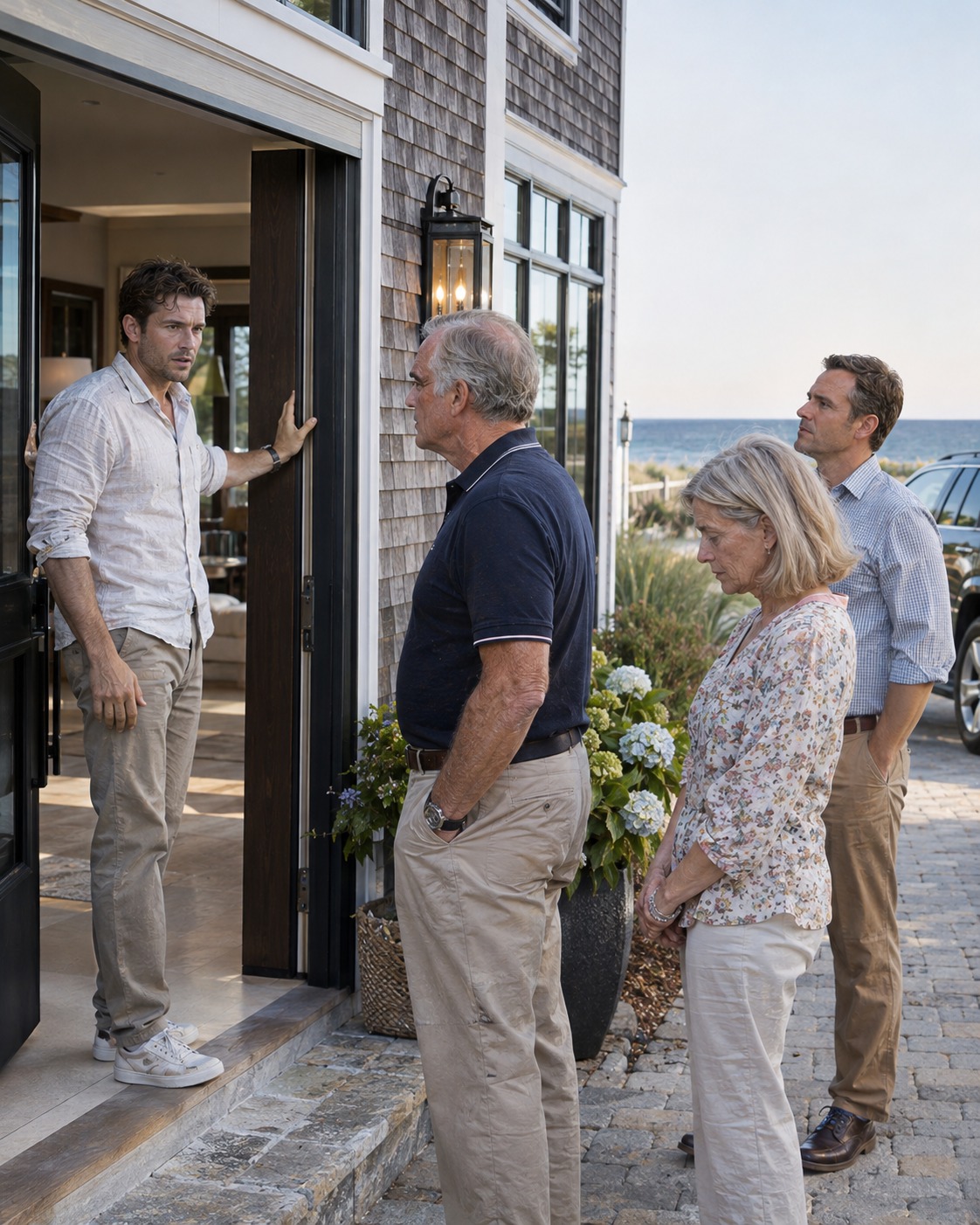
My father stood in the doorway of my $4.2 million beachfront home, staring at the ocean behind me.
Three days after my father’s apology, I received a photograph from Toby.
It showed our old backyard.
The grass was overgrown, the wooden fence leaned slightly to one side, and the oak tree near the back corner looked bigger than I remembered.
But what caught my attention was the tree house.
It was still there.
The paint had faded, and part of the railing was missing, but the little structure my father and I had built when I was nine was somehow still standing.
Underneath the photograph, Toby had written, “Dad hasn’t let anyone tear it down. He still checks the boards every spring.”
I stared at the picture longer than I wanted to admit.
Then I typed, “Does he know you sent me this?”
“No,” Toby replied. “But I thought you should see it.”
I didn’t respond immediately.
Part of me wanted to believe the tree house meant something. Another part remembered that a man could preserve a childhood memory while still failing the adult his child became.
Both things could be true.
The following Saturday, I met Toby at a small coffee shop about forty minutes from my house.
I arrived early and chose a table near the window.
When he walked in, I almost didn’t recognize him.
The skinny teenager I remembered had become a broad-shouldered young man with tired eyes and grease beneath his fingernails.
He spotted me and stopped.
For a moment, neither of us moved.
Then he smiled.
“Hey, big brother.”
Something tightened in my chest.
I stood and hugged him.
We held on longer than either of us probably expected.
Over coffee, we talked about ordinary things first. His job repairing commercial air-conditioning systems. My life near the beach. The terrible old pickup truck he’d somehow kept running.
He remembered details about me that I’d forgotten myself.
Like how I used to sneak him extra dessert when Dad wasn’t looking.
And how I’d once spent an entire afternoon helping him build a cardboard spaceship in the garage.
Eventually, I asked why he’d left college.
His smile faded.
“It’s complicated.”
“I’ve got time.”
He stared into his coffee.
“Dad helped Bradley through law school. He helped Audrey with her wedding. But when I told him engineering wasn’t the right fit for me, he said he wasn’t going to waste money on another son who couldn’t finish what he started.”
I felt my stomach tighten.
Another son.
Toby looked embarrassed.
“I tried to stick it out. But I hated every day. I wanted to work with my hands. Electrical systems, construction, things like that.”
“So you left?”
“Yeah. And for a while, Dad barely spoke to me.”
I looked out the window.
Six years had passed, and somehow our family was still having the same argument.
“Why didn’t you call me?” I asked.
Toby gave a small, sad laugh.
“Because everyone made it sound like you’d become this millionaire who thought he was too good for us.”
I turned back toward him.
“Who told you that?”
He hesitated.
“Bradley mostly. Audrey sometimes.”
I felt an old anger begin to rise.
But Toby shook his head.
“I don’t believe it anymore. I just wish I’d figured that out sooner.”
We sat quietly for a while.
Then I asked whether he wanted to go back to school.
“Maybe trade school,” he said. “I’d like to become a licensed electrician eventually. Maybe run my own business.”
“Sounds like a good plan.”
He looked surprised.
“You don’t think I should finish my engineering degree?”
“Do you want to?”
“No.”
“Then there’s your answer.”
For the first time that afternoon, he laughed without looking nervous.
Before we left, I told him that if he ever needed advice, a ride, or simply someone to listen, he could call.
He nodded.
Then he said something that stayed with me.
“It’s weird. I was worried you’d treat me like a failure. But you’re the first person who’s actually asked what I want.”
That night, I thought about how easily disappointment could become a family tradition.
And how much courage it sometimes took to break one.
For the next month, Toby and I talked regularly.
Sometimes he called about work. Sometimes we watched football together at my house. Once, he spent an entire Saturday helping me repair a damaged section of my deck.
I offered to pay him.
He refused.
“Brothers can help each other without sending invoices,” he said.
I smiled.
Then I handed him enough cash to cover his gas and lunch.
He rolled his eyes but accepted it.
Things with Dad moved more slowly.
We exchanged a few short messages.
He asked about the weather near the coast.
I asked whether his knee was still bothering him.
Neither of us mentioned forgiveness.
Strangely, that made the conversations easier.
Then, one Tuesday afternoon, Toby called while I was reviewing an investment proposal.
His voice sounded wrong.
“Can I ask you something?”
“Of course.”
“If someone takes out a loan against a house, can the bank force them to sell it?”
I sat upright.
“Depends on the loan. Why?”
A long silence followed.
Then Toby said, “I think Mom and Dad are going to lose the house.”
For several seconds, I couldn’t speak.
The house.
The one with the crooked fence and the tree house in the backyard.
The house where I’d learned to ride a bicycle.
The house where Dad had told me I was throwing my future away.
“What happened?”
Toby took a shaky breath.
“Bradley needed money for his firm. Dad used the house as collateral on a business loan. I don’t know all the details, but they’re behind on payments. There’s a letter from the bank.”
“Does Dad know you found out?”
“Yeah. He told me not to worry about it.”
I closed my laptop.
“How much?”
“I heard them talking about almost three hundred thousand dollars.”
I leaned back in my chair.
Suddenly, the unexpected visit to my beachfront home made considerably more sense.
The house hadn’t just been a reunion.
It had been an emergency.
And somehow, nobody had thought I deserved to know the truth.
I thanked Toby for telling me.
Before hanging up, he spoke again.
“Please don’t think I called because I want you to fix it.”
“I know.”
“I just didn’t want you finding out after everything was gone.”
His voice cracked slightly.
“It’s still our house, you know?”
I understood.
I just wasn’t sure what that meant anymore.
That evening, I called my father.
He answered on the fourth ring.
“Hello?”
“Dad, I know about the loan.”
Silence.
Then he sighed.
“Toby told you.”
“Yes.”
“He shouldn’t have involved you.”
“Apparently nobody in this family thinks I should be involved until they need my money.”
The words came out harsher than I’d intended.
Dad didn’t argue.
Instead, he said, “You’re right.”
That stopped me.
He continued quietly.
“I signed papers I shouldn’t have signed. Bradley convinced me his firm would recover. I thought I was helping my son.”
“And now?”
“Now I may lose the house.”
I rubbed my forehead.
“Why didn’t you tell me when you came here?”
“Because I was ashamed.”
“Bradley wasn’t ashamed.”
“No,” Dad said. “I suppose he wasn’t.”
I waited.
Then he said something unexpected.
“I didn’t call you to apologize because I wanted you to pay the loan.”
I wanted to believe him.
But after six years of silence, trust wasn’t something I could switch on.
“Then why did you come to my house in the first place?”
Another long pause.
“Bradley said if you saw us together, you might remember what family meant.”
I closed my eyes.
There it was.
The plan beneath the reunion.
Dad’s voice became strained.
“I let him convince me. And when I saw your home, I realized how wrong all of it was. You’d built a life, and we walked into it without permission because we wanted something.”
For the first time, I heard genuine disgust in his voice.
Not toward me.
Toward himself.
“I won’t ask you for money,” he said. “Not now. Not ever.”
We talked for another few minutes.
I told him I wasn’t ready to visit.
He said he understood.
After hanging up, I sat in the dark living room, watching the lights of fishing boats far out on the water.
I had enough money to help.
That wasn’t the difficult part.
The difficult part was knowing whether helping would repair anything or simply teach my family that consequences disappeared whenever they reached my front door.
Two days later, the situation became worse.
My attorney, Claire, called.
She had represented me during the acquisition of my company and remained one of the few people I trusted with complicated financial matters.
“Have you agreed to back a business venture connected to your brother’s law firm?” she asked.
“No. Why?”
“Because someone has been circulating documents that suggest you have.”
My heart began pounding.
Claire forwarded me a presentation.
It contained financial projections, a proposed restructuring plan, and a section titled “Strategic Investor Support.”
There, in black and white, was my full name.
Underneath it were descriptions of my software company’s successful acquisition and my personal investment experience.
The document didn’t directly say I’d invested.
It used carefully chosen language implying that my participation was expected.
I recognized Bradley’s style immediately.
He’d always been good at saying something without technically saying it.
“Is this legal?” I asked.
“That depends on what representations were made to potential investors. But you need to stop anyone from using your name without authorization.”
I asked her to send a formal notice.
Then I called Bradley.
He answered cheerfully.
“Hey! I was just thinking about you.”
“Remove my name from your investment materials.”
His tone changed.
“What?”
“You heard me.”
“It’s just a preliminary presentation.”
“You never asked my permission.”
“Come on. We’re brothers.”
“That’s not authorization.”
Bradley exhaled sharply.
“You know, I thought after everything Dad said, you might finally start acting like part of this family.”
My hand tightened around the phone.
“You used my name to make your business look financially secure.”
“I was trying to save our parents’ house!”
“By implying I’d agreed to something I never agreed to?”
“It wasn’t a guarantee.”
“Then you shouldn’t have any problem removing it.”
He went quiet.
Then he said, “You really have no idea what it’s like to be desperate anymore, do you?”
I almost laughed.
I remembered that grocery store parking lot.
I remembered checking my bank account before buying bread.
I remembered wondering whether I could make payroll.
“I know exactly what desperation feels like,” I said. “I just never used your name to get myself out of it.”
I hung up.
The next week was exhausting.
Claire contacted the people who had received the presentation. Bradley’s firm withdrew the materials and issued corrections.
But the damage within our family was already done.
Audrey sent me a message calling me selfish.
She said Bradley had made mistakes, but that threatening legal action against a family member was cruel.
I replied with one sentence.
“Using my name without permission was his decision, not mine.”
She sent six more messages.
I didn’t answer.
Then Mom called.
I expected another lecture about family loyalty.
Instead, she asked whether she could see me.
Alone.
I agreed to meet her at a quiet restaurant near my house.
When she arrived, she looked smaller than I remembered.
Her hair had more gray in it, and there were deep lines around her eyes.
She sat across from me and carefully folded her hands.
“I owe you an apology,” she said.
I waited.
“Not for one thing. For years of things.”
Her voice trembled.
“When your father stopped inviting you to family gatherings, I knew it was wrong. I knew you were hurting. But I kept telling myself that if I stayed calm, everyone would eventually make peace.”
I looked down at the table.
“I needed you, Mom.”
“I know.”
“No. I don’t think you do.”
She swallowed.
I told her about my twenty-third birthday.
How I’d bought a small grocery-store cupcake and eaten it alone at my desk after midnight.
How I’d opened my phone three different times, hoping someone from home had remembered.
Nobody had.
Mom covered her mouth.
“I thought you didn’t want to hear from us.”
“Who told you that?”
“Your father said you needed space.”
I shook my head.
“I needed a mother.”
She started crying.
For years, I’d imagined that seeing her cry would make me feel vindicated.
Instead, I just felt tired.
“I can’t get those years back,” I said.
“I know.”
“And I can’t become the person who fixes every problem because everyone suddenly remembers I’m family.”
She wiped her eyes.
“I’m not asking you to.”
We sat there for nearly an hour.
Before leaving, she reached across the table.
This time, I let her take my hand.
It wasn’t forgiveness.
But it was the first time in years I hadn’t felt completely alone with the past.
A few days later, Toby called with another development.
Bradley had found a lender willing to refinance part of the debt.
There was one condition.
Someone with steady employment and a clean credit history needed to sign as an additional guarantor.
Bradley’s finances were too damaged.
Dad’s income wasn’t sufficient.
Audrey had already refused.
And now Bradley was pressuring Toby.
“He says it’s temporary,” Toby told me. “Just until the firm gets back on its feet.”
My blood ran cold.
“Toby, don’t sign anything.”
“I haven’t.”
“Promise me.”
“I promise.”
He hesitated.
“But if I don’t, they might lose the house.”
I looked toward the ocean.
For a moment, I saw the little boy who used to follow me around the backyard, asking whether he could help build things.
“You are not responsible for repairing a mistake you didn’t make,” I said.
He was quiet.
Then he whispered, “That’s what I needed to hear.”
The following Sunday, I drove to my parents’ house.
I hadn’t been there in almost six years.
The neighborhood looked strangely unchanged.
The same mailboxes.
The same cracked sidewalks.
The same basketball hoop two houses down.
But when I pulled into the driveway, the place seemed smaller than it had in my memories.
Dad opened the door.
He looked genuinely surprised.
“You came.”
“We need to talk.”
He stepped aside.
Mom was in the kitchen. Audrey sat at the dining table, scrolling through her phone.
Bradley stood near the fireplace.
And Toby was on the couch, looking miserable.
Nobody spoke as I entered.
Bradley recovered first.
“Well, look who finally decided to show up.”
I ignored him.
“Where are the refinancing papers?”
Dad frowned.
“What papers?”
Bradley shifted.
“It’s a private financial matter.”
“Toby told me you want him to guarantee the loan.”
Dad turned slowly toward Bradley.
“You said he was only reviewing options.”
Bradley threw up his hands.
“That’s what we’re doing.”
I looked at Toby.
He seemed almost ashamed.
Dad noticed.
Then he asked his youngest son a question I’d never heard him ask any of us.
“Do you want to sign?”
Toby shook his head.
“No.”
Dad nodded once.
“Then you won’t.”
Bradley’s face reddened.
“Are you serious? We could lose everything!”
Dad turned toward him.
“We?”
“This is our family home!”
“And you’re asking your younger brother to risk his future to protect it.”
Bradley pointed at me.
“He could solve this with one check. But he’d rather sit on millions and watch us suffer.”
I felt everyone’s eyes move toward me.
There it was again.
The number in my bank account had become more important than the person sitting in the room.
I took a breath.
“I won’t fund your firm. And Toby isn’t signing that loan.”
Bradley laughed bitterly.
“Of course. The successful brother gets to make all the rules.”
“No,” I said. “I’m making decisions about my own money. Toby gets to make decisions about his future.”
Bradley turned to Dad.
“Say something.”
Dad stood very still.
For a second, I saw the man from six years earlier.
The man who believed authority meant making everyone obey.
Then he walked over to Toby.
He placed a hand on his shoulder.
“I made one son feel worthless because he chose a different future,” Dad said quietly. “I’m not doing it to another.”
The room went silent.
Bradley stared at him.
“So you’re choosing them over me?”
Dad shook his head.
“I’m choosing to stop hurting my children just because I’m afraid.”
Bradley grabbed his coat.
“You’ll regret this when the bank takes the house.”
Dad didn’t stop him.
The front door slammed.
Audrey followed a few minutes later, muttering that everyone had become unreasonable.
For the first time in my life, my father didn’t demand that I apologize for upsetting the family.
He simply sat down.
And looked exhausted.
We spent the next two hours discussing the situation.
I explained that I wouldn’t pay off Bradley’s obligations.
But I offered to cover the cost of an independent attorney and financial counselor so my parents could understand their options without relying on Bradley’s promises.
Dad initially refused.
“That’s still your money.”
“It’s advice, Dad. Not a bailout.”
He considered that.
Then he nodded.
“Okay.”
The consultation revealed how serious things had become.
The house was worth enough to cover the secured loan if sold promptly, but not if the situation deteriorated and additional costs accumulated.
Their attorney also discovered that some of Bradley’s financial projections had been dangerously optimistic.
Dad had signed the agreement without understanding how quickly the debt could become his responsibility.
He was furious.
But this time, he didn’t direct that anger at the easiest person to blame.
He asked the attorney what he could do.
The answer wasn’t pleasant.
Sell the house voluntarily.
Pay the debt.
Move somewhere smaller.
Start over.
Dad spent three days thinking about it.
Then he made the decision.
He would sell.
When Mom told me, I felt a sharp sadness I hadn’t expected.
I’d spent years convincing myself that the house no longer mattered.
Yet suddenly, the thought of strangers living there hurt more than I wanted to admit.
I considered buying it.
I could have afforded to.
For one afternoon, I even looked at comparable properties and thought about making an offer.
Then I called Toby.
“Would you want me to keep the house?”
He was quiet for a moment.
“Do you actually want it?”
“I don’t know.”
“Then don’t buy it because we’re scared to lose it.”
I smiled sadly.
When had my little brother become so wise?
He continued, “Maybe the house isn’t the thing we need to save.”
I didn’t answer.
But I knew he was right.
Over the following weeks, Dad worked with the attorney and a real estate agent.
The house sold faster than anyone expected.
There was enough money to clear the secured debt and cover the expenses, though my parents walked away with considerably less than they’d planned for retirement.
Bradley’s firm still faced separate obligations, and Dad refused to sign anything else.
For once, Bradley had to face his own financial decisions without someone else absorbing the consequences.
He blamed me.
Then Dad.
Then the economy.
Eventually, he stopped calling.
I hoped he’d learn something from it.
But I wasn’t going to organize my life around waiting for him.
The day before my parents moved, Toby asked if I’d come help him remove a few things from the backyard.
I agreed.
When I arrived, moving boxes filled the hallway.
The living room walls were bare.
I could see pale rectangles where family photographs had hung for decades.
Mom was packing dishes in the kitchen.
Dad was outside.
I found him standing beneath the old oak tree, looking up at the tree house.
“Still holding together,” he said.
“Barely.”
He smiled.
Then he reached for the ladder.
“Want to take one last look?”
I hesitated.
The last time I’d climbed into that tree house, I’d been a teenager.
Back then, I’d believed that growing up meant eventually becoming someone my father would admire.
Now I was standing in the same yard with more money than I’d ever imagined, and admiration no longer seemed like the thing I needed.
I climbed anyway.
The wooden floor creaked beneath my weight.
Dust covered the corners.
Someone had carved my initials into one of the boards.
I remembered doing it with a pocketknife I’d been forbidden to use.
Dad climbed up behind me.
He settled carefully on the opposite side.
For a while, we looked out over the neighborhood.
Then he said, “I used to come up here after you fell asleep.”
“I know. You told me.”
“Not just to reinforce the boards.”
I turned toward him.
He smiled faintly.
“Sometimes I’d sit here and wonder what kind of man you’d become.”
I swallowed.
“You weren’t happy with the answer.”
His expression changed.
“No. I wasn’t happy when you stopped becoming the man I’d already decided you should be.”
The words settled between us.
“I thought if I pushed you hard enough, you’d find your way back to the future I understood,” he continued. “And when you didn’t, I treated your independence like a betrayal.”
I looked at my old initials.
“Do you know how many times I wanted to call you?”
His eyes filled.
“I’ve thought about that.”
“I didn’t need you to believe my company would succeed. I just needed you to believe I was worth loving if it failed.”
Dad lowered his head.
For a long time, he said nothing.
Then he whispered, “You were.”
I closed my eyes.
“You didn’t make me feel that way.”
“I know.”
Outside, a truck passed on the street.
Somewhere nearby, a dog barked.
The world continued moving while two men sat inside a tree house, trying to understand six years of silence.
Finally, Dad spoke.
“I can’t change what I did. And I don’t want you to feel responsible for making me feel better about it.”
He paused.
“But if you’ll let me, I’d like to spend whatever time I have left being a better father.”
I looked at him.
“I’m not ready to pretend we’re close.”
“Then we won’t pretend.”
“I might still be angry sometimes.”
“You have a right to be.”
“And I need you to stop expecting my choices to make sense to you.”
Dad nodded.
“I can try.”
I considered that answer.
It wasn’t perfect.
But it was more honest than a promise he’d never make another mistake.
“Okay,” I said.
His eyes lifted.
“Okay?”
“We can try.”
He started crying.
I’d seen my father angry, disappointed, proud, and frustrated.
I’d almost never seen him cry.
I didn’t know what to do.
So I reached across the little wooden floor and put my hand on his shoulder.
For once, it felt like enough.
After a while, Toby called up from below.
“You two planning to move into that thing?”
We laughed.
Dad wiped his face.
Then he climbed down to help with the last boxes.
Before leaving, I took the board with my initials carved into it.
Dad carefully removed it using an old screwdriver.
He handed it to me without saying anything.
I put it in the trunk of my car.
For the first time, I was taking something from that house without feeling like I was stealing a piece of my past.
Three months later, my parents were settled in a small rental home about twenty minutes from their old neighborhood.
Dad started doing occasional carpentry jobs for neighbors.
Mom volunteered twice a week at a community food pantry.
They didn’t have the retirement they’d imagined.
But they seemed calmer.
There were fewer expensive dinners and fewer conversations about who was the most successful.
Dad began calling Toby every Sunday.
Sometimes he asked about his work.
Sometimes he simply listened.
Toby enrolled in an electrician apprenticeship program.
He earned his place through an entrance assessment and an interview, and I attended the small gathering where he celebrated his acceptance.
When he showed me the letter, he looked more excited than I’d ever seen him.
“First step toward my own company,” he said.
“I’ll be your first customer.”
“Only if you pay full price.”
“Family discount?”
“Absolutely not.”
We both laughed.
Audrey eventually sent me a message.
It was shorter than her previous ones.
She admitted she’d been angry about her divorce and frightened about her finances. She said seeing my success had made her feel like she’d failed.
It wasn’t a complete apology.
But she did acknowledge that she’d treated me unfairly.
I told her I appreciated her saying so.
I didn’t invite her to my house.
Not yet.
Bradley remained silent.
I occasionally heard updates through Toby.
He’d left his old firm and taken a position at a smaller practice.
Apparently, losing control of his career had been difficult for him.
I hoped he’d find his footing.
But I no longer confused wishing someone well with giving them access to my life.
Then, eight months after my father first appeared at my beachfront home, something happened that I never would have predicted.
I invited him over.
Not for a family reunion.
Not for a holiday.
Just a Saturday afternoon.
He arrived carrying a small wooden box.
“I made you something,” he said.
Inside was a handmade picture frame.
It was simple and slightly uneven, with carefully sanded edges.
He’d used a small piece of wood from the old tree house.
Inside the frame was a photograph of me at nine years old, standing proudly on the tree house ladder.
My father stood beside me, holding a hammer.
On the back, he’d written:
“You were building your future long before I understood what that meant.”
I read it twice.
Then I looked at him.
“Thank you, Dad.”
He nodded, clearly fighting tears.
We spent the afternoon drinking coffee on the deck.
He asked about my investments, but not how much money I had.
He asked whether I was happy.
That question meant more than he could have imagined.
Later, as we walked along the wooden steps leading toward the beach, Dad noticed one of the boards had become loose.
He crouched to examine it.
“Looks like this needs reinforcing.”
I smiled.
“Probably.”
He looked up.
“Want me to fix it?”
Something about the question caught me off guard.
Years ago, my father would have grabbed a toolbox and repaired it without asking.
He would have assumed he knew what needed fixing.
Now he was waiting for my answer.
“Yeah,” I said. “I’d appreciate that.”
He smiled.
We got my tools from the garage and worked on it together.
He held the board steady while I secured it.
Neither of us gave orders.
Neither of us tried to prove who knew more.
And when the job was finished, we sat on the steps and watched the waves roll in.
Dad looked toward the horizon.
“You know, when I first saw this house, I thought it meant you’d proved me wrong.”
I glanced at him.
“Didn’t it?”
He shook his head.
“You’d already proved something much more important before you ever bought it.”
“What’s that?”
“That you could build a life you believed in, even when the people closest to you didn’t understand.”
I looked out at the water.
For years, I’d imagined success as the moment my family finally admitted I’d been right.
I’d thought the house, the company, and the money might someday erase the feeling of being unwanted.
But sitting there beside my father, I realized something had changed.
I no longer needed him to tell me I’d succeeded.
I knew who I was.
And that meant I could choose to have him in my life without handing him control of it.
We didn’t become a perfect family after that afternoon.
Dad still occasionally said things that reminded me of the old days.
Sometimes I had to tell him when he’d crossed a line.
Sometimes he apologized.
And sometimes I needed space.
But he respected it.
Mom and I began having lunch together once a month.
Toby eventually moved closer to the coast for a better apprenticeship opportunity, and we started spending most Sundays together.
Bradley and I remained distant.
Audrey and I exchanged birthday messages and occasional phone calls.
Nothing returned to the way it had been.
And I was grateful for that.
Because the way things had been was what hurt us in the first place.
One evening, almost a year after my family first appeared at my door, Toby and I sat on my deck watching the sun disappear over the marsh behind the house.
He was telling me about a difficult electrical installation he’d completed that week.
Halfway through his story, he stopped.
“Can I ask you something?”
“Sure.”
“Do you ever regret leaving college?”
I thought about it.
I remembered the fear.
The hunger.
The nights I’d stared at a computer screen, wondering whether I’d ruined my life.
I remembered the loneliness that money hadn’t been able to heal.
“Sometimes I wonder what would’ve happened if I’d stayed,” I admitted. “But I don’t regret choosing my own path.”
Toby nodded.
“Do you regret letting Dad back in?”
That question took longer.
I looked at the framed photograph sitting beside the living room window.
The little boy in the picture was smiling like the world belonged to him.
He hadn’t known how much life would change.
He hadn’t known his father would someday hurt him deeply.
Or that forgiveness would turn out to be far more complicated than saying everything was okay.
“No,” I finally said. “But I’m glad I didn’t rush it.”
Toby leaned back.
“You know what’s funny?”
“What?”
“Dad used to say family was everything.”
I smiled faintly.
“He said that a lot.”
“But I think he meant family was everything as long as everyone did what he wanted.”
I nodded.
Toby continued, “Now he actually asks what we want.”
We watched the last light fade.
Then I said, “Maybe that’s what family was supposed to mean all along.”
Not agreement.
Not obedience.
Not sacrificing one person’s future to protect another person’s pride.
Just people who loved one another enough to respect the lives they chose.
Later that night, after Toby went home, I walked downstairs and checked the repaired board near the beach steps.
It was solid.
I thought about my father secretly reinforcing the tree house when I was a child.
Back then, he’d protected me from falling.
But when I grew old enough to build something of my own, he’d become so afraid of my failure that he’d forgotten to let me climb.
I understood that now.
And understanding didn’t erase the hurt.
It simply meant the hurt no longer had to decide everything for me.
I went back inside and looked at the photograph one more time.
Then I placed it on the shelf beside a picture of my two cofounders and me on the day we sold our company.
Two different beginnings.
Two different versions of the person I’d become.
Both belonged to me.
My phone buzzed.
It was a message from Dad.
“Got home safely. Thanks for having me today. Love you, son.”
I stared at those last three words.
For six years, I’d wanted to hear them without conditions.
Without disappointment hidden underneath.
Without some expectation I had to fulfill.
This time, I believed he meant them.
I typed back, “Love you too, Dad.”
Then I put my phone down and stepped outside.
The ocean was dark and endless beneath the stars.
My home was quiet.
My life was still mine.
And the peace I’d worked so hard to build hadn’t disappeared because I’d allowed someone back into it.
I’d learned that boundaries weren’t walls designed to punish people.
They were doors with locks I was allowed to control.
Some people would never receive a key.
Others might earn the chance to knock again.
And a few, with enough patience, honesty, and change, might eventually be welcomed inside.
Forgiveness doesn’t mean forgetting who hurt you. It means deciding whether their actions today deserve a place in the life you’ve built since.
My father had once told me I was throwing my future away.
He was wrong.
But the greatest victory wasn’t the company I’d sold, the millions I’d earned, or the beautiful house overlooking the water.
It was reaching a point where I no longer needed to prove that to him.
Because real success wasn’t making the people who doubted me regret their words.
It was becoming someone who could look back at everything he’d survived, everything he’d lost, and everything he’d rebuilt, and finally say:
I didn’t need their approval to build a good life. And I don’t need their permission to choose who gets to share it.