My father smiled coldly at our wedding reception as he handed me an envelope in front of my new wife
Part 2
Arthur answered on the fourth ring.
For a few seconds, neither of us spoke.
We hadn’t talked in nearly eight years.
Then he said, “I heard what happened.”
My throat tightened.
“How?”
“Because your father called me.”
I sat down.
“What did he say?”
Arthur gave a tired laugh.
“The same thing he told everyone else.”
I told him everything.
The invoice.
The wedding.
The emails.
The surprise gift story.
The confrontation at my apartment.
When I finished, there was a long silence.
Then Arthur said something I wasn’t prepared for.
“Your father did the same thing to me.”
I stared at the wall.
“What?”
“Not exactly the same amount.”
His voice had become quiet.
“But the same pattern.”
He told me that when he was twenty-eight, their father had promised him money to buy a house.
Arthur signed the paperwork.
He made the offer.
Then, two days before closing, their father sent him a demand for repayment.
“He said it was a test,” Arthur told me.
“He wanted to see whether I was responsible enough.”
“What happened?”
“I couldn’t pay.”
Arthur lost the house.
And after that, his parents told relatives that he was irresponsible and ungrateful.
I felt a strange chill move through me.
“Why didn’t you ever tell me?”
“Because I was ashamed.”
He paused.
“Then I realized shame was exactly what they wanted me to carry.”
I thought about my own invoice sitting somewhere in my father’s desk.
Arthur continued.
“It didn’t stop with me.”
He told me about cousins who had been promised tuition money, only to be asked for repayment after graduation.
An aunt who had been given money for medical bills, then accused of betrayal when she couldn’t repay it quickly enough.
A nephew whose wedding expenses had supposedly been a gift, until his parents demanded the money back after an argument.
And every time someone refused to play along, the family told the same story.
They were selfish.
They were unstable.
They had changed.
They had become difficult.
They had “turned against the family.”
Arthur’s voice cracked.
“They don’t give gifts, son.”
“They create debts.”
That sentence followed me for days.
The next person I called was my mother’s sister, Clara.
I expected another warning.
Instead, she said, “I wondered when they’d do it to you.”
My stomach dropped.
“You knew?”
“I knew they were capable of it.”
Clara told me that my mother’s family had their own version of the same pattern, though my mother had always pretended otherwise.
Money was offered as love.
Then the gift became leverage.
The recipient was expected to obey.
If they resisted, the gift was suddenly a loan.
If they questioned the rules, they were accused of betrayal.
Clara had walked away from the family years earlier.
She had lost birthdays, holidays, weddings, and funerals because she refused to apologize for refusing money.
“I thought I was the only one,” I whispered.
“No,” Clara said.
“You were simply the youngest person who finally noticed.”
After I hung up, I sat beside Teresa on our couch.
She leaned against my shoulder.
“What are you thinking?”
I looked at my hands.
“I spent my whole life wondering what was wrong with me.”
She squeezed my fingers.
“There was nothing wrong with you.”
I wanted to believe that.
For the first time, I almost did.
Then I opened my laptop.
I started typing.
Not an angry rant.
Not an accusation.
Not a list of insults.
Just the truth.
I wrote about growing up second.
I wrote about working at sixteen.
I wrote about watching Hannah receive a quarter-million dollars while I learned to stop asking.
I wrote about the wedding.
I included the exact invoice total.
I explained that my parents had told me they would pay, then demanded reimbursement two days after the reception.
I wrote about the “life lesson.”
I wrote about Arthur.
I wrote about Clara.
And I wrote one final sentence.
“I am not telling this story because I want their money; I am telling it because I refuse to spend another decade carrying shame that was never mine.”
My finger hovered over the publish button.
Teresa looked at me.
“Are you sure?”
“No,” I said.
“But I’m done being afraid.”
I posted it.
For the first hour, nothing happened.
Then somebody shared it.
Then another person shared it.
By midnight, thousands of people had read it.
Some recognized the pattern immediately.
Others told me about their own families.
A few called me selfish.
I expected that.
What I didn’t expect was how many people wrote, “This happened to me too.”
The next morning, my phone wouldn’t stop vibrating.
My mother called twelve times.
My father called seventeen.
Hannah sent one message.
“How could you do this to us?”
I didn’t answer any of them.
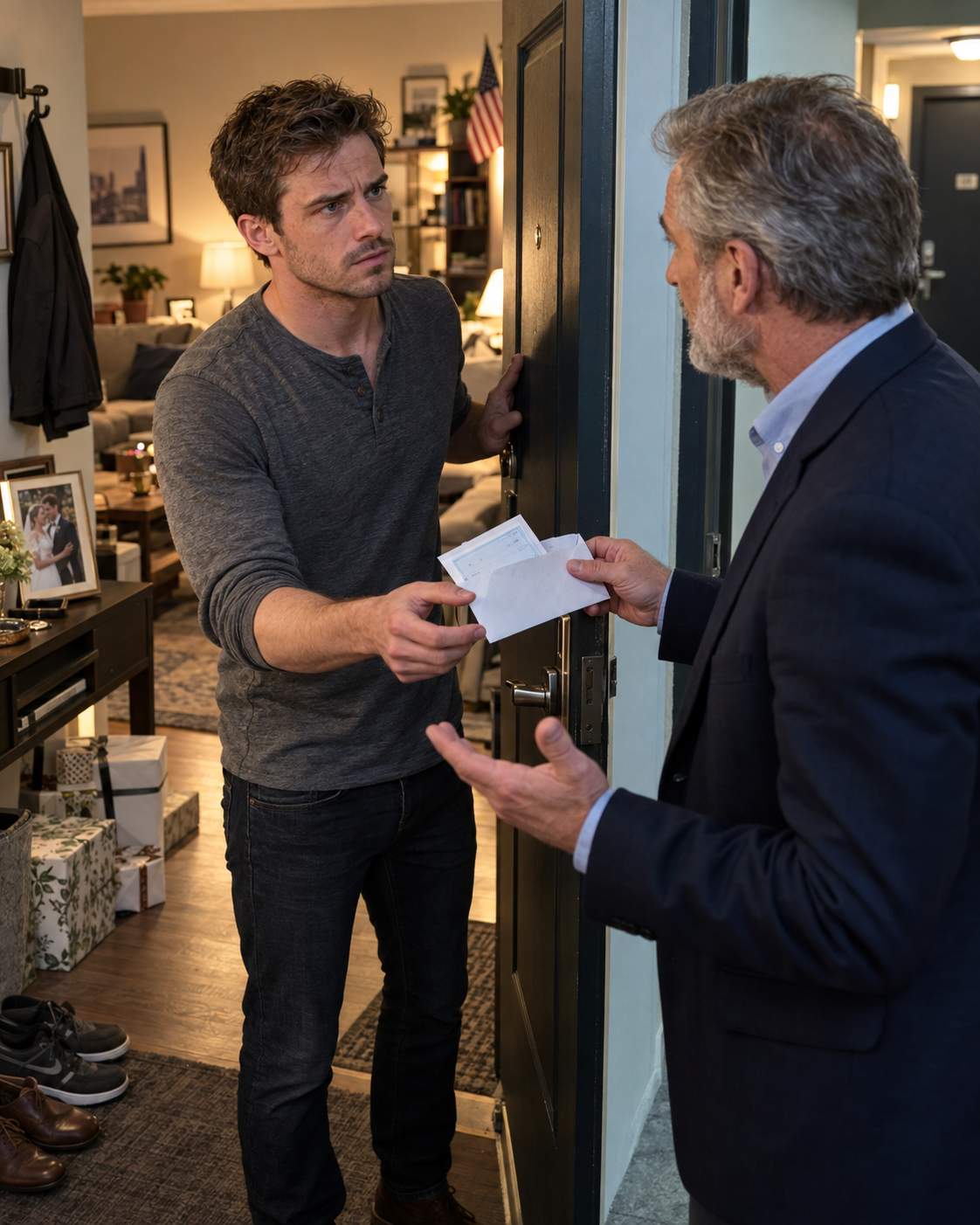
That afternoon, someone knocked on my door.
I looked through the peephole.
It was my father.
He held an envelope.
When I opened the door, he didn’t speak for several seconds.
Then he held it toward me.
“Your check.”
I looked at the envelope.
“You came all the way here to return it?”
“We shouldn’t have taken it.”
I almost believed him.
Almost.
Then I noticed something strange.
His hands were trembling.
Not with regret.
With fear.
“Why now?”
He looked away.
“Because your mother thinks we should make peace.”
“That’s not an answer.”
He sighed.
“We made a mistake.”
“What mistake?”
He didn’t respond.
I looked at the envelope again.
Something about the timing bothered me.
They had spent days insisting the money was a lesson.
Then they had accepted my check.
Then, after my post went public, they suddenly wanted to return it.
It didn’t make sense.
“Did you spend the money?”
My father looked at me.
“What?”
“The $17,843.62.”
He said nothing.
And that silence told me more than an explanation could have.
I felt my chest tighten.
“You spent it.”
“We were going to replace it.”
“With what?”
He rubbed his forehead.
“It’s complicated.”
“No.”
I stepped closer.
“It’s not complicated.”
His eyes finally met mine.
“Hannah needed help.”
There it was.
The name that had been sitting behind every argument.
Hannah.
“What kind of help?”
He looked exhausted.
“Medical treatment.”
I stared at him.
“For what?”
He hesitated.
“Fertility treatment.”
For a moment, I couldn’t speak.
Hannah had been struggling to have a baby for years.
I knew that.
I had sent flowers once.
I had offered to help her find a specialist.
She never answered.
But my parents had apparently been paying for expensive treatments.
And the money they demanded from me had gone toward them.
I looked at the check in his hand.
“So you needed my wedding money because Hannah needed more?”
“No.”
He shook his head quickly.
“That’s not what happened.”
“Then explain it.”
“We thought we’d replace it.”
“With what?”
Again, silence.
My father looked older than he had the day before.
“We were under pressure.”
I almost felt sorry for him.
Then I remembered the invoice.
Every flower.
Every chair.
Every song.
Every plate of food.
They had calculated my happiness down to the cent.
And while they were doing it, they had already spent the money.
“You didn’t give me a gift,” I said.
“You borrowed from me.”
He flinched.
“We’re family.”
“No.”
My voice was calm.
“That’s the excuse you’ve used every time.”
I took the envelope from his hand.
Then I gave it back.
“Keep it.”
He stared at me.
“I don’t want it.”
“Son…”
“I’m not taking anything from you.”
He opened his mouth.
I closed the door.
That night, I sat beside Teresa while she slept.
The apartment was silent.
For the first time, I wasn’t thinking about my parents.
I was thinking about what kind of father I wanted to become.
And then, almost as if the universe had been waiting for me to make that decision, Teresa woke me before sunrise.
She was sitting on the edge of the bed.
Her face was pale.
Her hands were trembling.
“I need to tell you something.”
I sat up.
“What happened?”
She smiled through tears.
“We’re having a baby.”
Everything inside me stopped.
For a few seconds, I couldn’t understand the words.
Then she placed the pregnancy test in my hand.
I looked at it.
Then at her.
Then back at it.
“We’re really having a baby?”
She nodded.
I laughed.
Then I cried.
Then I pulled her into my arms so tightly she started laughing too.
For the first time in my life, the future didn’t feel like something I had to survive.
It felt like something I was allowed to build.
But when Hannah found out, the reaction was nothing like what I expected.
Part 3
She called three days later.
I almost didn’t answer.
Then I did.
There was no greeting.
“You couldn’t wait?”
I frowned.
“For what?”
“To have your baby.”
I felt my stomach turn.
“Hannah, what are you talking about?”
“You knew what we were going through.”
“I did.”
“And you still had to announce yours now?”
I closed my eyes.
“We didn’t plan this to hurt you.”
“You always get everything.”
Her voice cracked.
“You always get to walk away.”
I wanted to tell her that she had no idea what walking away had cost me.
Instead, I said, “I’m sorry you’re hurting.”
She laughed bitterly.
“Don’t pretend you care.”
“I do care.”
“Then stop acting like you’re better than me.”
I looked across the room at Teresa.
She was standing quietly by the window.
“No one is better than anyone here.”
“That’s not what your post said.”
“My post was about our parents.”
“You made us all look terrible.”
I swallowed.
“Hannah, I didn’t tell the world anything you hadn’t already lived.”
Silence.
Then she whispered, “You don’t understand.”
Maybe she was right.
I didn’t understand what it felt like to go through years of fertility treatments.
I didn’t understand the grief of wanting a child and not knowing whether that dream would happen.
But she didn’t understand what it felt like to spend a lifetime believing love had to be earned by obedience.
Those two kinds of pain didn’t have to compete.
I told her that.
She didn’t answer.
After the call ended, I sat alone for a while.
I realized something painful.
Breaking a family pattern doesn’t always mean everyone will thank you.
Sometimes it means the people who benefited from the pattern will resent you for leaving it.
My parents never apologized.
Not really.
They sent occasional messages.
Some were sentimental.
Some were angry.
Some sounded almost sincere.
I stopped reading them.
Arthur and Clara stayed in my life.
They didn’t demand anything.
They didn’t offer money.
They didn’t ask me to choose sides.
They simply showed up.
Arthur came over one Saturday and helped me assemble the crib.
He struggled with the instructions for twenty minutes.
Then he looked at the tiny wooden frame and laughed.
“I’ve never built anything this important.”
I smiled.
“Me neither.”
Clara brought us a box of baby clothes.
Most were secondhand.
Every one had been washed, folded, and packed with care.
Inside the box was a handwritten note.
“You don’t have to earn love.”
I read it twice.
Then I cried.
Months passed.
Teresa’s belly grew.
Our apartment became crowded with tiny clothes, unfinished plans, and the strange excitement of preparing for someone we had never met.
We argued about names.
We assembled furniture badly.
We stood in the baby’s room at midnight imagining what she might look like.
And slowly, quietly, my parents became less important.
Not because I stopped remembering.
Because I stopped needing their approval to tell me who I was.
Our daughter was born on a cold morning in November.
The nurse placed her against Teresa first.
Then I held her.
She was impossibly small.
Her fingers curled around mine.
I stared at her face and felt something break open inside me.
I thought about the boy I had been at sixteen.
The boy who worked after school and came home exhausted.
The boy who learned not to ask for expensive things.
The boy who watched his sister receive what he was told he didn’t need.
I wished I could go back and tell him something.
You were never second.
You were simply standing in a family that didn’t know how to love without keeping score.
Our daughter opened her eyes.
I whispered, “Hi, sweetheart.”
Teresa smiled beside me.
“What should we call her?”
I looked at our baby girl.
Then I said the name we had quietly saved for months.
Lily.
That evening, while Teresa slept, I sat beside the hospital window holding Lily against my chest.
Outside, the city lights flickered in the darkness.
My phone buzzed.
A message from my mother.
“Congratulations.”
I stared at it.
For years, I would have analyzed that single word.
Was it sincere?
Was it manipulation?
Was it guilt?
Was it another test?
Now, I simply put the phone face down.
I didn’t need to know.
Lily stirred against my chest.
I adjusted the blanket around her.
And for the first time, I understood that peace isn’t always an apology.
Sometimes peace is deciding you no longer need one.
My parents had spent years teaching me that love came with conditions.
They had taught me that gifts could become weapons.
They had taught me that family could demand loyalty while offering very little safety.
But Teresa taught me something else.
And Lily made it impossible to forget.
Love isn’t supposed to keep a ledger.
It doesn’t arrive with an invoice.
It doesn’t disappear when you say no.
It doesn’t require you to become smaller so someone else can feel bigger.
I still think about my parents sometimes.
I still wonder whether they understand what they lost.
Maybe they do.
Maybe they don’t.
Hannah eventually stopped calling.
I hope she finds peace in her own life.
I hope one day she understands that my happiness was never an attack on hers.
And I hope she learns, as I finally did, that another person’s joy does not have to diminish your own.
I never got the childhood I wanted.
I never received the unconditional approval I spent decades chasing.
But standing in that hospital room with my daughter asleep against my heart, I realized I had been given something better.
A chance to stop the pattern.
A chance to raise a child who would never wonder whether she had earned her place in my heart.
A chance to build a family where love was not a prize for obedience.
I kissed Lily’s forehead.
She tightened her tiny fingers around mine.
And in that quiet room, with the past finally behind me and my wife sleeping peacefully beside us, I made myself a promise.
She would never have to become perfect to be loved.
She would never have to compete for affection.
She would never receive a gift and wonder what it would cost her later.
And she would never sit alone at a kitchen table believing that being loved was something she had to earn.
Because sometimes the most powerful thing you can inherit from a broken family is the decision to break the inheritance.
And as I held my daughter in my arms, I finally understood that walking away from my parents had never been about losing a family.
It had been about giving my daughter the chance to grow up in one.