My father signed away the four turkey barns I’d spent years running while I stood ten feet away, holding a paper plate of barbecue.
The next morning, I drove to my father’s farm with a folder on the passenger seat and one decision already made.
I wasn’t going back to being the son who fixed everything for free.
If Dad wanted my help, he was going to have to tell me the truth. All of it.
When I pulled into the driveway, I noticed something that made my stomach tighten.
There was a red notice taped to the equipment shed.
I parked, climbed out, and walked over.
It was from the bank.
A notice of default.
The amount listed at the bottom was $487,600.
I stared at the number.
Dad had spent forty years building this farm. Grandma Ruth had spent decades before that helping make it profitable.
And Caleb had managed to put nearly half a million dollars against it.
The farmhouse door opened.
Dad stepped onto the porch.
“Daniel, I’m glad you came.”
I held up the notice.
“Is this everything?”
He stopped smiling.
“What do you mean?”
“Is this the entire debt, or am I going to find another surprise after I agree to help?”
Caleb appeared behind him, carrying a coffee mug.
“You’re making a big deal out of nothing.”
I looked at him.
“Half a million dollars is nothing?”
He shrugged.
“The property’s worth more than that.”
“Then why aren’t you making the payments?”
His expression hardened.
Dad stepped between us.
“Let’s go inside.”
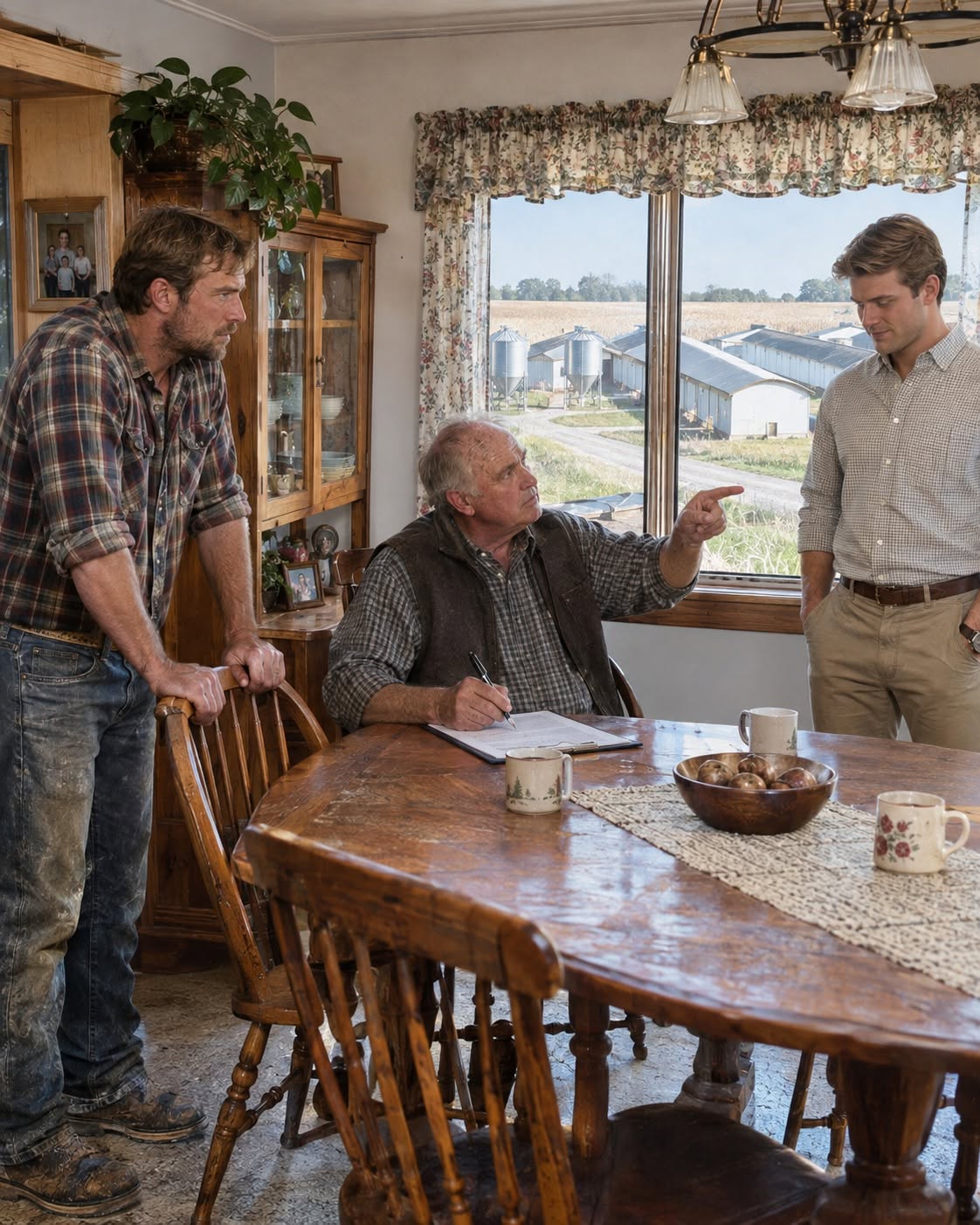
I followed them into the kitchen.
It looked exactly as I remembered. The faded yellow curtains. Grandma’s old wooden clock. The little scratch on the table where I’d dropped a wrench when I was fourteen.
Mom was sitting near the window.
She looked exhausted.
I placed my folder on the table.
“Before we discuss anything, I need the complete financial records. Loan agreements, equipment liens, unpaid bills, tax statements, and the processing plant’s audit report.”
Caleb laughed.
“You’re acting like you’re buying the place.”
“I’m acting like someone who knows what happens when a business runs without accurate records.”
Dad rubbed his forehead.
“We don’t have time for all this.”
“Then you don’t have time for me.”
I picked up my folder.
Mom suddenly spoke.
“Daniel, wait.”
I turned.
She was staring at Caleb.
“Tell him about the second loan.”
The kitchen went silent.
Caleb’s face changed.
“Mom, don’t.”
I slowly set the folder down.
“What second loan?”
Dad looked confused.
“What are you talking about, Evelyn?”
Mom’s hands trembled.
“The equipment loan. The one Caleb took out six months ago.”
Dad turned toward him.
“Caleb?”
My brother stared at the floor.
Finally, he muttered, “It was operating capital.”
“How much?” I asked.
He didn’t answer.
Mom did.
“One hundred and twenty thousand dollars.”
I felt the air leave my lungs.
“On top of the mortgage?”
She nodded.
I looked at Dad.
He seemed genuinely stunned.
For the first time, I realized he didn’t know everything either.
Caleb had been lying to all of us.
“Where did the money go?” I asked.
Caleb slammed his mug onto the table.
“I was trying to save the business!”
“By doing what?”
“Investing in a new poultry equipment company. They were supposed to triple the money.”
I stared at him.
“You borrowed against farm equipment to speculate on another business?”
“It wasn’t speculation!”
“Then where’s the money?”
He looked away.
That was answer enough.
Dad sank into a chair.
Mom began crying quietly.
I stood there looking at the family that had once told me I wasn’t educated enough to run the operation.
And I felt something unexpected.
Not satisfaction.
Not revenge.
Just exhaustion.
“I can’t save this farm,” I said.
Dad looked up sharply.
“Daniel—”
“Not like this. Not with hidden debts and somebody making decisions behind everyone’s back.”
Caleb pointed at me.
“So you’re walking away again?”
I looked him straight in the eye.
“No. I’m refusing to drown with you.”
I left before anyone could answer.
On the drive home, I passed the old pasture where Grandma Ruth used to keep a few cattle.
I remembered riding beside her in a battered pickup when I was sixteen.
She’d pointed toward a broken fence.
“Daniel, you can spend your whole life patching something that somebody else keeps tearing down.”
I’d laughed because I thought she was talking about cattle.
Now I wasn’t so sure.
When I got home, Clara was feeding Lydia breakfast.
She took one look at my face and handed me a cup of coffee.
“That bad?”
“Worse.”
I told her everything.
The mortgage.
The equipment loan.
The missing money.
Caleb’s lies.
When I finished, she sat quietly for a moment.
Then she asked, “What do you want to do?”
“I don’t know.”
“That’s not true.”
I looked at her.
She smiled sadly.
“You know what you want. You’re just afraid wanting it makes you selfish.”
I stared into my coffee.
“I want Grandma’s farm to survive.”
“Then maybe you need to stop trying to save the people who are destroying it.”
Those words stayed with me all day.
That afternoon, I called Brenda.
She answered on the second ring.
“Daniel, I was wondering when I’d hear from you.”
“I need to ask you something.”
“Go ahead.”
“If the bank forecloses on Dad’s farm, would the plant consider a contract with a new operator?”
She was quiet for a moment.
“Depends on who owns the property, the condition of the barns, and whether they pass inspection.”
“What if I leased them from whoever buys the place?”
“Then we’d evaluate the operation like any other grower.”
I took a breath.
“And if I bought them?”
Another pause.
“Daniel, are you seriously considering that?”
“I’m considering every option.”
Brenda’s voice softened.
“Your grandmother would be proud of what you’ve built. But don’t let nostalgia make a business decision for you.”
I almost smiled.
“That’s exactly what Clara said.”
“Then listen to her.”
The following week, I met with a farm attorney named Rebecca Lawson.
I brought every document I had, including the old promissory notes Dad had signed over the years.
Rebecca examined them carefully.
Some were too old to enforce easily.
Others were incomplete.
A few were properly executed and potentially collectible.
The total amount Dad had borrowed from me was just over $96,000.
I hadn’t realized it had grown that large.
Rebecca looked up.
“Have you ever demanded repayment?”
“No.”
“Why not?”
“Because he kept promising the farm would eventually be mine.”
She leaned back.
“Was that promise ever put in writing?”
I shook my head.
“Then we need to separate what you were promised from what you legally own.”
It hurt hearing her say it.
But she was right.
She reviewed the property records and discovered something else.
Grandma Ruth had left a small parcel of land behind the turkey barns to my father under a separate deed.
It included an old well, a service road, and a narrow strip connecting the barns to the county highway.
The parcel hadn’t been included in the transfer to Caleb.
Dad still owned it.
I stared at the survey.
“That’s the original access road.”
Rebecca nodded.
“And it may be important to any future operation.”
I remembered Grandma insisting that road remain separate when Dad expanded the barns.
At the time, I’d thought she was being stubborn.
Now I wondered whether she’d been protecting something.
Rebecca warned me not to assume the parcel gave us leverage without reviewing the recorded easements and loan documents.
But it was the first useful fact we’d uncovered in days.
Two weeks later, the bank scheduled a meeting with Dad and Caleb.
I attended only after they agreed in writing that I was there as a potential independent operator, not as a guarantor.
The loan officer was a woman named Susan Mercer.
She had the calm, tired expression of someone who’d heard every excuse imaginable.
She laid the numbers out plainly.
The farm was behind on its mortgage.
The equipment lender had filed a lien.
Several suppliers were demanding payment.
The processing contract had been suspended.
Without a credible plan, foreclosure was likely.
Dad looked at me.
“Daniel can get birds back in the barns.”
Susan turned toward me.
“Can you?”
“Not in their current condition.”
Caleb shifted angrily.
“The barns are fine.”
I opened my folder.
I had photographs from a walk-through Brenda had authorized with the family’s permission.
Broken ventilation fans.
Damaged drinker lines.
Rodent activity around the feed storage area.
A generator that hadn’t passed a load test.
And one barn with a section of insulation hanging loose above the bird area.
I slid the photographs across the table.
“These buildings need significant repairs before I’d put a single bird inside.”
Susan studied them.
“How much?”
“At least eighty thousand dollars. Possibly more once we open up the electrical panels.”
Dad looked devastated.
Caleb muttered, “You’re exaggerating.”
I ignored him.
Susan folded her hands.
“Mr. Whitaker, are you offering to fund those repairs?”
“No.”
Dad turned toward me.
I continued.
“I’m willing to discuss a lease or purchase after the financial and legal issues are resolved. But I won’t guarantee their debts, and I won’t invest in property Caleb controls.”
The room went quiet.
Susan nodded.
“That’s a reasonable distinction.”
Caleb stood.
“This is unbelievable. You’re all acting like I’m some criminal.”
Nobody answered.
He grabbed his jacket and walked out.
The meeting ended without an agreement.
Three days later, Dad called.
His voice sounded different.
Smaller.
“Daniel, I need to tell you something.”
I was standing beside one of my own barns, checking a ventilation controller.
“What is it?”
“I went through the old farm records.”
I waited.
“Your grandmother left me a letter.”
My chest tightened.
“What letter?”
“She wrote it before she died. Told me to give it to you when I was ready to hand over the operation.”
I closed my eyes.
“Why didn’t you?”
Dad’s voice broke.
“Because I didn’t like what it said.”
I didn’t speak.
He continued.
“She said you understood the birds better than anyone she’d ever worked with. She said the farm would be safe in your hands.”
I leaned against the barn wall.
For years, I’d wondered whether Grandma had believed in me as much as I believed in her.
Now I had my answer.
Dad swallowed.
“She also said I needed to stop confusing Caleb’s confidence with competence.”
A bitter laugh escaped me.
“Sounds like Grandma.”
“Daniel, I’m sorry.”
I stared across the yard.
“For what?”
“For giving away what you built. For using your money. For making you believe you had to earn my approval by sacrificing your own future.”
My throat tightened.
He took a shaky breath.
“I don’t expect you to forgive me.”
I looked toward the house, where Clara was carrying Lydia onto the porch.
“Good,” I said quietly. “Because I’m not ready.”
He didn’t argue.
That was new.
A month later, the bank began formal foreclosure proceedings.
Caleb moved out of the farmhouse.
Dad and Mom rented a small place near town.
The farm sat empty.
Every time I drove past, the barns looked smaller.
The weeds grew around the loading pads.
The old feed bins stood silent.
And the gravel road where I’d once watched trucks arrive before dawn was covered in fallen leaves.
I told myself not to look.
But I always did.
Then one afternoon, Lester stopped by my farm.
He was carrying a thermos and a newspaper.
“Got a minute?”
I waved him into the shop.
He sat down and placed the newspaper on the table.
There was a notice announcing the upcoming foreclosure sale.
Lester tapped it.
“You thinking about bidding?”
I sighed.
“Maybe.”
He studied me.
“Can you afford it?”
“Not without taking on more debt than I’m comfortable with.”
He nodded.
“Then don’t.”
I looked at him.
“That’s it?”
“That’s it.”
He took a sip of coffee.
“Daniel, Marge and I leased you those old barns because we saw a young man who knew how to work. We didn’t do it so you’d spend the rest of your life chasing somebody else’s mistakes.”
I stared at the newspaper.
He continued.
“Your grandmother’s legacy isn’t trapped in those buildings.”
I looked up.
“It’s in you.”
I didn’t answer.
Lester smiled.
“And in that little girl of yours, if you teach her right.”
That evening, Clara and I sat at the kitchen table with a calculator.
We reviewed our savings.
Our equipment loans.
Our operating expenses.
Lydia’s future.
The house we’d worked so hard to buy.
We could make a bid on the old farm.
But we’d be risking nearly everything.
Clara looked at me.
“Would you still want those barns if they hadn’t belonged to your family?”
I stared at the numbers.
Then I slowly shook my head.
“No.”
She reached across the table.
“Then there’s your answer.”
I thought that would be the end.
But the following morning, Rebecca called with unexpected news.
A regional agricultural investment company had expressed interest in purchasing the farm.
They weren’t planning to operate turkey barns.
They wanted the land for a distribution facility.
The barns would be demolished.
The farmhouse would likely be torn down.
And the old oak tree Grandma had planted beside the driveway would be removed.
I sat down hard.
“Can they do that?”
“If they acquire the property and obtain the necessary approvals, potentially.”
I looked out at my own barns.
For the first time, losing the farm felt real.
Not just losing ownership.
Losing the place itself.
That afternoon, I drove to the old property.
The gate was locked.
I parked beside the road and walked along the fence.
Through the trees, I could see the farmhouse.
The porch where Grandma used to sit.
The barn doors I’d repaired a dozen times.
The place where she’d taught me to recognize a sick bird by the way it stood apart from the flock.
I stood there for a long time.
Then I noticed something near the old service road.
A small wooden sign.
The paint had faded, but I could still read the words.
RUTH’S WAY.
Grandma had put it there when the road was built.
I remembered asking why she’d named a gravel lane after herself.
She’d laughed.
“Because somebody ought to remember who paid for it.”
I smiled through tears.
Then I drove home.
The next day, I called Rebecca.
“I don’t want to buy the whole farm.”
She sounded relieved.
“Good.”
“But I want to find out whether I can buy the farmhouse parcel and the original access road.”
She paused.
“That’s a different conversation.”
The bank’s attorney was willing to discuss dividing the property if the sale proceeds and lien priorities could be properly addressed.
The investment company wanted the larger tract.
They didn’t care about the farmhouse.
They did, however, need access for their proposed development.
Rebecca reviewed the recorded easements and negotiated carefully.
Over the next several weeks, a possibility emerged.
The investor could purchase the commercial acreage.
I could acquire the farmhouse and a small surrounding parcel through a separate transaction, provided the lender and other necessary parties approved.
Dad’s separately owned road parcel would require its own agreement.
Nothing was guaranteed.
But for the first time, I saw a way to preserve a piece of Grandma’s home without taking over the failing operation.
Then Caleb found out.
He showed up at my house on a Saturday afternoon.
Clara was inside with Lydia.
I was repairing a fence when his truck came down the driveway.
He climbed out, furious.
“I heard you’re trying to buy the farmhouse.”
I set down my hammer.
“I’m exploring it.”
“That’s my property.”
“Not after the foreclosure sale.”
His face twisted.
“You’ve been waiting for this.”
I looked at him.
“Waiting for what?”
“For me to fail so you could take everything.”
I felt anger rise.
But I kept my voice steady.
“Caleb, I spent years keeping those barns profitable. I left when Dad gave them to you. I built another business. I didn’t cause your debts.”
He stepped closer.
“You think you’re better than me.”
“No.”
“Then why does everybody keep saying you should’ve gotten the farm?”
I stared at him.
There it was.
The question beneath all his anger.
“Because I knew how to run it,” I said.
He looked away.
For a moment, I saw the little brother who used to follow me through the barns, complaining about the smell and asking when we could go fishing.
Then he said quietly, “Dad told me I could do anything.”
I nodded.
“I know.”
“He never told me I could fail.”
I looked at him.
“That doesn’t mean you couldn’t learn.”
He laughed bitterly.
“Well, I learned.”
He turned toward his truck.
Before he climbed in, I called after him.
“Caleb.”
He stopped.
“You can still build something of your own.”
He didn’t answer.
But he didn’t slam the door either.
The sale negotiations continued.
There were setbacks.
An environmental review delayed the investor’s plans.
A dispute over equipment liens complicated the allocation of proceeds.
The bank rejected one proposed purchase price.
At one point, I nearly walked away.
Then Rebecca called with the final numbers.
The farmhouse parcel could be purchased for an amount Clara and I could afford without borrowing against our operating business.
Dad agreed to sell the separate road parcel at a modest price, with the proceeds applied toward his remaining obligations.
The investor would acquire the rest.
The barns would be demolished after the necessary approvals.
I sat at the kitchen table staring at the proposed agreement.
Clara read it beside me.
“Are you sure?” she asked.
I nodded.
“I’m not buying the farm back.”
She smiled.
“I know.”
“I’m buying a place to remember it.”
We closed on the farmhouse parcel six weeks later.
The first time I walked through the front door as its owner, the house smelled like dust and old wood.
The kitchen was empty.
The curtains were gone.
But Grandma’s clock was still hanging on the wall.
Dad had left it there.
Beside it was an envelope with my name.
Inside was Grandma’s letter.
The original.
I sat at the kitchen table and read every word.
She wrote about hard work.
About honesty.
About the responsibility of caring for living creatures.
And near the end, she wrote something that made me cry.
“Daniel, if this farm ever becomes a burden instead of a blessing, don’t be afraid to let it go. Land can be bought and sold. Character cannot.”
I held the letter for a long time.
Then I called Dad.
“Thank you for leaving the clock.”
His voice was quiet.
“It belonged there.”
I looked around the kitchen.
“Do you want to come see the house sometime?”
He hesitated.
“I’d like that.”
A few months later, the old turkey barns came down.
I didn’t go watch.
I knew what demolition looked like.
I didn’t need to see those buildings fall.
Instead, I spent that morning at my own farm.
Lydia was sitting on Clara’s lap near the brooder house.
I showed her how to listen for the steady hum of the ventilation fans.
She was too young to understand most of it.
But she laughed when I pointed toward the birds.
“Turkey!” she shouted.
I smiled.
“That’s right, sweetheart.”
That afternoon, Dad came by.
He stood beside the barn door, watching me work.
For a while, neither of us spoke.
Then he said, “Your grandmother used to stand exactly like that.”
I looked at him.
“Like what?”
“Watching the birds before you touched anything.”
I smiled.
“She taught me.”
He nodded.
“I should’ve listened to her.”
I didn’t disagree.
We walked through the barn together.
Dad asked questions.
Real questions.
About ventilation settings.
Feed conversion.
Mortality rates.
The new monitoring system I’d installed.
For the first time, he seemed interested in learning from me instead of reminding me who was in charge.
When we reached the end of the barn, he stopped.
“Daniel, I can’t give you back the years.”
I looked at him.
“No.”
“And I can’t give you back the farm.”
“No.”
He swallowed.
“But I can tell you that I was wrong.”
I waited.
“You were the best grower that place ever had.”
My eyes burned.
For years, I’d wanted to hear those words.
Now they arrived after everything had changed.
And somehow, they still mattered.
“Thank you, Dad.”
He nodded.
We walked back outside.
A year later, Clara and I finished renovating Grandma’s farmhouse.
We didn’t move into it.
Our home was where our daughter was growing up, beside the barns we’d restored ourselves.
Instead, we turned the old house into a small agricultural training center.
Arthur, a retired poultry technician Brenda knew from the plant, helped us develop practical workshops for young growers.
Lester taught equipment maintenance.
Marge organized meals for the students.
Brenda arranged visits from experienced field representatives.
And I taught the first class.
There were twelve students.
Some came from farming families.
Others had never stepped inside a poultry barn.
I stood at the front of Grandma’s old kitchen, holding a notebook.
“Before we talk about equipment or contracts,” I said, “there’s something you need to understand.”
I looked around the room.
“A successful grower doesn’t manage birds from an office. You have to walk the floor.”
I smiled.
“That’s what my grandmother taught me.”
After class, a young man stayed behind.
He was twenty-two, working at a feed mill, and trying to save enough money to lease his first barns.
He looked nervous.
“Mr. Whitaker, can I ask you something?”
“Sure.”
“How did you know you could make it on your own?”
I thought about the day Dad handed the deed to Caleb.
The unpaid loans.
The broken roof.
The years of working before sunrise.
Then I thought about Clara waiting in the driveway when I finally left.
“I didn’t know,” I said.
He looked surprised.
“I just knew I couldn’t keep building my future on somebody else’s promises.”
He nodded slowly.
I continued.
“Start small. Keep good records. Learn everything you can. And never confuse being needed with being valued.”
He smiled.
“Thanks.”
After he left, I stood alone in Grandma’s kitchen.
The old clock ticked above the doorway.
Outside, Lydia was chasing butterflies while Clara watched from the porch.
Dad and Mom were sitting beneath the oak tree.
They’d begun visiting regularly.
Our relationship wasn’t perfect.
There were still things we didn’t discuss easily.
But Dad no longer asked me for money.
And when Caleb eventually found work managing inventory for a farm supply company, Dad didn’t try to make me responsible for his future.
Caleb and I spoke occasionally.
He’d started making payments on his remaining debts.
He was quieter now.
Less certain that the world owed him a second chance.
Maybe someday we’d become close again.
Maybe not.
I no longer felt responsible for forcing that outcome.
That evening, as the sun settled behind the trees, Clara came into the kitchen.
“Ready to go home?”
I looked around.
At the old table.
The clock.
Grandma’s letter framed beside the doorway.
Then I smiled.
“Yeah.”
We walked outside together.
Lydia ran toward me with her arms raised.
I picked her up and carried her down the porch steps.
Behind us stood the farmhouse I’d once believed I had to inherit to prove my worth.
I owned it now.
But not because Dad finally chose me.
Not because Caleb failed.
And not because I’d sacrificed everything to save a business that no longer made sense.
I owned it because Clara and I had built a life strong enough to make the choice freely.
Grandma had been right.
You couldn’t count turkeys from the doorway.
You had to walk the floor, pay attention, and recognize trouble before it spread.
I’d spent years applying that lesson to the birds.
It had taken me much longer to apply it to my own family.
But I’d finally learned.
Love doesn’t require you to finance someone else’s mistakes.
Loyalty doesn’t mean surrendering your future.
And sometimes, honoring the people who came before you means having the courage to do things differently.
The barns were gone.
The old farm business was gone.
But Grandma Ruth’s lessons were still alive.
They lived in every flock I raised, every young grower I trained, and every choice I made to protect the family Clara and I had built.
As I buckled Lydia into her car seat, she pointed toward the farmhouse.
“Grandma Ruth’s house!”
I smiled.
“That’s right, sweetheart.”
She looked at me.
“Will it always be there?”
I glanced at Clara.
Then at the old oak tree.
“I hope so,” I said. “But even if it isn’t, we’ll remember what she taught us.”
And driving home that evening, I finally understood something I’d spent half my life trying to learn.
An inheritance is something someone leaves you. A legacy is something you carry forward.
Grandma hadn’t needed to leave me four turkey barns to make me her successor.
She’d already given me everything that mattered.
And nobody—not my father, not my brother, not even the loss of the farm—could ever take that away.