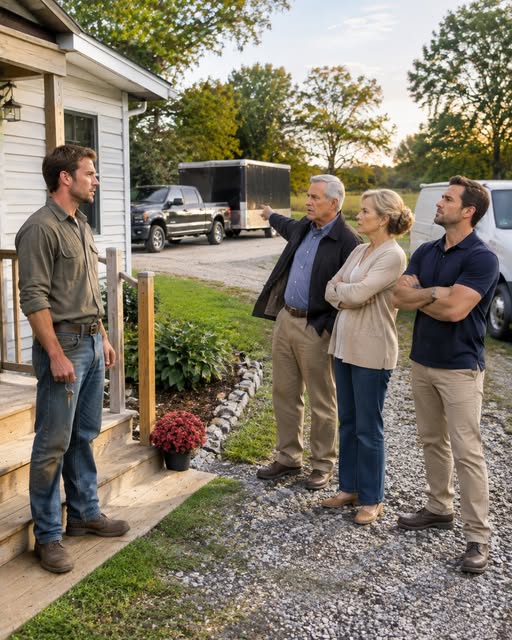
My father showed up at my property with a moving trailer, my mother, and my older brother.
I pulled the document from Patricia’s folder and placed it on the hood of my father’s truck.
“Before you start unloading that trailer, you need to read this.”
Dad snatched the paper from my hand.
His eyes moved across the first paragraph. Then the second.
By the time he reached the signature page, his expression had changed from irritation to disbelief.
“What the hell is this?”
“A recorded life estate agreement,” I said. “Sam and Clara have the legal right to live in that cottage for the rest of their lives. Tessa and I own the property, but we can’t simply throw them out because somebody else decides they want the place.”
Dad stared at me.
“You signed away control of your own house?”
“I protected the people who protected me.”
Bryce stepped forward and grabbed the document.
He scanned it, then gave a sharp laugh.
“This is ridiculous. They’re not even related to you.”
“Neither is Patricia,” I said. “But I still trust her more than I trust you.”
Patricia looked down, trying not to smile.
Mom pressed a hand against her chest.
“Toby, you’re being unnecessarily cruel.”
I turned toward her.
“Cruel would have been showing up at someone’s home with a moving trailer and announcing that the people already living there had to leave.”
Her mouth tightened.
“We assumed you’d want to help your parents.”
“You didn’t ask.”
Dad slapped the paper onto the truck.
“I’m your father. I shouldn’t have to ask.”
And there it was.
The same sentence, dressed in different words, that had controlled most of my childhood.
I looked at the trailer.
It was packed so tightly that boxes were visible through the rear window.
“You sold your house, didn’t you?”
Nobody answered.
I looked at Mom.
“Did you?”
She glanced at Bryce.
That was all the answer I needed.
My stomach sank.
“What happened?”
Dad folded his arms.
“We made some financial decisions.”
“What kind of decisions?”
“Family decisions.”
Bryce suddenly found something interesting about his boots.
I looked between them.
“Did you sell the house to pay off Bryce’s debts?”
Dad’s silence told me I’d hit something.
Mom spoke quickly.
“Your brother has been going through a difficult period.”
I almost laughed.
Bryce had been going through a difficult period since he was old enough to wreck his first car.
Every mistake became an emergency that somebody else had to solve.
“What happened this time?” I asked.
Bryce stepped closer.
“None of your business.”
“Then neither is my property.”
His face hardened.
“You always were a selfish little—”
“Finish that sentence,” Tessa said.
Her voice wasn’t loud.
It didn’t need to be.
Bryce looked at her, surprised.
Tessa folded her arms.
“You came to our home without permission. You brought a trailer full of belongings. You’re trying to move into a cottage occupied by two elderly people who have done nothing to you. And now you’re insulting my husband?”
Mom shook her head.
“Tessa, this is between family.”
Tessa smiled without warmth.
“Exactly. That’s why I’m involved.”
I loved that woman.
Dad reached for the trailer hitch.
“We’re not leaving until we figure something out.”
I took out my phone.
“Then I’ll call the sheriff’s office and ask for assistance removing an unwanted vehicle from my driveway.”
Dad stared at me.
“You’d call the police on your own parents?”
“I’d call them on anyone who refused to leave my property.”
For a moment, nobody moved.
Then a familiar voice came from behind us.
“Toby? Everything all right?”
Sam was walking up the gravel path from the cottage.
He was seventy-two, with silver hair, a weathered face, and the kind of hands that told you he’d spent his life fixing things.
Clara followed a few steps behind him.
I immediately wished they hadn’t heard the argument.
“Everything’s fine, Sam,” I said. “Just sorting out an unexpected visit.”
Dad turned toward them.
“So you’re the people living in my son’s house.”
Sam stopped.
Clara moved beside him.
“We are,” Sam said.
Dad gestured toward the cottage.
“Well, my wife and I need somewhere to stay. Surely you understand that family comes first.”
Sam looked at him for a long moment.
Then he said, “I understand family better than you might think.”
Dad scoffed.
“Really?”
Sam nodded.
“I remember the night Toby showed up at our garage apartment. He was nineteen, carrying a duffel bag and trying not to cry.”
My face grew hot.
Sam continued.
“He offered to sleep on the floor because he didn’t have enough money for a security deposit. Clara made him dinner, and I told him we’d figure out the rent later.”
Mom looked away.
“He left home by choice,” she whispered.
Sam shook his head.
“He told us his father had given him a choice between surrendering the van he’d paid for or getting out.”
Dad’s jaw tightened.
“That was a private family matter.”
“Maybe,” Sam said. “But the boy you sent away became part of ours.”
Nobody spoke.
Then Clara stepped forward.
She was small, barely five feet tall, but she had a way of making grown men pay attention.
“We’re not taking anything from you,” she told my parents. “Toby and Tessa built this cottage because they wanted us nearby. We never asked them for it.”
She looked toward me.
“And if they ever needed us to move, we’d discuss it like adults.”
I shook my head.
“You’re not going anywhere.”
Clara smiled.
“I know, sweetheart.”
Dad looked disgusted.
“This whole thing is absurd.”
He climbed into his truck.
Mom followed, but Bryce stayed where he was.
“You’ll regret this,” my brother said quietly.
I met his eyes.
“Maybe. But it won’t be because I finally told you no.”
He walked away.
The trailer rolled down our driveway ten minutes later.
I thought that was the end of it.
I was wrong.
Three days later, my phone rang while I was rebuilding a transmission at Arthur’s old repair shop.
Arthur had retired two years earlier, and I’d bought the business from him through a gradual ownership arrangement.
He still came in most mornings to drink coffee, criticize my organization, and tell stories about engines nobody made anymore.
I wiped my hands and answered.
It was Mom.
“Toby, we need to talk.”
I leaned against the workbench.
“About what?”
“Your father isn’t doing well.”
I closed my eyes.
“Is he sick?”
“He’s under tremendous stress.”
“That’s not the same thing.”
She sighed.
“We’re staying at a motel outside town. It’s expensive, and Bryce’s situation is getting worse.”
I looked through the shop window.
Arthur was helping one of our younger mechanics diagnose a fuel injector problem.
“What situation?”
Mom hesitated.
“His business failed.”
I frowned.
“Bryce had a business?”
“He was doing equipment financing.”
That caught my attention.
“What kind of equipment?”
“Trucks. Construction machinery. Things like that.”
I stood straighter.
“Mom, what exactly happened?”
Her voice dropped.
“There are people saying he owes them money.”
“How much?”
“I don’t know.”
“Then why did you sell your house?”
Silence.
“Mom?”
She started crying.
“Because your father thought we could save him.”
I rubbed my forehead.
“How much did you give Bryce?”
“Almost everything.”
For a moment, all I could hear was the hum of the shop ventilation fan.
“What does almost everything mean?”
She whispered a number.
Two hundred and sixty thousand dollars.
I sat down.
That was the equity they’d received after selling the house and paying off the remaining mortgage.
Their retirement savings had already been drained by earlier loans to Bryce.
Now the house money was gone too.
“What did he do with it?”
“He said he needed to satisfy some investors.”
I stared at the floor.
“Mom, you need to stop giving him money.”
“He’s your brother.”
“And you’re my mother. You shouldn’t have to destroy your retirement to keep him comfortable.”
She cried harder.
Then she said something that made my blood run cold.
“Your father says Bryce can get it back if he closes one more deal.”
I stood up so fast my chair scraped across the concrete.
“What deal?”
“He wouldn’t explain.”
I ended the call and immediately phoned Tessa.
She listened carefully.
Then she asked, “Do you think Bryce is doing something illegal?”
“I don’t know.”
“But you’re worried.”
“Yeah.”
She was quiet for a moment.
“Then don’t go confronting him alone.”
I promised I wouldn’t.
That promise lasted less than twenty-four hours.
The next afternoon, Bryce appeared at my shop.
He drove a black pickup I didn’t recognize, with temporary plates and a cracked windshield.
He walked into my office without knocking.
“We need to settle this cottage situation.”
I looked up from my computer.
“There is no cottage situation.”
He shut the door.
“Dad and Mom are sleeping in a motel while you’ve got two old strangers living rent-free on your property.”
I set down my pen.
“Sam and Clara aren’t strangers.”
“Whatever.”
He dropped a folder onto my desk.
“I’ve got a solution.”
I didn’t touch it.
“I’m listening.”
“You take out a home equity loan. Enough to get Mom and Dad into a place and help me straighten out a few obligations.”
I stared at him.
“You came here to ask me to borrow against my home?”
“Not ask. I’m giving you an opportunity to do the right thing.”
I laughed.
I couldn’t help it.
Bryce’s expression darkened.
“What’s funny?”
“You.”
He leaned forward.
“You think you’re better than me because you fix engines?”
“No. I think I’m responsible for my own debts. You should try it.”
He slammed his hand against the desk.
“You have no idea what kind of pressure I’m under.”
“Then tell me.”
For a second, his expression changed.
He looked genuinely frightened.
Then the arrogance returned.
“Just sign the paperwork.”
I opened the folder.
Inside was a proposed loan application.
My name appeared as the borrower.
Tessa’s name appeared beside mine.
The requested amount was $350,000.
I looked at Bryce.
“Where did you get our financial information?”
He shrugged.
“Dad knew enough to get things started.”
I flipped to the next page.
There were income estimates, property valuations, and a list of business assets.
Some figures were wrong.
Others were alarmingly accurate.
Then I reached the signature page.
My name was already written there.
So was Tessa’s.
Neither signature was ours.
I looked up slowly.
“Bryce, who signed this?”
He didn’t answer.
I held up the page.
“Who signed our names?”
He reached for the folder.
I pulled it away.
“Give me that,” he snapped.
“No.”
His face went pale.
“It’s just a preliminary application.”
“Then why are there forged signatures?”
He backed toward the door.
“You’re blowing this out of proportion.”
I stood.
“Get out.”
“Toby—”
“Get out of my office.”
He left without another word.
I locked the folder in my desk and called Tessa.
Then I called an attorney.
Her name was Rachel Bennett, and Arthur had recommended her years earlier when I purchased the shop.
She reviewed the paperwork the next morning.
Her expression grew more serious with every page.
“Did you authorize any of this?”
“No.”
“Did your wife?”
“Absolutely not.”
Rachel nodded.
“Then we need to contact the lender immediately, dispute the application in writing, and preserve the original documents.”
She also recommended checking our credit reports, placing appropriate fraud alerts or freezes, and documenting every interaction with Bryce.
I asked whether we should call the police.
She looked at me.
“If someone submitted an application using forged signatures, that’s a serious matter. We should report what we can verify.”
I stared at the papers.
Despite everything, a part of me still couldn’t believe my brother would go that far.
Rachel seemed to read my expression.
“Being related to someone doesn’t make unauthorized financial activity harmless.”
I nodded.
“Then let’s do it.”
By Friday, the lender had confirmed that an application had been submitted through a third-party broker.
It had not been funded.
The lender froze the file pending investigation.
That should have been a relief.
Instead, it made me wonder how many other applications Bryce had submitted.
Then something happened that changed the entire situation.
Arthur came into my office carrying an envelope.
“This arrived for you.”
There was no return address.
Inside was a photocopy of a financing agreement and a handwritten note.
“Ask Bryce about the excavator.”
I read the agreement.
It described a commercial excavator financed through a company called Ridgeway Equipment Solutions.
The listed borrower was a local contractor named Daniel Mercer.
The equipment value was $185,000.
The serial number looked familiar.
I walked into the service bay and pulled up our repair records.
Three weeks earlier, a customer had brought in an excavator hydraulic pump for inspection.
The machine’s serial number was in the service notes.
It matched the agreement.
But there was a problem.
The customer had told us the excavator belonged to a rental company.
I called Arthur over.
“Remember that yellow excavator from the quarry?”
He nodded.
“Hydraulic leak. Bad seals.”
“Did the customer mention ownership?”
Arthur frowned.
“Said he was renting it.”
I showed him the document.
His expression changed.
“Well, that doesn’t look right.”
I called Rachel.
She told me not to contact anyone involved until we could verify the records.
Within days, she helped arrange a meeting with Daniel Mercer and his attorney.
Daniel was a broad-shouldered man in his forties who looked like he hadn’t slept properly in weeks.
He stared at the financing agreement.
“I’ve never owned that excavator.”
Rachel asked him several questions.
Then Daniel pulled out his phone.
“Bryce approached me six months ago. Said he could help finance equipment for my company. I gave him business records, but I never signed this loan.”
He showed us emails.
Bryce had promised competitive rates and quick approvals.
Daniel had declined after the terms changed.
Yet the financing paperwork carried his company’s name.
I felt sick.
“How many people did Bryce approach?”
Daniel shook his head.
“I know of at least four.”
Rachel looked at me.
“We need to let the investigators handle this.”
Over the next several weeks, the situation unraveled.
The lender reviewing my forged application referred information to its fraud department.
Daniel filed his own report.
Other business owners came forward with complaints involving equipment that had allegedly been financed without proper authorization.
Investigators began examining Bryce’s transactions.
I cooperated when asked.
I didn’t speculate.
I didn’t exaggerate.
I simply provided the documents and information I had.
Dad called me furious.
“You’ve turned your own brother into a criminal!”
I was standing in the shop parking lot when he said it.
“No, Dad. I reported paperwork with my forged signature.”
“You could’ve handled this privately.”
“How? By giving him $350,000?”
Dad went silent.
I continued.
“Did you know he was using my name?”
“No.”
“Did you give him information about my property?”
A pause.
“I might have mentioned what it was worth.”
“Did you give him copies of anything?”
Another pause.
My stomach dropped.
“Dad?”
“He asked for some old paperwork. I didn’t think—”
“You didn’t think he’d use it?”
“He said he was helping the family.”
I closed my eyes.
“Dad, that’s what he always says.”
For the first time, my father didn’t have an answer.
Two weeks later, Bryce was arrested on charges connected to alleged financing fraud and identity-related offenses.
The case would take months to resolve.
I wasn’t happy when I heard the news.
I wasn’t celebrating.
I sat in my truck outside the shop for nearly half an hour, remembering the brother who used to teach me how to ride a bicycle.
Before the favoritism.
Before the lies.
Before every mistake became somebody else’s responsibility.
I wondered when he’d started believing that rules were only for other people.
Then I remembered how often Dad had protected him from consequences.
Maybe it hadn’t happened all at once.
Maybe it had happened a little at a time, every time somebody said, “That’s just Bryce.”
Mom called that evening.
Her voice was barely recognizable.
“Your brother is in jail.”
“I know.”
“Your father says you could’ve prevented this.”
I looked toward the kitchen, where Rosie was coloring at the table while Tessa prepared dinner.
“No, Mom. Bryce could’ve prevented this.”
She began crying.
I waited.
Then she whispered, “We don’t have anywhere to go.”
I closed my eyes.
There it was again.
The request hidden beneath the guilt.
But this time, I heard something different.
Not entitlement.
Fear.
“Mom, what happened to the motel?”
“We can’t afford another week.”
“Where’s Dad?”
“Outside.”
I took a breath.
“I’ll help you find a place. But you’re not moving into Sam and Clara’s cottage.”
She was quiet.
Then she said, “I understand.”
I wasn’t sure she did.
But it was a start.
Tessa and I talked that night.
We agreed to help my parents locate a small apartment and connect them with local senior housing resources.
We also offered to pay a limited portion of the initial moving expenses directly to the landlord.
No cash transfers.
No loans.
No access to our financial accounts.
And absolutely no involvement from Bryce.
Dad hated the conditions.
He called them insulting.
Tessa looked him straight in the eye.
“Then you’re free to decline.”
He didn’t.
The apartment was small but clean.
Two bedrooms, a narrow kitchen, and a little balcony overlooking a courtyard.
Mom cried when she saw it.
Dad complained about the stairs.
But they signed the lease.
For the first time in years, their lives weren’t organized around rescuing Bryce.
At first, they didn’t know what to do with themselves.
Dad called me constantly.
Sometimes to complain.
Sometimes to ask questions about bills.
Sometimes, I suspected, just because he was lonely.
I answered when I could.
But I didn’t abandon my work or my family to manage his life.
That was new for both of us.
One Sunday afternoon, Dad asked if he could visit.
I hesitated.
Then I agreed.
“Just you and Mom,” I said. “And call before you come.”
He arrived exactly when he said he would.
No trailer.
No demands.
No paperwork.
He stood awkwardly on the porch holding a bag of apples.
“Your mother thought Rosie might like these.”
I stepped aside.
“Come in.”
Rosie ran toward him.
“Grandpa!”
He knelt and hugged her.
Watching them, I felt a strange mixture of sadness and hope.
He’d missed so much of her life.
Not because he lived too far away.
Because he’d never made the effort.
After lunch, Sam came over to return a ladder.
Dad was sitting on the porch when he arrived.
For a moment, the two men looked at each other.
Then Dad stood.
“Sam.”
“Howard.”
An uncomfortable silence followed.
Dad cleared his throat.
“I owe you an apology.”
Sam raised an eyebrow.
Dad continued.
“For the way I spoke to you and Clara. And for showing up expecting you to give up your home.”
Sam studied him.
Then he nodded.
“Apology accepted.”
Dad looked down.
“And thank you for helping Toby when I didn’t.”
That was the sentence I’d never expected to hear.
Sam’s expression softened.
“He was easy to help. He worked hard and kept his word.”
Dad looked toward me.
“I know that now.”
I felt my throat tighten.
Clara appeared at the cottage doorway and called everyone over for pie.
The afternoon wasn’t perfect.
Dad still had a habit of offering opinions nobody requested.
Mom still looked uncomfortable when Rosie called Clara “Grandma Clara.”
But nobody argued.
And when Dad left, he thanked us for inviting him.
It wasn’t forgiveness.
Not yet.
But it was movement.
Several months later, Bryce accepted a plea agreement involving some of the charges against him.
He received a sentence that included incarceration, restitution obligations, and supervised release afterward.
The details were complicated, and I didn’t pretend to understand every part of the legal process.
I only knew that he would finally have to face consequences our parents couldn’t erase.
He wrote me a letter.
It arrived on a rainy Tuesday.
I sat at my desk and opened it.
The first page was full of excuses.
He blamed the economy.
He blamed dishonest business partners.
He blamed Dad for encouraging him to take risks.
Then, near the end, he wrote something different.
“I always thought you’d be there to clean up the mess because everyone said you were the responsible one. I never considered what that cost you.”
I read that sentence several times.
Then I folded the letter.
I didn’t answer immediately.
A week later, I wrote back.
I told him I hoped he would use his time to take responsibility for his choices.
I told him I wouldn’t send money or make promises about the future.
And I told him that rebuilding trust would require more than an apology.
It would require years of different behavior.
I mailed the letter and went back to work.
Life continued.
Rosie started kindergarten.
Tessa expanded her bookkeeping business.
Arthur finally stopped coming into the shop every morning, though he still appeared whenever he suspected we were doing something incorrectly.
Sam taught Rosie how to plant tomatoes.
Clara taught her to bake biscuits.
And every Sunday evening, we gathered around the long wooden table in our backyard.
Sometimes Mom and Dad joined us.
Sometimes they didn’t.
Nobody was required to attend.
Nobody had to earn their place by pretending.
One evening, Rosie asked me a question while we were cleaning up after dinner.
“Daddy, why do Grandpa Sam and Grandma Clara live in our little house?”
I smiled.
“Because they helped me when I was younger.”
She thought about that.
“Like when you help me tie my shoes?”
I laughed.
“Something like that.”
She looked toward the cottage, where Sam was watering the garden.
“So when I’m big, I can help people too?”
I knelt beside her.
“That’s exactly what I hope you’ll do.”
She hugged me.
Then she ran off to chase fireflies.
I stood there watching her, thinking about the day my father had arrived with a moving trailer.
He’d looked at everything I’d built and assumed it belonged to him because we shared a last name.
For years, I’d believed that being a good son meant eventually giving my parents whatever they asked for.
But I’d learned something different.
Love wasn’t a blank check.
Family wasn’t a license to take.
And gratitude wasn’t a debt that could be collected by whoever shouted the loudest.
Sam and Clara had never demanded anything from me.
They’d simply shown up when I needed help.
They’d given me a roof, a warm meal, and the confidence to believe I could build a better future.
When I finally had the means to give something back, I wanted to.
That was the difference.
Real generosity grows from love.
It doesn’t survive being forced.
A year after the trailer incident, Dad came over to help me repair a fence.
We worked side by side in the afternoon sun.
At one point, he stopped and looked toward the cottage.
“You know,” he said, “I used to think you built that place to make a point.”
I set down my hammer.
“What point?”
“That you cared more about them than us.”
I waited.
He rubbed his forehead.
“But I think I understand now.”
“Understand what?”
“You built it because they made you feel like you belonged somewhere.”
I looked at him.
He swallowed.
“And I should’ve done that for you.”
The words settled between us.
I didn’t rush to make him feel better.
He deserved to sit with what he’d said.
Finally, I nodded.
“Yeah, Dad. You should have.”
He looked toward the fence.
Then he picked up his hammer.
We finished the job without another word.
And somehow, that felt like progress.
That night, after everyone had gone home, I stood on the porch with Tessa.
The cottage windows glowed warmly across the yard.
I could see Clara moving around the kitchen and Sam settling into his favorite chair.
Rosie was asleep upstairs.
Our house was quiet.
Tessa slipped her hand into mine.
“Any regrets?”
I thought about the trailer.
The arguments.
The forged paperwork.
The months of legal trouble and family tension.
Then I looked at the little cottage.
“Not one.”
She smiled.
I wrapped my arm around her.
For years, I’d measured family by the people I was born connected to.
Now I understood that blood could explain a relationship, but it couldn’t guarantee love, respect, or loyalty.
Those things had to be demonstrated.
Sam and Clara had demonstrated them when I had nothing.
Tessa demonstrated them every day.
And I hoped Rosie would grow up knowing she never had to sacrifice her peace to prove she loved someone.
My father had once told me I could leave his house if I wouldn’t surrender what I’d earned.
So I left.
I built a home.
And when he finally came back demanding a place inside it, I learned the most important lesson of all.
A home isn’t defined by how many people you can fit beneath its roof.
It’s defined by whether the people inside feel safe, respected, and wanted.
And sometimes, protecting that home means having the courage to tell the people who raised you that they don’t get to decide who belongs there.
Because the family you build through kindness can be just as real as the family you’re born into.
And the people who stood beside you when you had nothing should never be pushed aside for the people who only appeared when you finally had something worth taking.