My father reported me to the state electrical board for dangerous wiring in nine houses.
Trevor looked at our father one last time, as if he were waiting for permission to tell the truth.
Dad didn’t look up.
“I did it,” Trevor finally said. “I wired the house.”
The kitchen went completely silent.
Evelyn lowered her clipboard. “Are you saying you performed the electrical installation yourself?”
Trevor nodded.
“Under whose license?”
He rubbed his hands against his jeans. “Nobody’s.”
The woman buying the house made a small sound. Her husband immediately stepped closer to her.
Evelyn kept her voice calm. “And the other eight properties?”
Trevor’s eyes filled with panic.
“Trevor,” Dad warned.
“Sir,” Evelyn interrupted, “your son needs to answer my question without your help.”
My brother stared at the floor.
“All nine,” he whispered. “I wired all nine.”
I had spent the past two weeks preparing to defend my career. I had imagined arguments, accusations, and maybe even my father trying to drag me into another shouting match.
I hadn’t imagined my younger brother standing in front of strangers, admitting everything with tears running down his face.
Evelyn wrote something on her clipboard.
“How much were you paid?”
Trevor hesitated.
“Three hundred dollars per house.”
The buyer’s husband looked at him in disbelief.
“You wired an entire house for three hundred dollars?”
Trevor nodded.
“And you thought that was enough to do the job safely?”
“I thought I knew what I was doing.”
Evelyn looked toward the open electrical panel.
“That’s exactly what concerns me.”
Dad finally raised his head.
“Everybody needs to calm down. The houses passed their regular inspections. This is getting blown out of proportion.”
Evelyn turned toward him.
“Did licensed electrical contractors perform the work listed on your renovation documents?”
Dad crossed his arms.
“I hired my son.”
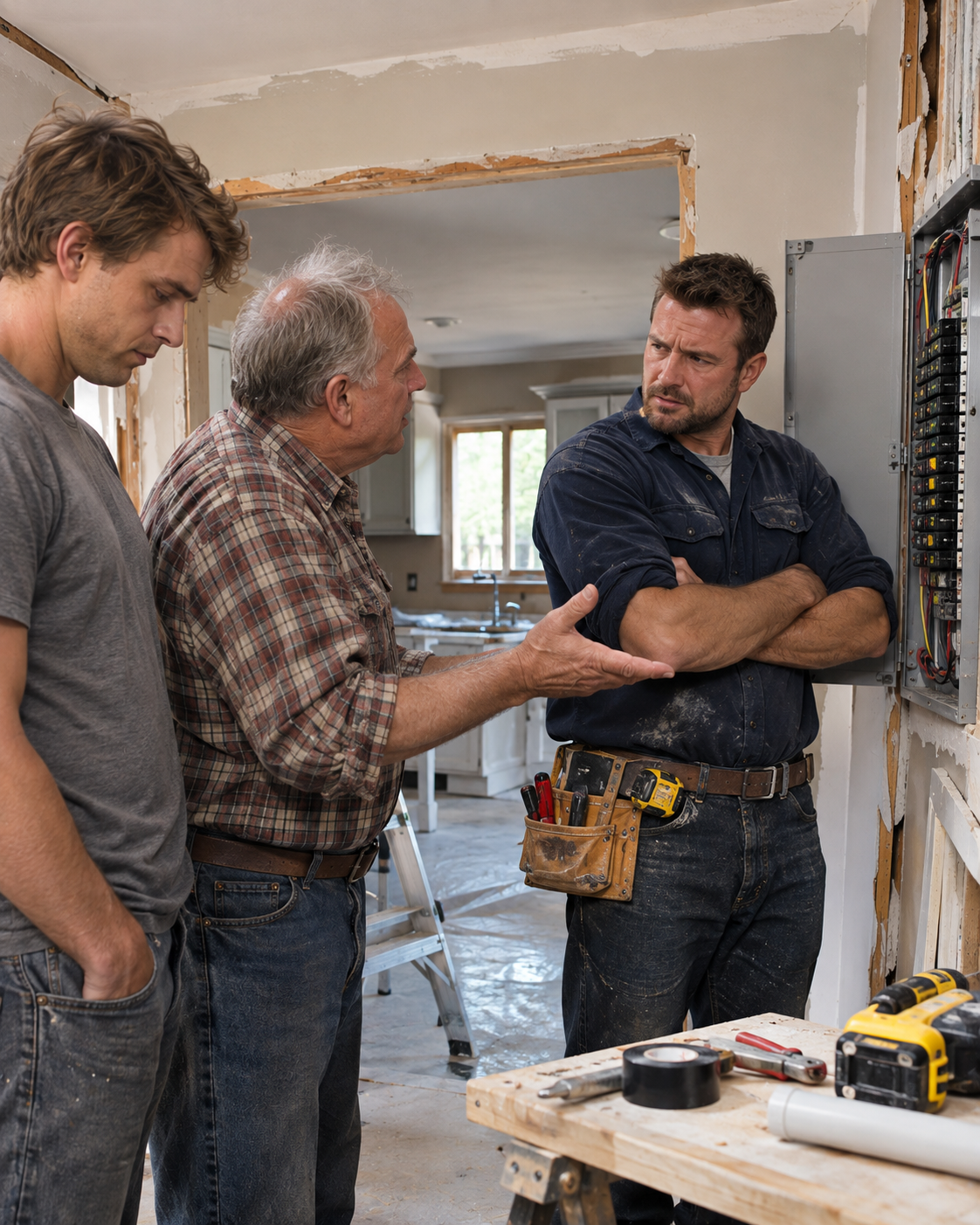
“That wasn’t my question.”
For the first time since I was a kid, I saw my father struggle to find something to say.
He had always been the loudest person in every room.
Now he seemed desperate to become invisible.
Evelyn asked everyone to step back while she continued examining the panel.
She pointed to several breakers.
“These are not listed for use with this equipment. That matters because a breaker needs to make proper contact and operate as designed.”
The buyer’s husband leaned forward.
“Could that cause a fire?”
“It creates a potential hazard that needs to be evaluated and corrected by a qualified electrician.”
His wife placed a hand over her stomach.
I hadn’t noticed until then that she was pregnant.
She looked at Dad.
“You told us everything was new and professionally installed.”
Dad opened his mouth.
She shook her head.
“Don’t.”
One word.
That was all it took to stop him.
Evelyn closed the panel and asked the buyers to wait outside.
They didn’t argue.
As they walked toward the front door, I heard the woman tell her husband, “We’re not bringing our baby into this house.”
The door shut behind them.
Dad turned on Trevor.
“Look what you’ve done.”
Something inside me snapped.
“No.”
Both of them looked at me.
“You don’t get to blame him for everything. You hired him. You knew he wasn’t licensed. Then you tried to make me responsible when I wouldn’t sign your paperwork.”
Dad pointed a finger at my chest.
“You have no idea what it costs to keep a business running.”
“I know what it costs to do the job right.”
“You think you’re better than me because you have a license?”
“No. I think having a license means I’m responsible for the work I put my name on.”
Evelyn stepped between us.
“This discussion is over. I have enough information to begin a formal investigation.”
Dad gave a short, bitter laugh.
“Investigation? Over a few breakers?”
Evelyn’s expression didn’t change.
“Over unlicensed electrical work at nine properties, potentially false documentation, and possible safety violations affecting current homeowners.”
Then she said something that made even me feel sick.
“Some of those houses are already occupied.”
I knew that.
I’d seen the addresses.
But hearing her say it out loud made the situation feel different.
This wasn’t just about my license anymore.
There were families sleeping behind walls filled with wiring nobody had properly verified.
And some of them had no idea.
Evelyn issued instructions preventing further electrical work at the property until the appropriate approvals and inspections could be completed.
She also told Dad that the remaining properties would need to be examined.
He looked ready to explode.
Instead, he pulled out his phone.
“I need to call my attorney.”
“You’re welcome to do that,” Evelyn replied.
Then she looked at me.
“I’ll need copies of the records you brought today.”
“You can have everything.”
As I handed her the folder, Trevor stepped closer.
“Can I talk to you?”
I looked at him.
He looked younger than his twenty-six years.
For a moment, I remembered the kid who used to follow me around our garage, asking why one wire was black and another was white.
I had taught him how to use a screwdriver.
I had shown him how to replace a broken light switch under supervision.
Somewhere along the way, he had mistaken those lessons for the training required to wire an entire house.
“Not here,” I said.
He nodded.
But before he could walk away, Dad grabbed his shoulder.
“Don’t say another word without me.”
Trevor pulled free.
It was a small movement.
But I had never seen him do that before.
Outside, the buyers were standing beside their car.
The husband approached me.
“Can I ask you something?”
“Sure.”
“If we’d moved in, how long could something like that have gone unnoticed?”
I thought carefully before answering.
“There’s no way to know. Some electrical problems show up quickly. Others can stay hidden until something fails.”
He glanced toward his wife.
“We’ve been trying to have a baby for six years.”
I didn’t know what to say.
He swallowed.
“That house was supposed to be our fresh start.”
“I’m sorry.”
He shook his head.
“You didn’t do this.”
Then he held out his hand.
“Thank you for refusing to sign those papers.”
I shook it.
His grip was tight.
He and his wife drove away without going back inside.
Their real estate agent followed a few minutes later.
Dad watched from the porch as the sale disappeared in front of him.
He didn’t say anything to me.
He just got into his truck and drove away.
That evening, I went home exhausted.
Hannah was making dinner when I walked into the kitchen.
She took one look at my face and turned off the stove.
“How bad?”
“Bad.”
I sat down and told her everything.
Trevor’s confession.
The breakers.
The buyers.
The investigation.
She listened without interrupting.
When I finished, she reached across the table and held my hand.
“You did the right thing.”
“I know.”
“But?”
I looked toward the window.
“I keep thinking about those families.”
Hannah squeezed my hand.
“Then help make sure they find out.”
I had already started contacting homeowners about possible safety concerns before the walkthrough.
Now I knew those warnings needed to be even clearer.
I called Evelyn the next morning.
She explained that official notices would be sent through the proper channels and warned me not to enter properties or perform work without authorization.
I understood.
I wasn’t trying to become anybody’s hero.
I just wanted people to know they might be living with a problem they couldn’t see.
By lunchtime, my phone was ringing constantly.
Some callers were angry.
Some were frightened.
One woman accused me of trying to ruin her property value.
Another asked whether she should turn off her electricity.
I told everyone the same basic thing.
They needed a qualified electrician and the appropriate inspections. If they noticed immediate signs of danger, they should contact the proper emergency services or utility provider.
I couldn’t diagnose their houses over the phone.
And I wasn’t going to pretend I could.
Then a man named Robert called.
He had purchased one of Dad’s renovated houses four months earlier.
“I got your message,” he said. “I thought you should know something.”
“What is it?”
“Two weeks ago, we smelled something burning near the laundry room.”
I sat up.
“Did you have it checked?”
“We called an electrician. He found a loose connection and repaired it.”
“That’s good.”
Robert went quiet.
“There’s more.”
I waited.
“My daughter sleeps in the bedroom on the other side of that wall.”
I closed my eyes.
“How old is she?”
“Seven.”
He took a breath.
“She was the one who smelled it first.”
For several seconds, neither of us spoke.
Then Robert asked a question I couldn’t answer.
“Did your father know these houses weren’t safe?”
“I don’t know what he knew about each specific problem,” I said. “But he knew the electrical work wasn’t done by a licensed contractor.”
Robert thanked me and hung up.
I sat in my truck for nearly twenty minutes afterward.
I had spent years believing that family loyalty meant protecting the people you loved.
Now I was learning that sometimes protecting people meant refusing to protect their mistakes.
Three days later, my boss called me into his office again.
His name was Mark, and he’d been running the electrical company for almost twenty years.
My mentor, Frank, was sitting beside his desk.
That made my stomach tighten.
Mark gestured toward the chair.
“Sit down.”
I did.
He placed a printed complaint on the desk.
It was the same accusation Dad had made about me doing side jobs during company hours.
“We’ve reviewed your timesheets,” Mark said.
I nodded.
“We also checked vehicle records, job assignments, and the permits connected to your work.”
Frank leaned forward.
“Everything matches.”
I let out a breath I hadn’t realized I was holding.
Mark folded his hands.
“There’s no evidence you used company time or equipment for these properties. As far as we’re concerned, that accusation is closed.”
“Thank you.”
“But I need to ask you something.”
“Okay.”
“Why didn’t you tell me your father was pressuring you before this happened?”
I stared at the desk.
“Because I thought I could handle it.”
Frank gave a quiet sigh.
“That’s what good people say right before they try carrying too much alone.”
Mark nodded.
“You’ve worked hard for your license. Don’t let somebody else’s shortcuts make you question that.”
I left the office feeling lighter.
For the first time in weeks, I could breathe.
Then Trevor called.
“Can we meet?”
I almost said no.
Instead, I asked where.
We met at a diner near the highway.
Trevor was already sitting in a booth when I arrived.
There was a cup of coffee in front of him, untouched.
He looked terrible.
Dark circles under his eyes.
Unshaven.
His hands wouldn’t stop moving.
I sat across from him.
“What’s going on?”
He stared into his coffee.
“Dad told me you were going to sign the permits.”
I frowned.
“When?”
“Before I started the first house.”
I felt my jaw tighten.
“He said you’d be the licensed electrician on record. He told me you were too busy to be there every day, but you’d check everything before the houses sold.”
I shook my head.
“He never asked me until after the work was done.”
Trevor looked up.
“I know that now.”
“Why didn’t you call me?”
He laughed without humor.
“Because I knew what you’d say.”
I didn’t argue.
He continued.
“At first, I thought I was helping Dad get back on his feet. He’d lost the factory job. The bank was calling. Mom was worried about the mortgage.”
Our mother had spent most of the past year trying to keep peace between everyone.
She hated arguments.
Sometimes I thought she hated them so much that she preferred not knowing what caused them.
Trevor rubbed his face.
“Then the first house sold. Dad was happy again. He took Mom out to dinner. He said we were finally turning things around.”
“And you kept going.”
He nodded.
“Every time I said we should hire somebody licensed, he told me there wasn’t enough money.”
I looked at him.
“Trevor, you could have killed somebody.”
His eyes filled.
“I know.”
“No, I need you to understand. This isn’t about whether you’re good with tools. It’s about knowing what you don’t know.”
He wiped his face with his sleeve.
“I thought if something was wrong, you’d catch it.”
That hurt more than I expected.
Because somewhere beneath his fear and poor judgment, my little brother had still believed I would come along and fix everything.
Just like when we were kids.
I leaned back.
“I can’t be your safety net when you hide the danger from me.”
He nodded.
Then he reached into his jacket and pulled out a folded piece of paper.
“I need to show you something.”
It was a photocopy of an invoice.
At the top was the name of Dad’s renovation company.
Under the description, it said electrical installation and certification.
The amount was nearly eight thousand dollars.
I stared at it.
“What’s this?”
“One of the closing documents for the last house.”
“Why does it say certification?”
Trevor shook his head.
“I don’t know. Dad handled all the paperwork.”
“Did you sign anything?”
“Just payment receipts.”
I examined the invoice again.
Trevor had received three hundred dollars for that house.
Yet the paperwork showed a much larger electrical charge to the buyer.
“Does Evelyn know about this?”
“Not yet.”
I slid the paper back toward him.
“Then she needs to.”
Trevor swallowed.
“Dad said if I give them anything else, I’m dead to him.”
I looked straight at my brother.
“He’s already trying to make you take the fall alone.”
Trevor stared at me.
Then he folded the invoice and put it back in his pocket.
“I’ll call her.”
Two days later, Evelyn contacted me.
She couldn’t share every detail of an active investigation, but she confirmed that additional financial and permit documents were being reviewed.
The nine properties would require further inspections, and corrective work would have to be completed by properly qualified contractors.
Dad’s renovation registration was also under review.
The consequences were becoming real.
And my father wasn’t handling them well.
Mom called that night.
Her voice sounded thin.
“Your father hasn’t slept.”
I stood in our hallway, listening.
“He barely eats. He’s talking about selling his truck.”
“I’m sorry, Mom.”
“Can’t you tell the board it was a misunderstanding?”
I closed my eyes.
“Mom.”
“Just tell them the family had a disagreement. Maybe they’ll give him another chance.”
“People could have been hurt.”
“I know.”
“Then why are you asking me to lie?”
She started crying.
I hated hearing it.
But I didn’t take back the question.
After a long silence, she whispered, “Because I don’t know how we’re going to survive this.”
That was the first time I understood how frightened she really was.
Dad had been making decisions for both of them for years.
Now those decisions were falling apart, and she was standing in the wreckage.
“I’ll help you figure out what comes next,” I told her. “But I won’t lie.”
She cried harder.
“I know you won’t.”
Then she said something that surprised me.
“Maybe that’s why I called you.”
A week later, the state board scheduled a formal hearing.
Dad hired an attorney.
Trevor hired a different one.
I attended with my records and Frank beside me.
Hannah had wanted to come, but I asked her to stay with Mom that morning.
I knew Mom would need someone.
The hearing room was smaller than I expected.
No dramatic courtroom.
No television cameras.
Just a long table, officials, attorneys, and several people whose lives had been affected.
Robert was there.
So were two other homeowners.
The pregnant buyer and her husband sat near the back.
Dad arrived wearing the same dark suit he’d worn to my wedding.
He looked older.
His shoulders were rounded, and his face had lost its usual confidence.
He didn’t acknowledge me.
The hearing began with the complaint against my license.
I answered questions about my work history, permit records, and the way I documented completed installations.
Frank confirmed our company’s procedures.
Mark’s written findings were also submitted.
Then Evelyn presented the results of the property inspections completed so far.
Several homes required corrective electrical work.
The problems varied.
Improperly matched equipment.
Connections that needed repair.
Installations that lacked the documentation and inspections required for approval.
Not every issue was an immediate emergency.
But none of it should have been ignored.
The officials asked Trevor to explain his role.
He spoke quietly.
He admitted performing the electrical installations without a license.
He admitted he had accepted payment.
He admitted he knew he wasn’t qualified to certify the work.
Then one official asked why he had continued after the first house.
Trevor looked toward Dad.
“Because my father told me my brother would sign off on everything.”
Dad’s attorney immediately leaned toward him.
The room became tense.
Trevor continued.
“I should have checked with my brother. I didn’t. That’s my responsibility.”
He paused.
“But I won’t let him get blamed for work he never touched.”
I looked down at my hands.
I hadn’t expected Trevor to defend me.
Not publicly.
Not with Dad sitting ten feet away.
Then the invoice came up.
Dad’s attorney argued that the charge covered multiple renovation services and had been described poorly.
The officials requested supporting records.
Dad answered several questions, but his explanations became increasingly difficult to follow.
At one point, he said he’d assumed Trevor was qualified because he’d learned electrical work from me.
Frank leaned toward me.
“Don’t react,” he whispered.
I kept my mouth shut.
But I wanted to stand up and tell everyone that knowing how to hold a tool didn’t make someone an electrician.
Years of training mattered.
Supervision mattered.
Testing mattered.
The rules weren’t there to make people feel important.
They existed because electricity doesn’t care whether someone meant well.
Near the end of the hearing, Robert was invited to speak.
He stood with a piece of paper trembling in his hand.
“I’m not here because I want anybody ruined,” he began.
He looked at Dad.
“I bought my house because I believed the renovations had been done professionally.”
He explained the burning smell near his laundry room.
He explained how his daughter had noticed it.
Then he said, “My little girl asked me if our house was going to catch fire while we slept.”
Nobody moved.
Robert looked down.
“I didn’t know what to tell her.”
He folded the paper.
“I don’t want revenge. I want my family to be safe. And I want the people responsible to stop pretending this was just a paperwork problem.”
When he sat down, Dad was staring at the table.
For the first time, I wondered whether he finally understood.
Not the fines.
Not the lost sales.
The people.
The hearing ended without an immediate final ruling.
The board needed to review additional documents and inspection findings.
We were told written decisions would follow.
Outside, Dad approached me.
Frank stayed nearby.
For a moment, my father just stood there.
Then he said, “You really did it.”
I frowned.
“Did what?”
“You stood there and let them tear this family apart.”
I felt the old familiar anger rise.
But something about his face stopped me.
He looked exhausted.
“Nobody made you file that complaint against me,” I said.
Dad looked away.
“You could’ve helped.”
“I tried to help by telling you to hire licensed electricians.”
“You knew I couldn’t afford that.”
“Then you couldn’t afford to flip those houses.”
His face tightened.
I thought he might yell.
Instead, he said quietly, “I was scared.”
I stared at him.
Dad had never admitted being afraid of anything.
He looked toward the parking lot.
“When the factory closed, I was fifty-four years old. I sent out applications for months. Nobody called.”
I listened.
“I spent thirty years working. Then one morning, they handed me a box and told me my job was gone.”
His voice cracked.
“I couldn’t stand the idea of your mother looking at me like I was useless.”
I felt a painful tug in my chest.
For years, I’d thought his pride was simply stubbornness.
Now I could see the fear underneath it.
But fear didn’t erase what he’d done.
“Dad,” I said, “you weren’t useless because you lost your job.”
He looked at me.
“You became dangerous when you decided being wrong was worse than putting other people at risk.”
He flinched.
I didn’t enjoy saying it.
But I meant every word.
He turned and walked away.
For nearly a month, I didn’t hear from him.
During that time, the official decisions arrived.
The complaint against my electrical license was dismissed based on the evidence.
My professional standing remained intact.
Trevor faced penalties for unlicensed electrical contracting, including fines and restrictions on performing further electrical work until he met the applicable licensing requirements.
Dad’s renovation registration was suspended.
He was required to arrange and pay for inspections and necessary repairs across the nine properties.
Official notices were sent to the affected homeowners.
The financial consequences were enormous.
Dad had to sell two unfinished properties at a loss.
He sold his truck.
Then he put the family house on the market.
Mom moved into a small rental apartment while they tried to sort out their finances.
It was painful to watch.
Even after everything, I didn’t want my parents to lose their home.
But I also couldn’t pretend the consequences were unfair.
The buyers had trusted Dad.
The homeowners had trusted his paperwork.
And he’d treated that trust like something he could borrow without ever paying back.
One Saturday morning, Trevor showed up at my house.
He was carrying a small cardboard box.
Hannah let him in.
I was sitting at the kitchen table when he placed it in front of me.
“What’s this?”
“Some of my tools.”
I looked inside.
Wire strippers.
Pliers.
A voltage tester.
The same kind of tools I’d used when I first started working with Frank.
Trevor sat down.
“I’m selling most of them.”
“Why?”
“To help pay the fines.”
I nodded.
Then he said, “I’ve been thinking about going back to school.”
I looked up.
“For what?”
“Electrical training. The real kind.”
I didn’t answer immediately.
He continued.
“I know I messed up. I know I can’t just say sorry and make it disappear.”
“You’re right.”
“But I still want to learn.”
I studied him.
“Why?”
He looked confused.
“What do you mean?”
“Why do you want to be an electrician?”
He thought for a moment.
“Because I like figuring things out. I like working with my hands.”
Then he added, “And because I want to know how to do something right instead of pretending I already do.”
That answer mattered.
I pushed the box back toward him.
“Keep the tools.”
He looked surprised.
“You’ll need them if you’re serious.”
His eyes filled.
“Would you teach me?”
I shook my head.
“Not the way we did before.”
He lowered his gaze.
“If you want this career, you start with proper training. You follow the rules. You earn every qualification. And you never use my name to cover work I haven’t done.”
He nodded quickly.
“Okay.”
I leaned forward.
“And Trevor?”
“Yeah?”
“If you ever feel pressured to do something unsafe again, you walk away. Even if the person asking is me.”
He gave a small, shaky smile.
“Especially if it’s you.”
For the first time in months, we both laughed.
It wasn’t forgiveness for everything.
But it was a beginning.
Dad’s change came more slowly.
For weeks, he avoided me.
Then one evening, Hannah answered the door and found him standing on our porch.
He wasn’t carrying anything.
No paperwork.
No permits.
No demands.
Just himself.
I stepped outside.
“Hey, Dad.”
He nodded.
“Can we talk?”
We sat on the porch steps.
The sun was going down, and the neighborhood was quiet.
He stared at his hands for a long time.
“I went to see one of the homeowners today.”
I waited.
“The family with the little girl.”
Robert’s family.
My chest tightened.
“What happened?”
“I apologized.”
I looked at him.
Dad swallowed.
“Robert showed me where the electrician repaired the wiring. He showed me the inspection report.”
He rubbed his forehead.
“Then his daughter came into the room.”
I didn’t interrupt.
“She asked me if I was the man who fixed their house.”
His voice broke.
“I didn’t know what to say.”
He stared toward the street.
“Her father told her I was the man who had arranged the renovations.”
Dad wiped his eyes.
“She said, ‘Then why didn’t you make it safe the first time?'”
I felt my throat tighten.
He shook his head.
“I couldn’t answer her.”
We sat in silence.
Then Dad turned toward me.
“I’ve spent my whole life telling you boys that a man takes care of his family.”
I nodded.
“But I was so afraid of failing mine that I put other families in danger.”
He looked down.
“And when you refused to help me hide it, I tried to destroy your career.”
I had waited months to hear him acknowledge that.
But now that the words were here, I didn’t feel victorious.
I just felt tired.
“I’m sorry,” he whispered.
I stared at him.
Dad had apologized for small things before.
A missed birthday.
A broken promise.
But never for something like this.
“I know I don’t deserve you to forgive me,” he continued. “And I’m not asking you to make the consequences go away.”
He took a breath.
“I just wanted you to hear me say I was wrong.”
I looked toward our front door.
Through the window, I could see Hannah moving around the kitchen.
The life we’d built was still there.
My career was intact.
My marriage was strong.
And for the first time, my father wasn’t asking me to sacrifice either one for him.
“I can’t pretend it didn’t happen,” I said.
“I know.”
“And I can’t trust you the way I used to.”
He nodded.
“I know that, too.”
“But I don’t want to spend the rest of my life hating you.”
Dad covered his face with one hand.
We didn’t hug that night.
We didn’t suddenly become a perfect family.
He sat on the porch until the streetlights came on.
Then he stood, thanked me for listening, and went home.
Over the next several months, the repairs across the nine properties were completed through properly qualified contractors, with the required inspections and approvals.
The process was expensive and difficult.
Some homeowners remained angry.
A few pursued additional compensation.
Others simply wanted the work finished so they could move on.
Dad had to face those consequences without expecting me to rescue him.
And slowly, he did.
He found a maintenance job at a local warehouse.
It wasn’t glamorous.
He didn’t make the money he’d hoped to earn flipping houses.
But he showed up every morning, did his work, and came home without having to hide anything.
Mom told me he seemed calmer than he’d been in years.
Trevor enrolled in an approved training program and began looking for supervised work once he was eligible.
He still had a long road ahead.
But he stopped talking about shortcuts.
Instead, he started asking questions.
Real questions.
The kind he should have asked before touching those nine houses.
One afternoon, Frank and I were finishing a commercial installation when Trevor stopped by to return a book I’d lent him.
Frank asked him what he’d learned that week.
Trevor smiled.
“Mostly how much I don’t know.”
Frank laughed.
“Good. That’s where every decent tradesman starts.”
I watched my brother carefully put the book back into his bag.
He wasn’t the same person who’d stood in that house and admitted wiring nine properties without a license.
He was still responsible for what he’d done.
But he was finally learning to build something instead of pretending it was already finished.
A year after the hearing, I received a letter from Robert.
Inside was a photograph.
His daughter was standing in front of their house, holding a handmade sign.
It read, “Our home is safe.”
Robert had written a short note on the back.
“All the required repairs are complete. Our daughter sleeps through the night again. Thank you for speaking up when it would have been easier to stay quiet.”
I sat at the kitchen table holding that photograph for a long time.
Hannah came over and read the note.
Then she wrapped her arms around my shoulders.
“That right there,” she said softly, “is why you did it.”
I nodded.
For months, I’d measured the whole experience in losses.
Dad’s business.
The family home.
The trust between us.
The money spent on lawyers and repairs.
The years it might take to rebuild our relationships.
But that photograph reminded me there was another side.
A little girl could sleep without being afraid.
A family could feel safe in the home they’d worked hard to buy.
My brother had a chance to learn a trade properly.
And my father was finally beginning to understand that responsibility meant more than providing money.
It meant telling the truth, even when the truth was expensive.
A few weeks later, Dad came over for Sunday dinner.
Trevor was there.
So were Mom and Frank.
Nobody brought up the hearing.
Nobody pretended it had never happened, either.
We ate, talked about work, and laughed when Trevor burned the garlic bread.
After dinner, Dad helped me carry the dishes into the kitchen.
He noticed the photograph from Robert hanging beside the refrigerator.
He stood there looking at it.
“That’s the little girl?” he asked.
“Yeah.”
He studied her smile.
Then he nodded.
“I’m glad she’s okay.”
“Me too.”
Dad turned toward me.
“You know, I used to think your license was just a piece of paper.”
I smiled faintly.
“I noticed.”
He looked embarrassed.
“But I understand now. It’s your promise that you know what you’re doing, and that you’ll stand behind your work.”
I thought about that.
“That’s part of it.”
“What’s the other part?”
“Knowing when you shouldn’t put your name on something.”
Dad nodded slowly.
Then he reached out and squeezed my shoulder.
It was a small gesture.
But it meant more than any grand speech.
Later that evening, after everyone had gone home, I went into the garage to put away my tools.
I found an old electrical panel cover leaning against the wall.
It was from a training setup Frank had given me years earlier.
Inside, written in black marker, were my initials and the date of my first supervised installation.
I smiled.
Back then, I’d thought those marks were just a habit my mentor insisted on.
Something small.
Something nobody would ever notice.
I understood them differently now.
They were proof that I’d been there.
That I’d done the work.
That I was willing to take responsibility for it.
I picked up the cover and ran my thumb across the faded writing.
Then I hung it on the wall above my workbench.
Not as a trophy.
As a reminder.
Because the hardest part of doing the right thing isn’t always knowing what the right thing is.
Sometimes you know exactly what you should do.
The hard part is doing it when the person asking you to compromise is someone you love.
My father wanted my signature because he believed family loyalty meant protecting him from the consequences of his choices.
But I learned that real loyalty doesn’t mean helping someone hide a dangerous mistake.
Sometimes it means refusing, even when that refusal costs you a relationship.
Sometimes it means telling the truth and allowing the people you love to face what they’ve done.
And sometimes, if you’re fortunate, the truth becomes the very thing that gives your family a chance to rebuild.
I nearly lost my father because I wouldn’t sign nine electrical permits.
But by refusing, I kept something I could never have replaced.
My integrity.
And somewhere in those nine houses, families were sleeping safely because the truth finally mattered more than appearances.
That was worth every difficult conversation, every sleepless night, and every painful consequence.
Because a signature should never mean more than the lives behind it.
And family should never ask you to choose between loving them and doing what’s right.