My father reported me to the state electrical board for dangerous wiring in nine houses. The strange part? He knew I hadn’t wired a single one.
“I did the wiring,” Trevor said.
The words came out so quietly that I almost didn’t hear them.
Evelyn closed her folder.
“All nine houses?”
Trevor nodded.
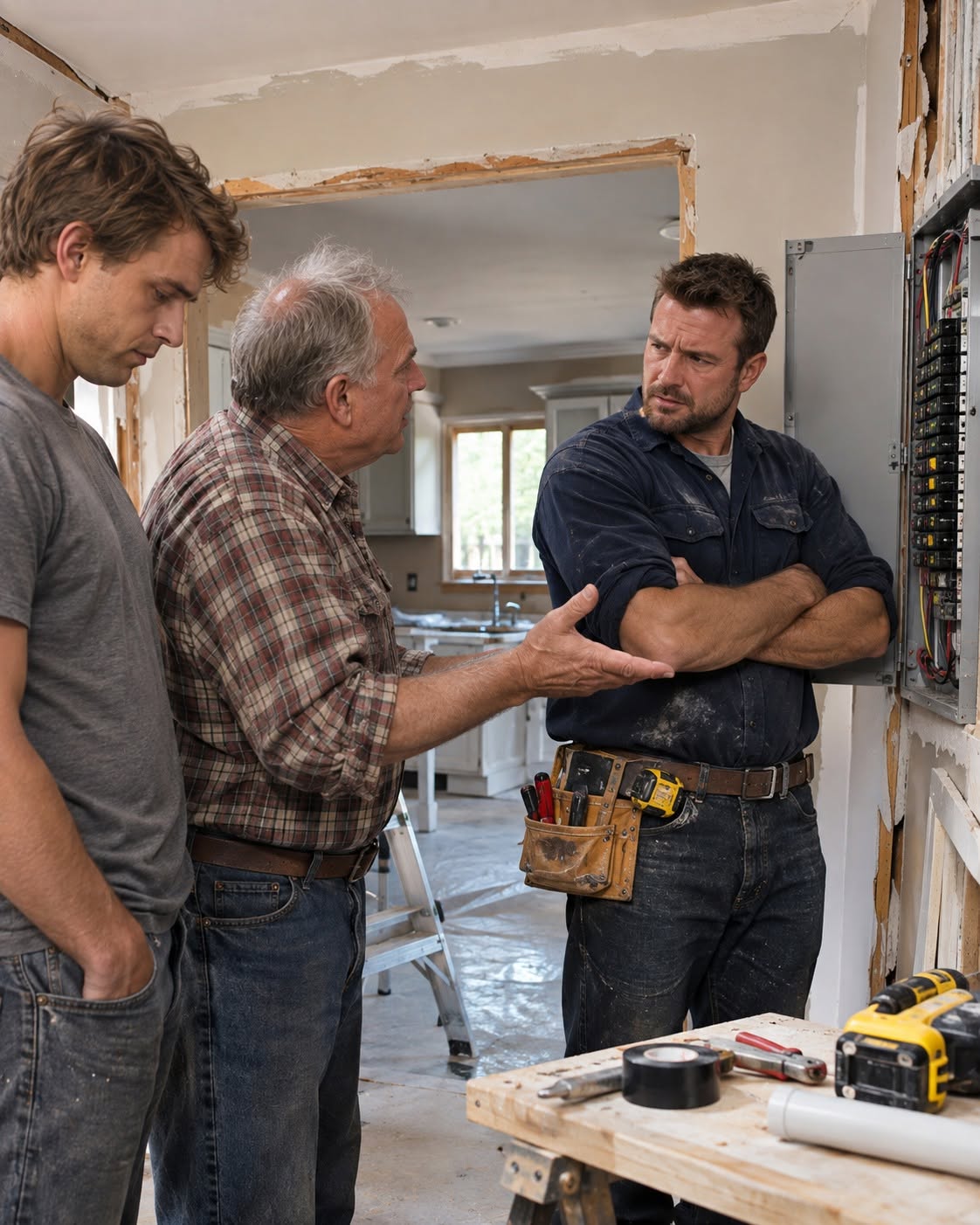
Dad immediately stepped between them.
“Now hold on. My boys worked together on those properties. Trevor’s just confused about who handled what.”
I stared at my father.
Even now, with an inspector standing in front of him and two frightened homebuyers listening, he was trying to drag me into his mess.
Trevor looked at me.
For a moment, I saw the little brother who used to follow me around the garage, begging to hold my tools.
Then he said something that changed everything.
“Dad told me you already approved the work.”
My stomach dropped.
“What?”
Trevor swallowed.
“He said you’d checked the plans and agreed to sign the permits when everything was finished.”
I turned toward Dad.
“You told him that?”
Dad’s jaw tightened.
“I told him we’d work things out as a family.”
“No,” Trevor said, his voice growing stronger. “You told me he knew.”
Evelyn raised her hand.
“Gentlemen, we’re going to stop arguing and establish the facts.”
She turned to Trevor.
“Did you personally install the electrical systems in all nine properties?”
“Yes.”
“Were you working under the supervision of a licensed electrical contractor?”
Trevor looked down.
“No.”
“Did you know your brother’s license number was being used on any paperwork?”
He hesitated.
Dad gave him a sharp look.
I knew that look.
I’d grown up with it.
It was the expression Dad used when he wanted us to understand that telling the truth would have consequences.
But Trevor didn’t look away this time.
“Yes,” he whispered.
Evelyn wrote something in her notebook.
“Who provided that number?”
Trevor’s eyes filled.
“Dad.”
The silence that followed was unbearable.
The prospective buyers stood near the kitchen doorway, looking as though they’d wandered into someone else’s nightmare.
The husband finally spoke.
“We were supposed to close on this house next Friday.”
His wife looked at Evelyn.
“Is it safe for our children?”
Evelyn glanced toward the open electrical panel.
“I can’t certify that based on what I’ve seen. This installation needs a comprehensive inspection, and potentially significant corrective work.”
The woman covered her mouth.
I felt sick.
Not because my father had embarrassed me.
Not because my brother had lied.
Because somewhere in those nine houses, families might already be sleeping beneath wiring that could fail without warning.
And my name was attached to it.
Evelyn stepped away from the panel.
“I’m referring these findings to the appropriate local building authority. Until the electrical systems are properly evaluated, no one should represent these installations as approved.”
Dad threw up his hands.
“This is ridiculous. You’re treating us like criminals over a few technicalities.”
Evelyn turned slowly.
“Mr. Whitaker, electrical safety requirements are not technicalities.”
Her voice was calm, but it carried across the room.
“They exist because mistakes can kill people.”
Dad opened his mouth.
Then closed it.
For the first time that morning, he had nothing to say.
My name is Nathan Whitaker.
I’m thirty-eight years old, and I’ve been a licensed electrician for fourteen years.
I earned that license after four years of apprenticeship, thousands of hours of supervised work, and more late nights studying electrical codes than I care to remember.
My father knew every bit of that.
He’d attended my licensing ceremony.
He’d shaken my hand afterward and told everyone how proud he was.
Now he was willing to destroy everything I’d worked for to protect a business he’d built on shortcuts.
Evelyn asked me to remain after the others stepped outside.
She examined my records again.
“Your documentation is unusually thorough,” she said.
“My mentor taught me that if something goes wrong, memories aren’t enough.”
“Smart man.”
“His name’s Walter Bennett. He’s been in the trade forty years.”
She nodded.
“Mr. Whitaker, based on what I’ve reviewed so far, there’s no evidence you performed this work. But the investigation isn’t finished.”
I understood.
“I’ll cooperate with whatever you need.”
She studied me.
“There’s something else.”
My chest tightened.
“What?”
“The complaint against you included photographs that appear to have been taken inside your employer’s facility.”
I stared at her.
“That doesn’t make sense.”
She showed me one.
It was a photograph of a workbench at the commercial electrical company where I worked.
On the bench sat a box of breakers.
Beside it was a clipboard bearing my name.
“Where did this come from?”
“Your father submitted it.”
I looked closer.
The photograph had been cropped.
But I recognized the clipboard.
It belonged to a job I’d completed six months earlier.
And the breakers weren’t even mine.
They were materials awaiting return to a supplier.
“Someone deliberately made this look like I was using company materials for private work.”
Evelyn nodded.
“That’s one possibility.”
I stared at the image.
Then I noticed something in the background.
A reflection in the polished metal cabinet.
A man wearing a dark baseball cap.
Trevor.
My brother had been inside my workplace.
And suddenly, I remembered something.
Three weeks earlier, Trevor had stopped by during my lunch break.
He’d said he needed advice about a panel replacement.
I’d let him into the break room while I finished a phone call.
At the time, it seemed harmless.
Now I wondered what else he’d done.
When I stepped outside, Trevor was standing beside his truck.
Dad was nowhere in sight.
I walked toward him.
“Did you take pictures at my job?”
His face changed.
“Nate—”
“Answer me.”
He rubbed his forehead.
“Dad asked me to.”
I felt something inside me go cold.
“Why?”
“He said he needed proof that you were helping us.”
“You knew I wasn’t.”
Trevor looked miserable.
“I thought he was going to use them to convince the bank we had a licensed electrician involved.”
I shook my head.
“You let him use my name.”
“I didn’t know he’d report you.”
“But you knew he was lying.”
Trevor didn’t answer.
That hurt more than anything he could’ve said.
I’d spent most of my life defending my little brother.
When he dropped out of trade school, I helped him find work.
When he wrecked his truck, I loaned him money.
When Dad’s factory closed, I gave them both whatever side jobs I could legally offer.
And somehow, they’d decided my loyalty meant they could use me without asking.
I turned away.
Trevor called after me.
“Nate, wait.”
I stopped.
He looked frightened.
“There’s something else.”
I faced him.
“What?”
“Dad’s been taking deposits on three more houses.”
My heart sank.
“Three?”
Trevor nodded.
“And he told the buyers the electrical work was already approved.”
I closed my eyes.
This wasn’t a misunderstanding.
It was a business built on promises Dad had no right to make.
That evening, Hannah found me sitting on the back porch.
I hadn’t turned on the lights.
I was staring at the yard, trying to remember when my family had become people I needed protection from.
She sat beside me.
“Walter called,” she said.
“What did he want?”
“He said your boss received another anonymous complaint.”
I looked at her.
“About what?”
“Missing inventory.”
I laughed bitterly.
“Of course.”
Hannah took my hand.
“Nathan, this isn’t going to stop because you keep being reasonable.”
“I know.”
“You need a lawyer.”
“I’ve already called one.”
She looked relieved.
Then I told her about Trevor.
About the photographs.
About the three additional houses.
By the time I finished, tears were running down her cheeks.
Not because she was afraid of losing money.
Because she knew how much my family meant to me.
“Your father is trying to make you choose between your career and your family,” she said.
I looked at her.
“What if choosing my career means losing them?”
She squeezed my hand.
“Then maybe the people asking you to sacrifice your future aren’t treating you like family.”
I wanted to argue.
But I couldn’t.
The next morning, I met with an attorney named Laura Mitchell.
She specialized in professional licensing and construction disputes.
She reviewed the complaint, my records, and Evelyn’s preliminary findings.
Then she asked a question I hadn’t considered.
“Who owns the properties?”
“My father arranged the renovation contracts. I think some belong to a company he formed.”
“What’s the company called?”
“Whitaker Residential Solutions.”
Laura searched the public business records.
A moment later, her expression changed.
“Nathan, you’re listed as a managing member.”
I stared at her.
“No, I’m not.”
She turned the screen toward me.
There it was.
Whitaker Residential Solutions LLC.
Managing members: Robert Whitaker, Trevor Whitaker, and Nathan Whitaker.
My name.
My home address.
And a signature on the formation paperwork that looked disturbingly like mine.
“I never signed that.”
Laura leaned back.
“Then we may be dealing with more than a false licensing complaint.”
She printed the document.
“Did your father ever ask you to join the company?”
“Last year. I said no.”
“Did you give him permission to use your name?”
“Absolutely not.”
She nodded.
“We’ll obtain the original filings and challenge any unauthorized representation. We also need to notify your employer and the licensing board immediately.”
I stared at the forged signature.
It was good.
Too good.
Then I remembered the Christmas before last.
Dad had asked me to sign a stack of papers related to his mortgage refinancing.
He’d said the bank needed a witness.
I hadn’t questioned him.
I had trusted him.
Now I wondered whether he’d used that signature as a model.
Laura noticed my expression.
“What is it?”
I told her.
She wrote it down.
“Trust makes these situations easier to exploit,” she said. “But it doesn’t make the conduct acceptable.”
Over the following week, the situation got worse.
Evelyn inspected the remaining properties with local officials and qualified electrical contractors.
Four houses had serious wiring defects requiring immediate correction.
Two had overloaded circuits.
One had improperly protected wiring concealed behind finished walls.
And another had a service-panel installation that raised significant safety concerns.
The ninth property was still unfinished.
Fortunately, several homes were vacant.
But three families had already moved in.
Local authorities arranged appropriate safety measures while repairs were planned.
One family had a newborn baby.
Another included an elderly woman who depended on electrically powered medical equipment.
When I heard that, I couldn’t sleep.
I kept imagining what might have happened if I’d signed those permits.
Every time Dad called, I let it go to voicemail.
He left messages ranging from angry to pleading.
“You’re ruining your brother’s future.”
“You know I only did this because I had no choice.”
“Your mother would be ashamed of you.”
That last one nearly broke me.
Mom had died seven years earlier.
She’d been the person who kept peace in our family.
The one who reminded Dad to apologize.
The one who taught Trevor and me that being strong didn’t mean being cruel.
Using her memory against me was the lowest thing Dad had ever done.
I saved every message.
Then I stopped listening to them.
Two weeks after the inspection, Trevor showed up at my house.
It was almost nine at night.
Hannah opened the door and called for me.
Trevor stood on the porch holding a cardboard box.
He looked exhausted.
“Can we talk?”
I stepped outside.
“Depends what you want.”
He handed me the box.
Inside were copies of invoices, bank statements, and handwritten job schedules.
“What’s this?”
“Everything Dad kept in the office.”
I looked at him.
“Why are you giving it to me?”
“Because I found out what he did with the money.”
We sat on the porch steps.
Trevor opened a folder.
Dad had collected nearly four hundred thousand dollars in payments and deposits over eighteen months.
Some of it had paid for materials.
Some had paid subcontractors.
But a large portion had been transferred to an account Trevor had never seen.
I studied the statements.
“Where did it go?”
Trevor swallowed.
“Dad’s been gambling.”
I stared at him.
“What?”
“Online sports betting. He started after losing his factory job.”
The words felt unreal.
Dad had always preached about hard work.
About responsibility.
About never spending money you didn’t have.
Trevor wiped his face.
“He told me the business was struggling because customers weren’t paying. He said we needed to finish more houses to stay ahead.”
I looked at the statements.
“He was using new deposits to cover old obligations.”
Trevor nodded.
“And when you refused to sign the permits, he panicked.”
“Because the buyers couldn’t close.”
“Because he couldn’t collect the remaining payments.”
I felt sick.
Trevor stared at the ground.
“I should’ve known.”
“Yes,” I said quietly. “You should have.”
He flinched.
I didn’t soften the words.
Not this time.
“You knew you weren’t qualified to do that work alone. You knew people could get hurt.”
“I know.”
“And you let Dad use my name.”
Tears filled his eyes.
“I know.”
For a long moment, neither of us spoke.
Then he said, “I’m going to tell the investigators everything.”
I looked at him.
“Even if it means losing the business?”
He nodded.
“Even if it means facing charges.”
I studied my brother’s face.
He was thirty-one years old.
A grown man.
For the first time, I realized I couldn’t keep treating him like the little kid who needed me to rescue him.
He had made his own choices.
Now he had to make better ones.
“Then tell the truth,” I said.
“And don’t leave anything out.”
Three days later, Dad was arrested.
The allegations included fraud, forgery, and financial misconduct connected to the renovation business.
The criminal case would take months.
Trevor cooperated with investigators and accepted responsibility for the unlicensed work.
I was called in for another interview.
This time, Evelyn had more questions.
She showed me a copy of the company’s operating agreement.
“Do you recognize this signature?”
“No.”
“And this one?”
“No.”
She studied me.
“Your brother says your father used your professional credentials without your permission.”
“That’s correct.”
She closed the folder.
“Your records support that account.”
I felt a small amount of relief.
Then she continued.
“But the board still needs to complete its review before making a final determination.”
I nodded.
“I understand.”
She looked at me for a moment.
“Mr. Whitaker, I know this has been difficult.”
I almost laughed.
Difficult didn’t begin to describe it.
I’d lost sleep.
I’d nearly lost my job.
I’d watched my brother confess to dangerous work.
And my father was sitting in jail because he’d chosen deception over asking for help.
But I simply said, “I just want my name cleared.”
Evelyn nodded.
“And the public protected.”
“Yes,” I said. “That too.”
A month later, the licensing board scheduled a formal hearing.
I arrived wearing the same navy suit I’d worn to my mother’s funeral.
Hannah sat beside me.
Walter Bennett sat on my other side.
My father was there with his attorney.
Trevor sat several rows behind him.
When the hearing began, I felt my heart pounding.
The board reviewed the permit records, the disputed signatures, my employment documentation, and the inspection findings.
Walter testified about my work habits.
He described the way I documented every installation and refused to approve work I hadn’t personally inspected.
My employer confirmed that I had been assigned to commercial projects during the periods when the residential wiring had been performed.
Then Evelyn presented her findings.
She explained that the evidence did not establish that I had installed, supervised, or approved the work at the nine houses.
She also described the safety defects discovered during inspection.
Finally, Trevor testified.
His voice shook.
“I installed the wiring without the required supervision. My father told me Nathan would approve it later. Nathan refused, and I knew he refused.”
The room was silent.
Trevor looked directly at the board.
“My brother tried to stop us. I should’ve listened.”
I stared at the table.
I didn’t know whether to feel grateful or furious.
Maybe both.
After a recess, the board announced its decision.
The complaint against my license was dismissed based on the evidence.
No disciplinary action would be taken against me.
The board would separately address the unauthorized use of credentials and the unlicensed electrical work through the appropriate proceedings.
For several seconds, I couldn’t move.
Then Hannah grabbed my hand.
“You did it,” she whispered.
I shook my head.
“We did.”
Walter patted my shoulder.
“Proud of you, son.”
Those four words nearly undid me.
Because they were the words I’d spent my whole life wanting to hear from my father.
And now they were coming from the man who’d taught me how to do the job right.
Outside the hearing room, Dad approached me.
His attorney stayed several feet behind him.
Dad looked older.
His shoulders were hunched.
His eyes were tired.
“Nathan,” he said.
I stopped.
Hannah remained beside me.
Dad glanced at her, then back at me.
“I never meant for it to go this far.”
I studied his face.
“You reported me to the board.”
“I was desperate.”
“You forged my signature.”
He looked away.
“I thought I could fix everything before anybody noticed.”
“You put families in danger.”
His eyes filled.
“I know.”
I waited.
For the first time, I didn’t rush to make him feel better.
Dad rubbed his hands together.
“I lost my job. Then your mother died. I couldn’t stand feeling useless.”
His voice cracked.
“I watched you build a career while I couldn’t even keep the lights on.”
I felt a familiar ache.
I’d known Dad was struggling.
I’d offered help.
I’d offered him work organizing inventory at my shop.
He’d refused because he considered it beneath him.
Now I understood that his pride had become something poisonous.
“You could’ve asked me for help,” I said.
“I did.”
“No, Dad. You asked me to lie.”
He looked at me.
“There’s a difference.”
Tears ran down his cheeks.
“I don’t know how to fix this.”
I took a slow breath.
“Neither do I.”
He reached toward me.
I stepped back.
The hurt in his expression was immediate.
But I couldn’t pretend that one conversation erased what he’d done.
“I hope you get help,” I said. “Real help. For the gambling. For everything.”
He nodded.
“But I can’t be the person who rescues you from the consequences anymore.”
Then I walked away.
It was the hardest thing I’d ever done.
And the first time I truly understood what a boundary was.
Not punishment.
Not revenge.
A line you draw because crossing it would cost you something you cannot afford to lose.
The criminal case continued.
Dad eventually pleaded guilty to several financial and forgery-related offenses.
He received a sentence that included incarceration, restitution obligations, and supervised treatment requirements.
The exact financial recovery would take years.
Trevor faced penalties for the unlicensed work and entered a supervised training arrangement after resolving his own legal and regulatory matters.
He couldn’t simply return to installing electrical systems.
He had to start over.
And this time, he did it properly.
He enrolled in an accredited apprenticeship program.
He attended classes.
He worked under licensed supervision.
He learned the codes he’d once dismissed as unnecessary.
One afternoon, nearly a year after the hearing, he came to my shop.
He was wearing work boots and carrying a textbook.
“Got a minute?”
I looked up from the panel I was assembling.
“Sure.”
He placed the book on my workbench.
“I passed my first electrical theory exam.”
I smiled despite myself.
“Good.”
He hesitated.
“I wanted you to know.”
I nodded.
Then he said, “I don’t expect you to forgive me.”
I looked at him.
“Trevor, forgiveness isn’t something you can demand from somebody because you’ve decided you’re sorry.”
“I know.”
“But I see you’re trying.”
His eyes filled.
“I’m going to keep trying.”
For the first time in a long while, I believed him.
Not because he’d promised.
Because he’d started doing the work.
The nine houses were eventually repaired by properly licensed contractors.
Independent inspections confirmed the corrected electrical systems met applicable requirements.
The affected families received assistance through a combination of insurance claims, legal settlements, and recovery efforts.
Not everyone was made completely whole.
Some lost money.
Some lost months of peace.
One couple had to delay moving into their first home for almost a year.
That reality stayed with me.
Clearing my name didn’t erase what happened to them.
So I did something I hadn’t planned.
I started volunteering one Saturday a month with a nonprofit that helped low-income homeowners address dangerous electrical conditions.
Walter joined me.
Then a few apprentices from my company.
Eventually, Trevor asked whether he could help with non-electrical tasks while he continued his training.
I thought about it for a long time.
Then I said yes.
Under supervision, he carried materials, cleaned work areas, and helped with the tasks he was qualified to perform.
He never complained.
One Saturday, we visited an elderly widow named Mrs. Collins.
Her kitchen lights flickered whenever she used the microwave.
She’d been living with extension cords running across the floor because she couldn’t afford repairs.
Walter inspected the panel.
I checked the circuits.
Trevor carried supplies.
By late afternoon, the unsafe wiring had been corrected.
Mrs. Collins stood in her kitchen, turning the lights on and off.
She laughed.
“Would you look at that?”
Then she started crying.
I asked if she was okay.
She nodded.
“I’ve been afraid to sleep with the lights on for months.”
I looked at Trevor.
He was staring at the floor.
Later, while we loaded the truck, he said something I’ll never forget.
“I used to think electrical work was just connecting wires.”
I closed the toolbox.
“What do you think now?”
He looked back toward the house.
“I think people trust us with their lives.”
I nodded.
“That’s exactly what they do.”
Two years after the complaint, my life looked different.
My license was still in good standing.
I’d been promoted to field supervisor.
Hannah and I had welcomed our first daughter, Emma.
And my relationship with Trevor was slowly healing.
Not perfectly.
Not quickly.
But honestly.
Dad had completed his sentence and was continuing treatment for his gambling problem.
We exchanged occasional letters.
He had apologized without excuses.
He’d also begun making restitution payments, even though the amounts were small.
I didn’t know whether we’d ever have the relationship we once had.
But I’d stopped believing that healing required pretending nothing happened.
One Sunday afternoon, I received a letter from him.
Inside was a photograph.
It showed me at twenty-four, standing outside the apprenticeship training center with my new electrician’s license.
Dad stood beside me, smiling proudly.
On the back, he’d written:
“I was proud of you that day. I should have spent the years afterward becoming someone you could be proud of, too.”
I sat at the kitchen table for a long time.
Hannah came in carrying Emma.
She noticed the photograph.
“From your dad?”
I nodded.
She sat beside me.
“Are you okay?”
I looked at our daughter.
Her tiny fingers wrapped around mine.
“Yeah,” I said quietly. “I think I am.”
Then I put the photograph in a drawer.
Not because I wanted to forget.
Because I wasn’t ready to put it on the wall.
And that was okay.
A few months later, Trevor completed another stage of his apprenticeship.
He called me immediately.
“Guess what?”
“What?”
“Passed the practical assessment.”
I smiled.
“Congratulations.”
He laughed.
“Walter said I should ask you to celebrate.”
“What did he suggest?”
“Dinner. Your place. I’ll bring dessert.”
I looked toward the living room, where Hannah was helping Emma stack colorful blocks.
“Saturday at six,” I said.
Trevor went quiet.
Then he whispered, “Thanks, Nate.”
I hung up and stood there for a moment.
For years, I’d believed protecting my family meant fixing every problem they created.
Now I understood something different.
Sometimes, protecting the people you love means refusing to help them destroy themselves.
Sometimes, love means telling the truth when everyone wants you to lie.
And sometimes, the kindest thing you can do is allow someone to face the consequences that might finally teach them to change.
That Saturday, Trevor arrived at six sharp.
He carried a chocolate cake and a small gift for Emma.
After dinner, he helped me wash the dishes.
We talked about work.
About his classes.
About how difficult conduit bending had been during his latest assessment.
For the first time in years, we sounded like brothers again.
Not partners in a family crisis.
Not enemies.
Just brothers.
Before he left, Trevor stopped beside the front door.
“Nate?”
“Yeah?”
He looked at me.
“I’m glad you didn’t sign those permits.”
I felt my throat tighten.
“Me too.”
He nodded.
“Because if you had, I never would’ve learned what I was doing wrong.”
I thought about that for a moment.
Then I put my hand on his shoulder.
“Just make sure you remember.”
“I will.”
After he drove away, I walked back into the kitchen.
Hannah was turning off the lights.
Emma was asleep upstairs.
The house was quiet.
Safe.
Warm.
I looked at the electrical panel tucked neatly inside the utility closet.
I’d installed it myself when we bought the house.
Every circuit was labeled.
Every connection had been checked.
Inside the cover were my initials and the date.
A small habit Walter had taught me years ago.
At the time, I’d thought it was simply good documentation.
Now I understood it represented something much bigger.
Accountability.
The willingness to put your name on work because you’re prepared to stand behind it.
My father had wanted my signature without my responsibility.
Trevor had wanted my approval without my supervision.
And both had expected me to sacrifice my integrity because we shared the same last name.
But family isn’t a license to endanger people.
Love isn’t permission to lie.
And loyalty doesn’t mean accepting blame for something you didn’t do.
I turned off the kitchen light and headed upstairs.
For fourteen years, I’d worked hard to earn the right to put my name on electrical installations.
That experience taught me how to protect a house from dangerous wiring.
But the hardest lesson of my life taught me how to protect something even more important.
My conscience.
Because the people who truly love you may need your help, but they should never demand that you become dishonest to prove you care.
And sometimes, the most powerful word you can say to someone you love is the one that saves both of you from a much greater disaster.
No.
THE END.