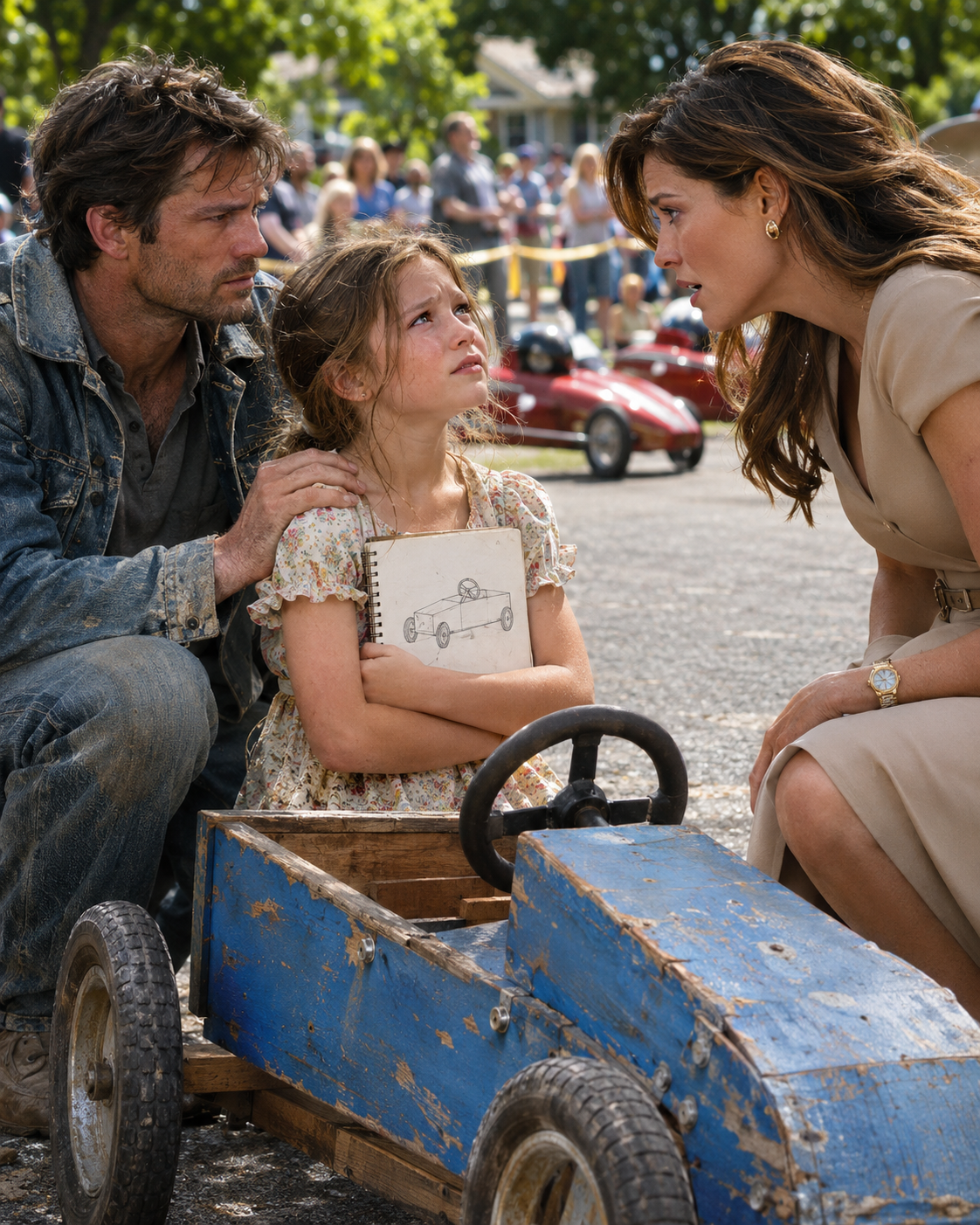
My daughter spent weeks building a race car from fifty dollars’ worth of discarded parts, only to be told she couldn’t compete.
“Before we begin today’s competition, I need to address a mistake we’ve made.”
The executive held up the rule sheet.
“This event was created to encourage children to learn about engineering, problem-solving, and teamwork. But somewhere along the way, we made purchasing our product more important than those things.”
The crowd grew quiet.
“Effective immediately, any racer that meets our technical and safety requirements will be allowed to compete, regardless of where its parts came from.”
My daughter grabbed my hand.
“Dad, does that mean me?”
Before I could answer, the executive looked directly at us.
“Yes, young lady. That includes you.”
My daughter’s face lit up.
I felt a lump rise in my throat as she wrapped her arms around my waist. All those late nights in the garage, all those scraped knuckles and failed attempts, suddenly felt worth it.
Not everyone was happy.
The father who had complained earlier raised his hand.
“What about those of us who spent money on the kits?”
“You’ve purchased a perfectly good racing kit,” the executive explained. “Your children can still compete. We’re simply making sure other children have the same opportunity.”
She also announced that future events would offer free kits to families who needed them and publish clear inspection requirements for anyone who wanted to build a car independently.
Then she handed the microphone back to the announcer.
The volunteer who had turned us away approached my daughter.
“Ready to race?”
She nodded so quickly that I almost laughed.
Together, we pushed her little blue car toward the starting line.
I helped her settle into the seat and checked her helmet.
“Remember what we practiced,” I told her.
“Steady steering. Look ahead. Brake at the finish.”
“And?”
She grinned.
“Have fun.”
When the starting signal sounded, her racer rolled down the ramp.
I stood behind the barrier, cheering louder than I had ever cheered for anything.
Her car wasn’t the fastest. Two racers pulled ahead almost immediately, and another passed her farther down the course.
But her steering held steady. Her wheels stayed aligned, and when she crossed the finish line, her brakes worked exactly as we’d designed them.
She finished fourth.
By the time I reached her, she was climbing out of the car with the biggest smile I’d seen all year.
“Dad! Nothing broke!”
I laughed and hugged her.
“That sounds like a pretty successful day to me.”
The boy who won the race came over while we were checking her wheels. He was one of her classmates, and his racer had been built from the official kit.
“Your car looks really cool,” he told her. “How did you make the steering?”
Instead of guarding her ideas, my daughter opened her notebook.
She showed him the drawings, explained why her first design had failed, and pointed out the changes that had finally made it work.
Soon, several other children were standing around her, asking questions.
I watched her explain everything with the same excitement she’d shown when she first brought home that race flyer.
During the awards ceremony, the executive announced a special Young Builder Award recognizing creativity, persistence, and practical engineering.
Then she called my daughter’s name.
My daughter looked at me in disbelief.
“Go on,” I said, smiling.
She walked onto the platform and accepted her award while the crowd applauded.
She hadn’t won the race, but she had earned recognition for something that mattered deeply to her.
A few months later, we began spending some of our weekends at a community workshop where children could learn to build things using donated materials.
My daughter helped younger kids measure pieces of wood, understand simple steering systems, and work through their mistakes.
Whenever someone became frustrated, she showed them the crossed-out pages in her old notebook.
“See?” she’d say. “Mine didn’t work the first time either.”
We still have that little blue racer in our garage. Its paint is scratched, and its wheels have collected plenty of dust.
But I wouldn’t trade it for the most expensive racing kit in the world.
Because my daughter taught me something that day.
Children don’t need the most expensive equipment to discover what they’re capable of. They need encouragement, room to make mistakes, and a fair chance to prove themselves.
Sometimes, fifty dollars’ worth of discarded parts can build something far more valuable than a winning race car.
It can build confidence that lasts a lifetime.