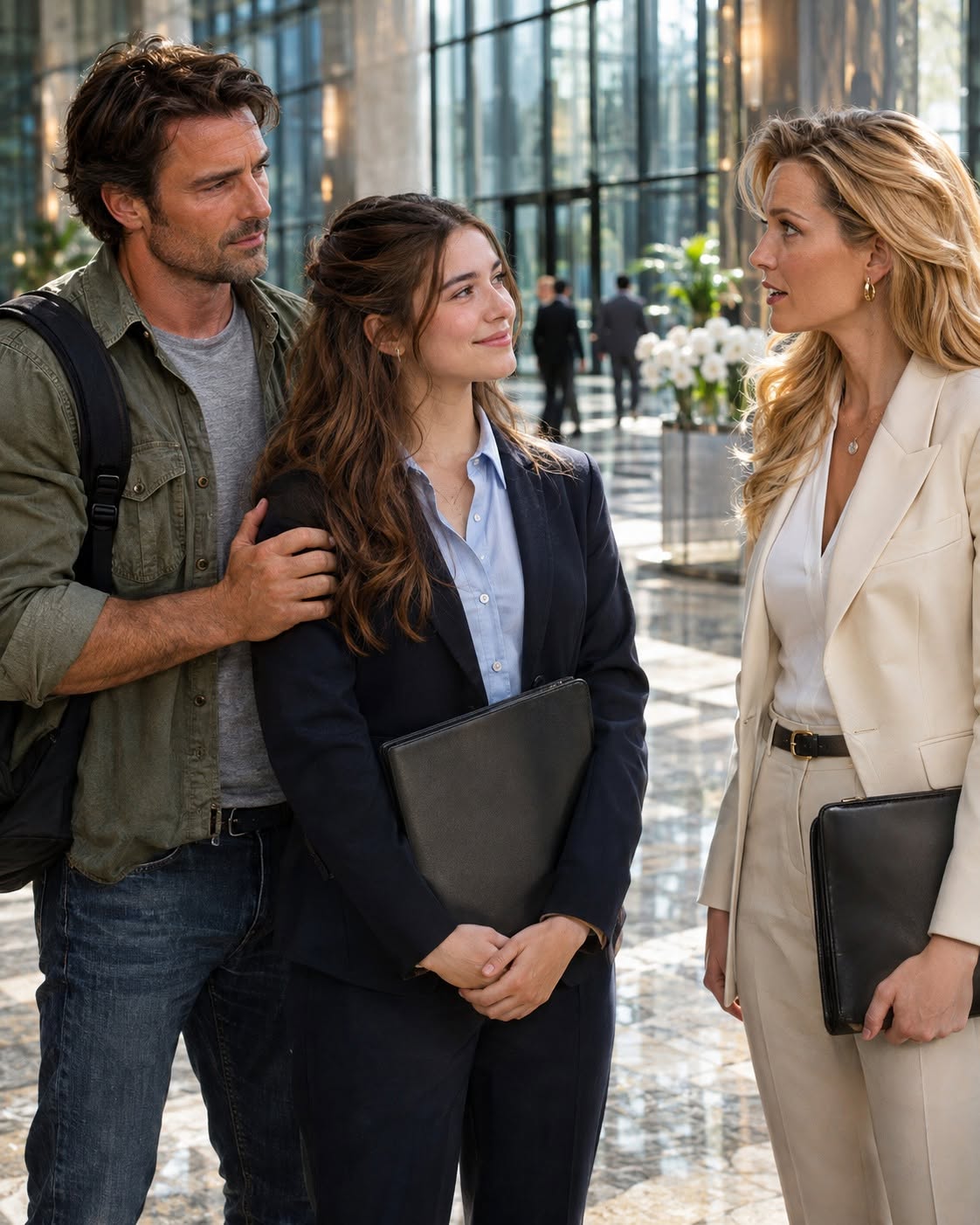
My dad walked into the lobby of my new office carrying a folder I’d forgotten at home. Ten minutes later, the CEO was staring at him like she’d just seen someone come back from the dead.
Monday morning arrived with a gray sky and the kind of rain that made every building in the financial district look colder than it really was.
I stood outside Vance Crown Holdings for nearly five minutes before walking through the revolving doors.
Eleven days earlier, I’d entered this building believing my biggest challenge would be proving I deserved the job. Now, after everything that had happened, I wasn’t even sure what the word deserved meant anymore.
The security guard recognized me.
“Good to see you back,” he said, handing me my temporary access badge.
I managed a smile.
“Good to be back.”
But the moment I stepped onto the executive floor, I realized things had changed.
Several offices were empty. The conference room where I’d first met Clara had its blinds drawn. Two employees stopped talking when I passed them.
And on my desk sat a thick envelope with my name written across it.
Inside was a single sheet of paper.
Your position remains active pending the conclusion of the external investigation. Please report to the independent audit team at 9:30 a.m.
There was no signature.
I read it twice before sitting down.
At 9:27, my supervisor, Elaine Porter, appeared in the doorway.
“Bring your laptop,” she said. “There’s something you need to see.”
The independent audit team occupied a conference room on the thirty-second floor. Three unfamiliar people were already seated around the table. Elaine introduced them as representatives of the accounting firm hired by the board.
Then she placed a large binder in front of me.
“We’ve spent the weekend reviewing the material you and your father provided,” she said. “We’ve confirmed the old payments were deliberately concealed. But there’s another problem.”
She opened the binder to a series of construction diagrams.
“Martin Cole wasn’t just involved in the old depot scandal. Some of the same consulting companies were used in the current Harbor Point redevelopment.”
I leaned forward.
Harbor Point was one of Vance Crown’s largest active projects. It involved transforming an abandoned industrial waterfront into a residential and commercial district, complete with apartments, offices, a public library, and a medical center.
The project was worth hundreds of millions of dollars.
“What exactly are we looking at?” I asked.
“Potentially falsified engineering documentation.”
Elaine turned another page.
A series of soil assessment reports appeared on the screen.
At first glance, they looked ordinary. Different dates, different contractors, different locations.
But there was something familiar about the borehole reference numbers.
I recognized the pattern immediately.
“These aren’t separate reports,” I said.
One of the auditors nodded.
“That’s what we’re trying to establish.”
I pointed to the third document.
“Look at the measurements. The original testing locations are identical, but the reports claim these samples came from different sections of Harbor Point.”
The room went quiet.
I’d spent enough time studying my father’s engineering drawings to recognize when measurements were being presented dishonestly.
Someone had taken an old geological assessment, changed the project references, and submitted it as new research.
But why?
Elaine folded her arms.
“That’s what we’d like you to find out.”
I looked at her.
“Am I actually authorized to investigate this?”
“The board has approved a temporary assignment under the external audit team. You’ll report to us, not to the redevelopment department.”
“And Martin?”
“Suspended. His access has been revoked. But there are people who worked under him who still have influence over the project.”
She paused.
“Be careful who you trust.”
I thought about my father’s face in the lobby.
For the first time, I understood that the old scandal might have been only the beginning.
By Wednesday, I’d identified six suspicious engineering reports.
By Thursday, there were fourteen.
Every one involved a consulting firm that had received payments through companies connected to Martin’s old financial network.
The strangest part was that the reports weren’t simply inaccurate.
They were designed to tell a particular story.
Harbor Point was being presented as a stable construction site with predictable foundation costs. The original geological data suggested something very different.
Parts of the waterfront had been built on reclaimed ground. The water table was higher than the redevelopment plans indicated, and certain sections required deeper foundations.
Those foundations would be expensive.
Very expensive.
If the original assessments were correct, the project would need substantial redesign.
That would delay construction and threaten the financing agreement.
But if the company continued using the altered reports, it could save millions in the short term.
At the potential cost of a major structural failure later.
I was reviewing a payment schedule when a message appeared on my computer.
We need to talk. Not through company email.
It came from someone named Tessa Grant.
I recognized the name. She was a project manager at Harbor Point and had been with Vance Crown for nearly nine years.
I replied with a meeting time.
We met in a small coffee shop three blocks from the office.
Tessa arrived carrying a paper bag she never opened.
“I know what you’re investigating,” she said.
“Then you know I can’t promise you anything.”
“I’m not asking for a promise.”
She looked around before lowering her voice.
“I signed some of those reports.”
I didn’t speak.
“Not all of them. Just the revised versions.”
“Did you know the measurements had been copied?”
Her eyes dropped to the table.
“I knew the numbers didn’t match the field notes.”
“Why did you approve them?”
She let out a nervous breath.
“Because I was told the original testing had been completed. I was told the discrepancies were administrative. Martin’s office said the corrections had already been verified.”
“Who told you that?”
“Victor Hale.”
I knew the name.
Victor was the senior director overseeing Harbor Point. He’d been one of Martin’s closest allies, although he hadn’t been formally accused of anything.
Tessa reached into her bag and placed a small flash drive on the table.
“I kept the original field reports.”
I stared at it.
“Why?”
“Because I knew something was wrong.”
She looked up, and her eyes were wet.
“My younger brother works on that construction site. He operates the heavy equipment. I kept thinking that if the reports were wrong, people like him could get hurt.”
I took the drive.
“Why didn’t you come forward sooner?”
“Because I have two children, a mortgage, and a husband who’s been out of work for six months.”
She gave a small, bitter laugh.
“Doing the right thing is easier when you don’t have anything to lose.”
I understood that more than I wanted to admit.
Before leaving, she said something that stayed with me.
“There’s another report. One Victor told everyone never existed. It was prepared before the project received its final approval.”
“Where is it?”
“I don’t know. But your father might.”
That evening, I drove home and found Dad in the garage.
He was standing beside his old workbench, examining a rolled engineering drawing.
I told him what Tessa had said.
For a long time, he didn’t respond.
Then he walked to the locked cabinet where he’d kept his old documents.
“I remember the site,” he said.
“Harbor Point?”
“Not by that name. Years ago, it was part of a larger industrial development plan. The waterfront soil was unstable in certain areas. There was an underground drainage channel that had been partially filled in.”
He unrolled a drawing.
It showed a cross-section of the original land.
“These areas needed additional testing before anyone could approve heavy construction.”
I pointed to a marked section.
“Is this where the apartments are supposed to go?”
Dad nodded.
“Yes.”
He looked at me.
“If they’ve used the old measurements, they’re working with information that was never intended to support those foundations.”
“Can we prove it?”
“Possibly.”
He disappeared into the back of the garage and returned with a battered metal case.
Inside were original survey notes, soil samples, handwritten calculations, and photographs from the old project.
At the bottom was a document with a red stamp across the top.
PRELIMINARY ENGINEERING WARNING — NOT FOR CONSTRUCTION APPROVAL.
I read it carefully.
The report described a potentially unstable section of reclaimed land and recommended further testing before development.
It was dated twelve years earlier.
The signature belonged to Owen Miller.
My father.
“Why didn’t you give this to the board before?” I asked.
He looked tired.
“Because I didn’t know they were using it again. And after what happened last time, I wasn’t interested in giving anyone another reason to call me a thief.”
I sat beside him.
“Dad, this could stop the project.”
“It could.”
“People could lose their jobs.”
“Yes.”
“And if we’re wrong…”
He finished the sentence for me.
“Then we’ll have caused damage to people who did nothing wrong.”
He placed the report on the workbench.
“But if we’re right and we stay quiet, the damage could be much worse.”
For a moment, neither of us spoke.
Then he asked, “Are you sure you want to keep doing this?”
I looked at the document.
“No,” I admitted. “But I don’t think being sure is the same as being right.”
He smiled faintly.
“Your mother used to say something like that.”
It was the first time in years that he’d mentioned her while talking about his work.
I took the documents back to the office the following morning.
The external auditors confirmed the report was authentic.
They also discovered that several pages had been removed from the digital archive.
One of those pages contained a record of an internal engineering review conducted shortly before Harbor Point received approval.
The review had recommended additional soil testing.
The recommendation had been rejected.
The person who rejected it was Victor Hale.
I thought that would be enough.
It wasn’t.
At 4:15 that afternoon, Victor appeared outside the conference room.
He was tall, silver-haired, and impeccably dressed. He had the calm expression of someone accustomed to being obeyed.
“May I speak with you?”
Elaine immediately stood.
“Anything you need to discuss can go through the audit team.”
Victor smiled.
“Of course. I simply wanted to welcome our returning analyst.”
He looked directly at me.
“Your father certainly seems to have become an important part of company affairs.”
I felt my jaw tighten.
“He’s provided historical engineering records.”
“Interesting.”
Victor glanced at the binder on the table.
“Just remember that old documents can be interpreted in many ways. Projects evolve. Conditions change. People sometimes confuse preliminary assessments with final approvals.”
“Then why were the original measurements copied into the new reports?”
His smile disappeared for half a second.
“That’s precisely the kind of technical question that should be handled by qualified engineers.”
“My father is a qualified engineer.”
“Was,” Victor corrected.
The room went silent.
I stood up.
“His professional history isn’t relevant to whether these reports are accurate.”
Victor looked at me for a long moment.
Then he nodded.
“You’re right. It isn’t.”
He turned to Elaine.
“Just make sure the investigation doesn’t become an excuse to destroy a project that thousands of people depend on.”
When he left, Elaine locked the conference room door.
“He’s worried,” she said.
I looked at the documents.
“No. He’s calculating.”
The following Monday, Harbor Point experienced its first serious construction incident.
A section of temporary retaining wall had shifted overnight.
No one was injured. The construction crew had noticed movement during an early inspection and evacuated the immediate area.
But photographs showed cracks spreading across the concrete.
By noon, the company had issued a statement describing the incident as a routine construction adjustment.
By two o’clock, Victor had sent a memo recommending that work continue in unaffected sections.
At three, I received a call from the site safety engineer.
His name was Ben Ortiz.
“I’ve seen your report,” he said.
“Which one?”
“The soil assessment.”
He sounded exhausted.
“There’s something you need to understand. The wall didn’t move because of a routine adjustment. We’ve been documenting water seepage in that section for weeks.”
“Did you report it?”
“Four times.”
“And?”
“My reports were marked as resolved.”
“Who marked them?”
“Victor’s office.”
I closed my eyes.
“Can you send me the original records?”
“I already tried.”
“What happened?”
“My supervisor told me I was creating unnecessary panic.”
There was a long pause.
Then Ben said, “I’m not calling because I want to get anyone in trouble. I’m calling because tomorrow morning, people are supposed to work near that wall again.”
I immediately contacted Elaine.
Within twenty minutes, the external audit team requested an emergency site inspection.
Victor objected.
He argued that the investigation had no authority to interfere with active construction operations.
Clara overruled him.
She ordered an immediate temporary shutdown of the affected section.
It was the first time she’d exercised direct authority since Martin’s suspension.
I watched the announcement appear on the internal company system.
Then my phone rang.
It was Clara.
“Can you come to my office?”
Clara looked older than she had in the lobby.
Her desk was covered with documents. A half-empty cup of tea sat beside a photograph of the original railroad depot.
She gestured for me to sit.
“I owe you an explanation.”
I waited.
She opened a folder and removed an old memorandum.
“I signed this twelve years ago.”
It was an executive approval document for the original redevelopment project.
Her signature appeared at the bottom.
“At the time, Martin told me the engineering concerns had been resolved. He showed me a summary that appeared to contain the necessary approvals.”
She turned the page.
“But I had seen an earlier warning. I remember questioning it.”
“Then why did you sign?”
She looked at me.
“Because the financing deadline was approaching. The board was threatening to withdraw support, and the project was already behind schedule.”
I felt something cold settle in my stomach.
“So you knew there was a concern.”
“I knew there had been one. I believed it had been addressed.”
“Did you verify that?”
She didn’t answer immediately.
“No.”
It was the first honest answer I’d heard from someone in her position.
She continued.
“Martin told me your father had falsified the reports and removed confidential files. He showed me documents that appeared to prove it. I was angry. I was embarrassed. And instead of asking Owen directly, I let Martin control the information.”
She looked down at her hands.
“I’ve spent years telling myself I was deceived. That’s true. But I also allowed myself to stop asking questions.”
I thought about Dad sitting alone at our kitchen table, believing the person he’d trusted most had abandoned him.
“Do you understand what that cost him?”
“Yes.”
“No, I don’t think you do.”
My voice was sharper than I’d intended.
“He spent twelve years taking whatever engineering work he could find. He stopped applying for major contracts because he believed his name was ruined. He never knew you hadn’t even tried to hear his side.”
Clara didn’t defend herself.
“I know I can’t give him those years back.”
“Then why tell me now?”
“Because I won’t let another person pay for my decision to look away.”
She slid the memorandum across the desk.
“I want the external auditors to have everything. Even the documents that make me look bad.”
I looked at her.
“That could cost you your position.”
“I know.”
For the first time, I believed she understood what accountability actually meant.
Two days later, the board held an emergency hearing.
The room was packed.
Investors, legal representatives, senior executives, and members of the external audit team filled every seat.
Victor sat at the far end of the table.
He looked composed.
I sat beside Elaine with my laptop open.
The hearing began with a summary of the old depot investigation. The auditors presented the shell-company payments, intercepted correspondence, and forged signatures.
Then they moved to Harbor Point.
The original soil reports appeared on the screen.
One by one, the altered documents were compared with the engineering records my father had preserved.
The measurements matched.
The dates did not.
The locations did not.
And the signatures on several approval documents were inconsistent with the originals.
Victor leaned back.
“This proves nothing about intentional misconduct,” he said. “There are administrative explanations for discrepancies in large-scale redevelopment projects.”
Elaine turned to the final page.
“Then perhaps you can explain this.”
She displayed an internal email recovered from an archived server.
It was dated eight months before construction began.
The sender was Victor Hale.
The recipient was Martin Cole.
The message contained only two sentences.
Use the earlier ground assessment. The new testing will push the budget beyond the approved ceiling.
Make sure the revised report is filed before the lender’s review.
No one moved.
Victor stared at the screen.
“That message has been taken out of context.”
Elaine continued.
“We also have the original field records showing that the required testing was never completed.”
Victor turned toward Clara.
“You’re going to allow this?”
Clara stood.
“Yes.”
He laughed once.
“After everything I’ve done for this company?”
Clara’s expression didn’t change.
“This company isn’t yours, Victor. And it isn’t mine. We are responsible for the people who work here and the people who will eventually live in these buildings.”
Victor looked toward the board.
“You’re about to destroy a billion-dollar project because of an old engineer’s paperwork and an analyst who has a personal interest in the outcome.”
I felt the room turn toward me.
For a moment, I was eleven days into my career again, sitting across from Clara in the interview room.
I remembered how everyone had focused on projected profits.
I remembered asking why the numbers didn’t add up.
I stood.
“This isn’t about my father,” I said.
Victor smirked.
“Of course it isn’t.”
“It’s about the people who will live in these buildings. It’s about the workers being asked to construct foundations based on measurements that were never verified. It’s about the fact that people reported warning signs and their concerns were buried because someone didn’t want to delay a project.”
I placed a copy of the original engineering warning on the table.
“My father prepared this report twelve years ago. It was ignored then. The same information was altered and presented as new research today.”
I looked around the room.
“We can debate who is responsible for the paperwork. But we cannot debate whether the ground beneath those buildings needs to be properly tested.”
Victor pushed his chair back.
“This is ridiculous.”
One of the board members raised a hand.
“Mr. Hale, please remain seated.”
He didn’t.
He gathered his papers and walked toward the door.
Security was waiting outside.
For the first time since I’d met him, Victor looked genuinely frightened.
But the most important decision hadn’t been made yet.
The board still had to decide what happened to Harbor Point.
The next three weeks were the hardest of my professional life.
The project was suspended pending a complete independent engineering assessment.
The company’s financing partners threatened to withdraw support.
Construction workers were reassigned where possible, but hundreds of people faced uncertainty.
Local residents were furious.
Some had already signed purchase agreements for apartments that might never be built.
Others had spent years waiting for the promised medical center and library.
At one public meeting, an elderly woman stood up and asked Clara a question that silenced the entire room.
“My husband has been receiving treatment across town. We were told the new medical center would open next year. Are you telling us that was a lie?”
Clara stepped away from the podium.
“No,” she said. “I’m telling you that we don’t know when it can safely open. And I won’t give you another date until I can prove the building will be safe.”
The woman sat down.
She didn’t applaud.
Neither did anyone else.
But I noticed something important.
For once, nobody was being offered a convenient promise.
Meanwhile, the external engineers completed their preliminary assessment.
Their findings were worse than we’d expected.
The reclaimed ground contained several unstable sections, and the original foundation design was inadequate in two locations.
The retaining wall movement had been an early warning.
If construction had continued according to the existing plans, the company could have faced serious structural problems in the future.
The board authorized a full redesign.
It would cost more money and take at least eighteen months.
Martin and Victor were both formally referred for further investigation. Several executives were placed on administrative leave, and Tessa agreed to cooperate with the auditors.
She also resigned from her management position.
When I asked why, she told me she couldn’t continue leading a team after signing documents she hadn’t properly verified.
“I want to do something useful with what happened,” she said. “But I need to start somewhere honest.”
Ben Ortiz remained at Harbor Point as the independent safety coordinator.
And Dad?
For the first time in twelve years, someone from the engineering profession called him by his full professional title.
Not former engineer.
Not disgraced employee.
Mr. Owen Miller, the original project engineer.
The independent investigation requested his assistance in reviewing the historical site data.
He hesitated when they first contacted him.
Then he agreed.
One evening, about a month after the board hearing, I found Dad sitting at the dining table with a stack of engineering papers.
He was wearing his old reading glasses.
A calculator sat beside his coffee.
“You’re working late,” I said.
He looked up.
“Apparently, I still remember how to do this.”
I smiled.
“How does it feel?”
He considered the question.
“Strange.”
“Good strange?”
“Some days.”
He turned one of the drawings toward me.
The external engineering team had invited him to help verify the original survey measurements. He wasn’t being paid a fortune, but he was being paid fairly, with his qualifications and experience acknowledged.
For him, that mattered more than the money.
“Do you think you’ll go back to engineering full-time?” I asked.
He shook his head.
“I’m too old to start chasing the same career I had before.”
“You’re not that old.”
He laughed.
“Tell that to my knees.”
Then his expression became serious.
“I’ve been thinking about something.”
“What?”
“That letter to Clara. The one I never mailed.”
I looked at him.
“Do you wish you’d sent it?”
“Every day.”
He folded his hands.
“I thought staying quiet would protect me. I thought if I walked away, the truth would eventually become obvious.”
He shook his head.
“But silence doesn’t correct a lie. Sometimes it just gives the lie more room to grow.”
I sat down opposite him.
“Would you have done anything differently?”
“Yes.”
He looked at me.
“I would’ve asked the questions I was afraid to ask. And I would’ve kept fighting for my work, even if people didn’t believe me.”
Then he smiled.
“But I can’t change twelve years. I can only decide what I do with the ones I have left.”
I thought about my own future at Vance Crown.
I still hadn’t decided whether I belonged there.
The decision came unexpectedly.
On a Thursday morning, Elaine called me into the conference room.
Clara was there, along with two board representatives.
A new organizational chart was displayed on the screen.
The board had approved the creation of an independent risk and compliance division.
It would report directly to the audit committee, not to the CEO or the redevelopment executives.
They wanted me to lead the investigative analysis team.
I stared at the document.
“Why me?”
Elaine answered before Clara could.
“Because you identified the original inconsistencies before you knew your father was connected to the company. You followed the evidence when doing so became uncomfortable. And you refused to sign off on information you couldn’t verify.”
Clara added, “You’ve earned the opportunity.”
I looked at her.
“There’s something I need to say.”
“Go ahead.”
“If I take this position, I don’t want anyone treating it as a personal favor. I want an independent hiring review, an external reporting line, and authority to escalate safety concerns without executive approval.”
One of the board members nodded.
“That’s already included in the proposal.”
“And if I investigate something involving you?”
Clara answered without hesitation.
“Then you investigate me.”
I looked at the organizational chart again.
It was the kind of opportunity I’d dreamed about when I applied for my first analyst position.
But there was still one thing I couldn’t ignore.
“Why me?” I asked again. “There are people with more experience.”
Clara leaned forward.
“Because experience without the courage to question assumptions is just another way of repeating old mistakes.”
I accepted the position.
Not because Clara had forgiven my father.
Not because the company had finally admitted it was wrong.
And certainly not because I believed everything would suddenly become honest.
I accepted because the work mattered.
And because this time, the rules would be different.
Six months later, Harbor Point reopened under a completely redesigned construction plan.
The revised foundation system cost considerably more than the original proposal.
The medical center was moved to a safer section of the property. Several residential buildings were redesigned, and the retaining wall was rebuilt using an independently verified engineering plan.
The opening date was pushed back.
Some investors withdrew.
Others stayed.
The workers returned gradually, with new safety procedures and independent inspections.
The company was not as profitable as it had hoped.
But the project was finally being built on reliable information.
Martin’s legal proceedings continued, and Victor was eventually charged in connection with falsified project records and financial misconduct. The investigation into the full network of payments was still ongoing.
Clara remained CEO, although her authority was now subject to stronger board oversight.
She also made a decision that surprised many people.
She publicly released the findings of the independent audit, including the parts that criticized her own decisions.
She didn’t describe herself as a victim of Martin’s deception.
She acknowledged that she had trusted the wrong person and failed to verify important information.
It wasn’t a perfect apology.
But it was a public admission.
And sometimes that is where rebuilding trust has to begin.
As for Dad, he was invited to speak at an engineering association meeting.
I attended.
He stood behind a small podium in a room filled with younger engineers and talked about structural safety, professional responsibility, and the importance of preserving original records.
He didn’t mention Martin.
He didn’t attack Clara.
He didn’t even talk much about the scandal.
Instead, he said something that made me sit up straighter.
“An engineer’s responsibility doesn’t end when a building is completed. It begins when someone trusts that building with their life.”
He paused.
“Never let a deadline convince you that an unsafe answer is good enough.”
The room applauded.
Dad looked uncomfortable, but he smiled.
Afterward, a young engineer approached him and asked if he would consider mentoring her.
He said yes.
On the drive home, he kept looking out the window.
“What are you thinking about?” I asked.
“That I should’ve done this years ago.”
“Spoken at an engineering meeting?”
“Mentored someone. Shared what I knew. I spent so much time believing my career was over that I forgot there were still people who could use what I’d learned.”
I smiled.
“Well, you’re making up for it.”
He shook his head.
“Not making up for it. Just starting again.”
A year after I’d first walked into Vance Crown Holdings, I returned to the lobby where everything had begun.
The security desk was still there.
The same polished floors reflected the overhead lights.
And the elevator doors still opened with that familiar soft chime.
Clara was waiting near the entrance.
She had asked to meet Dad and me before the company’s annual review.
Dad arrived a few minutes later, carrying a small leather folder.
Clara saw him and smiled.
“Owen.”
“Clara.”
They shook hands.
It was a simple gesture, but I noticed that neither of them looked away.
She handed him a photograph.
It showed the old railroad depot after the restoration work had been completed. The building had been preserved as a public engineering and transportation museum.
A small plaque had been installed near the entrance.
It acknowledged the original engineering team.
Dad’s name was among them.
He stared at it for a long time.
“You didn’t have to do this,” he said.
Clara shook her head.
“Yes, I did. Your work deserved to be acknowledged.”
Dad looked at her.
“Then let’s make sure the next person doesn’t have to wait twelve years.”
Clara nodded.
“I’d like that.”
We stood together for a moment, looking at the photograph.
Then my phone vibrated.
It was a message from Elaine.
The first annual report of the independent risk division had been approved.
There were no congratulations from executives, no promises of promotion, and no grand celebration.
Just a short sentence.
Your team caught three material discrepancies before approval. Good work.
I smiled.
Dad noticed.
“Everything okay?”
“Yeah.”
I showed him the message.
He read it and handed my phone back.
“Looks like you’re doing something right.”
I laughed.
“I’m trying.”
He put a hand on my shoulder.
“That’s all any of us can do.”
That evening, after Dad went to bed, I stayed at the kitchen table and opened the original folder from my first week at Vance Crown.
The one he’d forgotten to bring me that morning.
Inside was the same financial analysis that had first caught my attention.
Duplicate consulting fees.
Missing structural costs.
Unexplained payments.
Back then, I’d thought I was simply proving I was qualified for a job.
I hadn’t realized that asking one uncomfortable question would uncover a lie that had shaped two people’s lives for more than a decade.
I thought about everything that had followed.
The accusations.
The silence.
The investigation.
The boardroom confrontation.
The construction shutdown.
The people whose homes and livelihoods depended on decisions made by executives who would never have to live inside those buildings themselves.
And I thought about the lesson Dad had learned the hard way.
Trust was important.
But trust without questions could become dangerous.
Loyalty was valuable.
But loyalty that demanded silence wasn’t loyalty at all.
And a good reputation wasn’t something another person could permanently give or take away. It was something built through decisions, sometimes over an entire lifetime.
The next morning, I arrived at the office early.
There was a new analyst waiting outside the conference room. She looked nervous, clutching a folder against her chest.
“Are you the person leading the risk team?” she asked.
“I am.”
She swallowed.
“I found something in the latest redevelopment proposal. Everyone says it’s probably a formatting error, but I don’t think it is.”
I looked at the folder.
“What did you find?”
She opened it and pointed to a set of numbers.
For a moment, I was transported back to my first interview.
The same kind of discrepancy.
The same quiet doubt.
The same fear that asking the wrong question might cost someone an opportunity.
I pulled out a chair.
“Show me.”
She began explaining.
I listened without interrupting.
When she finished, I examined the figures and saw that she was right to be concerned.
“Good catch,” I said.
She looked surprised.
“You’re not going to tell me I’m overthinking it?”
“No.”
I turned the document toward her.
“Let’s find out why the numbers don’t match.”
She smiled, and I realized something.
The real victory wasn’t that my father had finally been cleared.
It wasn’t that Martin had lost his position or that Clara had admitted her mistakes.
It wasn’t even that I’d managed to keep my career.
The real victory was that the next person who noticed something wrong wouldn’t have to choose between protecting their future and telling the truth.
At Vance Crown, we were finally building a workplace where asking difficult questions was part of the job, not a threat to it.
And somewhere across town, my father was teaching a young engineer how to read an old foundation drawing, probably reminding her to check every measurement twice.
For twelve years, he’d believed one accusation had taken away his entire future.
But the truth was that his future had never belonged to the person who accused him.
It had always belonged to him.
And mine belonged to me.
I closed the folder, looked at the young analyst, and said the words I wished someone had said to my father all those years ago.
“Don’t be afraid to question something just because everyone else has already agreed with it.”
Because buildings can be repaired.
Companies can be rebuilt.
Careers can begin again.
But the most important thing we can protect is the courage to speak when something isn’t right.
And sometimes, one honest question is enough to change everything.