“My dad can beat you,” my eight-year-old daughter announced to a room full of chess players.
As it turned out, breakfast was considerably more complicated than chess.
Maya insisted that Celeste sit beside her in the booth, ordered pancakes with an unreasonable amount of whipped cream, and immediately began asking questions that would have made an experienced journalist proud.
“Do you have children?”
“No,” Celeste answered.
“Do you have a husband?”
“No.”
“Do you have a dog?”
“Unfortunately, no.”
Maya frowned.
“Who do you talk to when you get home?”
Celeste looked momentarily surprised.
“Usually my sister. Sometimes nobody.”
Maya considered this information while pouring syrup over her pancakes.
“You can call us. Daddy talks to himself when he’s fixing things anyway.”
I nearly choked on my coffee.
Celeste laughed so hard that several people turned toward our table.
It was the first time I’d seen her laugh without looking around to see who was watching.
We spent almost two hours at that diner. We talked about childhood, favorite movies, terrible first jobs, and the strange habits people developed after years of playing competitive chess.
Celeste told us that her father had introduced her to the game when she was five. By twelve, she was traveling across the country for tournaments. By nineteen, chess had become her profession.
“Did you always love it?” I asked.
“At first,” she admitted. “Then winning became so important that I forgot what losing was supposed to teach me.”
Maya looked up.
“Daddy says losing means you get to learn something for free.”
Celeste smiled at me.
“Your daddy seems to know a few things.”
When we finally left, she asked whether we might do it again sometime.
I told her I’d like that.
And I meant it.
Over the next several weeks, Celeste gradually became part of our routine.
She attended Maya’s Saturday chess club, helped her practice endgames, and occasionally stopped by the garage with coffee.
She never arrived in a way that made me feel embarrassed about my work.
If anything, she seemed fascinated by it.
One afternoon, she watched me repair an alternator and asked how I knew which component had failed.
“Experience,” I told her.
“That sounds like chess.”
“Except nobody pays me when I lose a chess game.”
She smiled.
“Maybe we should change that.”
Celeste explained that the Midwest Invitational was approaching. It was a major open tournament in Chicago, attracting professional players, talented amateurs, and several grandmasters.
The first-place prize was thirty thousand dollars.
I immediately shook my head.
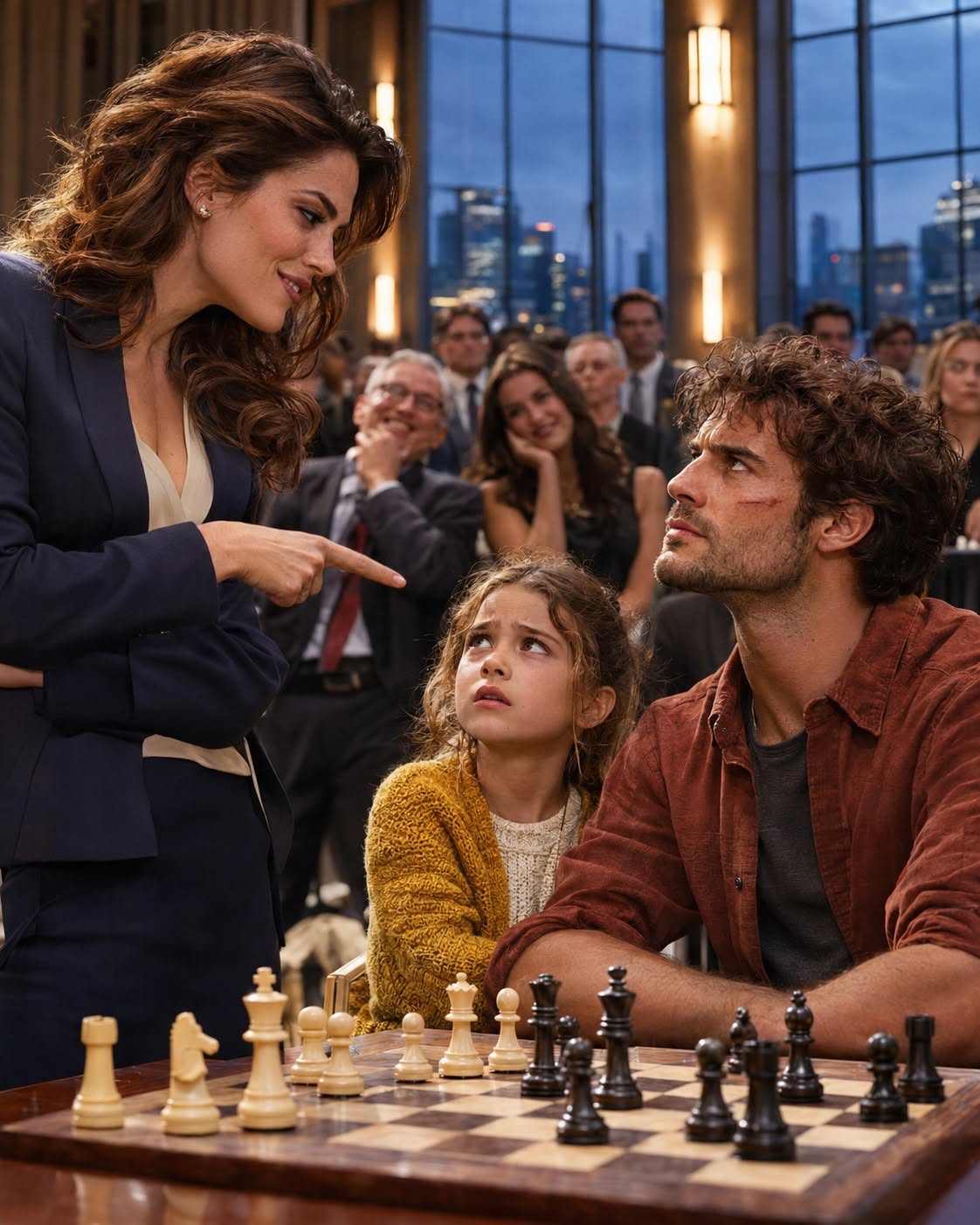
“I have a job. Maya has school. Chicago isn’t exactly around the corner.”
“It’s during her spring break.”
“You’ve done your research.”
“I play chess, remember? Preparation is important.”
The prize money would have made an enormous difference in our lives.
My truck needed repairs. The mortgage was becoming increasingly difficult to manage, and several of Hannah’s medical bills had followed us long after her death.
But I knew how competitive those tournaments could be.
Winning a regional knockout tournament didn’t make me a professional.
Still, when Maya heard about the invitational, her eyes practically lit up.
“Can we go somewhere on vacation where everybody plays chess?”
“That doesn’t sound much like a vacation.”
“It does to me.”
I eventually agreed to enter, provided Maya understood that we were going for the experience rather than the money.
Celeste entered as well.
For the first time in years, I had something on my calendar that made me excited instead of anxious.
Then, two weeks before the tournament, I came home to find Maya sitting on the living room floor with Hannah’s old photograph album.
She was crying.
I dropped my keys and knelt beside her.
“What’s wrong, sweetheart?”
She wiped her face with her sleeve.
“Are you going to marry Celeste?”
The question caught me completely off guard.
“Where did that come from?”
“Some kids at school saw the video. They said you won a new wife.”
I felt a terrible ache in my chest.
“Maya, that’s not how people get married.”
“Would she live here?”
“I don’t know. We haven’t talked about anything like that.”
She looked down at a photograph of Hannah holding her as a baby.
“If she comes here, where will Mommy go?”
I finally understood.
Maya had been encouraging me to spend time with Celeste because she wanted me to be happy.
But somewhere along the way, she’d started believing that making room for someone new meant removing someone she loved.
I sat beside her and opened the album.
“Your mommy isn’t going anywhere.”
“But she’s not here.”
“No,” I said gently. “And I wish she were.”
We looked through the photographs together. I told Maya stories about Hannah that she was too young to remember.
How her mother sang terribly in the shower. How she once drove forty miles in the wrong direction because she refused to admit she’d misread a map.
How she had laughed during our first date when I spilled an entire glass of water into my lap.
By the time we finished, Maya was smiling again.
“Would Mommy like Celeste?”
“I think she’d appreciate how kind Celeste has been to you.”
That evening, I told Celeste what had happened.
She listened without interrupting.
Then she said something that made me respect her even more.
“Maybe I should give Maya a little space.”
“You haven’t done anything wrong.”
“Neither has she. She’s eight years old, and she’s trying to understand something most adults struggle with.”
The following Saturday, Celeste brought a small wooden frame to our house.
Inside was a photograph Maya had shown her of Hannah sitting behind a chessboard.
“I thought this might look nice near your practice table,” Celeste told her.
Maya stared at it.
“You’re not mad that I miss Mommy?”
Celeste crouched beside her.
“I would never ask you to stop loving your mother. And I would never compete with her.”
Maya hugged her.
I turned toward the kitchen window, pretending there was something interesting happening outside.
A week later, the three of us drove to Chicago.
Maya treated the hotel room like a royal palace, mostly because it had an ice machine down the hallway and a television she could watch from bed.
The tournament itself was enormous.
Hundreds of players filled the convention center. Spectators gathered around demonstration boards, vendors sold chess equipment, and commentators discussed opening variations I hadn’t studied in years.
I felt completely out of place.
Then I saw Julian Thorne.
He was standing beside the registration desk, talking to several players.
When he noticed me, his expression became unreadable.
“Didn’t expect to see you here.”
“Didn’t expect to be here myself.”
He glanced toward Celeste.
“Quite the celebrity couple.”
“We’re here to play chess, Julian.”
“Of course you are.”
He walked away before I could respond.
Celeste touched my elbow.
“Don’t let him get inside your head.”
Unfortunately, Julian wouldn’t be my biggest problem.
During the first three rounds, I played better than I had expected. I won twice and drew against a highly rated international master.
By the fourth round, people were beginning to recognize me.
A tournament interviewer even asked whether I considered my return to chess a romantic comeback story.
“No,” I answered. “I’m just a mechanic who enjoys playing.”
Maya was watching from behind the spectator barrier, smiling proudly.
Everything seemed to be going wonderfully.
Then came the announcement.
Before the fifth round, a tournament official approached me and requested that I accompany him to a private office.
Inside were two arbiters and the tournament director.
A printed document lay on the table.
“Mr. Walker, we’ve received a formal complaint concerning possible outside assistance during your games.”
For several seconds, I thought I’d misunderstood.
“Outside assistance?”
“Electronic assistance. Potential communication with someone analyzing your positions.”
I stared at him.
“You’re accusing me of cheating?”
“We’re investigating an allegation.”
They explained that someone had submitted statistical comparisons between several of my recent games and the recommendations of a powerful chess engine.
There were also photographs of Celeste using her phone near the playing area.
According to the complaint, she might have been transmitting information to me through an undisclosed device.
I felt physically sick.
“Search me. Search everything I brought.”
The officials explained that they would conduct appropriate checks, review available footage, and interview relevant individuals.
Until then, I was temporarily removed from the next round pending an initial review.
When I returned to the hallway, Maya ran toward me.
“Did you win something?”
I looked at Celeste.
She immediately knew something was wrong.
Within an hour, rumors had spread throughout the convention center.
Someone posted an online message suggesting that the viral mechanic had been exposed as a fraud.
Another claimed that Celeste had deliberately lost both of our previous matches to manufacture a publicity stunt.
The story was getting uglier by the minute.
Maya heard two men discussing it near the elevators.
“That’s his daughter,” one whispered.
The other replied, “Poor kid. Imagine finding out your father’s a cheat.”
She burst into tears.
I took her upstairs and closed the hotel room door.
For the first time since returning to chess, I wished I’d never sat down across from Celeste at that exhibition.
Maya curled up beside me on the bed.
“You didn’t cheat, Daddy.”
“No, sweetheart.”
“Then why are they saying you did?”
“Sometimes people believe things before they know whether they’re true.”
She grabbed my hand.
“I don’t want you to play anymore.”
Those words hurt more than the accusations.
Chess had been something we shared.
Now it was becoming something she feared.
Celeste arrived shortly afterward.
She had voluntarily turned over relevant information from her phone and agreed to cooperate fully with the investigation.
Then she told me who had filed the complaint.
Julian.
I wasn’t surprised, but I was furious.
“What’s wrong with that man?”
Celeste sat beside me.
“There’s something else. He’s been questioning your earlier tournament results for years.”
“What earlier results?”
“The tournament you abandoned when Hannah was hospitalized.”
Apparently, Julian had told several members of the chess community that I had walked away from our match because I suspected I was about to be caught using outside assistance.
It was a lie that had quietly followed my name while I was busy caring for Hannah and raising Maya.
I stood and walked toward the window.
“He knew why I left.”
“Are you certain?”
“I told him Hannah was being taken to the hospital.”
Celeste looked troubled.
“Then we need to find out what he’s actually trying to prove.”
The following morning, I requested a meeting with the tournament officials.
I provided my previous game records, explained my preparation, and answered every question they asked.
I even played through several critical positions from my recent games, explaining why I had chosen moves that looked unusual to less experienced players.
One arbiter asked why I had rejected an obvious attacking continuation in my third-round game.
“Because it looked stronger than it was. My opponent could have forced a perpetual check.”
I demonstrated the sequence on the board.
The arbiter studied it and nodded.
The investigators eventually found no prohibited electronic device, no evidence of communication during play, and no reliable statistical basis for concluding that I had cheated.
Celeste’s phone activity also had an innocent explanation. She had been responding to messages from her sister during breaks in her own games.
By the following afternoon, the tournament director announced that I had been cleared to continue.
But I had already lost valuable standing because of the interruption, and the damage to my reputation wasn’t disappearing nearly as quickly as the official accusation.
I packed our suitcase.
Celeste found me folding Maya’s clothes.
“You’re leaving?”
“I’ve had enough.”
“Thomas, you were cleared.”
“Tell that to the little girl who’s afraid to walk through the lobby.”
Celeste didn’t argue.
She helped me pack.
Then someone knocked on the hotel room door.
It was Julian.
I considered closing it immediately.
Instead, I stepped into the hallway.
“What do you want?”
He looked exhausted.
“I heard they cleared you.”
“They did.”
He nodded awkwardly.
For a moment, neither of us spoke.
Then I asked the question that had bothered me for years.
“Why couldn’t you leave me alone?”
Julian looked toward the carpet.
“Because I hated what happened that night.”
“My wife was dying.”
“I know.”
His answer stopped me.
“What?”
“I knew she was sick. I didn’t know how serious it was until afterward.”
He explained that during our old tournament, he had been desperate to secure a result that would help him qualify for a prestigious championship.
His father, who had financed his chess career, had threatened to stop supporting him if he failed.
When I abandoned our game, the organizers awarded him the point.
But my withdrawal changed the final standings in a way that cost him an important qualification opportunity on a tiebreak.
He had blamed me ever since.
“That wasn’t my fault,” I said.
“I know that now.”
“Do you?”
He reached into his pocket and handed me a folded piece of paper.
It was a printed copy of an email from the old tournament director.
The email confirmed that I had withdrawn because of a family medical emergency.
Julian had possessed it for years.
“I kept telling myself there had to be another reason you left. When you started winning again, I couldn’t accept that you were simply better than me on those days.”
He swallowed.
“The engine analysis was real. But I selected the games that supported what I already believed. I ignored the ones that didn’t.”
I stared at him.
“You dragged my daughter into this because you couldn’t admit you lost?”
His eyes filled with tears.
“I didn’t think about her.”
“That’s exactly the problem.”
Julian apologized.
He offered to publicly withdraw his allegations and correct the rumors he’d spread about my earlier tournament.
I told him he needed to do that whether I forgave him or not.
Then I went back inside.
Maya was sitting on the bed.
“Are we going home?”
I sat beside her.
“Do you want to?”
She nodded, then hesitated.
“Are you leaving because of me?”
“No.”
“Because of that mean man?”
I didn’t know how to answer.
She looked toward the wooden travel chessboard on the dresser.
“Mommy didn’t stop playing with me when I was bad at chess.”
I smiled faintly.
“You were four.”
“I know. But she said I shouldn’t let being upset ruin something I loved.”
I felt tears gathering in my eyes.
Maya continued.
“I don’t want him to make you hate chess.”
That was when I unpacked our suitcase.
I returned to the tournament the following morning.
Julian had published a statement acknowledging that his accusations were unsupported. The organizers issued a clarification of their own, and several players approached me to express their support.
I wasn’t going to recover enough points to win the tournament.
But I discovered that I no longer cared.
I played three more games, won two, and lost one spectacularly against a seventeen-year-old who dismantled my position with almost embarrassing efficiency.
Afterward, I asked him to show me where I’d gone wrong.
He happily spent twenty minutes explaining.
Maya watched the entire conversation.
Meanwhile, Celeste had climbed steadily through the standings.
She entered the final round with an opportunity to finish first.
Her opponent was a grandmaster from California.
The game lasted nearly five hours.
Maya and I watched the public broadcast from the spectator area.
Eventually, Celeste reached an endgame with a small but significant advantage.
Just as everyone expected her to press for victory, she began struggling.
Her hands were trembling.
She repeatedly closed her eyes.
Then she asked an arbiter for assistance.
Within minutes, her game was stopped, and medical personnel were called.
I rushed toward the playing hall.
Celeste was conscious, but her face had gone pale, and she complained of dizziness.
At the hospital, doctors determined that she had become severely dehydrated and exhausted. She had been neglecting meals and sleep throughout the tournament, partly because she was worried about the investigation involving me.
Fortunately, she recovered after treatment and observation.
But she had lost her final game by withdrawing.
When I visited her hospital room, she looked devastated.
“I was so close,” she whispered.
I took her hand.
“To what?”
“Winning.”
“And what would that have changed?”
She looked away.
I understood that winning meant more to her than money or recognition.
It was how she’d spent her entire life proving she deserved to be taken seriously.
I sat beside her.
“Do you remember what Maya asked you at the diner?”
Celeste nodded.
“Who I talked to when I got home.”
“Well, you’ve got an answer now.”
She began crying.
“I’ve never been good at stopping.”
“I know.”
“My father used to say that somebody would always take my place if I slowed down.”
I squeezed her hand.
“Maybe some places aren’t worth keeping if staying there costs you everything else.”
Maya arrived later with a bag of crackers, a handmade card, and a miniature chess queen from the hotel’s gift shop.
She placed the queen beside Celeste’s bed.
“You can still be our champion.”
Celeste hugged her so tightly that Maya started giggling.
We returned to Columbus two days later.
None of us had won the tournament.
Strangely, it felt as though we’d brought home something more valuable.
Celeste took a break from professional competition.
I returned to the garage.
And Maya came up with an idea that eventually changed all three of our lives.
Her school chess club was losing its meeting space because of budget cuts. Several children were going to be unable to continue playing.
“Couldn’t we make our own club?” she asked.
“Where?”
She pointed toward the unused storage room behind my garage.
It was dusty, cluttered, and smelled faintly of old tires.
But it had electricity, a working heater, and enough space for several tables.
My boss, Frank, agreed to let us use it on Saturdays.
Celeste donated some of her spare chess sets. Parents brought folding chairs. Julian, after hearing about the project, offered to help teach.
I was reluctant at first.
But he had kept his promise to correct the false allegations, and I decided that giving someone an opportunity to behave differently wasn’t the same as forgetting what they’d done.
Our first meeting attracted six children.
By the end of the summer, we had thirty-two.
We called it Hannah’s Corner.
There were no expensive membership fees, designer uniforms, or requirements concerning a child’s ability.
Kids who couldn’t afford chess sets could borrow them.
Children whose parents worked weekends were welcomed whenever they could attend.
We taught them openings, patience, concentration, and how to shake hands after losing.
Celeste was particularly good at teaching the children who became frustrated when things didn’t go their way.
Perhaps because she understood them.
One afternoon, I found her helping a little boy who had overturned his chessboard after losing.
“Do you know what happens when you lose?” she asked him.
He shook his head.
“You get another chance to become better.”
I recognized Maya’s philosophy immediately.
A year after our first game, the local chess association invited us to return to the exhibition where we’d met.
The organizers wanted a rematch between the champion and the mystery mechanic.
Celeste agreed on one condition.
The event would raise money for Hannah’s Corner.
Hundreds of people attended.
Maya was nine by then, confident enough to give beginner lessons herself.
Before our match began, the announcer joked about Celeste’s famous marriage promise.
She smiled and took the microphone.
“I made a foolish promise that day. I thought I was being funny, but I was treating people like prizes and making assumptions about someone I didn’t know.”
She looked toward me.
“Fortunately, the man who beat me was wise enough to refuse the prize.”
The audience laughed.
Then she added, “What happened afterward was entirely our choice.”
We played a beautiful game.
This time, Celeste beat me.
I resigned after forty-six moves and extended my hand.
“Good game.”
She grinned.
“Finally.”
Maya cheered louder than anyone.
After the exhibition, Celeste and I returned to the diner where we’d shared our first pancakes.
Maya sat beside us, eating chocolate chip pancakes and telling us about a new student at the club.
When the waitress brought our check, Celeste reached into her bag and removed a small envelope.
Inside was a photograph of the three of us standing outside Hannah’s Corner.
On the back, she’d written a question.
Would you like to build a life together?
I looked at her.
“Are you proposing?”
“Only if you’re interested. And I should warn you, it has absolutely nothing to do with today’s result.”
Maya started laughing.
I took Celeste’s hand.
“Yes.”
We married the following autumn in a small ceremony at a neighborhood park.
Maya carried the rings.
Before the ceremony began, she placed Hannah’s photograph beside a vase of flowers and whispered something I couldn’t hear.
Later, when I asked what she’d said, she smiled.
“I told Mommy that we’re happy.”
That nearly broke me.
Today, I still work as a mechanic.
Celeste still competes occasionally, although she spends more time teaching than chasing trophies.
Julian has become one of our most dependable volunteers.
And Hannah’s Corner eventually moved into a larger community center, where children from all over Columbus come to play without worrying about whether their families can afford it.
Above the entrance hangs Hannah’s photograph.
Beside it is the old wooden chessboard she gave me for our anniversary.
Sometimes I watch Maya teaching a younger child and think about that afternoon when she stood in a room full of strangers and announced that her father could beat a champion.
She believed in me before I remembered how to believe in myself.
But the most important victory wasn’t the one I achieved across from Celeste.
It was learning that grief doesn’t have to be the final chapter of a beautiful life.
For years, I thought moving forward meant leaving Hannah behind.
I understand now that the love she gave me is precisely what allowed me to become the man who could love again.
Chess teaches us that even after losing something valuable, there may still be possibilities on the board that we haven’t noticed.
Life is more complicated, of course.
Some losses can never be repaired. Some people can never be replaced.
But that doesn’t mean every remaining move must be made in sadness.
Sometimes the future asks us to be brave enough to try something unfamiliar.
To forgive without forgetting.
To accept happiness without feeling guilty.
And to understand that the people who truly love us would never want their absence to become the reason we stopped living.
I once believed my best years were behind me.
Then an eight-year-old girl raised her hand, a proud chess champion made a ridiculous promise, and I agreed to play one more game.
I’m grateful every day that I didn’t walk away from that board.