My car lay half-submerged beside Cedar Hollow Road while I screamed for help, but Roland calmly hung up
The next morning, Sylvia arrived before visiting hours ended, carrying a thin manila envelope and the kind of expression attorneys wear when sympathy has to make room for evidence.
Clara sat beside me while Sylvia placed copies of the county records on the blanket across my lap.
“This is the deed of trust,” she said.
I stared at the page.
My name was typed beneath a signature that looked almost like mine.
Almost.
“The loan was recorded three weeks ago,” Sylvia continued, “and the lender filed it against your mother’s property.”
“Who took the loan?”
Sylvia looked at me carefully.
“We’re still tracing the borrower, but the notary is Naomi Mercer.”
My mouth went dry.
Naomi had once worked the front desk at Roland’s business.
She had also been at our house more times than I could count.
“Could she have seen my signature before?”
“Possibly,” Sylvia said, “but that is not enough to explain this.”
She slid another page toward me.
“This is the notarization date.”
I read it twice.
Then Clara gasped.
“That was Mom’s conference.”
Sylvia nodded.
“Exactly.”
Three weeks earlier, I had been in Pittsburgh for a work conference, almost four hundred miles from home.
I had hotel receipts, registration records, photographs, and a credit card statement that placed me there from Tuesday morning through Thursday night.
I could still remember sitting in that hotel ballroom, exhausted and taking notes while Roland texted me that everything at home was fine.
Everything was fine.
Those words now felt poisonous.
Sylvia leaned forward.
“Did you authorize Roland to borrow against the house?”
I laughed once, but there was no humor in it.
“No.”
“Did you ever sign a blank document for him?”
“Never.”
“Would you have agreed to the loan?”
“Not even if the sky had fallen.”
Sylvia’s eyes hardened slightly.
“Then we need to assume this was deliberate.”
Clara reached for my good hand.
“Mom, what haven’t you told me about Julian?”
I closed my eyes.
There were years I had hidden because speaking them aloud made me feel foolish.
When Julian opened his auto repair shop, he had been thirty-one and full of confidence.
He told Roland he only needed one more chance.
The shop needed new lifts, new diagnostic equipment, better tires, a cleaner waiting room.
Roland wanted to help, and I wanted to support my husband.
So I quietly used money from my personal savings.
Five thousand dollars became ten.
Ten became twenty.
Every time Roland said, “Just until he gets through this month,” I transferred another amount.
I never announced it.
I did not want Julian to feel ashamed.
I did not want Roland to feel pressured.
And I certainly did not want anyone to know how much of my mother’s inheritance I was protecting for the future.
“You paid for him,” Clara whispered.
“I helped.”
“That’s not the same thing.”
“It became the same thing eventually.”
The door opened before I could say more.
Brenda stepped inside.
Roland’s sister looked as though she had not slept.
She carried no flowers, no magazine, no small hospital gift.
She only carried the truth.
“I heard you were awake.”
“I am.”
Her eyes flicked toward Clara, then Sylvia.
“I should probably leave.”
“Why?”
Brenda exhaled.
“Because I know what Julian owes.”
The silence that followed was heavier than the rain outside.
“How much?” I asked.
Brenda looked at the floor.
“More than two hundred thousand.”
Clara stiffened.
“What?”
“Loans, overdue taxes, supplier bills, equipment financing, credit cards.”
Brenda rubbed her forehead.
“He’s been borrowing from Peter to pay Paul for months.”
“Does Roland know?”
Brenda gave me a look that broke something inside me.
“Roland knows everything.”
She hesitated.
“He told me the only way to save Julian was to get money from somewhere nobody could stop him.”
My pulse began pounding.
“Did he say where?”
Brenda did not answer.
She did not have to.
Sylvia slowly gathered the documents.
“We need to move quickly.”
That afternoon, Clara brought me copies of my hotel records.
My wrist throbbed as I held them.
I had never thought proof of where I slept could become the weapon that saved my mother’s house.
Sylvia contacted the lender and formally disputed the deed of trust.
She also requested the notary journal from Naomi’s commission records.
The answer came sooner than expected.
Naomi had notarized the document at 2:17 p.m. on the same day I was in Pittsburgh.
The journal contained my name.
My supposed signature.
And Naomi’s stamp.
But there was one problem.
Naomi’s own phone records placed her on a video call with Clara at the exact time.
She had called Clara that afternoon because she wanted a recipe.
Clara had saved the call automatically.
The timestamp matched.
Naomi was not with me because I was in Pittsburgh, and she was speaking to my daughter.
We had the first crack in Roland’s story.
Then came the knock I had been dreading.
Roland entered my hospital room without permission.
I sat upright despite the pain.
He looked angry, not worried.
There was no apology.
No “Are you okay?”
No hand reaching for mine.
Instead, he said, “Why did you call Sylvia?”
I stared at him.
“Because someone forged my name.”
His face changed for half a second.
Then the anger returned.
“You were going to ruin everything.”
“My property was used as collateral.”
“It was for Julian.”
“You took out a hundred fifty-five-thousand-dollar loan against my mother’s house.”
“I was trying to save my son.”
“By stealing from your wife?”
His jaw tightened.
“You never would have agreed.”
I felt something cold settle inside me.
“No,” I said. “I wouldn’t have.”
He looked away.
That was the moment I knew.
Not suspected.
Knew.
“You forged my signature.”
Roland said nothing.
“Say it.”
“You don’t understand what I was dealing with.”
“You forged my signature.”
He slammed his hand against the chair.
“Yes.”
The word seemed to split the room in two.
“I knew you would refuse,” he said. “You always protect that house like it’s sacred.”
“It belonged to my mother.”
“And Julian was drowning.”
“So you decided I should drown with him?”
Roland’s face crumpled with frustration.
“I did what I had to do.”
“You did what you wanted.”
He stepped closer.
“You’re my wife.”
“No,” I said quietly. “I was your wife while you were treating my loyalty like a resource you could spend.”
He froze.
I pointed toward the door.
“You are not coming back here.”
“Claire—”
“Leave.”
He did.
For the first time in fourteen years, I watched Roland walk away and felt more relief than loss.
The criminal complaint was filed two days later.
Naomi came to Sylvia’s office before the police could subpoena her.
She was crying.
“I thought I was helping him,” she said.
“Helping who?”
“Roland.”
She confessed that he had brought her a prepared document and told her I had already signed it.
He pressured her to notarize it without seeing me.
When she hesitated, he told her the loan would save Julian’s business and said I would never forgive him if Julian lost everything.
Naomi had believed him.
Then she saw my name in the county record and began to understand what she had done.
She surrendered her journal, her stamp, and every message between her and Roland.
Her notary commission was later revoked.
The lender placed the account on hold while the investigation proceeded.
For the first time since the crash, I slept without waking every hour.
Then Brenda called.
“There’s going to be a family dinner Sunday.”
“I know.”
“Roland wants you there.”
“I doubt he wants me there.”
Brenda was quiet.
“He says he wants everyone to hear his side.”
I looked at the green folder sitting inside Sylvia’s locked file cabinet.
“Then everyone can hear mine.”
Sunday arrived beneath a pale winter sky.
I walked into Brenda’s dining room with my wrist still wrapped.
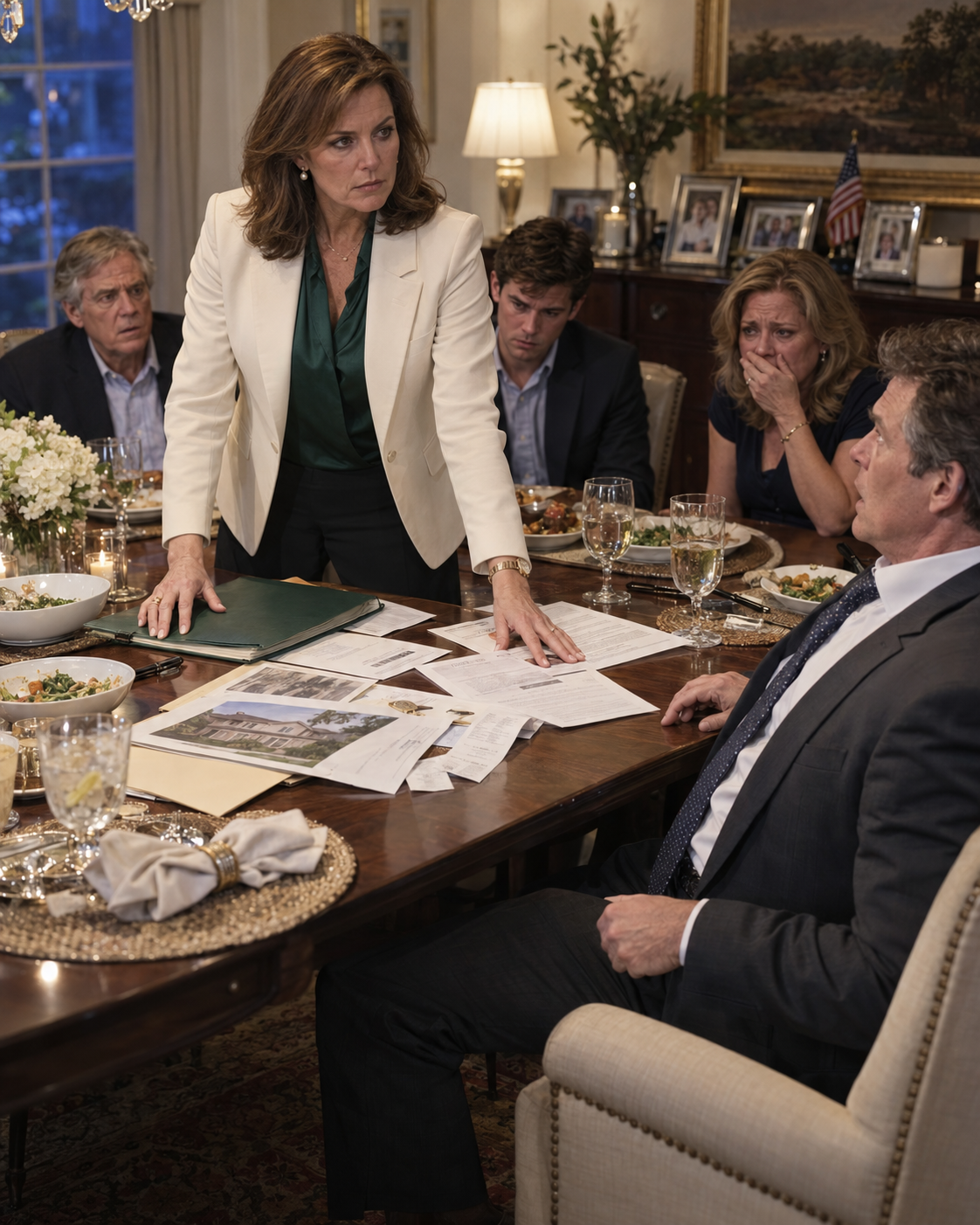
Roland sat at the head of the table like a man trying to reclaim a throne.
Julian sat beside him, pale and silent.
Brenda kept wiping her eyes before anyone had even spoken.
Roland looked at me.
“You didn’t have to make this public.”
“You made it public when you put my name on a loan.”
He leaned back.
“You are determined to destroy me.”
“No.”
I placed an envelope on the table.
“You destroyed your own story.”
I slid out the hotel receipt.
Then the conference registration.
Then the credit card statement.
Then the county deed of trust.
Then Naomi’s signed confession.
One by one, the papers crossed the table.
Julian picked up the hotel receipt.
His fingers began shaking.
“You weren’t even here.”
“No.”
He looked at his father.
“Dad?”
Roland said nothing.
Brenda broke down.
“Oh my God.”
I turned to Julian.
“Do you know how much money I gave your father over the years to help your shop?”
He stared at me.
“What?”
“Thirty-eight thousand dollars.”
Roland suddenly stood.
“Claire, stop.”
“No.”
I looked directly at Julian.
“I gave him money because I thought he was helping you.”
Julian’s face went gray.
“He told me everything came from him.”
That sentence hurt more than the forgery.
Not because of the money.
Because Roland had stolen even the gratitude that belonged to someone else.
Brenda covered her mouth.
“You told me you had paid for all of it.”
Roland looked at his sister.
“I was trying to protect everyone.”
“No,” I said.
“You were trying to become indispensable.”
Silence filled the room.
Julian pushed the papers away.
“You mortgaged her mother’s house?”
Roland’s eyes flashed.
“You needed help.”
“I needed you to tell me the truth.”
For the first time, I saw Roland lose control of the room.
He had built his identity on being the man who rescued everyone.
But the papers told a different story.
The police investigation moved quickly after that.
The lender dropped its claim against my mother’s house once the forged deed was established and pursued Roland for the fraudulent transaction.
The county record was corrected.
The court case took months.
Julian’s shop could not survive the debts that had been hidden from him and everyone around him.
He closed the doors in early spring.
I heard he sold the remaining equipment and took a job at another garage.
We never became close, but once, months later, he called me.
“I’m sorry,” he said.
I sat on the porch of my mother’s house and watched rain gather along the railing.
“You didn’t forge my name,” I told him.
“No,” he said. “But I let myself believe the version of my father that made me feel less afraid.”
I understood that.
Fear makes people accept convenient stories.
Love can make them accept even worse ones.
The divorce was finalized in June.
The judge returned the final papers, and I left the courthouse carrying them in the same green folder that had once frightened me.
I moved permanently into my mother’s house.
The place was old.
The floors creaked.
The kitchen faucet dripped at night.
The windows rattled whenever the wind rose.
I loved every imperfect inch of it.
I planted hydrangeas along the front steps because my mother had once told me they survived harsh winters better than delicate flowers.
For the first time in years, I spent money on something that had nothing to do with rescuing another person.
I bought paint.
I bought a new porch light.
I repaired the fence.
And one afternoon, I stood in the hallway holding the green folder.
I opened it.
The deed was still there.
My name was still mine.
The house was still standing.
I locked the folder in a small safe, not because I was afraid anymore, but because protecting something precious did not make me selfish.
It meant I finally understood its value.
Months passed.
My wrist healed.
The scar along my side faded into a thin silver line.
Sometimes, when rain struck the windows, I still remembered Cedar Hollow Road.
I remembered the wreck.
The cold.
The phone going dead in my hand.
Most of all, I remembered Daniel kneeling in the ditch beside me.
He had not known my name.
He had not known what I owned.
He had not known whether I could ever repay him.
He stayed anyway.
One rainy evening, months after the divorce, I was driving home along that same road when I saw hazard lights ahead.
A young woman stood beside a disabled car, soaked to the skin.
I pulled over.
For one second, I hesitated.
Not because I had become hard.
Because I had learned the difference between kindness and surrender.
I kept my doors unlocked and my boundaries firm.
I called roadside assistance before I stepped into the rain.
Then I held my umbrella over her while we waited.
“Thank you,” she said.
“You don’t have to thank me.”
Her hands trembled.
“My husband said he was coming.”
I went still.
The words echoed inside me with an almost physical force.
“He said he was coming?” I asked.
She nodded.
“He hung up on me a few minutes ago.”
Rain ran from the edge of my umbrella.
For a moment, Cedar Hollow Road disappeared, and I was back in that ditch, bleeding and shivering, listening to the person I trusted choose someone else.
I looked at this stranger and felt something I had thought the betrayal had stolen from me.
Compassion.
Not the kind that erases boundaries.
The kind that survives them.
“You’re not staying here alone,” I told her.
She looked at me with frightened eyes.
“Why?”
I tightened my grip on the umbrella.
“Because once, someone did the same for me.”
We waited together until the tow truck arrived.
Before she left, she handed me a crumpled business card she had found in her car.
“Just in case,” she said.
I glanced at the name printed across it.
I did not recognize the company.
But beneath the name was an address.
And it was only two miles from my mother’s house.
I felt the old warning stir inside me, quiet and unmistakable.
This time, I did not ignore it.
I turned the card over in my hand as the rain thickened, wondering why a stranger’s accident had led me back to a place connected to everything I had spent a year trying to escape.
The next morning, I drove past the address before I allowed myself to enter.
A weathered sign stood above a low brick building: Cedar Hollow Recovery and Storage.
My stomach tightened at the word Cedar Hollow.
I parked across the street and watched through the windshield.
A man carried boxes from a side door into a black SUV.
I knew that face.
Not well.
But enough.
He had been standing behind Roland the last time we signed papers for Julian’s shop equipment.
I reached for my phone, then stopped.
Old Claire would have rushed inside demanding answers.
The woman I had become stayed in the car and called Sylvia instead.
“I think the story isn’t finished,” I said.
Sylvia was quiet for a moment.
“Then don’t confront anyone yet.”
I looked at the building again.
“What if this is connected?”
“It may be,” she said. “And if it is, we find out with documents, not fear.”
I smiled despite myself.
Documents.
That was what had saved me.
Facts had done what love had failed to do.
They had refused to bend for anyone.
I started the car and drove home through the rain.
For the first time, the road behind me did not feel like a scar.
It felt like a warning I had finally learned how to read.
I still believe in helping people.
I still believe in answering when someone calls for help.
But I no longer believe love requires me to abandon myself.
Kindness without boundaries can become a door that dangerous people learn to open.
So now I lock the door.
I keep the green folder safe.
I tell the truth sooner.
And when my instincts whisper that something is wrong, I listen.
Because sometimes the moment that changes your life is not the crash.
Sometimes it is the second afterward, when you finally decide you will never again betray yourself just to keep someone else comfortable.