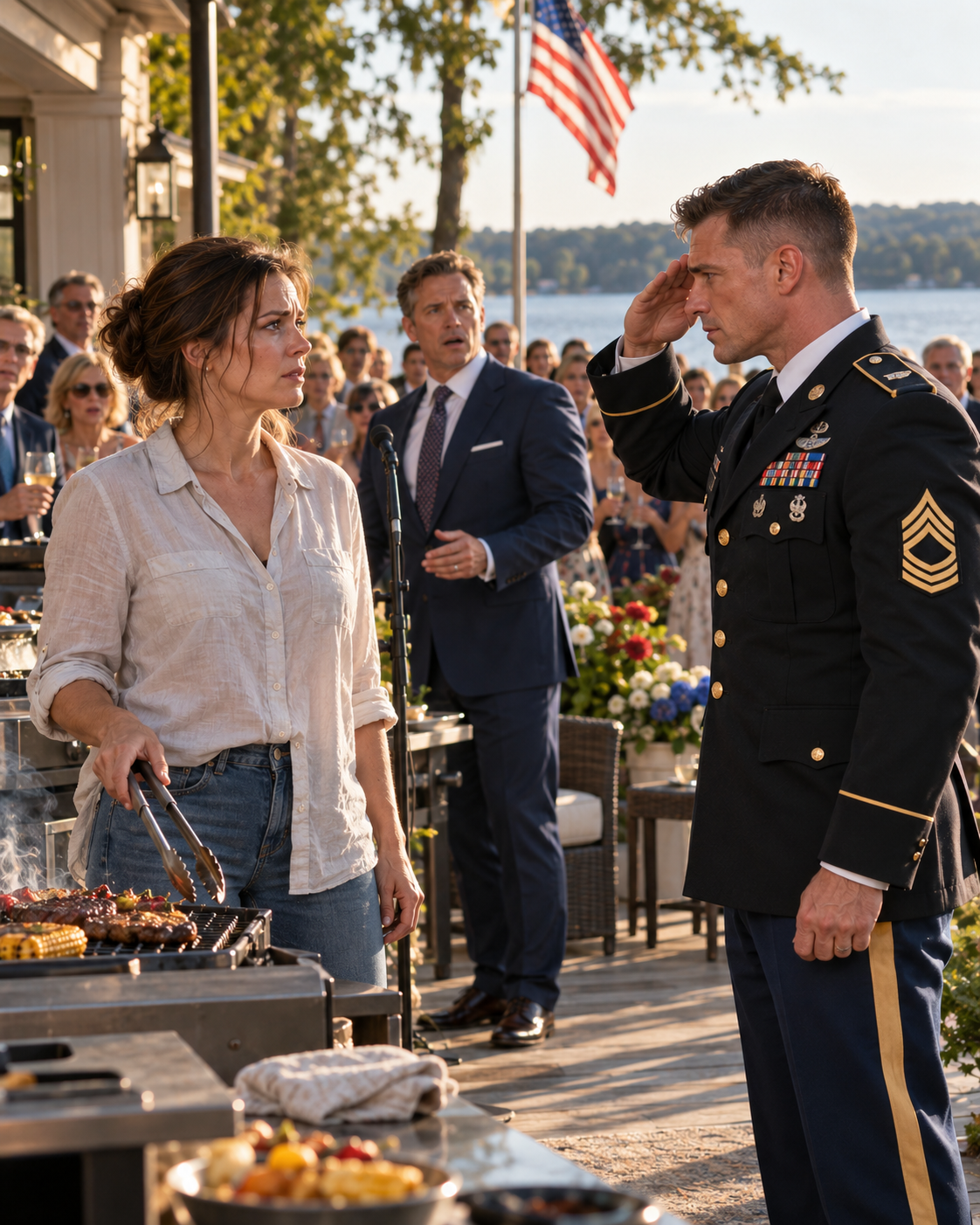
My brother humiliated me beside the smoking grill at his Memorial Day estate, calling me a paper-pushing soldier
I waited until I got home before opening the envelope.
Lily was asleep upstairs, and the house was finally quiet except for the old refrigerator humming in the kitchen.
I sat at the table beneath the small yellow lamp and turned the envelope over twice before breaking the seal.
Inside was a photocopied memorandum, a photograph, and three pages of correspondence.
At the top of the memorandum was Julian’s name.
My stomach tightened.
The document was dated four months earlier.
It outlined a proposed Memorial Day media event built around “authentic veteran leadership,” with Nathan Vance as the featured guest and my own military service referenced as a contrast.
I read the sentence again because my mind refused to accept it.
“Former combat personnel will reinforce the distinction between operational service and administrative service.”
Administrative service.
They had reduced nineteen years of my life to a marketing phrase.
Then I saw Nathan’s name handwritten across the bottom.
DECLINED.
Underneath it was one sentence.
“I will not participate in the public humiliation of Lieutenant Colonel Mercer.”
I leaned back in my chair.
Julian had known.
This wasn’t an impulsive insult at a family party.
He had planned the humiliation, packaged it, and nearly turned it into a public relations campaign.
Then I found the second page.
It was an email from Julian to a production company.
“Valerie will be present but unaware of the setup.”
The final line made my hands go cold.
“Her reaction should be natural.”
For a long moment, I could hear nothing but the clock above the sink.
My own brother had planned my embarrassment like entertainment.
I wanted to call him.
I wanted to hear him explain every word.
Instead, I called Nathan.
He answered immediately.
“You opened it.”
“Yes.”
“I thought you should know before someone else rewrote what happened.”
“Who else knows?”
“People who should.”
His voice softened.
“I didn’t send those documents because I wanted revenge.”
“Then why?”
“Because your brother is still telling everyone that the incident was a misunderstanding.”
I closed my eyes.
“Is he?”
“No.”
Nathan paused.
“He has been building a version of you that makes him look important.”
The next morning, Julian’s attorney called me.
He spoke politely, which somehow made it worse.
He claimed Julian regretted the misunderstanding and wanted the family to resolve the matter privately.
I asked one question.
“Did he know the event was designed to embarrass me?”
There was a pause.
“I am not authorized to discuss his intentions.”
That answer was enough.
I hung up.
An hour later, I received a message from Julian.
“Can we talk?”
I stared at it for a long time.
Then I wrote back.
“Not alone.”
He came to my office that evening with no assistant, no suit jacket, and none of the confidence he wore like armor.
He looked exhausted.
“You brought Nathan into this,” he said.
“No.”
I placed the documents on the table.
“You did.”
He stared at them.
“I never meant for it to become this.”
“You arranged it.”
“I wanted one day where people respected me.”
The sentence landed harder than an insult.
“You thought humiliating me would make them respect you?”
He looked away.
“I spent my whole life being your little brother.”
I almost laughed, but there was too much sadness in his face.
“Julian, you were never competing with me.”
“You were always the impressive one.”
“No.”
I pointed toward the window.
“You saw the uniform.”
“You saw the rank.”
“You never saw the years nobody applauded.”
He sat down.
For the first time, he looked less like my brother and more like a frightened man who had built himself out of other people’s approval.
“I was jealous,” he whispered.
I said nothing.
“I hated that you could walk into a room and not need anyone to notice.”
That confession should have satisfied me.
Instead, it made me tired.
“Why Nathan?”
“Because I thought if a real combat veteran said it, everyone would believe me.”
I looked at him.
“What did you want them to believe?”
“That I mattered.”
The room went quiet.
I had spent years imagining what I would say if Julian ever admitted the truth.
None of those words survived the moment.
“You mattered before you started performing for people,” I said.
He looked at me, almost like a child hearing something impossible.
Then his phone rang.
He ignored it.
It rang again.
He finally answered.
His face changed.
“What happened?”
He listened.
Then he stood.
“The production company has the footage.”
I frowned.
“What footage?”
He looked at me.
“The event.”
Someone had secretly recorded the entire party from multiple angles.
Not just the speeches.
Not just Nathan’s confrontation.
Everything.
Julian’s private setup.
His rehearsals.
His messages to the producer.
His instructions to the staff.
And worse, the footage included a conversation I had never heard.
Hours before Nathan arrived, Julian had told the event producer that I needed to be humiliated before sunset.
The producer had apparently retained the files because they were contractually protected.
Julian’s face drained of color.
“Who has them?”
“A reporter.”
I stood.
“Which reporter?”
He gave me the name.
The reporter had been investigating a veterans’ charity connected to Julian for months.
That changed everything.
I had never heard of the charity.
Julian’s corporation had created it the year before, using his company branding and expensive fundraising dinners to attract donations.
The charity’s website featured photographs of military ceremonies, though Julian himself had never served.
Its annual reports claimed partnerships with veterans and families.
Nathan was listed as an “advisory ambassador.”
He had never agreed to that title.
My anger finally had somewhere to go.
“This isn’t just about me.”
Julian swallowed.
“No.”
“You used veterans to make yourself look honorable.”
He nodded.
“And you used Nathan’s reputation.”
“Yes.”
I looked at him for a long time.
“Then tell the truth before someone else has to.”
He stared at me.
“What does that mean?”
“It means you don’t get to manage the apology.”
That night, Julian released a statement.
He admitted that the Memorial Day event had been designed to elevate his public image at my expense.
He removed every unapproved veteran endorsement from the charity’s website.
He announced an independent audit of the foundation’s finances.
For the first time in his adult life, Julian put his name beneath something that made him look small.
The response was brutal.
Some donors withdrew.
Some friends stopped answering his calls.
Business partners became cautious.
The same social crowd that had laughed on his cedar deck suddenly had places to be.
I expected to feel vindicated.
I didn’t.
I felt grief.
Because beneath all of it was my brother, and I remembered a different Julian.
He was twelve when he taught me how to ride a bicycle.
He ran beside me until he was out of breath.
When I crashed, he scraped his own knee trying to catch me.
He had not always been this man.
Somewhere along the way, approval had become an addiction.
Nathan called a week later.
“I heard Julian came clean.”
“He did.”
“Good.”
“What happens now?”
“Now you decide who you are without needing him to understand it.”
I smiled.
“You sound like my therapist.”
“I was going to say chaplain, but therapist sounded safer.”
I laughed.
It felt good.
Then Nathan asked whether I would attend a small memorial at Fort Campbell.
He didn’t explain why until I arrived.
There were twelve empty chairs.
Each one represented a soldier from the operation seven years earlier.
Not because they had died.
Because Nathan wanted them remembered as men who had survived.
He had invited their families.
I stood in the back at first.
Then one of the wives recognized me.
She walked over slowly.
“Are you Valerie Mercer?”
“Yes.”
She hugged me before I could respond.
“My husband talks about you.”
My throat tightened.
“He does?”
“He says you were the reason he came home.”
Another family approached.
Then another.
A father shook my hand.
A daughter handed me a photograph.
A soldier who had been seventeen when he deployed stood beside his mother in a faded uniform.
“You kept them alive,” she said.
I shook my head.
“Your son kept himself alive.”
She smiled through tears.
“You gave him the chance.”
For the rest of the evening, people told stories.
Not about medals.
Not about headlines.
About coffee.
Bad jokes.
Boots drying beside heaters.
Letters from home.
A soldier who sang terribly but refused to stop.
A medic who carried peppermint candies in every pocket.
The things that made people human.
I realized that was what service had always meant to me.
Not being important.
Not being remembered.
Making sure someone else got home.
When the ceremony ended, Nathan waited beside the empty chairs.
“You knew I’d need this.”
“I hoped.”
I looked at him.
“Why did you really come to Julian’s party?”
He smiled.
“Because I heard he was bringing in a hero.”
“And?”
“I figured I should meet the real one.”
I rolled my eyes.
“Don’t start.”
He laughed.
Then his expression became serious.
“I came because I owed you.”
“You didn’t owe me anything.”
“I did.”
He touched the edge of one of the empty chairs.
“I was the youngest man in that group.”
“My first combat rotation.”
“I was terrified.”
“You were surrounded.”
“I was.”
He looked directly at me.
“When the radio crackled and your voice came through, you sounded like the calmest person on earth.”
I remembered that night.
The bunker had smelled like stale coffee and electrical heat.
Mortars had shaken dust from the ceiling.
Someone had shouted that the extraction window was closing.
I had kept my hands on the map and told everyone to breathe.
Nathan smiled faintly.
“You told us to hold for eleven minutes.”
“I remember.”
“We thought eleven minutes was impossible.”
“It was.”
“You made it possible.”
I looked down.
“I was doing my job.”
“That is exactly what you said.”
He shook his head.
“And that’s why people like you disappear.”
The words stayed with me.
I had always believed quiet service was enough.
Maybe it was.
But quiet did not have to mean invisible.
Back home, I started changing small things.
I accepted invitations I once declined.
I spoke to junior officers who thought leadership meant never showing fear.
I told them the truth.
“You will be afraid.”
“You will doubt yourself.”
“You will make mistakes.”
“Your job is not to look invincible.”
“Your job is to protect people when you are not.”
Those words eventually found their way into a leadership workshop.
Then another.
Then another.
Months later, the Army asked me to speak at a professional development conference.
A thousand soldiers sat in front of me.
I stood at the podium and thought about Julian.
For years, I had hated podiums because I associated them with people who needed applause.
Now I understood that the podium itself was never the problem.
The problem was what you used it for.
So I said, “Never confuse being noticed with being useful.”
The room became completely still.
“Recognition is not the mission.”
“People are the mission.”
I saw young officers writing.
Some looked up.
Some nodded.
One woman in the front row wiped her eyes.
I kept going.
“Your finest decisions may never appear in a report.”
“Your best work may happen while everyone else is asleep.”
“And sometimes the most important thing you do is prevent a tragedy nobody will ever know you prevented.”
Afterward, Nathan found me in the hallway.
“You finally used a microphone.”
I smiled.
“Don’t tell Julian.”
He laughed.
“Too late.”
I groaned.
Then he handed me a small envelope.
“What’s this?”
“Something from him.”
Inside was a photograph.
It showed the cedar deck at the lake house after everyone had gone.
No guests.
No microphones.
Just an empty chair beside the cold grill.
On the back, Julian had written a single sentence.
“I finally understood that the person I was trying to defeat was someone I should have been proud to know.”
I read it twice.
I didn’t forgive him immediately.
Forgiveness is not a switch.
Sometimes it is a door you leave unlocked without knowing whether the other person deserves to walk through it.
A year passed.
Julian rebuilt the charity under independent leadership and began funding housing and counseling programs without putting his name on every banner.
He never asked me to praise him for it.
That mattered.
We started having lunch once a month.
The first few were awkward.
Then they became ordinary.
Ordinary was better.
One afternoon, he asked me about Lily.
I told him she was fourteen now and wanted to study engineering.
He smiled.
“She got that from you?”
“Maybe.”
He laughed.
“She definitely didn’t get it from me.”
I looked at him.
“You got more things right than you think.”
He became quiet.
Then he said, “I don’t know how to make up for what I did.”
“You can’t.”
He nodded.
“But you can stop adding to it.”
He looked out the window.
“That sounds like something you’d say to soldiers.”
“It applies to everyone.”
Years later, on another Memorial Day, Lily stood beside me at the same lake.
Julian’s house was gone.
He had sold it.
The cedar deck where he once humiliated me had been replaced by a public lakeside park.
There were no luxury cars.
No microphone.
No hired guests.
Just families placing flowers near the water.
Lily held Barnaby under one arm.
The bear was older now.
The brass button had been replaced with a new stitch, but I had kept the original button in a small wooden box.
Lily looked at it.
“Mom sewed that, right?”
“Yes.”
“Why did she use a brass button?”
I smiled.
“She said it made him look important.”
Lily laughed.
Then she became quiet.
“Do you think Mom would be proud of you?”
I looked across the water.
“I hope so.”
She leaned against my shoulder.
“I think she would.”
We stood there without speaking.
The sun lowered over the lake.
Somewhere behind us, children were laughing.
A flag moved gently in the wind.
And for once, I didn’t think about ranks, medals, reports, or the years my brother had tried to make me feel small.
I thought about twelve men coming home.
I thought about a boy learning to ride a bicycle.
I thought about a woman who had once told me that authentic love did not need an audience.
Then Lily reached into Barnaby’s torn lining and pulled out a folded piece of paper.
I frowned.
“What is that?”
She handed it to me.
The handwriting was Julian’s.
My pulse quickened.
There were only three words on the page.
“Ask Nathan why.”
I looked at Lily.
She looked back at me.
The lake suddenly felt colder.
And somewhere behind the laughter, my phone began to ring.
When I saw Nathan’s name on the screen, I knew the past had found one more way to knock on the door.
This time, I wasn’t afraid to answer.
Because I had finally learned that courage isn’t the absence of humiliation, grief, fear, or uncertainty.
Courage is deciding that none of those things get to choose what kind of person you become.
And sometimes the quietest life can carry the loudest proof of who you really are.