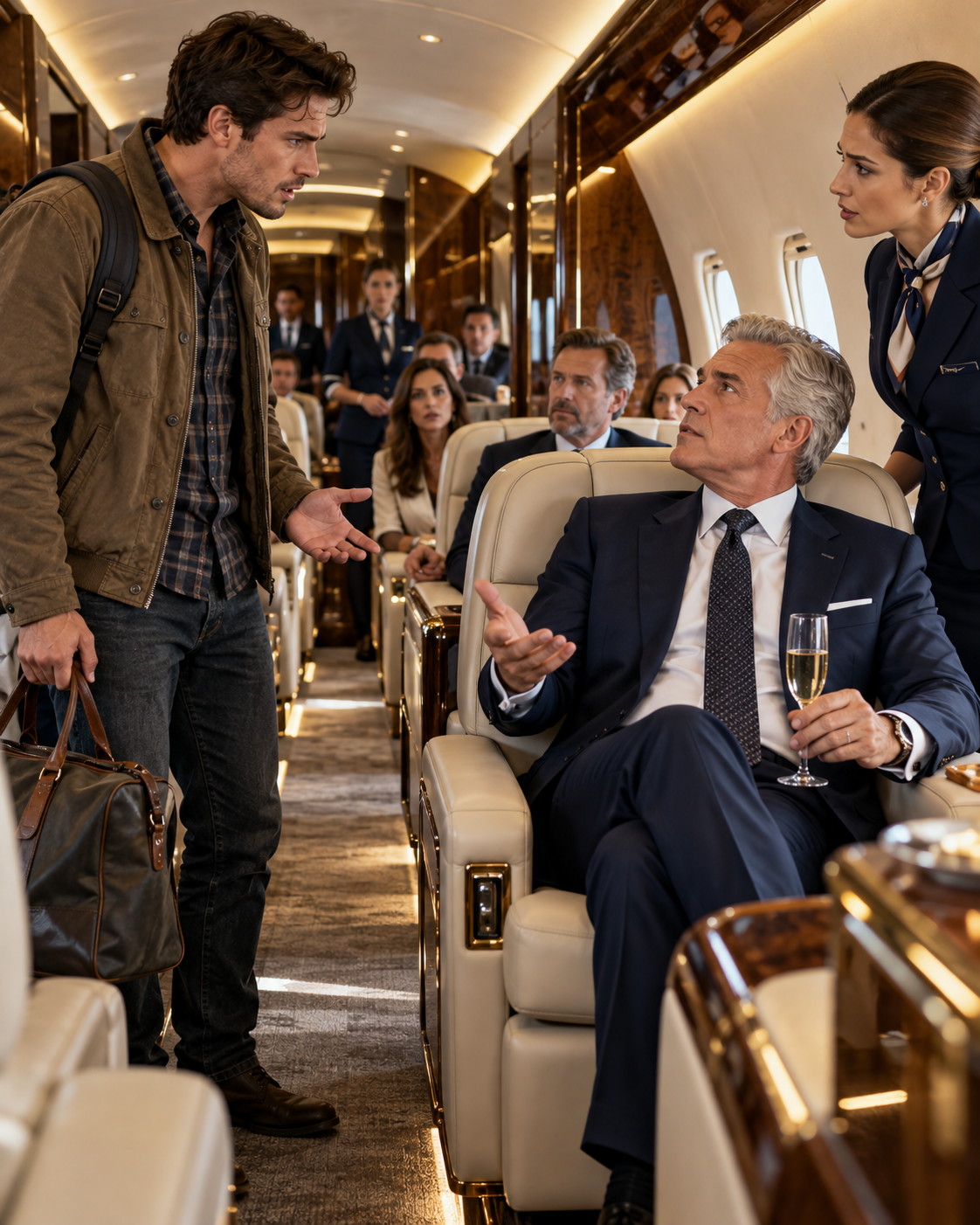
Mr. Sterling, that is my seat, and if you move me again, I may have to tell you why I was assigned to it,”
For a few seconds, nobody spoke.
The message glowed on my screen between my hands.
Victor’s keycard.
His face wasn’t visible in the photograph, only the card itself reflected in the aircraft’s curved skin, but I knew the number printed beneath the Sterling Aviation logo.
I’d issued that card myself nine years earlier, back when I was still chief engineer.
Victor noticed my expression.
“What is it?”
I locked my phone.
“Nothing I can discuss on the floor.”
His eyes narrowed.
“You’ve already grounded an aircraft.”
“Yes.”
“You’ve disrupted a billion-dollar demonstration.”
“Then the billion dollars can wait.”
Alistair stepped between us.
“You’re finished.”
I turned toward him.
“That’s not your decision.”
“Everything here is my decision.”
Victoria finally spoke.
“No, Alistair. It isn’t.”
He looked at her sharply.
That was the first time I’d seen uncertainty cross his face.
She had been CEO of Sterling Aviation for eleven years. She was also his sister, though most people in the company treated that relationship like an awkward family photograph nobody wanted hanging in the hallway.
She looked at me.
“Conference room. Now.”
The holding lounge filled quickly.
Executives.
Pilots.
Security.
Representatives from the leasing consortium that was supposed to announce its fleet order after the demonstration.
Everyone had an opinion.
Most of them had an opinion before they’d even heard the facts.
I stood at the end of the conference table while Victoria closed the door.
Victor remained near the wall.
Alistair dropped into a chair.
“You’re going to reinstate the flight,” he said.
“No.”
“Then you’re going to explain why.”
“I found evidence the structural vibration sensor beneath 1A may have been accessed after certification.”
Victor laughed.
“May have been?”
“That is why I stopped the flight.”
“You grounded a new aircraft because of a crooked sticker.”
“Seal.”
“What?”
“It’s a certification seal.”
He waved a hand.
“Whatever.”
I looked at Victoria.
“Who authorized the last maintenance access?”
She didn’t answer immediately.
Victor did.
“Routine inspection team.”
“Names?”
“Why?”
“Because the panel had been opened.”
Victor folded his arms.
“I don’t remember.”
“You signed the maintenance release.”
His expression hardened.
“You’re accusing me?”
“I’m asking a question.”
Alistair leaned forward.
“This is absurd.”
I could have fought him.
Instead, I asked Victoria for the maintenance log.
She nodded to an assistant.
The binder arrived.
The page showed a routine inspection completed at 6:12 that morning.
The mechanic’s name was Daniel Perez.
I knew Daniel.
He was careful, almost painfully so.
“Call him,” I said.
They did.
He answered from his apartment, where he was apparently still asleep.
When Victoria asked whether he’d opened the sensor panel, he sounded genuinely confused.
“No, ma’am. I wasn’t assigned to the X9 today.”
Silence.
I turned the page.
His signature was there.
Not Daniel’s handwriting.
Someone had copied it.
Victor stepped forward.
“Forgery can happen anywhere.”
“Exactly.”
I looked at him.
“Which means we need to preserve everything.”
He smiled without warmth.
“You’ve always been dramatic.”
The words landed harder than they should have.
Because I’d heard them before.
Nine years earlier, Victor had told me almost the same thing.
We had been testing an earlier Sterling prototype. A fatigue crack had appeared near a wing attachment point. I refused to sign the aircraft off.
Victor wanted another forty-eight hours.
The board wanted the aircraft demonstrated at a major air show.
I wrote the defect report anyway.
Two days later, I was removed as chief engineer.
The official reason was “failure to align with operational priorities.”
The real reason was simpler.
I wouldn’t change the report.
After that, I spent years rebuilding my career one certification at a time.
Independent inspections.
Small operators.
Regional airlines.
Corporate aircraft.
Long nights in hangars that smelled like hydraulic fluid and cold metal.
I learned to be comfortable with nobody powerful knowing my name.
My daughter had been six then.
Now she was sixteen.
That morning, she’d asked whether I would be home.
That mattered more to me than any title Sterling Aviation could offer.
My phone buzzed again.
This time it was Clara.
Not my daughter.
The flight attendant.
Can I speak to you alone?
I found her in a service corridor.
She closed the door.
“I didn’t know what was happening,” she said.
“I believe you.”
“You shouldn’t.”
She swallowed.
“Because I saw something.”
“What?”
“Victor came onto the aircraft before boarding.”
“How long?”
“Maybe fifteen minutes.”
“Did he have a keycard?”
“Yes.”
“Did he access the forward panel?”
“I don’t know.”
Her hands tightened around each other.
“But I heard metal.”
I waited.
“And when I asked what it was, he told me the cabin crew didn’t need to worry about engineering.”
That was enough to make my stomach turn.
“Did anyone else see him?”
She shook her head.
Then she said something I hadn’t expected.
“Victoria did.”
I stared at her.
“She was there?”
“Yes.”
“Did she stop him?”
“No.”
That was the moment my anger shifted.
Until then, I had been focused on Victor.
Now I had to consider Victoria.
The CEO had been silent because she wanted the fleet deal.
Or because she was protecting something else.
When I returned to the conference room, she was alone.
“Did you know Victor accessed the aircraft?”
She didn’t pretend not to understand.
“I suspected.”
“Suspected what?”
“That there was pressure on him.”
“That isn’t an answer.”
She sat down.
For the first time, she looked tired.
“Alistair had been pushing for the demonstration to happen today. The buyer representatives were already here. If we delayed, the contract could have been postponed.”
“So you let the flight proceed?”
“I didn’t know about the sensor.”
“But you knew Victor was doing something.”
“I knew he was checking something.”
“Without authorization?”
She looked at me.
“Yes.”
I couldn’t hide my disappointment.
“I thought you were better than that.”
She flinched.
That reaction told me more than an argument would have.
“I was trying to keep the company alive,” she said.
“And I was trying to keep people alive.”
She closed her eyes.
“I know.”
Before either of us could continue, the conference room door opened.
Alistair walked in with two communications executives.
“We’re holding a press briefing.”
Victoria stood.
“No.”
“Yes.”
“You don’t have authority to do that.”
“I have investors.”
“I am the CEO.”
“And your certification inspector has just embarrassed the company in front of half our future customers.”
He looked at me.
“Your old credentials are already circulating.”
My stomach tightened.
“What credentials?”
He smiled.
“Your archived Sterling files.”
Victor appeared behind him.
I understood then.
They weren’t preparing to defend the aircraft.
They were preparing to discredit me.
Within twenty minutes, someone had circulated an internal memo claiming I had used outdated Sterling credentials to interfere with the flight.
The allegation was carefully written.
Not an outright accusation of sabotage.
Just enough doubt.
A disgruntled former employee.
A personal grievance.
Unauthorized access.
Possible financial motive.
It was the sort of story people believed because it sounded boring.
I felt something inside me go quiet.
Not rage.
Something colder.
I opened my laptop.
“Fine,” I said.
Victor raised an eyebrow.
“Fine?”
“Let’s show everyone what happened.”
The press briefing began in a boardroom overlooking the runway.
Cameras were set up.
The board members sat along the rear wall.
Alistair spoke first.
He described the incident as an unfortunate operational interruption.
Then he mentioned my employment history.
Then the phrase “former chief engineer.”
Then “archived credentials.”
The implication hung in the air.
I stood.
“May I?”
Victoria looked at me.
“Yes.”
I connected my laptop.
“Mr. Sterling says I accessed the aircraft using obsolete credentials.”
I displayed my current independent certification.
Issued three months earlier.
Verified through the federal registry.
Then I showed my flight records.
At 5:42 that morning, I had arrived at the airport.
At 6:03, my vehicle entered the inspection lot.
At 6:17, I signed into the certification system.
At 6:41, I was photographed beside the X9.
At 6:52, I left the hangar to meet the insurance representative.
The timeline was precise.
I looked at Alistair.
“If I sabotaged the aircraft before that photograph, I would have needed to be in two places at once.”
A board member leaned forward.
“Can we verify the footage?”
Victor answered too quickly.
“Security footage from that area was corrupted.”
I smiled faintly.
“Only the hangar camera?”
He didn’t answer.
I pulled up another image.
A parking mirror.
Cheap.
Convex.
Mounted on a utility vehicle across the access road.
The reflection showed the X9.
And a ground cart hitting the left wing.
The timestamp was visible.
5:58.
The aircraft had been struck before I arrived.
The room went silent.
Victoria stood.
“Where did you get that?”
“An airport maintenance worker sent it to me after seeing the news.”
Victor’s face had lost its color.
I enlarged the image.
The cart operator wasn’t visible.
But the cart itself had a fleet number.
Sterling Aviation.
“Now,” I said, “we know why the left wing paint didn’t match.”
A board member whispered something.
Victor stepped forward.
“That proves nothing about me.”
“No.”
I opened another file.
“But this does.”
It was the access log.
His keycard had entered the hangar at 6:04.
Six minutes after the impact.
Then again at 6:18.
And again at 6:27.
Someone on the board said, “Victor, explain that.”
He stared at the screen.
“I was investigating.”
“Without documenting it?”
“I was trying to protect the company.”
“By opening a certification panel?”
He looked at Victoria.
She didn’t help him.
Alistair suddenly stood.
“This is ridiculous. Even if Victor made mistakes, that doesn’t prove the sensor was compromised.”
“No,” I said.
“It proves something worse.”
I pulled up the sensor data.
There was a gap.
A twelve-minute gap.
Then the readings resumed.
But the underlying system had retained a backup stream.
The sensor had recorded a collision event.
At 5:58.
And another vibration spike at 6:21.
Someone had attempted to erase the original data.
They had failed.
The room erupted.
Questions came from every direction.
Who had access?
Why was the maintenance log forged?
Why had the footage disappeared?
Why had the aircraft been presented for demonstration?
Then Alistair’s voice cut through the room.
“You’re making assumptions.”
I turned toward him.
“Your email says otherwise.”
He stopped.
I displayed it.
Three weeks earlier, Alistair had written to Victor:
If the wing issue is within tolerance, keep the demonstration on schedule. We cannot lose the fleet order over another engineering delay.
Another line followed:
People accept calculated risk when the upside is large enough.
I didn’t say anything.
I didn’t need to.
Victoria read it twice.
Then she looked at her brother.
“Did you know about the impact?”
Victor’s mouth opened.
Nothing came out.
Alistair stepped backward.
“This is being taken out of context.”
“Then give us the context,” Victoria said.
He couldn’t.
Security moved toward him.
Raymond Drake was the one who finally spoke.
“We have one more problem.”
He looked at me.
“The sensor data shows an access attempt happening right now.”
I frowned.
“Where?”
“Aircraft.”
My blood went cold.
We ran.
The X9 sat alone beneath the hangar lights.
Raymond unlocked the cabin.
Seat 1A was empty.
The floor panel beside it was open.
Victor was kneeling beneath the seat.
He froze when he saw us.
His hand was inside the compartment.
A small data device lay beside him.
Raymond grabbed his wrist.
Victor pulled away.
“Don’t touch me.”
Raymond pointed toward the device.
“What were you doing?”
“Nothing.”
I crouched.
The sensor’s memory module was still intact.
The uncorrupted collision data was blinking on the diagnostic screen.
Victor had been trying to erase it.
He looked at me.
“Evan.”
I said nothing.
“Listen.”
He lowered his voice.
“I can fix this.”
“You can’t.”
“You don’t understand what’s at stake.”
“I understand exactly.”
“The company employs twelve thousand people.”
“I know.”
“People will lose everything.”
His voice cracked.
For the first time, he didn’t sound arrogant.
He sounded frightened.
Then he reached into his jacket.
An envelope appeared.
He held it toward me.
“Two million.”
I stared at it.
“I don’t want your money.”
“Five.”
“Victor.”
“Ten.”
He was bargaining with me like my integrity was a price he simply hadn’t reached yet.
I stood.
“You still don’t understand.”
He looked at me.
“I was fired once because I told the truth.”
His face changed.
“I lost everything.”
I pointed toward the sensor.
“But I got to keep the one thing I couldn’t replace.”
“What?”
“Myself.”
Raymond took Victor into custody.
Later, federal investigators arrived.
The board suspended Victor immediately.
Alistair’s attorneys began calling before midnight.
He threatened to withdraw investment.
Victoria told him the company would cooperate with investigators regardless.
The fleet contract was suspended.
The press conference was canceled.
And the X9 stayed in the hangar for twenty-three days.
During those twenty-three days, the aircraft was stripped down.
The damaged wing structure was replaced.
The sensor system was rebuilt.
Every maintenance record was independently audited.
Every security camera was replaced.
Most importantly, Victoria changed the certification policy.
No executive could override an inspector.
No sales deadline could supersede a safety hold.
No employee could be punished for grounding an aircraft in good faith.
I didn’t ask for those changes.
I asked for one more.
A direct reporting line for safety personnel outside the corporate chain of command.
Victoria agreed.
On the twenty-fourth morning, I stood beside the X9 again.
Same hangar.
Same aircraft.
Different feeling.
Victoria approached me.
“You were right about one thing.”
“Which one?”
“You shouldn’t have been sitting in 1A that first day.”
I smiled.
“Because Alistair took it?”
“No.”
She looked toward the aircraft.
“Because I had no business asking you to prove your integrity while I was compromising mine.”
I didn’t know what to say.
She handed me a boarding pass.
1A.
I looked at it.
Then at her.
“You’re coming?”
“No.”
“Why not?”
“Because this time, I want the right person in that seat.”
The certification flight lasted two hours and eleven minutes.
No champagne.
No investors in the cabin.
No press.
Just the crew, two engineers, an independent observer, and me.
When we landed, the aircraft performed exactly as it should have.
I drove home through evening traffic.
Clara was waiting on the porch.
She ran down the steps before I had even turned off the engine.
“How’d it go?”
“Perfect.”
“You were really on the real flight?”
“I was.”
She hugged me.
Then she pulled back.
“You made it.”
“I promised.”
She smiled.
“I got the scholarship.”
For a second, the entire twenty-four days disappeared.
The threats.
The boardroom.
Victor under the floor panel.
The envelope.
The cameras.
All of it.
I looked at my daughter and thought about that first morning, when I’d been afraid I might disappoint her by coming home late.
Instead, I had come home with something better than a schedule.
I had come home knowing the person she trusted was still the person standing in front of her.
Months later, the new safety policy was posted in every Sterling Aviation facility.
It wasn’t written for executives.
It wasn’t written for inspectors.
It wasn’t written for people like me.
It was written for the mechanic on the night shift who notices one bolt that doesn’t look right, the flight attendant who hears something she can’t explain, the engineer who feels pressured to sign too quickly, and the person who is afraid that speaking up will cost them everything.
At the bottom of the policy, Victoria had added one sentence.
I didn’t write it.
She did.
“No contract, no title, and no passenger stands higher than the truth.”
I kept a copy at home.
Not framed.
Not displayed.
Just folded inside the same certification folder I had carried onto that first flight.
Because every time I opened it, I remembered the scratched screw beneath seat 1A.
And the strange thing was, I no longer thought about Alistair taking my seat.
I thought about the moment I almost argued with him.
Almost let pride make the decision.
Instead, I had picked up my pen.
And sometimes the smallest things are what keep an entire machine from coming apart.