Mom, if you’re going to send me back to the kitchen, at least tell me what I did wrong,” I said, balancing four champagne glasses
For several seconds, I couldn’t hear anything except the hum of the refrigeration unit behind the bar.
The music was still playing. People were still talking. Vivienne was still laughing.
But Sterling’s message had changed the room.
Not because of what it said.
Because of what it reminded me.
There was a document from 2015 that I had deliberately forgotten.
I slipped my phone into my pocket.
“Where’s Sterling?”
Maren shook her head. “He didn’t come. He said you told him not to.”
“I did.”
“Then why did he text you?”
“I don’t know.”
Maren studied my face.
“Are you okay?”
I looked at the invoice again.
One hundred eighty-seven thousand, four hundred sixty dollars.
The number wasn’t frightening because I couldn’t afford it.
It was frightening because I knew exactly what it represented.
A line crossed.
A favor converted into entitlement.
My mother had always said Hawthorne Ridge was the one thing she had managed to keep after losing everything else.
I had never corrected her.
But paying for the place didn’t mean I had bought the right to humiliate her.
That was the story I had told myself.
The problem was that somewhere along the way, the arrangement had changed.
I walked outside through the side door.
The evening air was cool enough to raise gooseflesh along my arms. Beyond the parking area, the fields stretched into darkness, and the barn windows glowed against the black.
I called Sterling.
He answered on the second ring.
“Did you read it?”
“Yes.”
“You weren’t supposed to find out tonight.”
“About the lease?”
“No. About the 2015 declaration.”
I leaned against the brick wall.
“Why would you keep that from me?”
“Because you told me never to use it unless you asked.”
I closed my eyes.
That sounded like me.
It was exactly the sort of instruction I would have given ten years ago, when every conversation with my mother still felt like stepping barefoot over broken glass.
“What’s in the declaration?”
“Your ownership.”
“I know I own the property.”
“You know. Your mother doesn’t.”
I looked back through the glass doors.
Eleanor was talking to Cecelia.
Cecelia glanced toward the window.
“So why does she have it?”
“She doesn’t.”
I frowned.
“Then why did you say she knows?”
“I said she suspects.”
There was a pause.
“Cecelia was at the acquisition meeting in 2014,” Sterling said. “Her company was one of the groups considering the land. She recognized the structure we used when the purchase closed.”
My stomach tightened.
“She knew?”
“She suspected. She never had proof.”
“Why didn’t she say anything?”
“Because she thought you were protecting your mother.”
I let out a breath that almost became a laugh.
“She was right.”
“Yes.”
Sterling’s voice softened.
“Are you still protecting her?”
I didn’t answer.
That was answer enough.
When I returned inside, the dinner had begun.
I took my place at a small table near the service entrance because nobody had assigned me a seat at the head table.
That didn’t hurt as much as it should have.
I had spent years making myself easy to overlook.
A person can’t complain forever when others eventually become good at it.
During the first course, Vivienne leaned over.
“Are you all right?”
I looked at her.
There was something almost sincere in her face.
“I’m fine.”
She lowered her voice.
“Mom didn’t mean anything by the kitchen thing.”
“You’re right.”
“She gets stressed.”
“I know.”
“And the wedding bill isn’t really a big deal.”
That made me pause.
“Isn’t it?”
She shrugged.
“It’s all going through the venue.”
“That’s not what I asked.”
She frowned.
“Why are you acting weird?”
I stared at her for a moment.
Because I remembered her at seventeen, sitting on the floor outside Maeve’s office while we waited for Mom to finish a phone call.
Because I remembered hearing Maeve tell Eleanor, “Vivienne is wonderful, but this place belongs with the one who understands what it costs.”
Because I remembered Vivienne hearing that sentence.
She had never forgotten it.
Neither had I.
“You’ve always hated me for that,” I said quietly.
Her face changed.
“For what?”
“For being offered the property.”
She looked away.
“You always think everything is about that.”
“I didn’t say everything.”
She pushed her napkin onto her lap.
“You left.”
The words came out sharper than I expected.
“You left Mom here. You went to Columbus. You built your little career. You got to be the responsible one while I stayed and dealt with her.”
I stared at her.
“You think I abandoned you?”
“You weren’t here.”
“That doesn’t answer me.”
She swallowed.
For the first time that evening, the polished surface cracked.
“You got to leave before you knew what it was like.”
“What was it like?”
She looked toward our mother.
“Being the daughter nobody trusted with anything.”
I didn’t know what to say.
That was the first time I understood that Vivienne’s resentment wasn’t entirely about money.
It was about being compared to me.
And I had spent eleven years making the comparison worse by pretending I had nothing.
Before I could answer, Eleanor stood.
She tapped a spoon against her glass.
The room quieted.
“I’d like to make a toast.”
People turned toward her.
She smiled at Vivienne first.
Then Liam.
Then the guests.
Finally, she looked at me.
“And to family,” she said. “Even when family members take different paths.”
A few people nodded.
I felt the old warning in my chest.
Eleanor continued.
“Some people find their purpose early. Others need more time.”
The room went still in that particular way rooms do when everyone understands a sentence has a target.
“I only hope,” she said, smiling at me, “that someday our oldest daughter finds something she can truly be proud of.”
There was polite laughter.
My mother lifted her glass.
I looked at the champagne in front of me.
Then at Maren.
She was already shaking her head.
Don’t.
I stood anyway.
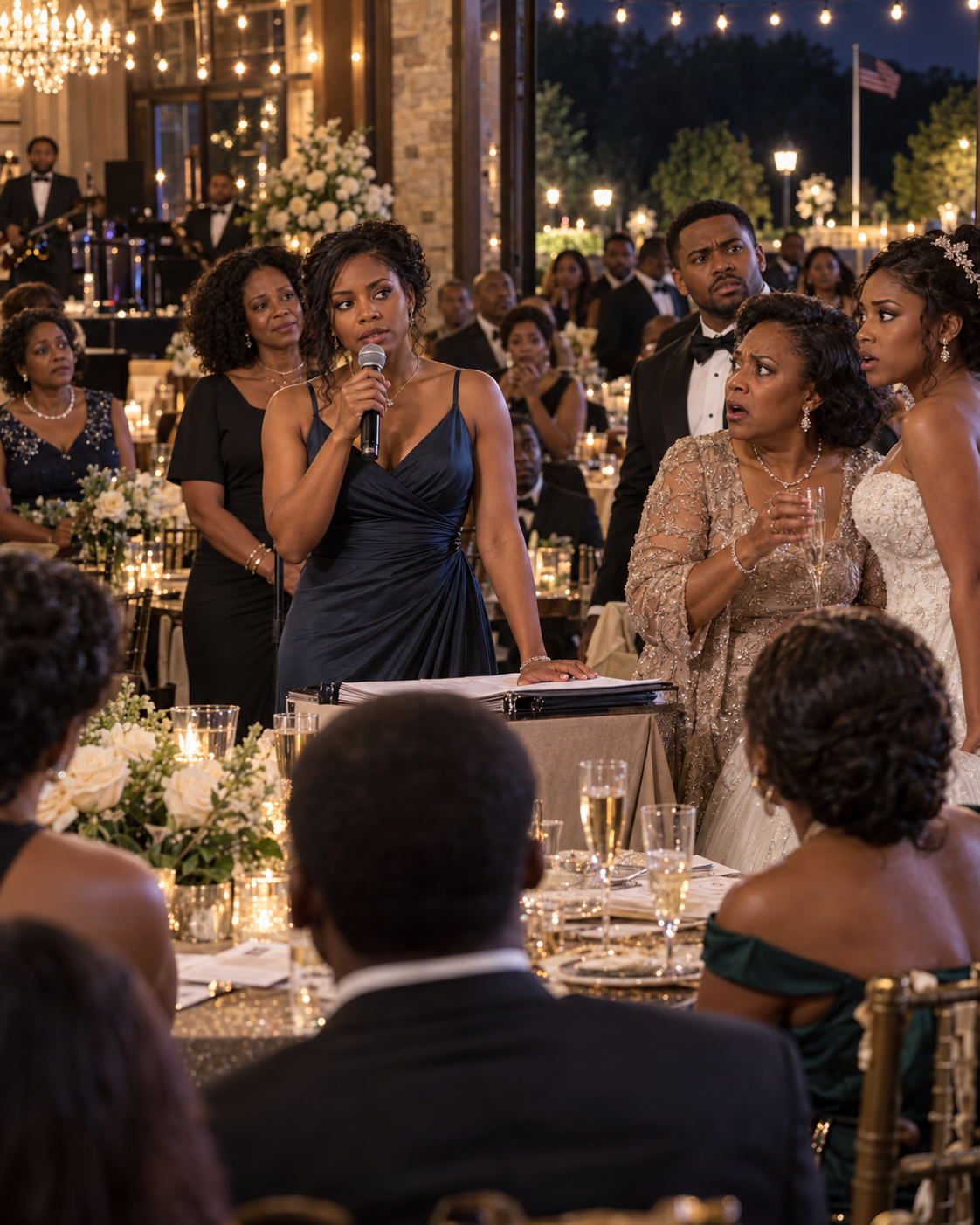
Maren had the microphone.
I walked toward her.
She whispered, “Are you sure?”
“No.”
That was the truth.
I took the microphone.
My hands were cold.
“I’d like to add something.”
Eleanor’s smile disappeared.
I looked around the room.
“Ninety people are here tonight.”
Nobody spoke.
“Some of you have known me since I was a kid. Some of you met me today. Most of you probably think you know what I do here.”
Vivienne shifted in her chair.
I continued.
“I keep the books. I answer vendor calls. I order supplies. I sometimes carry champagne glasses when my mother tells me to.”
A few nervous laughs.
Then I looked at Eleanor.
“But there’s one detail that hasn’t been mentioned.”
She stood.
“Don’t.”
I heard her.
So did everyone else.
I set the microphone against my palm.
“Hawthorne Ridge doesn’t belong to my mother.”
Silence.
“It belongs to me.”
Nobody moved.
I could hear the old clock above the fireplace.
Tick.
Tick.
Tick.
Vivienne stared at me.
Liam looked at Eleanor.
Eleanor’s face had gone completely white.
I went on because stopping would have been easier, and I had already spent too much of my life choosing easy.
“In 2014, this property was headed toward foreclosure. There were mortgages. Tax liens. A developer was preparing to purchase the land.”
I looked at my mother.
“You were drowning.”
She whispered my name.
I pulled a folder from beneath the table where Maren had placed it.
“The property was purchased through an entity controlled by me in 2015.”
I opened the folder.
“The purchase price was $4.2 million.”
A man near the bar actually whispered, “Jesus.”
I didn’t look at him.
“The land is mine. The barns are mine. The house is mine. The equipment is mine. The business is mine.”
Vivienne stood abruptly.
“No.”
I looked at her.
She shook her head.
“No. That’s not possible.”
“I have the deed.”
“You don’t.”
“I do.”
She looked at our mother.
“Mom?”
Eleanor didn’t answer.
That was when Vivienne understood.
Not from my words.
From her silence.
She sat down slowly.
Liam turned toward Eleanor.
“You knew?”
Eleanor’s eyes filled.
“I thought—”
“You knew?”
“I thought she was helping us.”
“She has been helping us,” Cecelia said from across the room.
Everyone turned.
She placed her glass on the table.
“I knew something was unusual about the 2015 purchase.”
Eleanor looked at her.
Cecelia continued carefully.
“I didn’t know it was your daughter.”
I watched her cross the room.
She stopped beside me.
“I owe you an apology,” she said.
“For what?”
“For allowing myself to believe that your silence meant weakness.”
The words landed harder than I expected.
I nodded once.
“Thank you.”
Cecelia turned toward Liam.
“We’re not discussing the wedding tonight.”
Vivienne looked at her.
“What does that mean?”
“It means,” Cecelia said, “that my son is not going to begin his marriage with a debt he didn’t know existed.”
Liam looked sick.
“I didn’t know.”
“I know.”
I stepped in before the room could fracture further.
“The wedding is paid for.”
Vivienne stared at me.
“What?”
“I said it’s paid for.”
“You paid for all of this?”
“Yes.”
“Why?”
I looked at her.
Because I had loved her.
Because I had loved Mom.
Because I had loved Maeve.
Because sometimes love becomes a habit long after it stops being healthy.
But I couldn’t say any of that without making the moment smaller.
So I said the simplest thing.
“Because I thought family meant protecting people when they were too proud to admit they needed help.”
Vivienne’s face crumpled.
“You never told me.”
“No.”
“You let me think you failed.”
“Yes.”
“Why?”
“Because you needed someone to be less successful than you.”
She flinched.
I regretted the sentence immediately.
Not because it wasn’t true.
Because I knew it wasn’t the whole truth.
She wiped at her cheek.
“I hated you.”
“I know.”
“I didn’t know why.”
“I think you did.”
She looked down.
“I heard Grandma that day.”
“I know.”
“I thought she chose you.”
“She did.”
Vivienne looked up.
I took a breath.
“But she didn’t choose you against me.”
That silenced her.
“She chose me because she thought I understood the work. That doesn’t mean you weren’t worth choosing.”
Vivienne began to cry.
Quietly.
Not theatrically.
The kind of crying that makes a person look younger.
For a second I saw the little girl who used to crawl into my bed during thunderstorms.
Then Eleanor spoke.
“You were always going to take it.”
I turned.
“What?”
“Hawthorne Ridge.”
Her voice was thin.
“Your grandmother always intended for you to have it.”
“Yes.”
“And you let me believe I still owned it.”
“I leased it to you.”
“For one dollar.”
“Yes.”
“Why?”
I almost laughed.
Not because it was funny.
Because I suddenly understood how strange the whole thing sounded when spoken aloud.
“Because you couldn’t bear losing it.”
Eleanor looked around the room.
“All these years, I told everyone I saved this place.”
“I know.”
“I couldn’t admit that I couldn’t.”
“I know.”
She covered her mouth.
“I thought if I admitted it, I’d be nothing.”
I stepped closer.
“You were never the property, Mom.”
Her eyes met mine.
“You were my mother.”
It was the most painful thing I’d said all night.
She started crying.
And for the first time in eleven years, I didn’t move toward her.
That was the part that surprised me.
I had spent so long believing forgiveness required immediate rescue.
Maybe it didn’t.
Maybe sometimes love meant letting someone stand in the consequences of their own choices.
The next morning, the estate was silent.
Wedding flowers still lined the porch.
Half-empty champagne bottles sat in metal tubs.
Someone had left a single white shoe beneath a table.
I found Maren in the office at seven.
She was holding two cups of coffee.
“I didn’t sleep.”
“Neither did I.”
She handed me one.
“Are you going to fire your mother?”
I looked through the office window toward the fields.
“No.”
Maren waited.
“I can’t do that to her.”
“What are you going to do?”
I thought about the lease.
The one-dollar payment.
The little fiction that had kept Eleanor’s dignity intact.
“I’m ending it.”
Maren nodded slowly.
“Today?”
“Today.”
She was quiet for a moment.
“What happens to Hawthorne Ridge?”
I looked at her.
“What do you want to happen?”
Her eyes widened.
“You’re asking me?”
“Yes.”
“I’ve worked here eleven years.”
“I know.”
“I know every vendor. Every seasonal employee. Every wedding planner. Every leak in the roof.”
“I know.”
She laughed softly.
“I’d keep it open.”
“Then you’re the director.”
She stared at me.
“You’re serious.”
“I am.”
“What about you?”
I looked down at the coffee in my hands.
“I’ll still own it.”
“That isn’t what I asked.”
I smiled.
For once, I didn’t have an answer ready.
That afternoon, Eleanor came to the office alone.
She carried a cardboard box.
Inside were old photographs.
Maeve standing beside the first barn.
Maeve painting a window frame.
Maeve sitting at the kitchen table with flour on her cheek.
At the bottom was a photograph of me at twenty-two, holding the keys.
I picked it up.
“I forgot about this.”
“You weren’t supposed to,” Eleanor said.
We sat across from each other.
She looked smaller without an audience.
“I was cruel to you,” she said.
I didn’t correct her.
“I kept thinking that if I could make you feel small, I wouldn’t have to feel ashamed.”
I looked at the photograph.
“Why didn’t you tell me?”
“I was afraid you’d take it away.”
“I never wanted to take it away.”
“I know that now.”
There was a long silence.
Then she pushed a manila envelope toward me.
“What is this?”
“Something I should have given you years ago.”
Inside was Maeve’s handwriting.
A letter.
My hands began to shake before I even unfolded it.
The paper was yellowed at the edges.
I read the first line.
My dear girl, if you’re reading this, you’re probably angry with me.
I stopped.
Eleanor looked away.
“Mom?”
“She gave it to me the week before she died.”
“You had this?”
“Yes.”
“For eleven years?”
She nodded.
I wanted to be furious.
Part of me was.
But beneath the anger was something else.
Fear.
Because I suddenly understood that whatever Maeve had written could change the meaning of every year I had spent carrying that regret.
I unfolded the letter.
Maeve had written that she knew I would blame myself for leaving.
She wrote that she had never expected me to abandon my career, my life, or my future for Hawthorne Ridge.
She wrote that the five years had never been a test.
They had been permission.
Permission to become something beyond the farm.
Permission to leave.
Permission to return only if I wanted to.
And then, near the bottom, she wrote one sentence that made my chest ache.
You do not honor me by spending your life paying for the fact that I died before you were ready.
I read it twice.
Then a third time.
Eleanor cried quietly across from me.
“I should have given it to you.”
“Yes.”
“I was angry.”
“At me?”
“At myself.”
She wiped her eyes.
“I wanted you to need me.”
That sentence hurt more than the toast had.
Because it was honest.
And honesty, after years of performance, can feel almost violent.
I folded the letter carefully.
“I don’t know how to forgive you yet.”
“I don’t expect you to.”
“I might someday.”
She nodded.
“That would be enough.”
She stood to leave.
At the door, she turned.
“Vivienne wants to see you.”
I almost said no.
Then I remembered her sitting alone beneath the chandelier the night before.
“Send her in.”
Vivienne entered five minutes later.
She had no makeup on.
Her hair was pulled into a loose knot.
She looked exhausted.
She sat in the chair her grandmother had used.
“I called off the wedding.”
My stomach tightened.
“Because of the money?”
“Because I realized I was about to marry someone who had been standing beside me while I treated you like you were nothing.”
I didn’t know what to say.
“I love Liam,” she continued. “But I don’t know if I know myself very well.”
“That isn’t something you have to decide today.”
“I know.”
She looked at the letter on my desk.
“Is that Grandma’s?”
“Yes.”
“Did she say anything about me?”
I hesitated.
“She loved you.”
Vivienne looked down.
“That wasn’t my question.”
I smiled sadly.
“No. She didn’t say anything bad about you.”
Vivienne breathed out.
“Good.”
We sat quietly.
Then she said, “Can I work here?”
I laughed despite myself.
“What?”
“Hawthorne Ridge.”
“You hate bookkeeping.”
“I don’t want bookkeeping.”
“What do you want?”
She looked through the window.
“The events side.”
I studied her.
“You’d have to start at the bottom.”
“I know.”
“You’d report to Maren.”
“I know.”
“You’d make mistakes.”
“I know.”
“And nobody is going to call you the owner’s daughter.”
She nodded.
“Good.”
That was how Vivienne began again.
Not as my sister.
Not as the woman who had humiliated me.
Not as the person who had once believed she had lost something because I had been given it.
Just as a woman who finally wanted to learn what the thing actually cost.
Months later, the first wedding under Maren’s leadership was held beneath the old sycamore trees.
I watched from a distance.
No tray in my hands.
No ledger tucked under my arm.
No need to explain why I was there.
The bride’s father stood on the porch crying as his daughter walked down the aisle.
Maren caught my eye from across the lawn.
She lifted her coffee cup.
I lifted mine.
For the first time, Hawthorne Ridge felt less like a debt and more like a place.
I still owned every acre.
I still paid the taxes.
I still signed the contracts.
But I stopped hiding.
That was the real change.
A year after the reception, I found myself standing in Maeve’s old office, looking at the same window where she had once pushed a ring of keys across the desk.
The fields were green.
The barns were freshly painted.
Somewhere outside, Vivienne was arguing with a florist about peonies.
Maren was laughing at her.
And my mother had come to the property that morning, not as its owner, not as its victim, but as a guest.
She asked if she could help set tables.
Maren handed her a stack of napkins.
It was strangely ordinary.
I liked it.
I kept Maeve’s letter in the top drawer of my desk.
Not because I needed it to forgive anyone.
Not because it absolved me.
I kept it because for eleven years I had mistaken guilt for loyalty.
I had believed that if I paid enough, endured enough, and stayed quiet enough, I could keep everyone I loved from losing face.
But love wasn’t supposed to require me to disappear.
The afternoon sun fell across the floorboards.
I touched the old keys hanging beside the desk.
Then I left the office door open.
And for the first time since Maeve died, I walked out into Hawthorne Ridge without feeling that I owed the ground beneath my feet an apology.