Marcus was pointing at Chloe like she was evidence, not our daughter, and when he shouted
The room seemed to contract around that one transaction.
Five thousand dollars.
February 8.
A wire transfer from an account belonging to Evelyn’s family trust to a payment processor I’d never heard of.
I read the line twice.
Then a third time.
“Why,” I asked, “is your name on this?”
Evelyn’s mouth opened, but nothing came out.
Marcus finally looked at me.
“Natalie, please.”
That was when I understood something even more frightening than the accusation.
He wasn’t shocked by the evidence.
He was shocked that I had it.
Arthur pulled a chair away from the table for me.
“Sit down.”
I didn’t want to sit. Sitting felt like surrender.
But Chloe had started squirming against my chest, tired and confused by the voices around her, so I lowered myself carefully into the chair and adjusted her blanket.
Dr. Vance remained standing.
“The genetic report presented by Mr. Hale was not issued by any accredited laboratory. The laboratory identification number belongs to a dental testing facility in Nevada that stopped operating three years ago.”
Marcus swallowed.
Arthur continued.
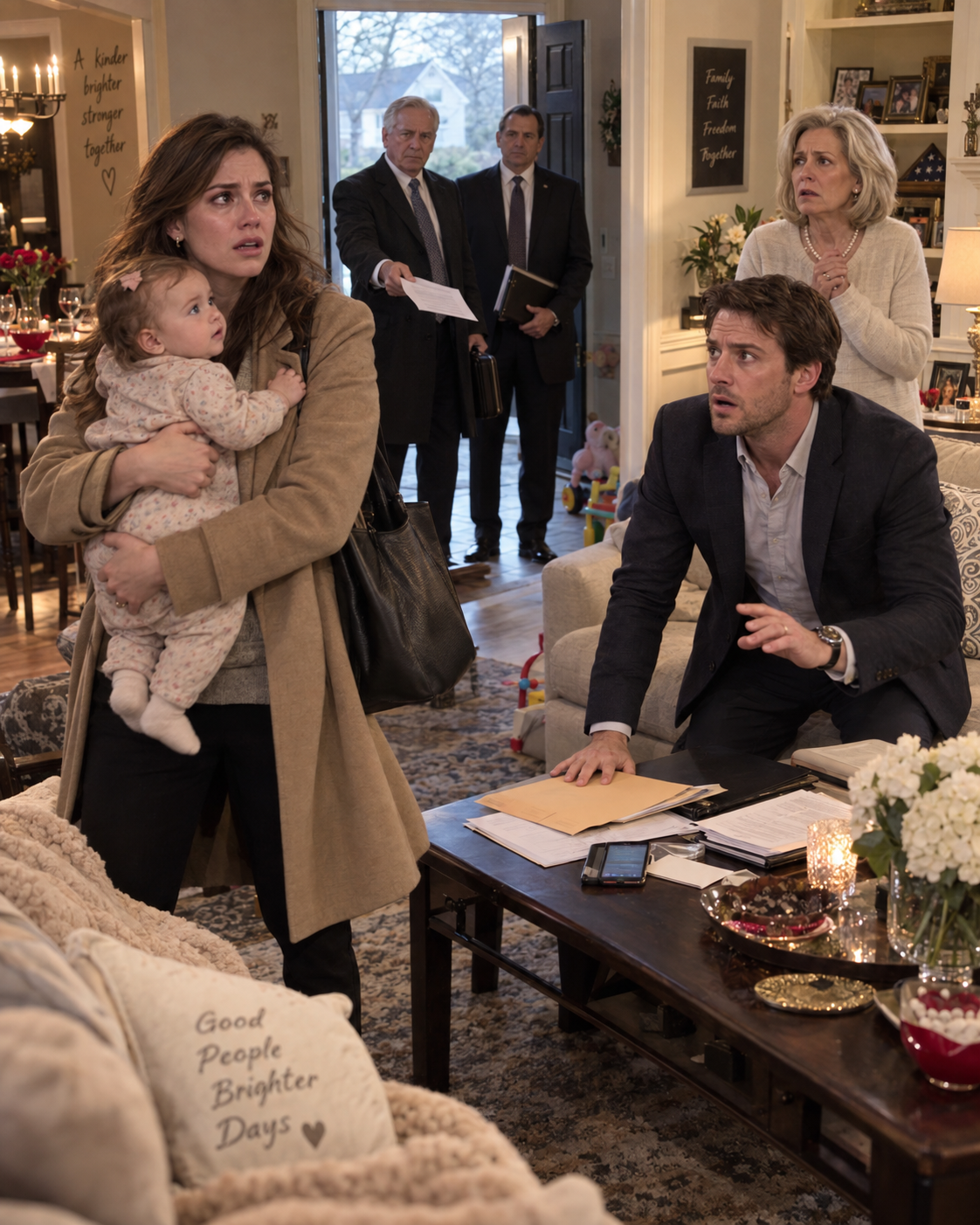
“The document was generated using a template stolen from a legitimate diagnostic service. The formatting was altered. The signatures were copied. The result itself was fabricated.”
My father leaned forward.
“How did you find that out?”
Dr. Vance glanced at me.
“Because Mr. Pendleton contacted St. Jude Memorial Hospital this afternoon after receiving a concerning inquiry regarding a paternity record.”
I looked at Arthur.
“How did you know to call?”
He didn’t answer immediately.
Instead, he took another document from his briefcase.
“The Hale residence is covered by a provision in your prenuptial agreement concerning fraud, material misrepresentation, and marital misconduct.”
My stomach tightened.
“What provision?”
“The forfeiture clause.”
Marcus closed his eyes.
Arthur looked at him.
“If either spouse is found to have engaged in certain forms of documented marital fraud, the agreement permits the innocent spouse to seek immediate protection of separately owned assets and, under specified circumstances, triggers a property transfer mechanism.”
I stared at Marcus.
“You were trying to use the prenup.”
He said nothing.
“To take the house.”
Still nothing.
The silence answered me.
I suddenly remembered the strange questions he’d been asking for weeks.
Whether the deed was in my name alone.
Whether I’d ever updated the beneficiary on my life insurance.
Whether the mortgage company had required both signatures.
Whether I still had copies of our original financial disclosures.
At the time, I’d assumed he was preparing for some business refinancing.
Now those conversations rearranged themselves in my head.
They had never been about refinancing.
They had been reconnaissance.
I stood up.
“Why?”
Marcus finally looked at me.
“I was trying to save the company.”
The words came out so softly that for a moment they sounded almost reasonable.
His company, Hale Meridian Logistics, had been his pride for nearly a decade. It wasn’t enormous, but it had a handful of regional contracts, a warehouse outside Columbus, and a reputation for moving specialized equipment for manufacturers.
I’d helped him build the first financial model when we were dating.
I’d also watched him become increasingly secretive over the previous year.
Late-night calls.
Unopened mail.
Bank envelopes tucked into his truck.
He’d started taking showers the moment he got home, as though washing off the day before talking to me.
I had noticed.
I had simply chosen not to turn every marriage problem into an investigation.
That was one of the things I had to forgive myself for later.
Arthur spread several bank statements across the table.
“Your husband has been borrowing against receivables that were already pledged to another lender.”
My father frowned.
“That’s fraud.”
“Potentially,” Arthur said. “There are also missing financial statements.”
I looked at Marcus.
“How bad is it?”
He rubbed both hands over his face.
“Bad.”
“How bad?”
“We’re behind.”
“How far?”
He didn’t answer.
Arthur did.
“Approximately 1.8 million dollars in disputed liabilities and short-term obligations.”
My chest tightened.
I’d known the business was struggling.
I hadn’t known it was drowning.
“Why didn’t you tell me?”
Marcus’s eyes filled.
“Because I was ashamed.”
It was the first honest thing he’d said all night.
For one fragile second, I saw the man I had married.
Not the man holding the forged report.
Not the man who had arranged this spectacle.
The exhausted man who had once fallen asleep at our kitchen table while trying to reconcile invoices because he was terrified of failing.
Then Evelyn spoke.
“We were going to fix it.”
I turned toward her.
“We?”
She looked at Marcus.
“Family protects family.”
My father gave a bitter laugh.
“You don’t protect family by framing the mother of a ten-month-old baby.”
Evelyn flinched.
“I wasn’t trying to hurt Natalie.”
“Then what were you trying to do?”
She looked at me.
“Preserve the house.”
I didn’t understand.
Arthur did.
“The house is the principal asset not exposed to the company’s creditors.”
Evelyn nodded.
“If Marcus could establish marital fraud under the prenup, he believed he could force a transfer.”
I stared at her.
“You knew?”
She started crying.
Not dramatically. No theatrical sobbing. Just tears slipping down her cheeks while she twisted a tissue between her fingers.
“I knew about the test.”
“Did you know it was fake?”
A pause.
Then she whispered, “I knew it wasn’t done through a normal hospital.”
The room went silent.
Marcus turned toward her.
“Mom.”
“I thought it was private,” she said quickly. “I thought someone had found a way to get the answer without making a scene.”
“You paid for it.”
Her eyes closed.
“Yes.”
The five thousand dollars suddenly felt heavier than the entire house.
Dr. Vance picked up the sealed hospital record.
“There is something else.”
She handed it to me.
“This is the original neonatal genetic documentation associated with Chloe’s birth.”
My fingers trembled as I opened it.
I remembered the hospital.
The fluorescent lights.
Marcus asleep in the chair beside my bed.
The first time the nurse put Chloe against my chest.
I remembered Marcus crying so hard he couldn’t speak.
He had whispered, “She’s perfect.”
The record contained genetic markers from Chloe’s umbilical blood sample and paternal reference material collected after birth.
Dr. Vance explained the medical chain of custody, but I barely heard her.
The conclusion was unmistakable.
Marcus was Chloe’s biological father.
There had never been a question.
There had never been another man.
There had only been a forged piece of paper and a marriage my husband had been willing to destroy in order to keep a house.
Marcus reached for me.
I stepped backward.
He stopped.
“Don’t.”
His hand fell.
“I didn’t know how else to fix it.”
“You didn’t try to fix it.”
My voice surprised me by staying steady.
“You tried to make me guilty.”
He looked down.
“I thought if I could trigger the clause, we could protect the house from creditors.”
“We?”
He swallowed.
“For Chloe.”
I laughed once, but it came out broken.
“Don’t use our daughter to make this sound noble.”
He had no answer.
Arthur closed his briefcase.
“I have already contacted counsel representing the secured lender.”
Marcus looked alarmed.
“You said this could stay between us.”
“I said nothing of the sort.”
Arthur removed a folded document.
“Given the evidence of attempted fraudulent asset transfer, I’ve filed for emergency injunctive relief.”
Marcus stared at the paper.
“What does that mean?”
“It means you are not selling, transferring, encumbering, or accessing certain marital assets while this is being litigated.”
Evelyn’s face drained.
Arthur turned to her.
“And your involvement is documented.”
She sat down.
“What happens to me?”
“That depends on the prosecutor.”
Marcus looked at me again.
“Natalie.”
I had spent the entire evening waiting for some sentence from him that would make the room make sense again.
There wasn’t one.
So I did the only thing that still felt real.
I picked up Chloe.
She had fallen asleep against my shoulder.
I carried her upstairs.
Halfway up, I heard Marcus behind me.
“Please.”
I stopped without turning.
He said, “I love you.”
For a long time, I couldn’t answer.
Then I said, “I believe you loved me.”
I continued upstairs.
That distinction became the boundary of my life.
The weeks that followed were uglier than I had expected.
There were lawyers, accountants, subpoenas, phone calls, and meetings in rooms where everyone used words like exposure, liability, discovery, and restitution.
I learned things about my husband that I wish I had never known.
His company had been losing money for nearly a year.
He had borrowed from two private lenders.
He had personally guaranteed several debts.
He had hidden notices from creditors.
And three weeks before Valentine’s Day, he had searched online for ways to challenge property ownership under our prenup.
That search history was eventually recovered from a company laptop.
The forgery itself led investigators to a private online broker who advertised “confidential genetic verification.”
The broker had used stolen laboratory templates and fabricated reports for people willing to pay.
Evelyn had communicated with the broker from her home network.
She had transferred the money.
She had forwarded Marcus the final file.
The evidence was painfully ordinary.
Emails.
Bank records.
Browser history.
A payment receipt.
A text message that simply read: “It looks official enough.”
That sentence haunted me more than the accusation.
It wasn’t rage that destroyed us.
It was convenience.
They had needed a document that looked official enough.
A lie that looked official enough.
A marriage they thought could be rearranged on paper.
Marcus’s attorney eventually advised him to cooperate with investigators.
His company entered receivership.
Within months, creditors forced a bankruptcy proceeding.
Evelyn spent much of her retirement savings on legal fees and restitution agreements.
Criminal charges were discussed throughout the investigation, though the final resolution involved negotiated cooperation and financial penalties rather than the dramatic courtroom ending I had once imagined.
I had imagined justice as something loud.
Instead, it was mostly paperwork.
A signature.
A hearing.
A bank account frozen.
A box of company keys handed to a receiver.
The divorce was finalized eight months after that Valentine’s Day.
I was awarded sole custody of Chloe.
The house remained mine under the final settlement, free of the claim Marcus had tried to manufacture.
There was restitution for legal costs and losses associated with his attempted fraudulent transfer.
He retained visitation rights under a structured schedule.
I insisted on that.
Not because I trusted him.
Because Chloe deserved the chance to grow up knowing the difference between an imperfect father and an absent one.
There were people who expected me to punish him through her.
I couldn’t do it.
She hadn’t created any of this.
She shouldn’t have to carry it.
The first time Marcus came to pick her up after the divorce, he stood on the porch holding a stuffed rabbit he’d bought her.
For a few seconds neither of us spoke.
Then he said, “She looks happy.”
“She is.”
He nodded.
“I am sorry.”
I believed that too.
It didn’t change anything.
That was something I learned slowly.
Forgiveness and reconciliation were not the same door.
Sometimes forgiveness meant putting down the weight of what someone had done without handing them the keys to your life again.
Six months after that Valentine’s Day, I was sitting on the back steps with my laptop open while Chloe toddled across the grass.
My first client had just signed a contract with the forensic auditing firm I had started from the spare bedroom.
It was small.
Just me, one part-time analyst, and a growing list of referrals.
But every report carried my name.
Every dollar was mine.
Every hour I worked was a choice rather than something dictated by the fear of missing Chloe’s first steps.
She stopped near the hydrangeas and looked back at me.
“Mommy!”
I closed the laptop.
“Coming.”
She ran toward me with the unsteady confidence only toddlers possess.
I caught her before she fell.
She laughed against my shoulder.
For a moment, the whole story felt impossibly far away.
Then I noticed something on the kitchen counter through the window.
A cream envelope.
I had seen the handwriting before.
Arthur’s.
I carried Chloe inside and opened it while she played with measuring cups on the kitchen floor.
The letter was brief.
There had been one final accounting discrepancy discovered during the bankruptcy review.
A transfer Marcus had made two days before the forged DNA test.
Not to a lender.
Not to the fraud broker.
To an account controlled by someone whose name I didn’t recognize.
The amount was only $12,400.
But beneath the transaction was a notation from the receiver.
“Payment description entered by Marcus Hale: emergency family protection.”
I read it twice.
Then I looked at the date.
February 6.
Two days before Evelyn sent the five thousand dollars.
I sat down slowly.
Chloe dropped a measuring cup and clapped.
I barely heard it.
Because I suddenly understood that the forged DNA test had not been the beginning of Marcus’s plan.
It had been the middle.
And somewhere between the money, the house, and the lie, there was another person he had been paying to protect—or another truth he had never told me.
I folded Arthur’s letter and slipped it beneath my laptop.
Then I picked up my daughter and held her close.
This time, I wasn’t afraid of what I might discover.
I was afraid of how much of my marriage I still didn’t know.