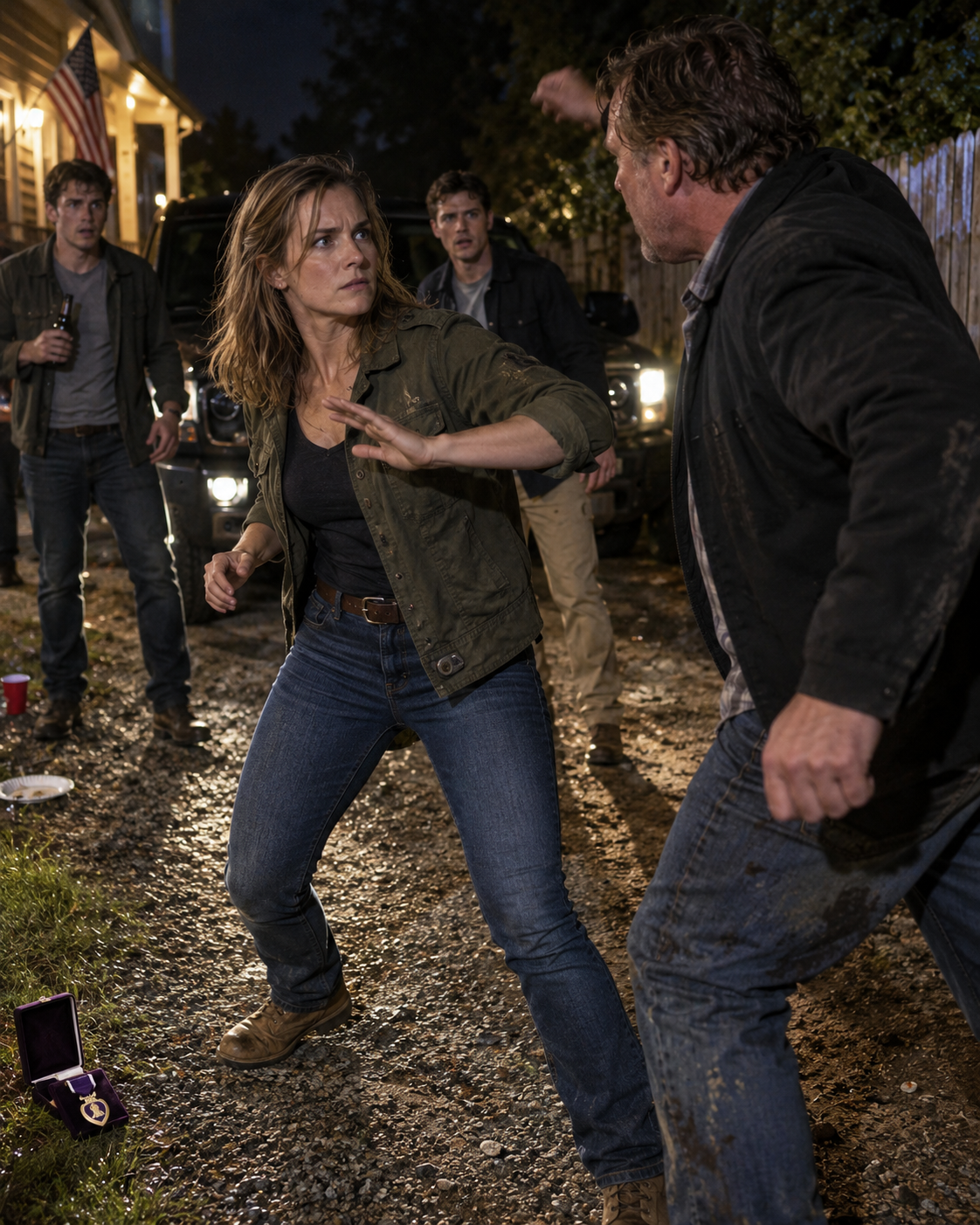
Marcus was laughing with fifteen relatives when he slammed my eighteen-year-old cousin against a wooden fence
I listened to the detective’s voicemail twice before calling back.
He asked me to come to the station that afternoon.
He didn’t sound accusing.
He sounded careful.
That frightened me more.
When I arrived, a detective named Reynolds met me in the lobby.
He was carrying a thin folder.
“Before we talk,” he said, “I want you to know that Chloe is safe.”
My shoulders finally loosened.
“Good.”
He nodded.
“She’s with her mother.”
We sat in a small interview room.
Reynolds placed the folder on the table.
“Marcus has cameras around the property.”
“I assumed so.”
“One camera caught what happened in the driveway.”
I looked at him.
“And?”
“And it supports your account.”
I exhaled.
“Then why am I here?”
He opened the folder.
“Because the same cameras captured several incidents over the past year.”
My stomach tightened.
He showed me still photographs.
Marcus shouting at Chloe.
Marcus grabbing her wrist.
Marcus pushing Ethan.
Marcus standing over Lucas during an argument.
None of them showed the entire story, but together they revealed a pattern.
This wasn’t one terrible night.
It was a household built around fear.
I stared at the photographs.
“Why didn’t Chloe tell anyone?”
“She did.”
I looked up.
“She told her school counselor.”
Reynolds slid another document toward me.
“Her counselor made a report.”
My hands went cold.
“Then why was nothing done?”
“Because Chloe withdrew the complaint.”
I understood immediately.
Marcus had probably convinced her nobody would believe her.
Maybe he had threatened her.
Maybe he had apologized afterward.
Maybe he had simply made her feel responsible for what he did.
Abuse rarely needs a locked door.
Sometimes it only needs someone young enough to believe they have nowhere else to go.
Reynolds looked at me.
“She asked whether you were coming back.”
I swallowed.
“Did she say why?”
“She said you were the first person in the family who ever stood up to him.”
I looked down at my hands.
Those hands had carried rifles.
They had carried wounded soldiers.
They had signed reports after nights I still couldn’t remember clearly.
But none of those memories hurt as much as hearing that an eighteen-year-old girl had been waiting for one person to say enough.
“Is Marcus being charged?”
“The evidence is being reviewed.”
I nodded.
Then Reynolds said something unexpected.
“There’s another issue.”
He opened a second folder.
Inside was my Purple Heart.
Not the medal itself.
A photograph of it lying on the gravel.
“Marcus’s sons posted this online.”
I stared at the image.
Someone had captioned it with a joke about my military service.
The post had spread through the neighborhood.
I felt embarrassed for about three seconds.
Then the feeling disappeared.
I had spent too many years believing humiliation was something I had to carry quietly.
Not anymore.
When I left the station, Chloe called me.
Her voice was tiny.
“I’m sorry.”
“For what?”
“Everything.”
I pulled my car to the curb.
“You don’t apologize for someone else’s behavior.”
She sniffed.
“I thought you hated us.”
I closed my eyes.
“I don’t hate you.”
“Then why did you leave?”
Because I had been tired.
Because I had spent years confusing endurance with loyalty.
Because sometimes loving someone meant refusing to stand in the same room while they were destroying another person.
“I left because I needed to remember who I was.”
She was silent.
Then she asked, “Can I remember with you?”
That sentence stayed with me.
A week later, Marcus’s lawyer contacted me.
He wanted to know whether I would “clarify” the incident.
I understood what that meant.
They wanted me to soften it.
They wanted the story to become a family disagreement.
I refused.
I told the lawyer exactly what happened.
I didn’t exaggerate.
I didn’t embellish.
I didn’t call Marcus names.
I simply described the facts.
Marcus had attacked Chloe.
He had destroyed my medal.
He had attempted to strike me.
I had defended myself.
Nothing more.
The truth didn’t need decoration.
Meanwhile, my parents called almost every evening.
At first, they defended Marcus.
“He was drunk.”
“He lost his temper.”
“You know how he gets.”
Then their tone changed.
They started asking me to come home.
“We need to talk.”
“There are things you don’t understand.”
I almost ignored them.
Instead, I agreed to meet them at a diner.
My mother looked exhausted.
My father looked smaller than I remembered.
He stared at his coffee for nearly a minute before speaking.
“Marcus has always been difficult.”
I waited.
“We thought if we kept the peace, things would eventually improve.”
I looked at him.
“Whose peace?”
He didn’t answer.
“Because it wasn’t Chloe’s.”
My mother began crying.
“We were afraid.”
“So was she.”
That silenced her.
My father rubbed his forehead.
“I should have protected her.”
“Yes.”
He looked surprised that I hadn’t softened the answer.
I wasn’t cruel.
I was simply done protecting adults from consequences.
Then Mom reached into her purse and pulled out a folded letter.
“We found this in Marcus’s office.”
I opened it.
It was an old military document.
Marcus’s name was on it.
The document revealed something I hadn’t known.
He hadn’t simply washed out.
He had been medically discharged after an incident involving another soldier.
There had been an investigation.
No criminal conviction.
But several statements described intimidation, reckless behavior, and an inability to follow orders.
I stared at the paper.
“Why did he always talk about being the toughest person in the room?”
Dad answered quietly.
“Because he couldn’t bear remembering that he wasn’t.”
Suddenly, his behavior made more sense.
Not excusable.
Just understandable.
Marcus had built his entire identity around never appearing weak.
And anyone weaker became a target.
Chloe.
His sons.
My family.
Me.
But I wasn’t going to become his opposite.
I wasn’t going to destroy him because he had tried to destroy me.
I wanted accountability.
There was a difference.
The court process stretched on for months.
Marcus’s injuries improved slowly.
His jaw healed.
The sensation in his leg gradually returned.
His lawyers argued that he had been intoxicated and provoked.
The security footage told a different story.
Eventually, he accepted responsibility for the assault against Chloe and for threatening me.
The sentence wasn’t dramatic.
There were restrictions, mandatory counseling, financial penalties, and community service.
But for the first time, Marcus had to live in a world where his behavior had consequences.
I never visited him.
I never wanted an apology from him.
Some doors don’t need to be reopened just because someone finally admits they should have been closed.
Chloe, however, began changing.
She cut her hair.
She enrolled in community college.
She started working part-time at a veterinary clinic.
One afternoon, she came to my apartment carrying a small cardboard box.
“I brought you something.”
I opened it.
Inside was the Purple Heart box.
My real one.
The velvet was still scratched.
The medal still carried a tiny mark from the gravel.
“I thought you might want this,” she said.
I smiled.
“I never stopped wanting it.”
She looked down.
“I used to think medals were about being fearless.”
“What do you think now?”
She considered it.
“Maybe they’re about surviving something that scared you.”
I nodded.
“That’s closer.”
She hugged me.
It was the first time anyone in my family had hugged me without needing something afterward.
Months passed.
I began rebuilding my life.
I moved into a smaller house near the water.
I started consulting on veteran housing projects.
My work was quiet.
No speeches.
No ceremonies.
Just drawings, permits, meetings, and the slow process of creating places where people could feel safe.
One evening, I was reviewing plans when my phone rang.
It was Reynolds.
“I thought you might want to know.”
“About Marcus?”
“Yes.”
I leaned back.
“What happened?”
“He completed his required counseling.”
I waited.
“Apparently, he requested a meeting with Chloe.”
My stomach tightened.
“Did she agree?”
“Yes.”
“Did you attend?”
“No.”
“Good.”
Reynolds paused.
“She didn’t want anyone there.”
I respected that.
Chloe deserved to own her own voice.
Later that night, she called me.
She didn’t tell me everything.
She simply said, “He apologized.”
I stayed quiet.
“Do you believe him?”
She sighed.
“I don’t know.”
“That’s okay.”
“He said he was angry at himself, not me.”
I looked out at the dark water beyond my window.
“Then he has something to work on.”
She laughed softly.
“That’s what I told him.”
For the first time, I heard strength in her voice.
Not the loud kind Marcus had always worshiped.
The quiet kind.
The kind that doesn’t need an audience.
A year after the night in the driveway, my family held a small gathering.
I almost didn’t go.
Then Chloe called.
“I want you there.”
So I went.
The house felt different.
The old wooden fence had been replaced.
The patio lights were gone.
The place looked ordinary.
Maybe that was the point.
My father opened the door.
“Sarah.”
I nodded.
He stepped aside.
No dramatic apology.
No speech.
Just space.
Inside, Chloe was sitting at the table.
She smiled.
“I saved you a seat.”
I sat beside her.
For a while, nobody talked.
Then my father cleared his throat.
“I owe you an apology.”
I looked at him.
“You owe yourself honesty.”
He nodded slowly.
“I was ashamed of Marcus.”
“Then you should have been protecting Chloe, not protecting the family’s image.”
“I know.”
Those two words were enough.
Not because they fixed anything.
Because they finally stopped denying what happened.
Later, I stepped outside alone.
The evening air was cool.
I reached into my pocket and touched the Purple Heart.
Its surface was scratched.
For years, I had thought scars were proof that something had been taken from me.
Now I understood they could also be proof that something had failed to take everything.
My comrades were still gone.
The deployment was still part of me.
My spine still hurt on certain mornings.
None of that disappeared because I had survived Marcus.
Survival wasn’t a victory parade.
Sometimes it was simply waking up and deciding that yesterday would not dictate today.
Chloe came outside.
“Sarah?”
I turned.
She was holding an envelope.
“What is that?”
“Something Marcus gave me.”
My chest tightened.
She handed it to me.
I opened it carefully.
Inside was a handwritten letter.
Marcus admitted that he had spent years pretending strength meant making other people afraid.
He admitted that my medal had reminded him of everything he believed he had failed to become.
And then came the sentence that stayed with me.
“I hated what your courage made me see in myself.”
I folded the letter.
“Do you want me to keep this?”
“No.”
She smiled.
“I think you should burn it.”
We stood together beside the porch.
I struck a match.
The paper caught slowly.
The flames curled around his words until they disappeared.
I watched the ashes rise into the night.
For a moment, I thought about the three men whose names I still carried inside me.
I thought about Chloe’s frightened face.
I thought about my medal lying in the gravel.
And I realized something I should have understood years earlier.
Courage isn’t always charging forward.
Sometimes courage is refusing to become cruel after someone has been cruel to you.
Sometimes it is telling the truth when silence would be easier.
Sometimes it is leaving a family gathering, a relationship, or a life that requires you to disappear in order to belong.
And sometimes the strongest thing a person can do is stand quietly and say, “Enough.”
I slipped the Purple Heart back into its box.
The metal was scratched, but it still shone.
Chloe looked at it.
“Does it bother you?”
“What?”
“The mark.”
I smiled.
“No.”
I closed the velvet box.
“Now it reminds me that something can be damaged without losing its meaning.”
We walked back inside together.
For the first time, I didn’t feel like a soldier returning from a war.
I felt like a woman returning to herself.
And when I looked through the doorway, I saw my father holding an old photograph from my deployment, his eyes fixed on the faces of the three men who never came home.
He looked at me and whispered, “I never knew what you carried.”
I answered softly, “Neither did I.”
That night, I drove home with the Purple Heart beside me on the passenger seat.
The road was dark.
The water reflected the moon.
And for once, I wasn’t running from anything.
But just before I reached my driveway, my phone rang from an unknown number.
I answered.
A man’s voice said, “Sarah, you don’t know me, but I served with one of the men who died overseas.”
I tightened my grip on the steering wheel.
“How did you get my number?”
There was a pause.
Then he said, “Because I found something in an old field report with your name on it.”
My headlights swept across the empty road.
“What did you find?”
His answer was barely above a whisper.
“Something that changes what happened the night your unit lost those three men.”
The call went silent.
I pulled the Jeep to the side of the road.
For a long moment, I stared at the Purple Heart resting beside me.
I had spent a year believing the hardest chapter of my life was finally behind me.
Now, with the ocean black beyond the windshield and an old military secret waiting somewhere in the dark, I realized surviving one war didn’t always mean the war was finished.
Sometimes the past simply waits until you’re finally strong enough to hear the truth.