Kenechi slid my tin bracelet across the restaurant table with two fingers and asked why a man like Somto
For several seconds, I simply stood there.
The office around me continued as though nothing had happened.
Phones rang. Printers hummed. Someone laughed near the reception desk. Outside the glass wall, a courier balanced two boxes against his hip while arguing with the security guard.
But my hands had gone cold.
I picked up the paper.
There was no signature.
No explanation.
Just the name.
IGUAY GROUP.
I turned it over.
Nothing.
My first thought was that someone had discovered me.
My second was worse.
Someone had discovered enough to hurt me.
I opened the drawer where I kept the notebook.
Empty.
I checked beneath the keyboard. The filing cabinet. My handbag. Even the wastebasket.
Nothing.
Then I noticed my desk drawer was not fully closed.
I never left it that way.
I crouched and pulled it open.
Inside were several loose pages from the company’s internal ledger.
They were pages I had never printed.
At the bottom of the stack was a photocopy of a Crest View Logistics account statement.
My name had been written across it in black ink.
I heard footsteps behind me.
Kenechi.
She stood at the end of the aisle holding a cup of coffee.
“You look pale.”
I straightened.
“Did you go through my desk?”
Her eyebrows rose.
“Why would I?”
“My notebook is missing.”
“Maybe you lost it.”
“I don’t lose things.”
She took a slow sip.
“That sounds like a personal problem.”
Then she walked away.
I watched her disappear through the glass doors.
Something inside me settled.
Not fear.
Certainty.
Someone had deliberately put those papers there.
And Kenechi knew something.
The problem was that I still didn’t know what.
I took photographs of everything with my phone before touching another page.
That evening, I waited for Somto outside his apartment.
He was late.
When he finally arrived, he looked exhausted.
“Can we talk?”
He unlocked the door.
“Of course.”
Inside, the lights were off. He dropped his keys on the counter and loosened his collar.
I held up the sheet.
“I found this on my desk.”
He looked at the words.
His face changed.
Not dramatically.
Just enough.
“What is that?”
“I don’t know.”
“Why is Iguay Group in your office?”
“I don’t know.”
He stared at me.
“You expect me to believe that?”
The question hurt more than I expected.
“Somto, please.”
“You’ve been acting strangely for weeks.”
“Because the company is in trouble.”
“Everyone knows that.”
“I found irregularities.”
“What irregularities?”
“I can’t tell you yet.”
His jaw tightened.
“Why?”
“Because I need proof.”
“Proof of what?”
I hesitated.
That was my mistake.
Because hesitation can sound like guilt when the person asking already feels betrayed.
He stepped away from me.
“Are you investigating my family?”
“No.”
“Then what are you doing?”
“Trying to understand what’s happening.”
“Without telling me?”
“I was trying to protect you.”
He laughed once, without humor.
“From what?”
I couldn’t say.
Not yet.
Not when I still didn’t know whether Chief Nnamdi was involved, whether Kenechi was acting alone, or whether someone had discovered the Iguay connection and was trying to make me look like the person destroying the company.
Somto shook his head.
“I don’t know who you are right now.”
That sentence stayed with me long after I left.
The next morning, I was called into a meeting with Human Resources.
Chief Nnamdi was there.
So was Kenechi.
I knew immediately that something had happened.
HR slid a folder across the table.
Inside were copies of financial documents.
“Unauthorized access,” the HR manager said.
My eyes moved across the pages.
My employee login appeared in the audit trail.
My handwriting appeared on one of the notes.
And beside it was a list of transfers to Crest View Logistics.
I looked at Chief Nnamdi.
He gave me a sorrowful expression so convincing I almost admired it.
“We’ve always trusted you,” he said.
I stared at him.
“Then why are you lying?”
The room went still.
His expression hardened.
“You should be careful.”
“No. You should.”
Kenechi leaned forward.
“This is exactly the problem. She has been obsessed with the company finances.”
“I am an accountant.”
“You’re a junior accountant.”
“And you’re not an accountant at all.”
Her mouth tightened.
HR suspended me pending investigation.
My badge was collected before I could return to my desk.
As I walked through the lobby, I saw Somto standing near the elevator.
He had heard.
He didn’t come toward me.
That hurt more than losing my job.
I went home and cried for the first time since my father’s funeral.
Not because I had been suspended.
Not because Kenechi had humiliated me.
Because Somto had looked at me like a stranger.
Three days later, someone knocked on my door after midnight.
I opened it to find Chief Nnamdi.
I should have called security.
Instead, I stood there in silence.
“You’re making a mistake,” he said.
“I’ve made several.”
“Drop this.”
“I don’t know what you’re talking about.”
He stepped closer.
“I know who your father was.”
My heart stopped.
He smiled.
“Now you understand.”
I gripped the edge of the door.
“You don’t know anything about me.”
“I know enough.”
He lowered his voice.
“Whatever you think you found in those accounts, destroy it.”
“Why?”
“Because people like you don’t survive fights with people like me.”
I looked directly into his eyes.
“Then why are you here instead of letting the police handle it?”
For the first time, his confidence slipped.
Only slightly.
But I saw it.
“You’re going to regret this.”
He left.
I locked the door and immediately called Pa Emeka.
He answered on the second ring.
“Are you safe?”
“Yes.”
“Did he come to you?”
I closed my eyes.
“You knew?”
“I suspected.”
“Who is he?”
There was a long silence.
“Your father once told me that the most dangerous person in a company is not always the person stealing money. Sometimes it is the person who convinces everyone else that the theft is loyalty.”
My throat tightened.
“Pa Emeka, I need to know what my father had to do with all this.”
“You will.”
“When?”
“Tomorrow.”
The line went dead.
The next morning, Pa Emeka asked Somto to meet him at his house.
Somto arrived angry.
He had spent days avoiding my calls because he said he needed space.
He expected another lecture about the company.
Instead, Pa Emeka handed him an old leather box.
“Open it.”
Inside was a photograph.
Somto recognized his grandfather beside a much younger Mazi.
He frowned.
“Who is this?”
“Your father’s old friend.”
“I know.”
“No,” Pa Emeka said. “You don’t.”
He took out a second photograph.
Then a third.
Documents followed.
Corporate filings.
Trust records.
Debt acquisition agreements.
Somto read silently.
His face drained.
“This can’t be right.”
“It is.”
“Iguay Group?”
“Yes.”
He looked up.
“And her?”
Pa Emeka nodded.
“Your fiancée is the sole controlling heir.”
Somto sat down.
For a long moment, he didn’t speak.
Then he whispered, “She knew?”
“She knew who she was.”
“Why didn’t she tell me?”
“Because your father told her never to let wealth decide whether a person loved her.”
Somto stared at the papers.
Pa Emeka leaned toward him.
“She wanted to know whether you would choose her without knowing what she could give you.”
“Then why didn’t she tell me when the company started collapsing?”
“Because she was afraid.”
“Of me?”
“Of becoming the reason you stayed.”
That broke something in him.
He stood abruptly.
“Where is she?”
“Working on saving your family from people who are trying to destroy it.”
Somto was already reaching for his keys.
But before he could leave, Pa Emeka stopped him.
“There is something else.”
Somto turned.
“The foreclosure signing is tomorrow morning.”
“I know.”
“No.”
Pa Emeka’s voice became quiet.
“You don’t know who will be sitting at the head of that table.”
Meanwhile, I had stopped waiting for anyone to believe me.
I went back through every transaction from the previous year.
I noticed something I had missed before.
The Crest View accounts were not receiving random payments.
They were receiving money in patterns.
Every transfer happened within forty-eight hours of an internal authorization signed by Chief Nnamdi.
But the authorization numbers had been altered.
Someone had copied legitimate approval codes and changed the final digits.
That meant whoever forged the documents had access to archived files.
I searched the company’s old server through a former colleague who still trusted me.
He sent me a backup.
There it was.
A folder created eleven months earlier.
CrestView_Reconciliation.
Inside were spreadsheets showing the real transfers.
The money had gone through three shell vendors.
The final beneficiary was an account belonging to a company called NMA Strategic Holdings.
The director was Chief Nnamdi’s nephew.
But there was another name.
Kenechi.
I stared at it for nearly a minute.
Then I opened the transaction history.
She had received two transfers.
Not millions.
Small amounts.
But enough to establish involvement.
I sat back.
Part of me wanted to hate her.
It would have been easier.
Instead, I remembered the way she’d looked at me in the restaurant.
Not contempt.
Fear.
Suddenly, I wondered whether she had been threatened.
That possibility complicated everything.
I called her.
She didn’t answer.
I sent one message.
“Meet me. Alone.”
She replied twenty minutes later.
“Where?”
We met in a quiet café in Lekki.
She arrived without makeup, wearing a plain gray blouse.
For the first time since I had known her, she looked young.
Tired.
Scared.
She sat across from me.
“You found it.”
I placed the transaction records on the table.
“How much does Nnamdi have on you?”
She looked away.
“So he does.”
“Don’t say his name so loudly.”
“Kenechi, did you steal my notebook?”
She closed her eyes.
“Yes.”
The admission landed softly.
Almost worse than a denial.
“Why?”
“He knew you were investigating.”
“And you helped him?”
“I thought I was helping my family.”
Her voice cracked.
“Nnamdi told me the company was going under and that if the books were audited, my father would be blamed. He said he could fix the situation if I helped him identify anyone digging too deeply.”
“You framed me.”
“I know.”
“You could have ruined my life.”
“I know.”
“Why the Iguay note?”
She swallowed.
“I found it in your notebook.”
“So you knew.”
“I didn’t understand what it meant.”
She looked at me.
“When I gave it to Nnamdi, he went completely quiet.”
That frightened me more than anything else.
“What did he say?”
“He said, ‘This changes everything.’”
I leaned back.
“Did he tell you why?”
“No.”
She reached into her bag and placed something on the table.
My missing notebook.
I grabbed it.
“Why are you giving this back?”
“Because I finally understood what kind of man I was helping.”
She stood.
“I have one more thing.”
“What?”
She looked toward the window.
“Nnamdi has someone inside the bank. Tomorrow’s signing is not just about foreclosure.”
“What is it?”
“They’re planning to transfer the remaining company assets tonight.”
My stomach dropped.
“Then why are you telling me?”
Her eyes filled with tears.
“Because I don’t want to become the person I was becoming.”
She walked away before I could answer.
I spent that night reviewing every page of my father’s old records.
Near dawn, I found a letter.
It had been tucked behind a copy of the debt acquisition agreement.
My father’s handwriting filled one page.
He had written it two months before his death.
He had expected the possibility that Emeka Maritime would collapse.
He had also written one sentence that made me stop breathing.
“If my daughter ever stands between forgiveness and justice, I hope she remembers that justice does not require hatred.”
I folded the letter.
Then I called my attorney.
“Prepare the debt transfer documents.”
He was silent for a moment.
“Are you certain?”
“No.”
I looked at my father’s bracelet on the table.
“But I’m responsible.”
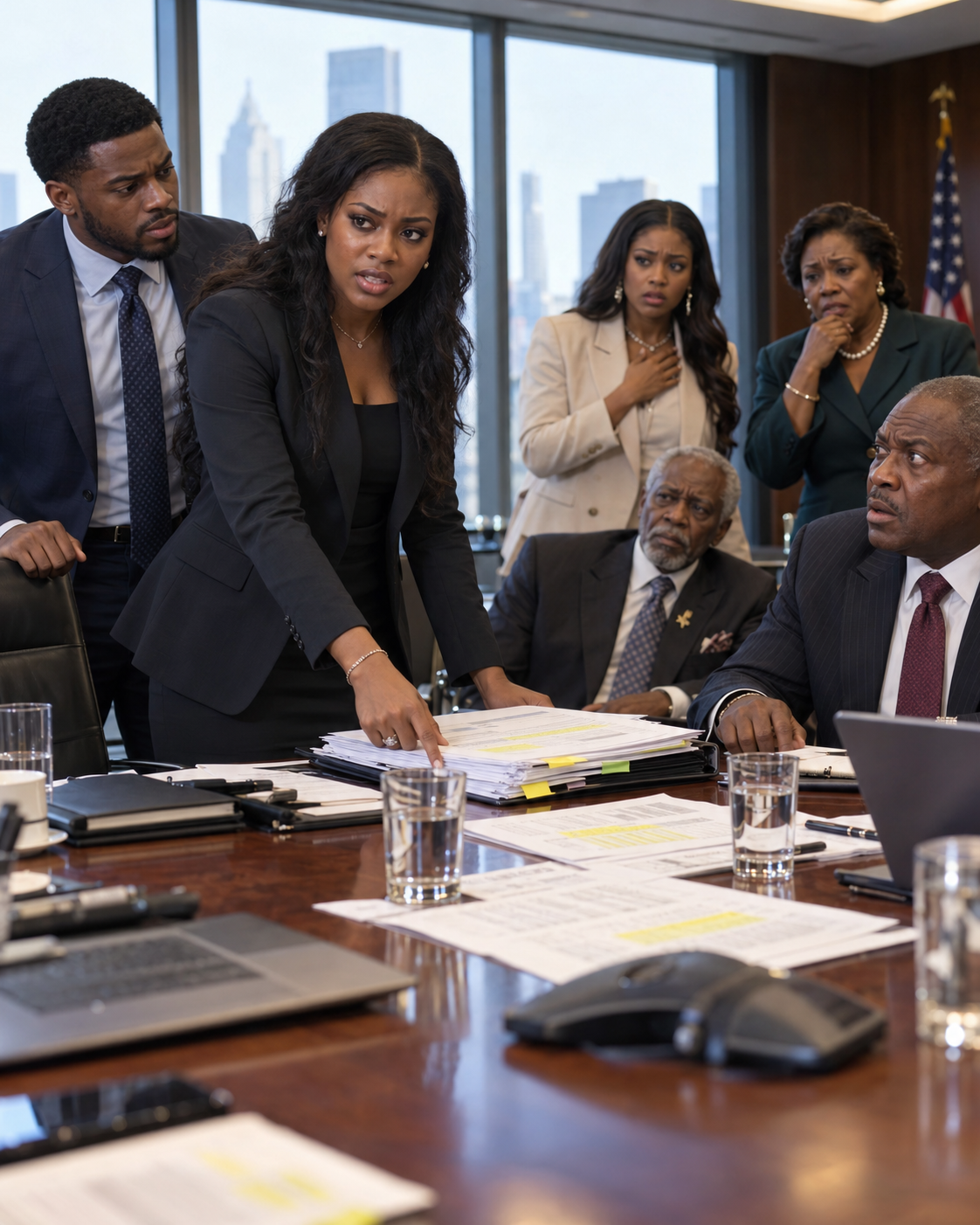
The next morning, the boardroom was full.
Banks.
Lawyers.
Executives.
Accountants.
Pa Emeka sat at the far end beside Somto’s mother.
Chief Nnamdi stood near the window, calm and immaculate.
I entered last.
For a moment, nobody recognized me.
I was wearing a navy suit and the same tin bracelet.
Then the room went quiet.
Chief Nnamdi’s face changed first.
Somto stood.
His eyes found mine.
There was pain in them.
And something else.
Relief.
The bank representative cleared his throat.
“We are ready to proceed with the foreclosure transfer.”
I placed my folder on the table.
“No.”
Chief Nnamdi laughed.
“This is not your meeting.”
I looked at the bank representative.
“It is now.”
I slid the debt acquisition certificate across the table.
He read it.
Then read it again.
His face went pale.
“Who authorized this?”
“Iguay Group.”
The room stirred.
Chief Nnamdi looked at me.
“No.”
I met his eyes.
“Yes.”
Somto’s mother covered her mouth.
Pa Emeka simply lowered his head.
The bank representative whispered, “You are the creditor?”
“I am the controlling beneficiary.”
Chief Nnamdi stepped forward.
“This is absurd.”
“No,” I said quietly. “What’s absurd is that you believed nobody would notice.”
I opened the first file.
Transaction after transaction.
Authorization numbers.
Shell companies.
Bank transfers.
Crest View Logistics.
NMA Strategic Holdings.
His nephew.
Then Kenechi’s transfers.
The room became so silent I could hear the air-conditioning.
Chief Nnamdi stared at the documents.
“These are fabricated.”
I placed the server backup on the table.
“Then we can let the forensic auditors decide.”
His face collapsed.
Not dramatically.
Just enough.
The bank representative called his legal department.
Pa Emeka’s attorney called the police.
Kenechi began crying.
Chief Nnamdi turned toward her.
“You stupid girl.”
Somto stepped between them.
“Don’t.”
For the first time, Chief Nnamdi looked afraid.
But I wasn’t interested in watching him suffer.
I was interested in stopping the bleeding.
I handed the board one final document.
“Iguay Group is prepared to restructure the company’s debt.”
Somto stared at me.
“What?”
“I am not foreclosing.”
Chief Nnamdi laughed bitterly.
“You expect them to believe this is charity?”
“No.”
I looked around the room.
“It’s a responsibility.”
I explained the terms.
The debt would be frozen.
The company would undergo an independent audit.
Employees would receive every unpaid wage.
Executives involved in fraud would be removed pending investigation.
No family member would receive a guaranteed position simply because of their surname.
And the company would remain under Pa Emeka’s oversight until a professional management structure was established.
Somto’s mother began crying.
She came toward me slowly.
“I was wrong.”
I said nothing.
“I wanted my son to marry money because I was terrified of losing everything.”
Her voice shook.
“I looked at you and saw what you didn’t have.”
She wiped her cheeks.
“I never bothered to see what you were.”
I reached for her hand.
“I’m not asking you to forget.”
“I know.”
“Just don’t make fear your decision-maker again.”
She nodded.
That was all.
Somto waited until the room emptied.
When we were finally alone, he didn’t touch me.
“I owe you an apology.”
“You owe me more than one.”
A faint smile crossed his face.
“I know.”
I looked at him.
“You believed I was lying.”
“I did.”
“You thought I was investigating your family.”
“I did.”
“You asked for space.”
“I did.”
He swallowed.
“I was hurt.”
“So was I.”
He nodded.
“I thought if you had told me, I would have stayed because of your money.”
“Would you have?”
He took a long breath.
“I don’t know.”
That answer surprised me.
It was not romantic.
It was honest.
And somehow, honesty was exactly what I needed.
He continued.
“But I know something else.”
“What?”
“I fell in love with you before I knew any of this.”
My eyes burned.
He stepped closer.
“And I was terrified that after I learned the truth, every memory would become a test I had failed.”
I looked down at my bracelet.
“My father spent years teaching me not to use money as proof of love.”
“And now?”
“Now I’m learning not to use secrecy as proof of it either.”
He nodded.
“That sounds fair.”
I finally took his hand.
It was warm.
Familiar.
Still his.
We didn’t fix everything that afternoon.
We didn’t pretend trust could be repaired because a powerful creditor had walked into a boardroom and solved a company’s financial crisis.
Trust was not a debt.
It could not be transferred.
It had to be earned again.
Kenechi pleaded guilty to stealing the notebook and later cooperated with investigators.
Chief Nnamdi was charged after the forensic audit confirmed years of financial misconduct.
Some of the money was recovered.
Some wasn’t.
The company survived, but it changed.
So did I.
I stopped pretending my ordinary life was the only honest version of myself.
I also stopped believing my inheritance made me responsible for rescuing everyone who needed saving.
The family fund came later.
I named it after my father.
Its first purpose was simple: repay the employees who had gone months without salaries.
The woman who cleaned the offices received hers.
The driver who had borrowed money for school fees received his.
The warehouse supervisor who had quietly sold his motorcycle to feed his children received every naira owed to him.
Those were the moments that stayed with me.
Not the boardroom.
Not Chief Nnamdi’s expression.
Not the shock on anyone’s face when they learned who I was.
It was watching ordinary people get back the money they had earned.
Months later, Somto and I stood outside my father’s old house after a rainstorm.
The yard smelled of wet earth.
He looked at the bracelet on my wrist.
“You still wear it.”
“Of course.”
“Even though you can afford a better one?”
I smiled.
“Especially because I can.”
He laughed.
Then he became quiet.
“Do you ever wish you’d told me sooner?”
I considered the question.
“Yes.”
He nodded.
“Me too.”
We stood there for a while without trying to fill the silence.
Then he reached for my hand.
Not because I owned Iguay Group.
Not because I had saved his family’s company.
Not because anyone was watching.
Just because he wanted to.
And this time, I didn’t need to test what that meant.
I already knew.
The bracelet was still tin.
The fortune was still enormous.
The past could not be rewritten.
But somewhere between the ledger pages, the stolen notebook, the old photographs, and the boardroom where everyone finally learned my name, I had understood something my father had tried to teach me years earlier.
Love is not proven by what someone refuses to take from you.
Sometimes it is proven by what remains after they discover what you have.
And when Somto slipped his fingers through mine that evening, I found myself grateful for one thing above all the money my father had left me:
I had finally stopped needing to hide who I was in order to believe that someone could love me.