Julian was supposed to be two hundred miles away giving a keynote, so when I saw his hand slide a diamond onto another woman
For a few seconds, neither of us spoke.
The house was quiet around us. Morning light came through the leaded windows in thin gold squares, landing across the floorboards I had spent years trying to protect from exactly this kind of chaos.
Julian finally said, “You weren’t supposed to see that.”
It was such a small sentence.
Not I’m sorry.
Not What are you doing here?
Not I can explain.
You weren’t supposed to see that.
I held up my phone.
“Who owns the photographs?”
“Maeve—”
“Who owns them?”
He rubbed his forehead.
“It’s a concept deck.”
“That wasn’t my question.”
He looked toward the kitchen.
“You’re making this into something it isn’t.”
I almost laughed.
The sound caught somewhere in my throat.
“My kitchen is in your hotel proposal.”
“It’s inspiration.”
“My studio is in your hotel proposal.”
“You know how development works.”
“My clients’ commissions are in your hotel proposal.”
He stopped.
That was the first time I saw the calculation happen behind his eyes.
Not remorse.
Calculation.
“How many did you use?”
“All right,” he said quietly. “There are some images.”
“Some?”
He exhaled.
“Bianca helped put the deck together.”
“She’s listed as creative lead.”
“It’s a working title.”
“And the property?”
He didn’t answer.
“Julian.”
“It’s a private development.”
“My house is a private residence.”
“We were going to discuss it with you.”
“When?”
He looked away.
That was answer enough.
I called Denise Harper from the foyer.
She arrived that afternoon with a legal pad, reading glasses, and the unnerving calm of someone who had spent decades watching people mistake paperwork for morality.
We sat at my dining table.
Julian stayed in his office.
Denise went through the estate documents one by one.
My aunt had owned the house outright. Her will had transferred it to me. I had refinanced portions of the renovation years earlier, but the title remained solely in my name.
Marriage had not magically erased that.
Neither had Julian’s plans.
“Your house is not his to put into a business plan,” Denise said.
I stared at the deed.
“What about the business?”
“Your studio?”
“Yes.”
“That depends on how it was structured, when assets were acquired, and whether marital funds were used.”
I nodded.
For the first time since the mall, the anger gave way to something colder.
Facts.
I needed facts.
So I began collecting them.
Invoices.
Client agreements.
Original sketches.
Photographs with metadata.
Emails.
Receipts for materials.
Copyright registrations.
Old project files.
I called three clients whose homes appeared in the deck.
One was a retired couple in Chestnut Hill whose blue-and-white bathroom had taken me nine months to complete.
Another was a restaurant owner whose mosaic wall had been photographed only for my private portfolio.
The third was a pediatrician whose front entry featured a hand-cut landscape of birds and reeds.
None of them had authorized commercial use.
The retired couple were horrified.
The restaurant owner was furious.
The pediatrician asked me one question.
“Maeve, did your husband do this?”
I looked at the pile of evidence on my table.
“Yes.”
The word felt heavier than I expected.
That evening, Julian finally came into the kitchen.
He had changed clothes.
He looked tired.
For a brief, dangerous moment, I remembered the man who used to bring me tea when I worked late in the studio.
Then he said, “I need you to understand how this happened.”
I folded the towel in my hands.
“I’m listening.”
“The hotel project started as a conversation.”
“With Bianca.”
“Yes.”
“How long?”
He didn’t answer immediately.
“Eight months.”
The towel slipped from my fingers.
Eight months.
I had asked him, during those eight months, why he came home smelling like someone else’s perfume.
He had said the investor meetings were smoky.
I had asked why he suddenly hated our bedroom wallpaper.
He said he needed a change.
I had asked why he stopped asking about my commissions.
He said he was overwhelmed.
Eight months had lived inside all those ordinary explanations.
“Were you sleeping with her?”
His eyes closed.
“Yes.”
The room seemed to tilt.
I sat down.
Not because I forgave him.
Not because I wanted him near me.
Because my body had reached its limit before my mind had.
“I thought we were discussing a business deck,” I said.
“We are.”
“No. We aren’t.”
I looked at him.
“You’ve been having an affair for eight months, and you used my work to build a hotel around a house you don’t own.”
“It wasn’t supposed to happen like this.”
“How was it supposed to happen?”
He had no answer.
Then he said something that, somehow, hurt more.
“I thought you’d be part of it.”
I stared at him.
“You thought I’d be part of the business built from my stolen work and my stolen home?”
“I thought you’d understand the vision.”
“No, Julian. You thought I would make it legitimate.”
His face tightened.
That was when I understood the part of him I had spent years excusing.
He didn’t always lie because he wanted to hurt me.
Sometimes he lied because he wanted reality to cooperate with his plans.
I stood.
“You need to leave.”
He looked genuinely stunned.
“Maeve.”
“Take your clothes.”
“Can we please not make a permanent decision tonight?”
“You made yours eight months ago.”
He stayed another hour, pleading, arguing, then promising.
I didn’t raise my voice.
Eventually, he packed a suitcase.
At the front door, he stopped.
“You’re going to regret this.”
I almost told him I already regretted something.
Instead, I said, “Take the suitcase.”
He left.
Two hours later, Bianca called.
I answered because I wanted to hear what someone who had been part of this story believed she was entitled to say.
“You are destroying a major opportunity,” she said without greeting.
“My intellectual property is not an opportunity.”
“We had permission to use the property concept.”
“From whom?”
“Julian.”
“He doesn’t own it.”
There was silence.
Then she said, “You’re doing this because you’re jealous.”
I leaned against the kitchen counter.
“No.”
“You’ve always resented me.”
“I barely know you.”
“You’re humiliating Julian because he chose something bigger.”
That sentence stayed with me.
Not because it was cruel.
Because it revealed how different our realities were.
She thought he had chosen her.
I thought he had chosen a life that required pretending I didn’t exist.
“Remove my work,” I said.
“We’re not taking down the deck.”
“Then my attorney will handle it.”
“You can’t stop a development because you’re upset.”
“I can stop you from using my work without permission.”
She hung up.
The next morning, Denise sent formal notices.
My clients sent their own.
The deck disappeared from two private investor portals within forty-eight hours.
Then Julian called.
“You’ve jeopardized the financing.”
I looked down at the contractor’s estimate sitting beside my coffee.
The flooring was scheduled to begin Monday.
“I’m sorry,” I said.
I wasn’t.
He tried to cancel the contractors that afternoon.
They called me instead.
“Your husband says the project is off.”
“It’s not.”
“He says he’s authorized.”
“He isn’t.”
That was how the five-day renovation began.
Monday, demolition.
Tuesday, heating coils.
Wednesday, marble.
Thursday, sealing.
Friday, the floors were finished.
I spent the entire week living in a hotel because the house was full of dust, tools, and strangers carrying slabs of stone through rooms that had once held my marriage.
The $68,000 charge sat on our joint account like an accusation.
I transferred the money from my studio account the following week.
It took a painful bite out of my savings.
I hated seeing the balance afterward.
But I didn’t regret paying it.
Not because the floor had saved me.
It hadn’t.
I had simply stopped waiting for permission to make a decision about my own home.
For a while, I thought that was the end of it.
Then I received an invitation to the Mid-Atlantic Design Summit.
The flagship hotel project was still scheduled to be presented.
Apparently, they had rebuilt the deck around “licensed materials” and hired consultants to replace what they couldn’t use.
Denise advised me to attend.
Not to make a scene.
To document.
So I went.
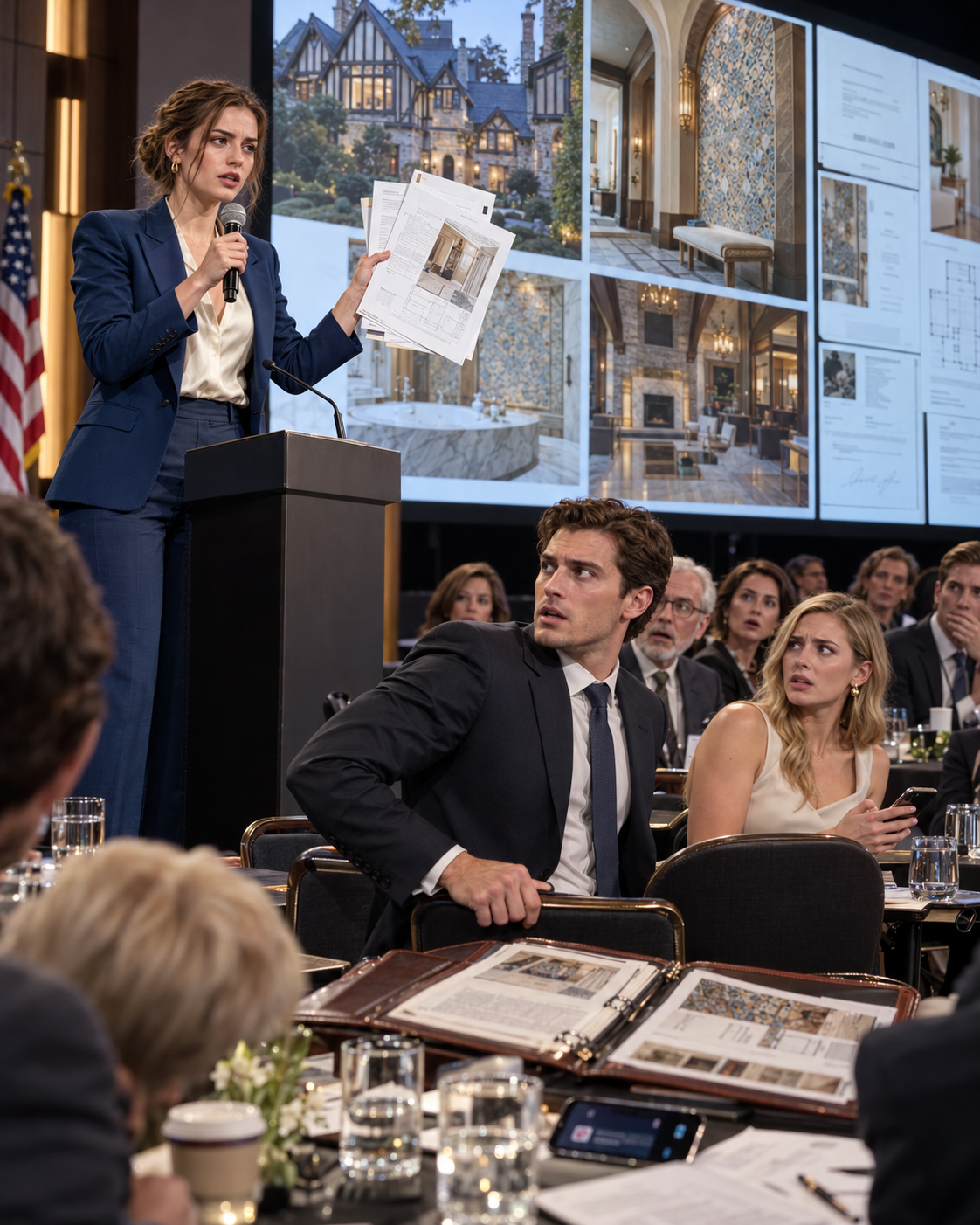
The ballroom was packed with architects, developers, preservationists, designers, and investors.
On the giant screen behind the stage, the first rendering appeared.
I knew it instantly.
They had altered my house digitally.
The windows were slightly different.
The roofline had been cleaned up.
But it was still mine.
Still Hawthorne House.
And the project was being presented as Bianca’s creative vision.
I sat in the audience with a folder on my lap.
For twenty minutes, I listened.
Bianca spoke beautifully.
She talked about historic preservation.
She talked about “respecting material memory.”
She talked about craftsmanship.
I almost admired the language.
Then she showed a mosaic installation that was unmistakably mine.
Not from my house.
From a client’s house.
The contract was in my folder.
The photograph was too.
When the presentation ended, the moderator opened the floor for questions.
My hand went up.
Bianca saw me.
Her face went pale.
The moderator pointed.
I stood.
“I’m Maeve Callahan. I’m the owner of Callahan Mosaic Studio, and I’d like to ask a question about the provenance of the work just presented.”
Bianca stepped toward the microphone.
“Maeve, this isn’t appropriate.”
I didn’t look at her.
I looked at the moderator.
“I have signed contracts from every client whose private work appeared in this presentation. None authorized this commercial use.”
A murmur moved through the room.
Julian was standing near the side of the stage.
He looked like he wanted to disappear.
The moderator asked for clarification.
I handed her copies.
Then another.
Then another.
“I also have the original design files, dated photographs, invoices, and copyright documentation.”
Bianca whispered something to Julian.
He shook his head.
I continued.
“The flagship property shown in the presentation is my private residence. I own the property separately from this venture. No one associated with this project has permission to market it as a development site.”
The lead investor, a man named Graham Holt, had been sitting in the front row.
He stood.
“Are you saying the project team represented this residence as available for acquisition?”
“No,” I said.
“I’m saying they represented it as the conceptual basis for a project they intended to finance.”
He turned toward Julian.
“Is that accurate?”
Julian didn’t answer.
That was enough.
Graham picked up his folder.
“I think we’re done here.”
He walked out.
The room erupted into overlapping voices.
Bianca accused Julian of assuring her that the property issue was handled.
Julian said Bianca had approved the deck.
Bianca said Julian had supplied the images.
Someone from the development firm asked whether either of them had actually created the work.
Neither answered.
I stood there listening to two people who had once seemed so certain of themselves suddenly arguing over ownership of a story they had never written.
And strangely, I didn’t feel victorious.
I felt tired.
Because underneath the spectacle was something much sadder.
Julian had spent months building a future that depended on me remaining silent.
I had spent years building a life that depended on him being honest.
The difference was everything.
The venture collapsed within weeks.
Investors withdrew.
The hotel site was put on hold.
Bianca left the development partnership.
Julian was removed from the board of his company after an internal review found that he had represented assets and creative materials without authorization.
He called me several times after that.
I stopped answering.
Then, one evening, he sent a photograph.
The diamond was sitting on a jeweler’s counter.
Underneath it was a message.
“I have to sell this.”
I stared at the screen for a long time.
There had been a version of me who would have taken pleasure in that.
The woman sitting there felt mostly sad.
Not for him.
For the person I had been when I thought love meant making myself easier to live with.
Our divorce took months.
There were arguments about money, furniture, business expenses, and the renovation.
There were lawyers and spreadsheets and uncomfortable questions about which account had paid for what.
In the end, I retained Hawthorne House.
My studio remained mine.
The $68,000 renovation charge was paid entirely from my own accounts.
It hurt.
I let it hurt.
Some lessons are expensive precisely because you spent years avoiding them.
The first morning I walked barefoot across the finished marble floor, the house was completely quiet.
Sunlight reached the entryway.
The stone was warm beneath my feet.
For the first time in months, I didn’t feel like I was waiting for somebody to come home.
I was already home.
A year passed.
My studio grew faster than I expected.
Some clients came because of the summit.
Others came because of referrals.
Most never mentioned Julian.
I preferred it that way.
I didn’t want my career to become the aftermath of my marriage.
I wanted it to become what it had always been.
Mine.
Then came the restoration commission that changed the rhythm of my life again.
A nineteenth-century train station outside Baltimore was being converted into a public arts center, and the architect leading the restoration was a man named Leo Bennett.
He was the first architect I had met in years who didn’t ask me to make old materials look new.
He asked how they had been made.
Who had touched them.
Why the original craftsmen had chosen certain stone.
What could be repaired instead of replaced.
During our first site meeting, I watched him kneel beside a cracked marble threshold.
“We could replace this,” he said.
I crouched beside him.
“We could.”
He ran his thumb lightly over the fracture.
“But we’d lose the evidence that someone stood here for a hundred years.”
I looked at him.
He smiled.
“Too sentimental?”
“No,” I said. “Accurate.”
That was how it started.
Not with fireworks.
Not with a grand gesture.
With two people kneeling on dusty stone, agreeing that damage didn’t always mean something had to be discarded.
Months later, Leo came to Hawthorne House for dinner.
I showed him the floors.
He didn’t ask what they cost.
He didn’t ask why I had chosen marble.
He simply stood in the entryway and said, “This feels like you.”
I smiled.
“It took me a while.”
He glanced at the old framed photograph on the wall.
“What took you a while?”
I looked toward the studio.
Pinned above my desk was a screenshot of the banking alert from that afternoon at the mall.
$68,000.
Joint Household Card.
Approved.
I had printed it because I wanted to remember something very specific.
Not Julian.
Not Bianca.
Not the affair.
The moment before I knew what would happen.
The moment when I was still frightened and still uncertain and still capable of making a choice.
I had once thought the charge was the reckless thing I did after catching my husband with another woman.
Now I understood it differently.
It wasn’t revenge.
It wasn’t even courage.
It was simply the first decision I made without asking whether someone else would approve.
Leo came up behind me.
“You keep that?”
“Apparently.”
He studied the paper.
“Expensive reminder.”
“Very.”
He laughed softly.
I touched the edge of the photograph.
Outside, rain began tapping against the old Tudor windows.
The house settled around us with the familiar creaks I had once mistaken for silence.
I thought about my aunt.
About my clients.
About all the years I had spent restoring beautiful things while quietly accepting cracks in places no one else could see.
Then I looked across the warm marble floor, at the house I still owned, at the studio where my name was printed on every contract, and at the man beside me who had never once asked me to make myself smaller so his plans would fit.
The payment alert was still there.
So was the scar.
But neither one belonged to Julian anymore.
They belonged to the woman who had finally learned that reclaiming a life doesn’t always sound like a slammed door.
Sometimes it sounds like a contractor asking, “Are you sure?”
And you answer, quietly,
“Yes.”