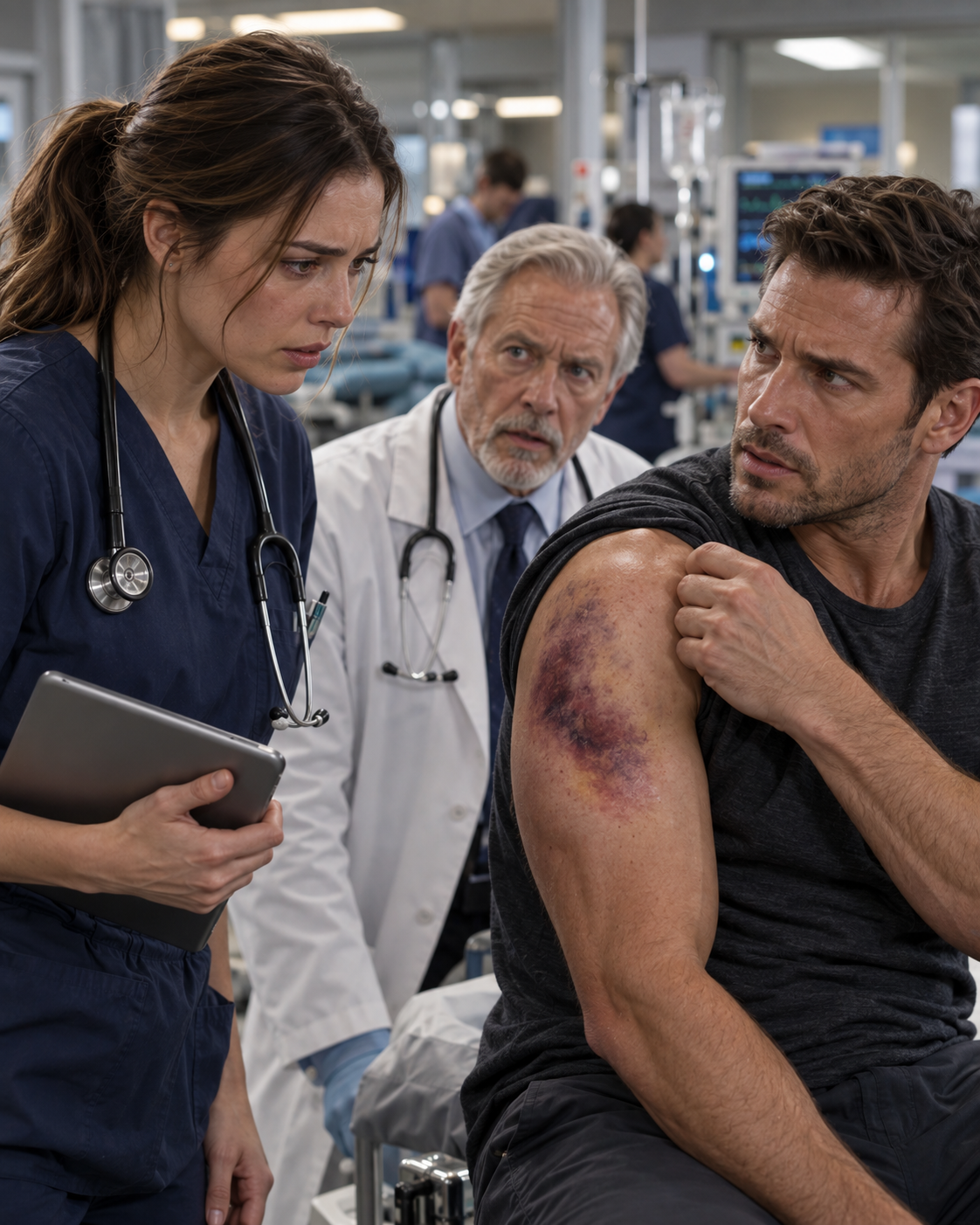
In the middle of Harbor Crest’s emergency department, Dr. Keane brushed off my warning and told me to stop frightening a stable patient
I stared at the intake form until the letters seemed to blur together.
The emergency contact was listed as Thomas Vance.
I knew the name because it was printed on the framed photographs in Harbor Crest’s veterans’ rehabilitation wing.
Thomas Vance had been a Navy commander who died three years earlier after complications from a stroke.
He had also been Derek’s father.
“Maybe the number was copied from an old record,” I said.
Lorraine shook her head.
“Derek checked in himself.”
She tapped the screen.
“And he entered it less than twenty minutes ago.”
A cold feeling moved through me.
The obvious explanation was a mistake.
The second explanation was that someone had deliberately entered a dead man’s information.
Neither one made sense.
Before I could say anything else, the ICU doors opened and a respiratory therapist hurried toward us.
“Derek’s asking for you.”
I followed her.
The room was dim except for the monitors surrounding his bed.
Derek was awake, but the controlled calm I had seen earlier was gone.
He looked exhausted.
“Did you find it?” he asked.
“Find what?”
His eyes moved toward Lorraine.
She closed the door.
Derek took a slow breath.
“My father’s number.”
I felt my pulse quicken.
“You put it there.”
“Yes.”
“Why?”
He looked at the ceiling.
“Because I didn’t know who else to trust.”
The words hung between us.
I pulled a chair closer.
“Derek, you need to tell us what happened.”
He was silent for several seconds.
Then he said, “The dive wasn’t supposed to happen.”
His voice was barely above a whisper.
“It was a private training exercise arranged through a contractor, not a standard military operation.”
He explained that he had left active duty years earlier but still worked as a specialized instructor and consultant.
The exercise eight days earlier had been designed to test emergency procedures at significant depth.
There were supposed to be strict ascent protocols, redundant communication systems, and a medical team standing by.
Instead, something went wrong.
His dive partner became disoriented.
A communications failure separated them from the surface team.
Then the ascent line malfunctioned.
Derek had made the decision to ascend quickly.
“I knew the risk,” he said.
“What I didn’t know was that someone had changed the decompression schedule.”
I looked at him.
“Changed it how?”
“The posted schedule wasn’t the one I was given afterward.”
Lorraine folded her arms.
“Are you saying someone altered the records?”
“I’m saying I don’t know what happened.”
Derek closed his eyes.
“Two days after the dive, I received an anonymous message.”
“What did it say?”
His jaw tightened.
“Stop asking questions about the dive.”
The room suddenly felt much smaller.
“Why didn’t you go to the authorities?”
“Because the person who sent it knew details that weren’t public.”
He looked at his injured arm.
“And because I thought it was a warning, not a threat.”
I glanced at Lorraine.
She was already reaching for the phone.
“We need hospital security involved.”
Derek nodded.
“I agree.”
Then the monitor beside him began alarming.
Dr. Dorsey entered immediately.
The room filled with movement.
For several minutes, everything became medication, instructions, numbers, and gloved hands.
Derek’s blood pressure dropped sharply.
The surgical team was called.
I stood near his head while they stabilized him.
He looked at me through half-closed eyes.
“Don’t let them take my records.”
“Who?”
He tried to answer.
“Vance Maritime.”
Then he lost consciousness.
The name meant nothing to me.
It meant everything to Lorraine.
She looked at me.
“That’s the contractor.”
By sunrise, Harbor Crest was no longer treating Derek’s case as an ordinary medical emergency.
Security reviewed the intake system.
Someone had accessed Derek’s file before he arrived.
Someone had also attempted to delete the original triage notes.
The deletion failed because our system automatically retained an audit trail.
My note about the mottled discoloration was still there.
So was the time stamp showing exactly when I documented it.
That small detail suddenly felt enormous.
At 8:40 a.m., Dr. Keane called me into his office.
I expected criticism.
Instead, he closed the door and sat down.
“I owe you an apology.”
I said nothing.
“I dismissed your concern too quickly.”
“You were trying to make a judgment with limited information.”
“That doesn’t excuse it.”
He rubbed his forehead.
“You may have saved his arm.”
I looked at the floor.
“I just didn’t want to ignore something that looked wrong.”
“That is exactly what good nurses do.”
His words stayed with me.
Not because they made me proud.
Because they reminded me how close I had come to staying silent.
Later that morning, Derek underwent surgery.
Dr. Dorsey found extensive tissue damage and evidence of infection that required aggressive treatment.
They preserved the limb.
But nobody promised that the outcome was secure.
The next forty-eight hours became a blur.
Hyperbaric sessions.
Antibiotics.
Wound care.
Repeat examinations.
Long stretches when Derek slept.
Short moments when he woke and asked whether his fingers still moved.
On the third day, he finally flexed his hand.
Barely.
But he did it.
His eyes filled with tears.
“I can feel that.”
Dr. Dorsey smiled.
“That’s a good sign.”
Derek looked at me.
I had been checking his chart when he caught my attention.
“You were right.”
I shook my head.
“I wasn’t right about everything.”
“You were right to keep looking.”
That distinction mattered.
Medicine wasn’t magic.
It was attention.
It was recognizing when the obvious answer didn’t fit.
It was having the courage to say, “Something isn’t right,” even when someone more experienced told you otherwise.
But the mystery surrounding Derek’s dive was getting darker.
An investigator from the Navy arrived at Harbor Crest.
Then another person arrived claiming to represent Vance Maritime.
His name was Colin Mercer.
He was impeccably dressed and unnervingly polite.
“I’d like copies of Mr. Vance’s medical records,” he said.
I directed him to medical records.
He smiled.
“We’re trying to protect Derek’s privacy.”
Something about the sentence bothered me.
People who genuinely wanted to protect someone usually didn’t walk into a hospital demanding information.
That evening, Derek asked me whether Colin had visited.
“Yes.”
His face changed.
“Don’t give him anything.”
“He went through medical records.”
“Then tell security he is not authorized to see me.”
I documented the conversation.
Twenty minutes later, someone called the nurses’ station claiming to be Derek’s brother.
He asked about Derek’s condition.
Lorraine refused to provide information.
The caller became angry.
Then he said something that made her hang up.
“He won’t be safe if he talks.”
Security traced the call to a disposable phone.
Derek listened silently when we told him.
Then he finally revealed the part he had been avoiding.
His father had once investigated corruption involving defense contractors.
The investigation had disappeared before it reached court.
Thomas Vance had believed someone inside the system had buried it.
Derek had spent years refusing to discuss it.
Until the dive.
“I found an old file in my father’s storage unit,” he said.
“What was in it?”
“Names.”
“Whose names?”
He looked directly at me.
“People connected to Vance Maritime.”
I understood then why he had entered his father’s phone number.
He hadn’t been calling a dead man.
He had been leaving a message for anyone who might understand the reference.
The following afternoon, federal investigators arrived with a warrant.
Colin Mercer disappeared before they reached the hospital.
The audit logs from Harbor Crest became evidence.
My original nursing note became evidence.
The altered dive records became evidence.
Even the anonymous messages on Derek’s phone became evidence.
For the first time, I realized how fragile the line had been between a patient surviving a medical crisis and becoming a witness in something much larger.
A week later, Derek was finally strong enough to sit in a chair.
He looked at his arm.
There were scars.
There would be more.
But his hand moved.
His fingers closed around mine.
“I thought losing my arm would be the worst thing that could happen to me.”
I waited.
“It wasn’t.”
“What was?”
“Realizing I almost stopped trusting myself.”
I smiled.
“I know that feeling.”
He laughed softly.
“You’re seven months into nursing.”
“Eight now.”
“Then remember something.”
“What?”
“Experience matters.”
He looked at his healing hand.
“But sometimes the person who has been there the longest is too familiar with what they’re seeing.”
I never forgot that.
Months passed.
The investigation revealed that the dive records had been manipulated.
The altered decompression schedule had been distributed through an internal system, and several people had knowingly ignored the discrepancy.
There was no evidence that Derek’s injury had been intentionally caused.
But there was evidence that warnings about the equipment and safety procedures had been suppressed.
The anonymous threats had come from someone connected to the contractor.
Eventually, arrests followed.
Derek testified.
His father’s old investigation was reopened.
For the first time in years, Thomas Vance’s name appeared in the news for the work he had tried to finish rather than the way he had died.
Derek never returned to operational diving.
At first, that devastated him.
He told me he felt as though sixteen years of his life had been taken away.
But slowly, something changed.
He began teaching injured veterans adaptive water training.
He taught them how to move through fear without pretending fear didn’t exist.
He became less interested in proving how strong he was and more interested in helping other people discover that they could survive being changed.
One year after the night he entered Harbor Crest, Derek came back to the emergency department.
I recognized him immediately.
He carried a small wooden box.
“I brought you something.”
Inside was a challenge coin from his old unit.
I shook my head.
“I can’t take this.”
“You didn’t earn it.”
He smiled.
“You earned the reason I’m still here.”
I closed my fingers around the coin.
“I was doing my job.”
“No,” he said quietly.
“You were paying attention.”
That was the difference.
Years later, when I became a charge nurse myself, new nurses would sometimes come to me after making a mistake.
They would apologize before they even told me what happened.
I always stopped them.
“Tell me what you noticed.”
Because I learned that night that good medicine isn’t built only from certainty.
Sometimes it begins with discomfort.
Sometimes it begins with a question that feels too small to ask.
Sometimes it begins when the newest person in the room notices what everyone else has learned to overlook.
Derek eventually mailed me one final letter.
Inside was a photograph of himself standing beside a group of veterans at the water’s edge.
His injured arm was visible.
The scar ran from his forearm toward his shoulder.
On the back, he had written six words.
“Still here, because you looked twice.”
I kept that photograph in my locker.
Not as a trophy.
As a reminder.
Because Derek taught me something no textbook could have taught me.
A patient is never just a diagnosis.
A scar is never just a scar.
And a quiet instinct should never be dismissed simply because the person having it is the least experienced person in the room.
Sometimes the warning arrives as a strange color beneath someone’s skin.
Sometimes it arrives as a question nobody else thought to ask.
And sometimes, if you are brave enough to listen, that tiny warning is the difference between a life ending and a life getting another chapter.