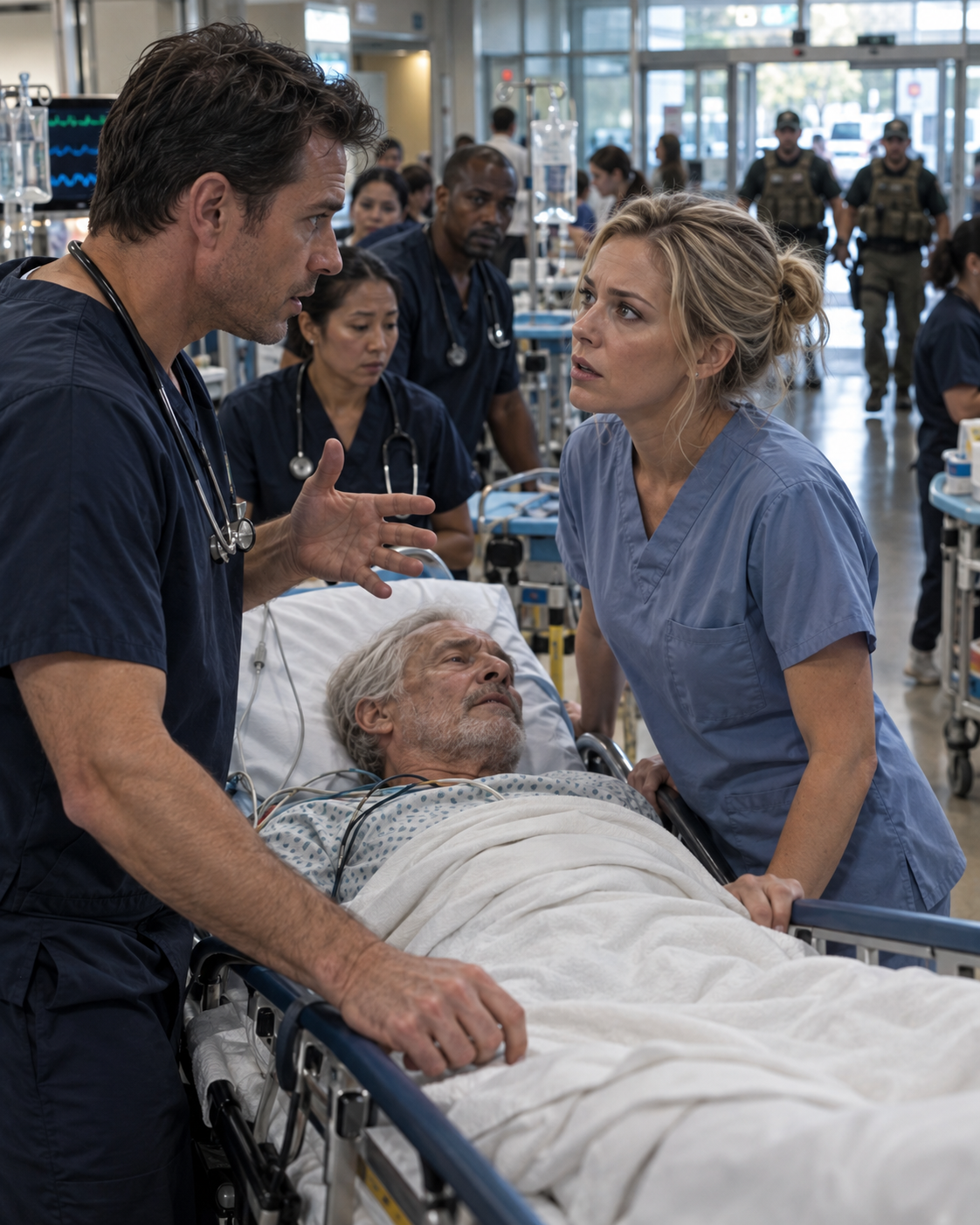
I watched the chief surgeon order my dying patient dumped into a hallway while he saved a politician’s son
I stared at the second dog tag in General Caldwell’s hand.
For several seconds, I couldn’t breathe.
The name engraved across the battered metal belonged to someone I had spent fifteen years trying not to remember.
My father.
“Where did you get that?”
Colonel Harrison’s eyes remained fixed on me.
“Your father saved my life.”
I shook my head.
“My father died when I was nineteen.”
“That’s what your family was told.”
The room seemed to tilt.
I looked at General Caldwell.
“Who is he?”
Caldwell glanced toward the hallway.
“His name was Daniel Jenkins.”
My knees weakened.
Sarah Jenkins.
Daniel Jenkins.
The same name.
The same face I remembered from a childhood photograph.
My father.
A man I had been told died in a construction accident when I was nineteen.
A man whose funeral I had attended without ever seeing his body.
“That’s impossible.”
Colonel Harrison slowly sat higher against his pillows.
“Your father was a combat medic.”
I stared at him.
“No.”
“He served under me.”
“You knew him?”
“Better than most people.”
The room became painfully quiet.
Then Colonel Harrison spoke.
“Fifteen years ago, our convoy was hit outside Kandahar.”
My heartbeat accelerated.
“Your father was there.”
Caldwell continued.
“He treated wounded soldiers under fire.”
“Why didn’t anyone tell me?”
“Because your father wasn’t supposed to be there.”
I frowned.
“What does that mean?”
Colonel Harrison closed his eyes.
“Your father was working undercover.”
The words seemed absurd.
My father had never been a soldier.
That was the story I had been given.
He had been a construction worker.
He had hated violence.
He had come home every night smelling like sawdust and motor oil.
At least, that was the man I remembered.
Then Colonel Harrison reached toward the second dog tag.
“He carried this one for another soldier.”
“Who?”
He looked at Caldwell.
Caldwell answered.
“Captain Michael Reeves.”
The name meant nothing to me.
But when Colonel Harrison described the circumstances of his death, something inside me shifted.
Michael Reeves had been carrying classified evidence concerning a military contracting scandal.
He was killed during the convoy attack.
Your father found him alive.
He stayed behind.
“He saved six men that day,” Harrison whispered.
“Then he disappeared.”
I stared at him.
“Disappeared?”
Caldwell nodded.
“Officially, he died.”
“Officially?”
“We needed the world to believe that.”
My hands began trembling.
“Why?”
Caldwell leaned forward.
“Because someone inside the operation had betrayed us.”
The room suddenly felt colder.
“Someone inside the military?”
“Yes.”
“And my father knew?”
“He knew enough to become dangerous.”
I looked at the dog tag.
“Then why did he leave me?”
Colonel Harrison’s expression broke.
“He didn’t.”
I looked at him.
“What?”
“He tried to come home.”
The words struck harder than anything else.
“He tried to contact your mother.”
My throat tightened.
“She never said.”
“Because she never received the message.”
Caldwell reached into the briefcase his aide had carried into the hospital.
He removed a thin folder.
“Your father’s last known communication was intercepted.”
I opened it.
Inside was a handwritten letter.
The handwriting was unmistakable.
My father’s handwriting.
My fingers shook as I read the first line.
“Sarah, if you’re reading this, I didn’t abandon you.”
I stopped.
The room blurred.
I pressed the paper against my chest.
For fifteen years, I had carried a quiet anger toward a dead man.
I had believed he had chosen another life.
I had believed I hadn’t been enough to make him stay.
Now I was holding proof that the story might have been a lie.
I read the rest.
He wrote about loving me.
About wanting to come home.
About fearing someone was watching his family.
He had deliberately disappeared because he believed staying near us would make us targets.
At the bottom was one sentence.
“Tell Sarah I loved her before she ever learned how to hate me.”
I couldn’t see anymore.
Tears covered the page.
Colonel Harrison reached for my hand.
“I’m sorry.”
I pulled it away.
“Why didn’t you tell me?”
His eyes filled.
“Because your father asked us to keep you safe.”
“You call lying to me safe?”
“No.”
His voice cracked.
“We called it necessary.”
I left the room.
I walked through the hospital corridors without knowing where I was going.
The same fluorescent lights.
The same smell of antiseptic.
The same floors where Pendleton had ripped my badge from my chest.
But everything had changed.
My father wasn’t a coward.
He hadn’t abandoned me.
Someone had stolen fifteen years of my life.
I found an empty stairwell and sat on the steps.
I cried until my chest hurt.
Then the stairwell door opened.
General Caldwell stood there.
He didn’t come closer.
“Your father saved my life too.”
I looked up.
“Then why did he disappear?”
“Because he discovered who betrayed the operation.”
“Who?”
Caldwell’s face hardened.
“We don’t know.”
“You’ve had fifteen years.”
“We found fragments.”
“Then why bring this to me now?”
He hesitated.
“Because Colonel Harrison was carrying the evidence.”
I looked toward the operating room.
“The dog tag?”
Caldwell nodded.
“Your father gave it to him before he disappeared.”
“Why?”
“Because he told Harrison that if anything happened to him, the truth would eventually find its way back to you.”
I stared at him.
“Through a dying man in a Chicago emergency room?”
“Apparently.”
A strange laugh escaped me.
It sounded almost like a sob.
“That’s one hell of a delivery system.”
Caldwell almost smiled.
Then his expression became serious.
“Sarah, there’s something else.”
Of course there was.
He handed me another photograph.
A grainy image from a security camera.
A man entering a federal building in Washington.
Older.
Gray-haired.
But the face was unmistakable.
My father.
Alive.
My entire body went numb.
“No.”
Caldwell watched me carefully.
“We believe this photograph was taken eleven months ago.”
I stared at it.
The man in the photograph was walking normally.
Older than my memory.
But alive.
My father was alive.
The man I had buried without a body had apparently been living somewhere for fifteen years.
I stood.
“Where is he?”
“We don’t know.”
“Then find him.”
“We’re trying.”
“No.”
My voice became steady.
“You’ve been trying for fifteen years.”
I held the photograph tighter.
“Now I’m trying.”
The investigation began quietly.
Caldwell connected me with federal investigators.
Colonel Harrison remained at Walter Reed.
Pendleton’s medical board hearing became public.
The hospital underwent a formal investigation.
The city councilman whose son had received priority treatment was furious that his name had been mentioned.
But none of that mattered to me anymore.
I wanted my father.
Three weeks later, an investigator called.
They had found a location.
A small town in Montana.
A man named Daniel Harris lived there.
He owned a repair shop.
I flew there alone.
The town was cold and quiet.
Snow covered the sidewalks.
The repair shop sat at the end of a narrow street.
A bell rang when I opened the door.
A man looked up from behind the counter.
He was older.
Thinner.
Gray at the temples.
But his eyes were exactly the same.
Blue.
Tired.
Familiar.
He dropped the wrench in his hand.
“Sarah?”
I couldn’t move.
Neither could he.
For fifteen years, I had imagined this moment.
Sometimes I imagined screaming.
Sometimes I imagined hitting him.
Sometimes I imagined running into his arms.
Instead, I whispered,
“Hi, Dad.”
He sat down.
His face collapsed.
“Oh God.”
I crossed the room.
He stood.
We stared at each other.
Then he touched my face like he was afraid I wasn’t real.
“You grew up.”
I laughed through tears.
“I tried.”
He closed his eyes.
“I’m sorry.”
I wanted to hate him.
I had practiced hating him for years.
But standing there, I saw something I hadn’t expected.
He was afraid.
Not of me.
For me.
“You could have told me.”
“I couldn’t.”
“You could have written.”
“I did.”
“Why didn’t I get them?”
He looked down.
“Because they were intercepted.”
“Who intercepted them?”
His face changed.
“That’s why I stayed hidden.”
The air became heavy.
“Who?”
He didn’t answer immediately.
Then he walked to a locked cabinet.
He opened it.
Inside were photographs.
Names.
Dates.
Bank transfers.
Military reports.
And one photograph that made my blood run cold.
Dr. Arthur Pendleton.
I stared at it.
“What does he have to do with this?”
My father looked at me.
“He was never just a surgeon.”
The room seemed to shrink.
“Pendleton was connected to the military contractor responsible for the operation.”
“How?”
“He helped move medical supplies and classified equipment through private hospitals.”
I thought about Mercy General.
The political connections.
The VIP treatment.
The arrogance.
My father pointed to another photograph.
Pendleton standing beside a senior contractor.
“This wasn’t about your patient being homeless.”
I remembered the old man’s dirty coat.
His dog tag.
His blood pressure.
“Then why did Pendleton want him ignored?”
“Because Colonel Harrison had evidence.”
My stomach dropped.
“What evidence?”
My father handed me a small encrypted drive.
“Harrison carried it for fifteen years.”
I stared at it.
“What’s on it?”
“Names.”
“Whose names?”
He looked directly into my eyes.
“People who made fortunes from wounded soldiers.”
I couldn’t speak.
Then my father’s phone rang.
He answered.
His expression changed.
“Hello?”
Silence.
He slowly lowered the phone.
“We need to leave.”
“Why?”
“Because someone knows you’re here.”
The shop lights went out.
Outside, tires screamed against the snow.
A vehicle stopped in front of the building.
My father grabbed my arm.
“Back door.”
We ran.
For the first time in fifteen years, I was running beside my father.
Not away from him.
With him.
We reached the alley.
A dark vehicle accelerated toward us.
My father shoved me aside.
The vehicle slammed into a parked truck.
Metal screamed.
The driver fled.
My father collapsed against the wall.
“Dad!”
“I’m okay.”
He wasn’t.
Blood was spreading across his coat.
I called 911.
As sirens approached, he gripped my hand.
“Sarah.”
“I’m here.”
“Don’t trust anyone who tells you the truth is finished.”
“What does that mean?”
He looked toward the road.
“It means the man who betrayed us never left.”
His eyes closed.
I squeezed his hand.
“Stay with me.”
He opened them again.
“That’s what you used to say.”
I started crying.
“And you always listened.”
He smiled weakly.
“Maybe I learned from you.”
He survived.
But the investigation exploded after that night.
The encrypted drive contained records linking private contractors, military officials, and hospital procurement networks to a long-running scheme involving falsified medical contracts and diverted supplies.
Pendleton wasn’t the mastermind.
He was one piece of a much larger machine.
The evidence led investigators toward people who had spent years believing their money made them untouchable.
Colonel Harrison testified.
My father testified.
I testified too.
Not as a soldier.
Not as an investigator.
As the nurse who had refused to let a dying man disappear because nobody knew his name.
Mercy General changed its triage policies.
Pendleton lost his medical license.
Several contractors faced federal investigations.
The hospital created a new trauma ethics program.
And they offered me my old job back.
I declined.
I didn’t want to return to the place where I had learned how easily authority could silence compassion.
Instead, General Caldwell offered me another position.
Director of Trauma Training for a military medical program.
I accepted.
Years later, I stood in a classroom surrounded by young medics.
I held up an old photograph of Colonel Harrison.
“Who is this?” I asked.
A trainee raised his hand.
“A soldier?”
“Yes.”
“What rank?”
I smiled.
“That isn’t the important part.”
I held up another photograph.
A homeless man sleeping beneath a hospital blanket.
“Who is this?”
Nobody answered.
“The important part,” I said, “is that you don’t know.”
The room became silent.
“You don’t know their rank.”
“You don’t know their bank account.”
“You don’t know their family.”
“You don’t know whether they saved a hundred lives.”
“You only know that they are standing in front of you and they need help.”
I looked around the room.
“Your job is not to decide who deserves to live.”
“Your job is to do everything within your training to help the person in front of you.”
After class, I walked outside.
My father was waiting near the parking lot.
He had recovered enough to work again.
Colonel Harrison stood beside him.
Two men who had once disappeared from my life were now arguing about coffee.
My father waved.
“Sarah.”
I smiled.
For years, I had believed my story began with abandonment.
Then I believed it began with the night I saved Colonel Harrison.
I was wrong.
It began much earlier.
It began with a father who disappeared because he believed distance could protect his daughter.
It continued with a nurse who refused to let a stranger die because someone had decided he was worthless.
And somewhere between those two moments, I learned the truth I had spent half my life searching for.
Sometimes courage doesn’t look like charging into battle.
Sometimes it looks like saying no when everyone around you says yes.
Sometimes it looks like staying beside someone nobody else wants.
And sometimes, after years of believing a door was permanently closed, you discover it was never locked at all.
That evening, my father handed me the old dog tag.
I turned it over.
On the back, beneath the scratches, was a sentence I had never seen before.
“Leave no one behind.”
I closed my fingers around the metal.
For the first time, the words didn’t feel like an order.
They felt like a promise.
And as my father walked beside me beneath the fading evening light, I realized there was still one name on the encrypted files that neither Colonel Harrison nor my father had been able to explain.
A name that appeared beside every missing document.
A name that had been erased from every official report.
And when I finally saw it, I understood why my father had been afraid to come home for fifteen years.
The name belonged to someone I had trusted.
Someone who had been standing beside me all along.