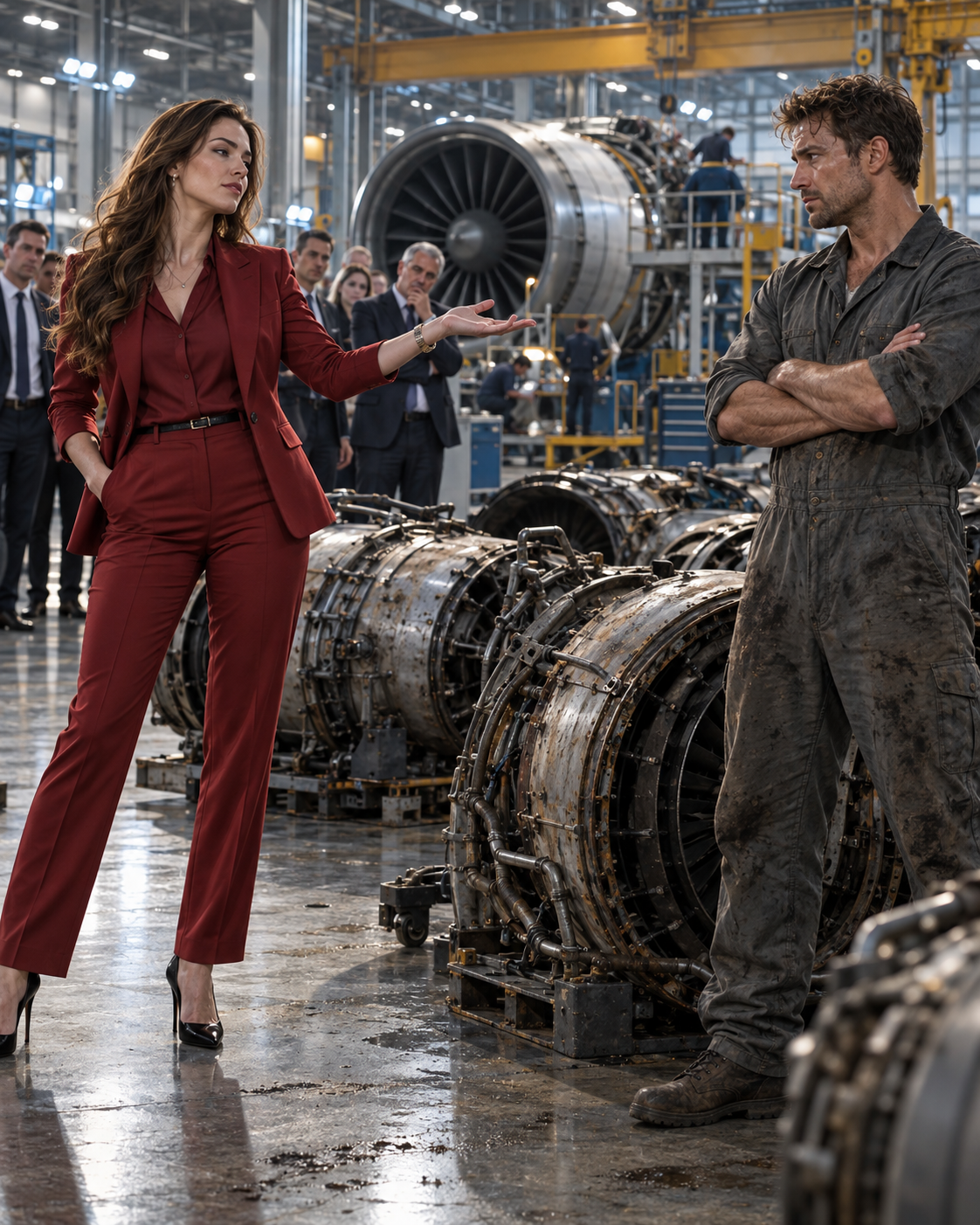
I watched six rusted motors crash onto the factory floor while our new CEO laughed and called them worthless junk
Part 2
The plant manager called me two days later.
Then he called again.
Then again.
By the end of the week, three other people were calling me.
They wanted test results.
They wanted specifications.
They wanted to know who owned the design.
I told them.
“I do.”
For the first time in my life, those two words didn’t feel arrogant.
They felt terrifying.
Because owning an idea meant becoming responsible for what happened next.
I rented a storage unit and turned it into a tiny workshop.
Then I realized I needed a company.
I called it Apex Dynamics.
The name came from something Emily once told me when we were young.
She said, “If you’re going to climb, don’t climb halfway.”
I never forgot it.
The first year was brutal.
I had no investors.
No manufacturing facility.
No marketing department.
No wealthy friends.
Just a machine that worked and a growing list of people who wanted proof.
So I gave them proof.
One factory became two.
Two became six.
Six became twenty.
Every installation produced more data.
Every test made the system better.
And every successful month made it harder for the skeptics to dismiss me.
But success did not arrive like a movie.
It arrived as invoices.
Late nights.
Broken equipment.
Payroll problems.
Phone calls at midnight.
Workers asking whether their checks would clear.
I understood those fears because I had lived them.
So when Apex finally needed employees, I didn’t look for perfect resumes.
I looked for people who needed a second chance.
A mechanic who had been laid off.
A machinist whose plant had closed.
A young engineer who had dropped out of school to support his mother.
A single mother who had spent years being told she wasn’t flexible enough for serious work.
I hired them.
Then I told them something simple.
“Build something you would be proud to put your name on.”
The warehouse slowly filled with people.
Then machines.
Then orders.
Then trucks.
Then customers.
Our technology spread through Ohio first.
Then Michigan.
Pennsylvania.
Texas.
California.
Factories began reporting energy savings that seemed impossible to people who had spent decades accepting waste as normal.
I kept the original prototype in my office.
It was ugly.
Its casing was scratched.
One corner was still visibly rusted.
I refused to replace it.
Whenever someone asked why, I told them the truth.
“Because somebody thought it was worthless.”
Five years after that day on the factory floor, Apex Dynamics employed hundreds of people.
We had facilities in several states.
Our drive systems were being installed across the continent.
And then one morning, my chief financial officer walked into my office holding a folder.
He closed the door.
“We have an offer.”
I looked up.
“From who?”
He told me.
It was one of the largest industrial corporations in the world.
I stared at the number in the proposal.
More than five hundred million dollars.
For a few seconds, I couldn’t speak.
The first thing I thought about was not the money.
It was the six motors hitting the concrete.
The laughter.
Evelyn Crawford’s smile.
The garage.
The blood on my hands.
The nights when I wondered whether I was wasting what little money we had.
And Chloe’s voice.
“Then don’t quit.”
I closed the folder.
“Give me an hour.”
I drove home.
Chloe was sixteen by then.
She was taller than her mother had been at that age.
She had Emily’s eyes.
She was sitting at the kitchen table doing homework.
I placed the folder in front of her.
She looked at me.
“What is it?”
“We got an offer for the company.”
“Is it good?”
I smiled.
“It’s very good.”
She opened the folder.
Her eyes widened.
“Dad.”
“Yeah.”
“Is that real?”
“Yes.”
She stared at me for a long time.
Then she asked the only question that mattered.
“Are you happy?”
I looked toward the photograph of Emily on the shelf.
Then back at my daughter.
“Yes.”
She smiled.
“Then you should take it.”
So I did.
The acquisition transformed my life.
But it did not erase the years before it.
I still woke before dawn.
I still walked through factories.
I still knew what a failing bearing sounded like.
And I still kept the first six motors.
I had them mounted in a glass display inside the headquarters.
There was no plaque explaining how brilliant they were.
Only one sentence.
“Never confuse discarded with worthless.”
One afternoon, I received an invitation to an international manufacturing conference.
The keynote speaker had canceled.
They wanted me to replace him.
I almost refused.
Public speaking had never been my strength.
Building things was easier.
Machines didn’t judge you when you struggled to find the right words.
But then I saw Chloe’s name on the calendar.
She was coming.
So I accepted.
The conference hall was enormous.
Thousands of executives, engineers, investors, and industry leaders filled the seats.
Behind the stage, a giant screen displayed the Apex logo.
I stood backstage listening to the applause for the previous speaker.
Then someone approached me.
“Mr. Vance?”
I turned.
Evelyn Crawford stood there.
For a moment, neither of us spoke.
She looked older.
Her hair was silver at the edges.
The confidence was still there, but something had changed behind her eyes.
Recognition.
Regret.
Maybe both.
“I heard you were speaking,” she said.
“I heard you were attending.”
She glanced toward the stage.
“Five hundred million dollars.”
I nodded.
“That’s what they paid.”
She gave a small laugh.
“I never imagined.”
I looked at her.
“You didn’t.”
She lowered her eyes.
“I remember those motors.”
“So do I.”
“I thought you were wasting your time.”
“You thought I was wasting company property.”
“I thought you were a maintenance technician who didn’t know his place.”
The words hung between us.
I could have humiliated her.
I could have reminded her of the laughter.
I could have told her how many nights I spent bleeding over those machines.
Instead, I said something that surprised even me.
“You were wrong.”
She nodded.
“I was.”
Then she looked at me.
“I’m sorry.”
I believed she meant it.
Not because her apology could change anything.
It couldn’t.
But because sometimes people finally become honest when the thing they once mocked becomes impossible to ignore.
A stage manager approached.
“Mr. Vance, you’re up.”
I walked onto the stage.
The lights were bright enough to erase the audience.
Then I saw Chloe.
Front row.
Sixteen years old.
Smiling.
I forgot the executives.
Forgot the cameras.
Forgot the money.
I saw only my daughter.
And suddenly I knew exactly what I wanted to say.
Part 3
“I want to tell you about six broken motors.”
The room became quiet.
“They were rusted, damaged, and considered worthless.”
I paused.
“They were thrown onto a concrete floor while people laughed.”
I looked toward Chloe.
“I took them home.”
A few people smiled.
“Not because I knew they were valuable.”
I shook my head.
“I took them because I couldn’t afford to believe that something broken had no future.”
The room was completely silent now.
I told them about the garage.
The failures.
The cuts.
The sleepless nights.
The rejection emails.
The first factory in Ohio.
The workers who eventually joined Apex.
I told them about my wife.
Not in detail.
Just enough.
“I lost my wife three years before those motors came into my life,” I said.
“After that, I thought my job was simply to survive long enough to raise my daughter.”
I looked at Chloe.
“Then those machines reminded me that survival and living are not the same thing.”
Her eyes filled with tears.
I continued.
“I spent years thinking I had abandoned my dream of becoming an engineer.”
I smiled.
“The truth is, I hadn’t abandoned it.”
“I had simply forgotten where I left it.”
Someone in the audience began applauding.
Then stopped.
I wasn’t finished.
“People will tell you that success comes from talent.”
“They will tell you it comes from money.”
“They will tell you it comes from connections.”
“Sometimes it does.”
“But sometimes success begins with a person standing alone in a dirty garage at two in the morning, looking at something everyone else has already given up on.”
I looked toward Evelyn.
She was sitting quietly in the audience.
I did not mention her name.
I didn’t need to.
Then I looked back at Chloe.
“Your greatest enemy may not be failure.”
“It may be the voice that convinces you that you are not worth trying.”
The room was silent.
“So when somebody laughs at your dream, don’t automatically assume they’re right.”
“Listen.”
“Learn.”
“Work.”
“And if the evidence tells you that you are wrong, change direction.”
“But if the evidence tells you that you’re right, keep going.”
I took a breath.
“Even when nobody claps.”
“Especially then.”
The applause began slowly.
Then it filled the entire hall.
I stepped away from the microphone.
Chloe was standing.
She was crying.
So was I.
After the speech, she met me backstage.
She hugged me tightly.
“Mom would be proud.”
I closed my eyes.
“I hope so.”
“She would.”
We stood there for a while.
Then Chloe pulled away.
“You know what I remember most?”
“What?”
“The garage.”
I smiled.
“You hated that garage.”
“I did.”
“You were always covered in grease.”
“Still am.”
She laughed.
Then she became serious.
“You taught me something.”
I waited.
“That people can be wrong about you.”
I looked at her.
“And?”
She smiled through her tears.
“That doesn’t mean you have to become angry about it.”
I felt something break open inside me.
Because that was the lesson I had never known how to teach.
The point was never to prove Evelyn wrong.
The point was to prove Chloe right.
That her father could lose almost everything and still choose to build.
That dignity did not come from other people’s approval.
That courage was not always loud.
Sometimes courage looked like showing up for another twelve-hour shift.
Sometimes it looked like raising a child alone.
Sometimes it looked like spending your last spare dollar on one more experiment.
Sometimes it looked like taking six broken machines home when everyone else saw garbage.
Years later, the original garage was gone.
The house had changed.
The company had changed.
My daughter had grown into a woman with a career of her own.
But I kept one thing.
One of the original motors.
The smallest one.
The ugliest one.
It sat on a shelf in my study.
One evening, Chloe came to visit.
She picked it up.
“You still have this?”
“Of course.”
She turned it over in her hands.
“You know, Dad, it really is ugly.”
I laughed.
“That’s what they said.”
She placed it back on the shelf.
Then she hugged me.
I held her a little longer than usual.
Because life had taught me that nothing is guaranteed.
Not success.
Not money.
Not tomorrow.
But some moments are worth holding onto.
After she left, I stood alone in the study.
The room was quiet.
The little motor sat beneath the warm light.
I thought about Emily.
About the factory.
About Evelyn.
About every rejection.
About every person who had told me no.
And I realized something I had been too busy to understand when I was younger.
The five hundred million dollars had changed my circumstances.
It had not changed my life.
Chloe had.
The night I chose to keep working after failure, she was the reason.
The morning I almost gave up, she was the reason.
Every long shift, every sacrifice, every risk had been an attempt to show her something words could never fully explain.
You do not control what happens to you.
You do control what you build from it.
I turned off the light.
Before leaving, I looked once more at the old motor.
It had spent years being called scrap.
Then it became the beginning of something extraordinary.
And perhaps people are like that too.
Perhaps the world is sometimes too quick to measure us by the damage it can see.
Perhaps grief makes us believe we are finished.
Perhaps failure convinces us that our best days are behind us.
But broken is not the same as finished.
Discarded is not the same as worthless.
And being underestimated is not the end of your story.
Sometimes it is the first quiet chapter of it.
I closed the door to my study.
In the darkness, I could still picture six rusted motors falling onto a factory floor while powerful people laughed.
I could still hear the sound.
But I no longer heard humiliation in it.
I heard an invitation.
A challenge.
A beginning.
And somewhere beyond that memory, I could hear Chloe’s eight-year-old voice asking why I had brought broken machines home.
I smiled.
Because now I finally knew the answer.
I hadn’t brought those machines home because they were valuable.
I brought them home because I was still willing to believe that something broken could become something beautiful.
And in the end, that was never really the story of six motors.
It was the story of a father trying to teach his daughter that the world does not get to decide what you are worth.
You do.