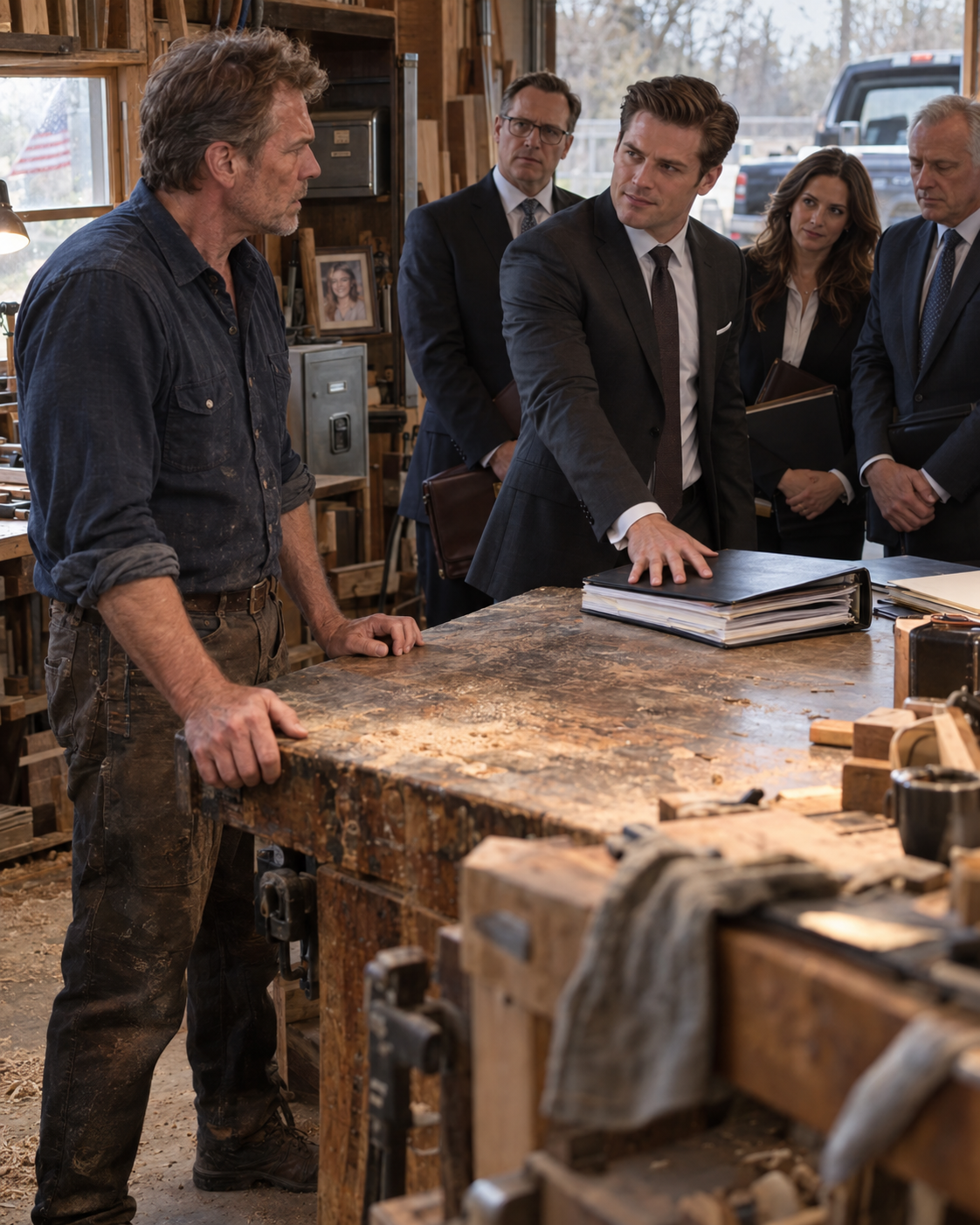
I watched my stepson slam a legal file onto my woodworking counter while three strangers demanded my life’s work
Eleanor’s words stayed with me long after we ended the call.
I sat alone in my workshop that evening, surrounded by half-finished furniture and the faint smell of cedar, trying to understand how the woman sleeping in my house had become someone I was afraid to trust.
“What did you find behind the signature?” I asked when I called Eleanor back.
“I found a pattern,” she said.
“Not just one forged document.”
My hand tightened around the phone.
“How many?”
“Enough to tell us this wasn’t an accident.”
She explained that the beneficiary change on my life insurance policy was only the most obvious piece.
There were copies of old financial statements that had been accessed, scanned, and apparently photographed.
There were notes about property values.
There were handwritten calculations estimating what would happen if I died without changing my estate plan.
And one document contained a date from almost a year earlier.
Evelyn and I hadn’t even been married yet.
I felt something inside me go completely still.
“Are you saying she was planning this before the wedding?”
“I’m saying the documents raise that question,” Eleanor replied carefully.
She never exaggerated.
That was one reason I trusted her.
She told me to bring nothing home, touch nothing unusual, and let her investigators handle the rest.
The next morning, I opened my shop before sunrise.
For years, those early hours had been peaceful.
The first light would come through the dusty windows, and the machines would hum while coffee cooled beside my drafting table.
That morning, every familiar sound felt different.
My own life suddenly seemed like a house where someone had been quietly moving the furniture while I slept.
At nine, Eleanor arrived.
She carried a small evidence box.
“We found something in the study.”
Inside was a tiny flash drive.
I recognized it immediately.
It had been kept in a locked drawer where I stored scanned copies of Clara’s trust documents.
“Where did you find it?”
“Under the false bottom of a decorative box.”
I stared at it.
I had made that box myself.
Evelyn had always loved it.
Eleanor looked at me.
“Your wife knew where it was.”
I didn’t answer.
I couldn’t.
That evening, I went home and watched Evelyn prepare dinner.
She hummed while chopping vegetables.
For a moment, I remembered the woman I had married.
The woman who used to fall asleep against my shoulder during movies.
The woman who brought me coffee when I worked late.
I wanted desperately to believe that person still existed.
“How was your day?” she asked.
“Busy.”
She smiled.
“Arthur said those attorneys met with you.”
“They did.”
Her knife stopped.
“Was everything resolved?”
“Not yet.”
She looked at me for a second too long.
Then she smiled again.
“I just want what’s fair.”
I almost asked her what she thought fair meant.
Instead, I said, “So do I.”
That night, I slept in the guest room.
At two in the morning, I heard footsteps in the hallway.
I opened the door slightly.
Evelyn stood outside my study.
She looked around, then quietly tried the handle.
It was locked.
She returned to the bedroom.
I waited ten minutes before calling Eleanor.
“Don’t confront her yet,” Eleanor said.
“Let us finish documenting everything.”
So I waited.
Waiting was harder than anger.
Anger gives you something to hold.
Waiting leaves you alone with every memory.
I remembered our wedding.
Her hand in mine.
Her tears when she said she had finally found a man she could trust.
And I wondered whether she had been crying because she loved me or because she believed she had finally found security.
Three days later, Eleanor returned with the investigators’ report.
There was more.
Arthur had been communicating with a financial consultant before the wedding.
The messages weren’t explicit enough to prove criminal intent by themselves, but they showed repeated questions about how separate property could be brought into a marital estate.
One message asked what happened if a wealthy spouse died without a current beneficiary designation.
Another asked whether a forged signature could be challenged after death.
My stomach turned.
“Arthur knew,” I whispered.
“We can’t assume everything,” Eleanor said.
“But we can document what we have.”
Then she placed another paper in front of me.
It was a draft agreement.
My name was typed at the top.
Evelyn’s name was beneath it.
The document proposed transferring my house and business into a family holding company.
The proposed ownership structure gave Evelyn controlling authority.
Arthur was listed as successor manager.
I stared at the page.
It had never been shown to me.
Yet there it was.
Ready to be signed.
Except for one thing.
The signature line already contained my name.
Forged again.
That was the moment something inside me broke.
Not because of the money.
Money had never been what kept me awake.
It was the realization that every tender moment might have had a second meaning.
Every question.
Every kiss.
Every “I love you.”
I had no idea where affection ended and calculation began.
Eleanor finally said, “Tom, you need to decide whether you’re protecting your marriage or protecting yourself.”
I looked at Clara’s old photograph sitting on my desk.
She was laughing in it.
Her hair was blowing across her face.
She had hated photographs, but somehow that one captured exactly who she was.
I remembered her final promise.
Don’t let anyone turn what we built into a reason to change who you are.
“I think,” I said slowly, “I’ve already been protecting a marriage that doesn’t exist.”
Eleanor nodded.
The divorce papers were filed the following week.
Evelyn received them at home.
I wasn’t there when she opened the envelope.
I was in the shop sanding a cherrywood table when my phone rang.
Her name appeared on the screen.
I let it ring.
It rang again.
Then again.
Finally, a message appeared.
“We need to talk.”
I didn’t respond.
A second message came.
“Please don’t do this.”
Then another.
“You don’t understand.”
I stared at those words until they blurred.
I had spent months trying to understand her.
Now I wasn’t sure I wanted to.
That evening, Arthur called.
I answered because I wanted to hear what he would say without his attorneys standing beside him.
“Tom.”
His voice sounded different.
There was no arrogance.
Only fear.
“We need to meet.”
“No.”
“Please.”
“Why?”
Silence.
Then he said, “Because things got out of control.”
I closed my eyes.
“What things?”
“I thought my mother just wanted security.”
“And the forged signatures?”
Another silence.
“I didn’t know about that.”
“Did you know about the documents?”
“I knew she was looking into your finances.”
“Before we were married?”
“I didn’t think it was going to become this.”
His voice cracked slightly.
“Tom, please.”
I felt an old instinct to protect him.
For years, I had treated Arthur like my own son.
I had helped him with his first car.
I had taught him how to repair a cabinet.
I had even paid the deposit when he started his first business.
Hearing fear in his voice hurt more than I expected.
“What do you want?”
“Can we settle this privately?”
“Settle what?”
“The divorce.”
“Why?”
He hesitated.
“Because if this goes to court, everything comes out.”
I felt a chill move through me.
“What everything?”
He didn’t answer.
That was the answer.
Eleanor later explained that the evidence could expose the extent of the financial planning and the forged documents.
There was also the possibility that additional parties had been involved.
We would let the proper authorities determine whether any laws had been broken.
I wasn’t interested in revenge.
I wanted distance.
I wanted my name back.
I wanted to wake up without wondering whether the person beside me was calculating the value of my death.
The divorce became complicated, but the central financial question was surprisingly simple.
Clara’s trusts had been established long before Evelyn entered my life.
Their terms were clear.
They were separate property.
Eleanor produced the original documents, the trust records, and the chain of ownership.
Every attempt to pull those assets into the marriage collapsed under documentation.
My house remained mine.
My business remained mine.
The investments Clara had left me remained protected according to the trust structures.
And the thirty-five million dollars everyone had imagined themselves dividing never became theirs to divide.
But winning the financial argument didn’t feel like winning anything.
I lost sleep.
I lost trust.
I lost the ability to hear the words “I love you” without wondering what they were worth.
One afternoon, Evelyn came to the shop.
She stood outside the glass door while I worked.
I didn’t invite her in.
She raised her hand and knocked.
I kept sanding.
She knocked again.
Finally, I opened the door.
She looked exhausted.
“I didn’t want it to end like this.”
“Neither did I.”
“I loved you.”
I looked at her.
“Did you?”
Her eyes filled with tears.
“Yes.”
“Then why did you need my money before you needed my trust?”
She looked away.
“I was afraid.”
“Of what?”
“Of being left with nothing.”
I took a slow breath.
“You were afraid of being left with nothing, so you tried to make sure I couldn’t leave you with nothing.”
She began crying.
For one second, I almost reached for her.
Then I remembered the forged signature.
I remembered the locked drawer.
I remembered Arthur’s legal file sitting on my workbench like an eviction notice from my own life.
“I’m sorry,” she whispered.
I believed that she was sorry.
I just no longer believed sorry could rebuild what had been destroyed.
She walked away.
I watched her cross the parking lot without calling her back.
Months passed.
The divorce was finalized.
Arthur stopped contacting me.
The shop returned to its old rhythm.
Customers came in asking about dining tables and custom cabinets.
I returned to my work.
Slowly, ordinary life began to feel ordinary again.
Then one rainy Thursday, Eleanor called.
“There is something you should know.”
I sat down.
“What now?”
“The investigators found another file.”
“Where?”
“In storage.”
My heart sank.
“What kind of file?”
“One Clara created.”
I couldn’t breathe for a moment.
“Clara?”
“Yes.”
Eleanor explained that the file had been sealed with several other estate documents years earlier.
It contained instructions Clara had written for me in case I ever remarried.
I had never seen it.
“Why would she do that?”
“Because she knew you,” Eleanor said.
“She knew you would always assume the best in people.”
The file was delivered to me the next morning.
I opened it alone.
Inside was a letter.
The handwriting was unmistakably Clara’s.
My hands shook as I unfolded it.
Tom,
If you’re reading this, then you’ve probably married again.
I smiled despite myself.
She had always been able to make me feel seen.
The letter continued.
I don’t want you to spend the rest of your life alone because you loved me.
But I want you to remember something.
Money attracts people who mistake access for intimacy.
Never confuse someone wanting a place in your life with someone deserving a place in your life.
I stopped reading.
Tears fell onto the paper.
There was one final paragraph.
If someone ever tries to convince you that protecting what I left you means you don’t trust them, remember this: trust does not require surrender.
Love does not require ownership.
And marriage should never feel like a negotiation over who gets to hold the keys after you’re gone.
I folded the letter carefully.
For the first time in months, I cried for Clara.
Not because I had lost her again.
Because she had somehow managed to protect me even after she was gone.
That evening, I locked the shop and sat alone beneath the warm light above my workbench.
Outside, rain tapped against the windows.
The world was quiet.
I thought about Evelyn.
I thought about Arthur.
I thought about Clara.
And I realized the lesson had never really been about thirty-five million dollars.
It was about knowing the difference between generosity and surrender.
I had spent my life believing that being a good man meant giving people the benefit of the doubt.
Clara had taught me that boundaries could be an act of love too.
The next morning, I opened the shop before sunrise.
I placed Clara’s letter inside the drawer beneath my plans.
Then I picked up my pencil and began designing a new table.
It was going to be simple.
Strong legs.
Clean lines.
No hidden compartments.
Nothing disguised as something it wasn’t.
As I worked, I noticed an envelope on the corner of my desk.
It wasn’t there the night before.
My name was written across the front.
I froze.
There was no return address.
I opened it slowly.
Inside was a single photograph.
Arthur was standing beside someone I didn’t recognize.
On the back, four words had been written in black ink.
“Ask him about Clara.”
I stared at the photograph until the shop seemed to disappear around me.
Because suddenly, I understood something I had never considered.
Evelyn might not have been the beginning of the story.
And Arthur might not have been acting alone.
I turned the photograph over again.
Then I looked toward the locked door of my shop.
For the first time since the divorce, I wondered whether the truth I had uncovered was actually the end of the betrayal…
or merely the first layer of it.