I watched my mother raise a champagne glass to my brother at our dining-room table and call the $36,000 down payment a sacrifice
The $50,000 wasn’t the only debt they hid.
For several seconds, I couldn’t speak.
Rain tapped against the windows of my condo while I stared at the phone in my hand, suddenly remembering how my mother had always insisted that I was the one who “made everything complicated.”
“What else is there?” I finally asked.
Elena exhaled.
“Something connected to Julian.”
My stomach tightened.
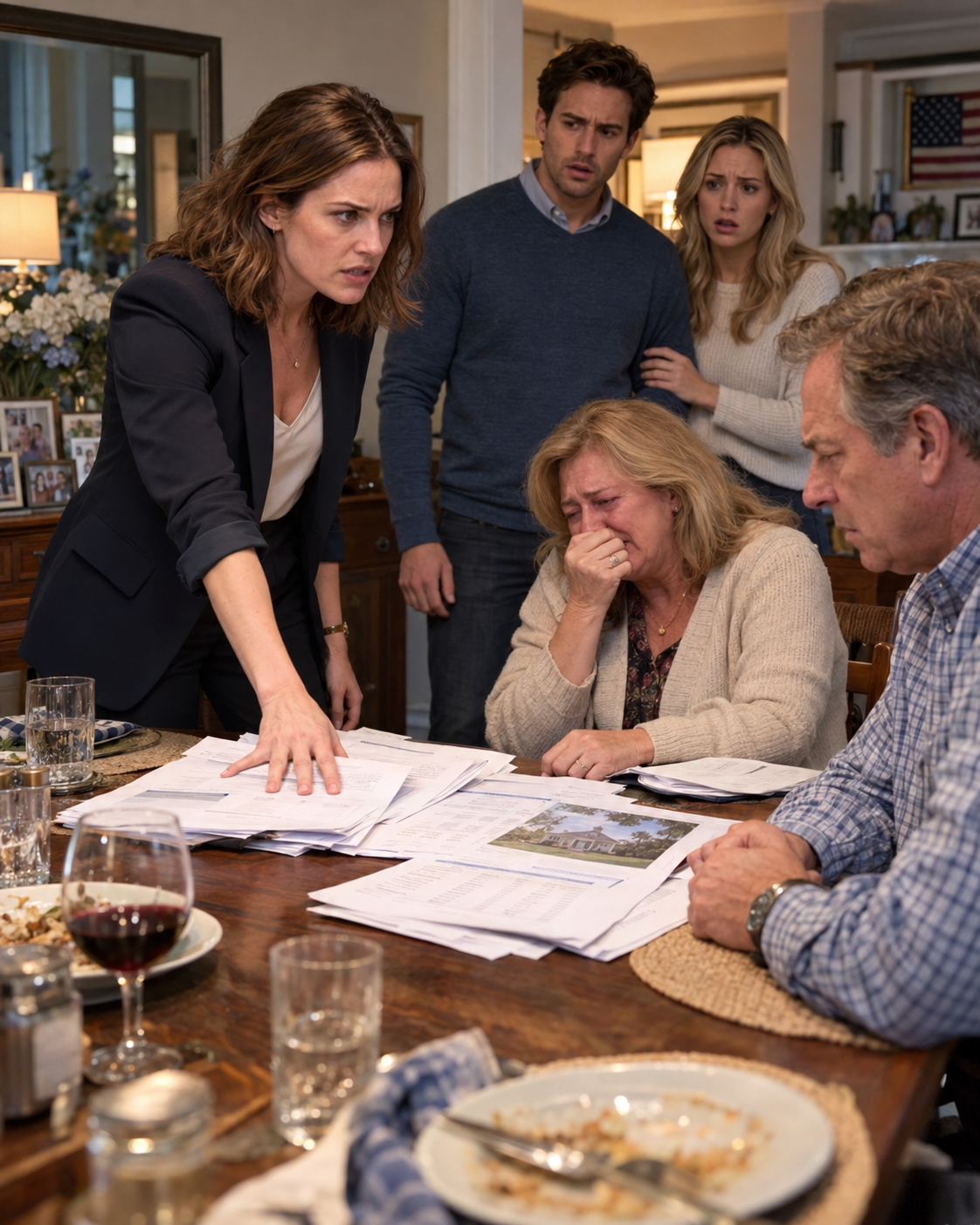
She told me she had found a second set of financial documents buried among the disclosures from the sale of my parents’ house.
There were old transfers, private loans, and handwritten notes that had never appeared in the statements my parents had shown the family.
One name appeared again and again.
Julian.
I called him immediately.
He answered on the third ring.
“What’s wrong?”
“I don’t know yet,” I said.
“But Elena found something involving you.”
There was silence.
Then Julian whispered, “I knew they were hiding something.”
That sentence stopped me cold.
“You knew?”
“Not this,” he said quickly.
“I mean I knew they were asking me for money behind your back.”
He told me that for years, our parents had portrayed him as the struggling son who needed protection.
Whenever Clara and he fell behind on a bill, Mom would call and tell him not to worry because “the family would handle it.”
But Julian had never understood where that money came from.
He assumed our parents were using their own savings.
Then he told me something I had never heard before.
“When we were buying the house, Mom told us you were helping too.”
My chest tightened.
“What?”
“She said you wanted us to have a fresh start.”
I closed my eyes.
Of course she had.
She had taken the money I was sending for their mortgage and used the story of family sacrifice to make herself look generous to Julian.
But there was more.
Elena sent me the documents.
I opened them slowly.
The first page was an old spreadsheet.
The second showed transfers to Julian and Clara.
The third showed withdrawals from the home equity line.
Then I saw something that made my hands go numb.
My parents had used part of the $50,000 credit line to cover expenses connected to Julian’s house purchase.
They had told everyone the $36,000 gift came from their savings.
It hadn’t.
Some of it had come from borrowed money secured against their home.
And some of that home was being paid for by me.
I read the documents twice.
Then a third time.
The betrayal felt different now.
Before, I had believed my parents were simply selfish.
Now I understood that they had built an entire family narrative around hidden transactions.
They had turned my labor into evidence of their generosity.
They had turned Julian’s dependence into proof of my supposed failure.
And somehow, they had convinced both of us that the other was responsible.
I called Julian back.
“They used money borrowed against the house to help you buy yours.”
He was silent for so long that I thought the call had dropped.
Finally, he said, “Clara is going to be sick.”
She was.
When Julian told her, she refused to believe it until Elena sent over the documents.
Then Clara called me herself.
“I am so sorry,” she said.
“You didn’t do this.”
“I know.”
But hearing her say it still made something inside me loosen.
For years, I had wanted someone in my family to say those four words.
You didn’t do this.
Not the loneliness.
Not the distance.
Not the resentment.
Not the financial chaos.
Not the impossible expectations.
None of it.
The following week, Julian came to my condo.
He brought a folder.
“I want you to see this.”
Inside were bank statements from the last five years.
He had highlighted every transfer our parents had made to him.
Some were small.
Some were significant.
Together, they told a story I hadn’t expected.
Our parents had been quietly subsidizing Julian while simultaneously telling me he was independent.
And whenever they gave him money, they told him not to mention it because “your sister will make everything about money.”
I stared at the pages.
“They said that about me?”
Julian looked ashamed.
“All the time.”
For once, I didn’t feel anger toward him.
I felt tired.
We sat across from each other in silence.
Then he said something that broke through the last wall between us.
“I spent half my life thinking you didn’t care about us.”
I looked at him.
“I spent half my life thinking you were the reason they didn’t care about me.”
Neither of us laughed.
It was too painful.
But it was honest.
That honesty became the beginning of something new.
Meanwhile, my parents began missing their repayment installments.
First one.
Then another.
Elena sent a formal notice.
My mother called me that night.
“You are really going to do this to your own parents?”
I stared at the number glowing on my screen.
For years, that question would have destroyed me.
This time, it didn’t.
“I’m not doing anything to you, Mom.”
“You are humiliating us.”
“No,” I said quietly.
“I’m finally refusing to hide what you did.”
She started crying.
Then came the familiar words.
After everything we’ve done for you.
You were always difficult.
Your brother never treated us like this.
I listened until she ran out of accusations.
Then I said, “You taught me that family means taking care of each other.”
She sniffed.
“Exactly.”
“So why was I the only one expected to keep paying?”
She hung up.
I didn’t call back.
The next morning, I received a message from my father.
It contained only one sentence.
Your mother is devastated.
I typed a response, erased it, then typed another.
I finally sent, “So was I.”
Nothing came after that.
Weeks passed.
My parents sold what remained of their valuables and moved into the rental.
The repayment plan continued.
Five hundred dollars a month.
Slowly.
Uncomfortably.
Without applause.
For the first time, they had to live inside the consequences of their decisions.
And perhaps that was the hardest thing for them to accept.
Not losing the house.
Not losing access to my money.
Not even losing the admiration of relatives.
It was losing the ability to rewrite reality.
At family gatherings, the old version of the story no longer worked.
People knew.
My aunt apologized.
My cousin admitted she had believed everything my mother said.
One uncle never apologized.
He simply stopped speaking to me.
I let him.
I had finally learned that peace sometimes means allowing people to misunderstand you.
You don’t have to chase every person who walks away because someone else gave them a false map of your life.
Julian changed too.
He and Clara started cutting expenses and stopped accepting money from our parents.
Then one month, Julian sent me $250.
I called him immediately.
“What is this?”
He laughed nervously.
“My payment.”
“You don’t owe me.”
“I know.”
“Then why?”
He paused.
“Because I spent years benefiting from a system I didn’t understand.”
I wanted to send it back.
Instead, I told him I appreciated the gesture, but he needed to make sure his own family was secure first.
He promised.
The next month, another $250 arrived.
Then another.
Eventually, I told him to stop.
He said, “Okay.”
And for once, he listened.
That mattered more than the money.
Our relationship became something neither of us had ever known.
Voluntary.
Equal.
Unforced.
We started having coffee without our parents.
We talked about work, marriage, childhood memories, and all the things we had misunderstood.
One evening, Julian asked me whether I hated our parents.
I thought about it carefully.
“No,” I said.
“Then what do you feel?”
I looked through the window at the lights of the city.
“Relief.”
He nodded.
I realized relief was not the same thing as forgiveness.
Forgiveness, if it ever came, would be mine to give.
Relief was simply the feeling of finally putting down a weight that had never belonged to me.
A few months later, I sat on the balcony of my condo with a spreadsheet open on my laptop.
For the first time in years, my retirement contributions were back on track.
My emergency fund was healthy.
My mortgage was manageable.
There was no automatic $1,850 transfer leaving my account every month.
That empty line in my budget looked almost strange.
I stared at it for a long time.
Then I smiled.
Not because I had won.
Because I had stopped losing.
That distinction changed me.
I stopped measuring love by sacrifice.
I stopped believing that saying no made me cruel.
I stopped confusing guilt with responsibility.
And most importantly, I stopped allowing people to decide that my success belonged to them.
My parents eventually completed enough of the repayment plan to reduce the debt substantially.
They never became the parents I had imagined as a child.
There was no dramatic dinner where everyone hugged and admitted their mistakes.
Real life rarely gives you endings that clean.
My mother still occasionally sent messages about family obligations.
My father still struggled to say he was wrong.
But their words no longer controlled the weather inside my head.
Then, almost a year after the confrontation, Elena called again.
This time, she sounded almost amused.
“You’re going to want to sit down.”
I laughed.
“That phrase has never meant anything good when you say it.”
She said there was one final document from the original mortgage file that had surfaced during a records review.
It was signed shortly before the foreclosure notice that had started everything.
I opened the scanned copy.
At the bottom was my mother’s signature.
Beside it was a handwritten note.
I read it once.
Then again.
Then I felt the strange, familiar coldness spread through my chest.
The note said that if the house ever had to be sold, the family should “make sure she doesn’t receive anything until she understands what she owes us.”
She.
Me.
I sat there staring at those words long after Elena stopped talking.
All those years, I had believed my parents were simply demanding money because they thought I had more than they did.
But the document revealed something darker and sadder.
They hadn’t merely wanted my help.
They believed my success was something they were entitled to collect.
That was the secret I finally understood.
The debt had never really been financial.
The money was only the measurement.
The real debt was the one they had spent decades convincing me I owed for being born into their family.
And for the first time, I knew I would never pay it.
A year later, Julian and I stood together at my condo during Thanksgiving.
There were no speeches.
No forced gratitude.
No comparisons.
Just Clara laughing in the kitchen while the kids argued over a board game.
Julian handed me a cup of coffee and looked around.
“You know what I keep thinking?”
“What?”
“We could have been friends this whole time.”
I smiled.
“We were busy being siblings.”
He laughed.
Then his expression became serious.
“Do you think Mom and Dad will ever understand?”
I looked at the people I loved, the life I had built, and the quiet home I had once been afraid I didn’t deserve.
“Maybe,” I said.
“But I don’t need them to anymore.”
Outside, rain began tapping against the glass.
The sound reminded me of that night Elena first called about the hidden debt.
Only now, the rain didn’t feel like a warning.
It sounded like something washing the past away.
I used to think family meant carrying everyone, even when they climbed onto your back and called it love.
Now I understand that love without boundaries can become a prison, and guilt can look remarkably like loyalty when you’ve lived with it long enough.
I didn’t save my parents’ house.
I didn’t destroy my family.
I simply stopped financing a story that was never true.
And somewhere between the first $1,850 transfer and the final $500 repayment, I finally learned the most painful lesson of my life.
You can love people deeply without surrendering your future to them.
You can forgive without reopening the door.
And sometimes, the bravest thing you can do for a family is refuse to keep lying about what is happening inside it.
My mother once told everyone that I had money but no heart.
Years later, I finally realized she had been wrong about one part.
I had a heart.
I had simply stopped handing it to people who treated it like a checking account.
And when I looked across that Thanksgiving table at Julian, Clara, and the children laughing beneath the warm kitchen lights, I knew something my younger self could never have understood.
I hadn’t lost my family when I stopped paying for them.
I had finally discovered which parts of my family were real.