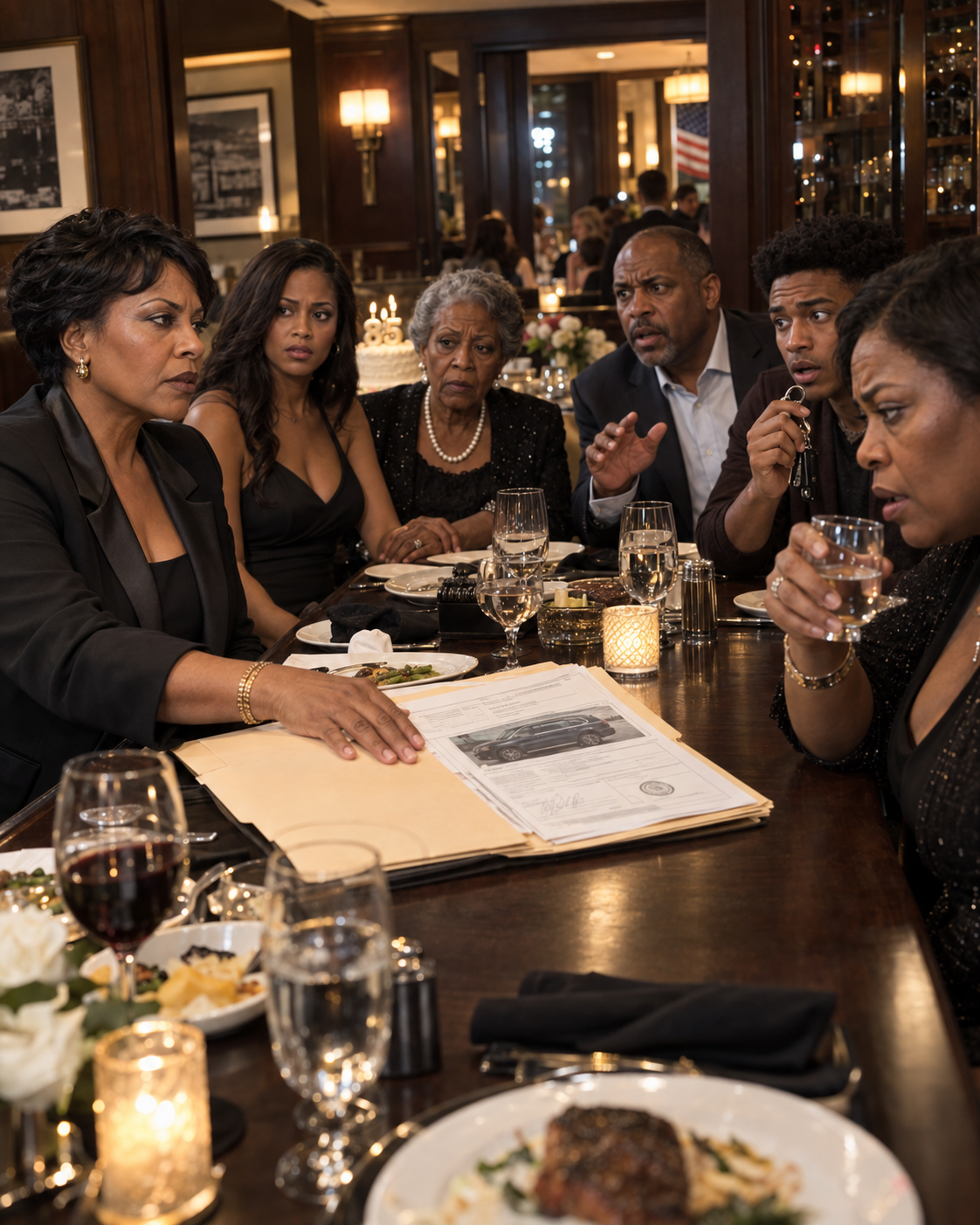
I watched my mother calmly hand my $40,000 SUV keys to my younger brother inside our family’s private dining room
I sat behind the steering wheel with the envelope open on my lap, staring at that signature until the letters blurred.
It was my mother’s handwriting.
There was no mistaking it.
But what frightened me wasn’t the signature.
It was the date.
The document had been signed almost two years before my graduation.
I read it again.
Then again.
My hands began to shake.
The document was an old financial agreement connected to Mercer Consulting LLC, Brenda’s company.
At first, I couldn’t understand why my mother’s name was anywhere near it.
Then I saw a line highlighted in yellow.
“Beneficiary designation: Khloe Vance.”
My heart stopped.
I called Brenda immediately.
She answered on the second ring.
“Where are you?”
“In my car.”
“Are you alone?”
“Yes.”
There was silence.
Then she said, “You found it.”
My stomach tightened.
“You knew?”
“I knew you would eventually.”
“Brenda, what is this?”
She exhaled slowly.
“Come to my office.”
I drove downtown without turning on the radio.
Every streetlight seemed brighter than usual.
Every passing car made me feel like someone was watching me.
When I reached Brenda’s office, she was standing beside the window with her arms crossed.
The folder I had received was sitting open on her desk.
“You deserve the truth,” she said.
I stared at her.
“Then tell me everything.”
Brenda pulled out a chair.
“Your grandmother asked me to help protect you.”
“From what?”
“Your parents.”
The words landed harder than I expected.
I laughed nervously.
“My parents?”
Brenda nodded.
“Not because they wanted to hurt you, but because they had become financially dependent on Julian and were beginning to make decisions that could affect you.”
I sat down.
“How long have you known?”
“Years.”
She explained that after Julian’s second failed business, my parents had started borrowing money against their home to cover his debts.
Then they opened accounts and signed agreements they barely understood.
Brenda had warned them to stop.
They didn’t.
“What does that have to do with me?”
She looked at me for a long moment.
“Everything.”
She showed me another document.
It was a financial plan prepared years earlier.
My grandmother had quietly transferred a portion of a family investment account into a protected trust.
My name was listed as the beneficiary.
I stared at the page.
“I didn’t know Grandma had money like this.”
“She didn’t want you to know.”
“Why?”
“Because she was afraid your parents would pressure you into giving it to Julian.”
I felt sick.
For years, I had believed my family saw me as the responsible one.
I hadn’t realized that being responsible had also made me the easiest person to manipulate.
Brenda leaned forward.
“Your grandmother watched you work yourself sick while your parents kept rescuing Julian.”
She paused.
“She was proud of you.”
I looked down.
A tear landed on the paper.
“Why didn’t anyone tell me?”
“Because your grandmother wanted you to build your life without depending on an inheritance.”
That sentence stayed with me.
She hadn’t wanted to make me rich.
She had wanted to make sure nobody could make me poor.
I went home that evening carrying copies of documents I had never known existed.
My mother was waiting outside my apartment.
She looked exhausted.
“Can we talk?”
I almost said no.
Then I saw her face.
Not the confident woman from the restaurant.
Not the woman who had casually handed my SUV to Julian.
Just my mother.
So I unlocked the door.
She stepped inside.
For several seconds, neither of us spoke.
Then I placed the photocopy on the kitchen table.
“Why did you sign this?”
Her face changed instantly.
She sat down.
“Who gave you that?”
“That doesn’t matter.”
“It matters to me.”
“Why did you sign it?”
She covered her mouth.
“I thought I was protecting everyone.”
“By putting my name on financial documents?”
“You don’t understand.”
“Then explain it.”
She started crying.
My mother told me that years earlier, Julian had accumulated debts so large that my father threatened to stop helping him.
Julian disappeared for three days.
When he came back, he told them he had borrowed money from dangerous people.
My parents panicked.
They went to Brenda for help.
Brenda refused to give Julian cash.
Instead, she helped restructure my parents’ finances and insisted that certain assets be protected from being used as collateral.
My mother signed the documents.
But there was something she hadn’t told Brenda.
She had secretly promised Julian that once he stabilized, they would find another way to give him access to the protected money.
My mother looked at me through tears.
“I was trying to keep your brother alive.”
“And what about me?”
She couldn’t answer.
That silence hurt more than anything.
I stood up.
“You were willing to sacrifice my security for his.”
“No.”
“You were.”
She shook her head.
“I never thought you would need it.”
I stared at her.
“That’s exactly the problem.”
She began crying harder.
“You always seemed like you could handle anything.”
I whispered, “That doesn’t mean I should have to.”
She looked away.
For the first time in my life, I saw the truth beneath all those years of favoritism.
My parents hadn’t believed Julian was stronger than me.
They believed I was strong enough to survive being treated unfairly.
That distinction broke something inside me.
My mother left an hour later.
I thought the worst part was over.
I was wrong.
The next morning, Brenda called me before sunrise.
“Don’t panic.”
Whenever someone begins a sentence that way, panic is usually the correct response.
“What happened?”
“Julian contacted the attorney.”
“Why?”
“He wants access to the trust.”
I closed my eyes.
“Of course he does.”
“He claims your grandmother promised him part of it.”
“Did she?”
“No.”
Brenda’s voice became firm.
“But he has another problem.”
“What?”
“He knows about the document.”
My stomach dropped.
“How?”
“We don’t know yet.”
That afternoon, I received a message from an unknown number.
It contained one sentence.
“You really think Brenda is protecting you?”
Then another message arrived.
“You should ask her what happened the night your father went bankrupt.”
I stared at the screen.
I didn’t know what to do.
Then the phone rang.
It was Grandma.
Her voice was weak.
“Khloe, come see me.”
I drove to her house immediately.
She was sitting beside the window with an old wooden box in her lap.
“I think it’s time,” she said.
“Time for what?”
She opened the box.
Inside were letters.
Dozens of them.
Some were addressed to Brenda.
Some were addressed to my mother.
And one had my name on it.
The envelope was yellow with age.
My name was written in Grandma’s handwriting.
I opened it carefully.
Inside was a letter written before I entered nursing school.
“Dear Khloe, if you’re reading this, something has gone wrong.”
I stopped breathing.
Grandma continued writing that she had spent years watching our family become divided by one dangerous belief.
That Julian was fragile.
That I was strong.
That therefore Julian deserved rescuing and I deserved sacrifice.
She wrote that this belief had nearly destroyed all of us.
Then she revealed something I had never imagined.
“Your father did not lose his business because of Julian.”
I stared at the sentence.
“What?”
Grandma’s letter explained that my father had once been a successful contractor.
Years earlier, he had secretly taken money from the family investment account to cover a business deal.
The deal failed.
Instead of telling my grandmother, he blamed the losses on a series of bad decisions involving Julian.
My father had been hiding the truth ever since.
The debts that everyone believed belonged to Julian were partially my father’s.
Julian had been irresponsible, yes.
But he hadn’t caused the financial collapse that started everything.
My grandmother had discovered the truth.
She had confronted my father.
He begged her not to tell my mother.
And somehow, the secret had become the foundation of our family.
I looked up at Grandma.
“Why didn’t you tell me?”
“Because I wanted you to stay out of it.”
“That didn’t work.”
She gave me a sad smile.
“No.”
She reached for my hand.
“Families sometimes confuse silence with love.”
I felt tears fill my eyes.
“Was Mom involved?”
“Not at first.”
“Then when?”
“Later.”
Grandma looked toward the window.
“When your mother realized your father had lied, she chose to protect the marriage instead of exposing him.”
I felt something inside me collapse.
All those years.
All those explanations.
All those times I had been told to understand.
It suddenly made sense.
My mother hadn’t been protecting Julian.
She had been protecting the family secret that surrounded him.
And I had been the convenient child who could be trusted to endure whatever was necessary to keep that secret buried.
I drove home that night feeling hollow.
But there was one thing I couldn’t stop thinking about.
The anonymous messages.
Someone knew enough to mention my father’s bankruptcy.
Someone knew about the trust.
Someone wanted me to doubt Brenda.
I called her.
“Did you tell anyone about the trust?”
“No.”
“Did my mother?”
“No.”
“Then someone else knows.”
Brenda went quiet.
“Khloe, I need you to listen carefully.”
“I’m listening.”
“Don’t meet anyone alone.”
Three days later, I received another message.
This time there was a photograph attached.
It showed Julian standing outside Brenda’s office.
The timestamp was from the previous night.
Underneath it was a message.
“Your brother isn’t the one you should be afraid of.”
My hands went cold.
I forwarded the photograph to Brenda.
She called immediately.
“Stay home.”
“What is happening?”
“I don’t know yet.”
That evening, someone knocked on my apartment door.
I froze.
I didn’t move.
The knocking came again.
Then a man’s voice came through the door.
“Khloe, it’s your father.”
I looked through the peephole.
He was standing there alone.
I almost opened it.
Then I noticed something.
His hands were empty.
No keys.
No phone.
No wallet.
Nothing.
I called Brenda instead.
Within ten minutes, she arrived with her attorney.
My father was still outside.
When he saw Brenda, his expression changed.
“I need to talk to my daughter.”
Brenda stood between us.
“You can talk with witnesses present.”
He looked exhausted.
“I made mistakes.”
I said nothing.
He lowered his head.
“Your mother and I thought we could fix everything before you ever found out.”
“What exactly were you fixing?”
He swallowed.
“The money.”
“What money?”
He looked at Brenda.
She already knew.
“Tell her,” Brenda said.
My father finally admitted that he had recently attempted to liquidate another family asset to repay debts connected to an old business liability.
The asset was partially tied to the trust.
If the transaction had gone through, I could have lost a substantial portion of what Grandma had protected for me.
I stared at him.
“And the SUV?”
He shook his head.
“That wasn’t about the money.”
“Then what was it about?”
He looked ashamed.
“Julian told us he needed it to convince a potential employer that he was financially stable.”
I almost laughed.
The absurdity hurt.
They had taken something I had earned so Julian could pretend to be someone he wasn’t.
My father whispered, “We thought you would forgive us.”
I finally opened the door.
Not because I forgave him.
Because I needed him to hear me.
“You kept making me pay for problems I didn’t create.”
He nodded.
“You called it family.”
He started crying.
“I know.”
“No,” I said softly.
“I don’t think you do.”
I told him that forgiveness was not the same as permission.
Love was not the same as access.
And being someone’s daughter did not mean surrendering everything I had worked to build.
He nodded slowly.
Then he left.
For several weeks, things were quiet.
Julian found a steady job.
He kept the cheap car he had bought.
My mother began therapy.
My father finally sold the business property he had been hiding.
The trust was reviewed by independent attorneys.
Everything was placed beyond my family’s control.
For the first time, my future belonged entirely to me.
Months later, I visited Grandma.
She was weaker, but her eyes were clear.
I sat beside her and held her hand.
“Do you regret protecting me?”
She smiled.
“No.”
“Do you regret waiting so long?”
She looked toward the window.
“Every day.”
I leaned against her shoulder.
She whispered, “Promise me something.”
“What?”
“Never confuse peace with silence.”
I closed my eyes.
“I promise.”
A few weeks later, Grandma passed away peacefully.
At her funeral, my mother stood beside me.
She didn’t ask for forgiveness.
She simply held my hand.
And for the first time in years, I didn’t pull away.
Not because everything was fixed.
Because I finally understood that healing didn’t require pretending nothing had happened.
It required refusing to let what happened decide who I became.
Months later, I drove my gray SUV home after another twelve-hour shift at the hospital.
The red bow was long gone.
The paint had a few tiny scratches.
The driver’s seat smelled faintly like coffee.
It wasn’t perfect.
Neither was my family.
Neither was I.
But when I pulled into my driveway, I saw an envelope waiting beneath my apartment door.
My heart immediately tightened.
There was no return address.
I opened it slowly.
Inside was a single photograph of Grandma, Brenda, my mother, and me from the year I graduated.
On the back, Grandma had written one sentence.
“Khloe, there is one more thing Brenda never told you.”
I stared at those words until the room went completely silent.
Then I turned the photograph over again.
And beneath Grandma’s handwriting was a second line I had never seen before.
“The SUV was never the thing they were trying to take from you.”
I felt the blood drain from my face.
Because suddenly, every secret, every document, every betrayal seemed to point toward something much bigger than a car.
And for the first time, I understood that the night Brenda dropped that folder onto the restaurant table, she hadn’t been ending the story.
She had only been opening the first door.