I watched my daughter stop halfway down the aisle at the Palmetto Grand while her future husband stared at her
Part 2
The two agents crossed the marble floor without hurry.
By then, everyone understood that the wedding had become something else entirely.
My wife had contacted our family attorney, Phyllis Crane, forty-eight hours earlier.
Phyllis had spent those two days working with the prosecutor’s office and arranging for law enforcement to be present before the ceremony began.
The agents had been waiting for the right moment.
Now there was no reason to wait.
Archer Dre was already on his phone.
When Agent Moser approached him, Archer ended the call with remarkable calm.
“My attorney will be here within the hour,” he said.
Agent Moser looked at him.
“That won’t be necessary right now.”
Archer’s expression hardened.
“You don’t understand who you’re dealing with.”
The agent did not answer.
Across the room, Sasha sat with another investigator.
She was still crying.
But once she began speaking, she did not stop.
I could not hear every word.
I could see her leaning forward, answering question after question.
For eight weeks, she had carried the secret like a stone inside her chest.
Now she was finally putting it down.
Harper stood beside me.
Her wedding dress was still immaculate.
Her bouquet lay crushed on the marble.
Her grandmother’s pearls still rested against her ears.
Everything looked almost exactly as it had thirty minutes earlier.
Except my daughter had changed.
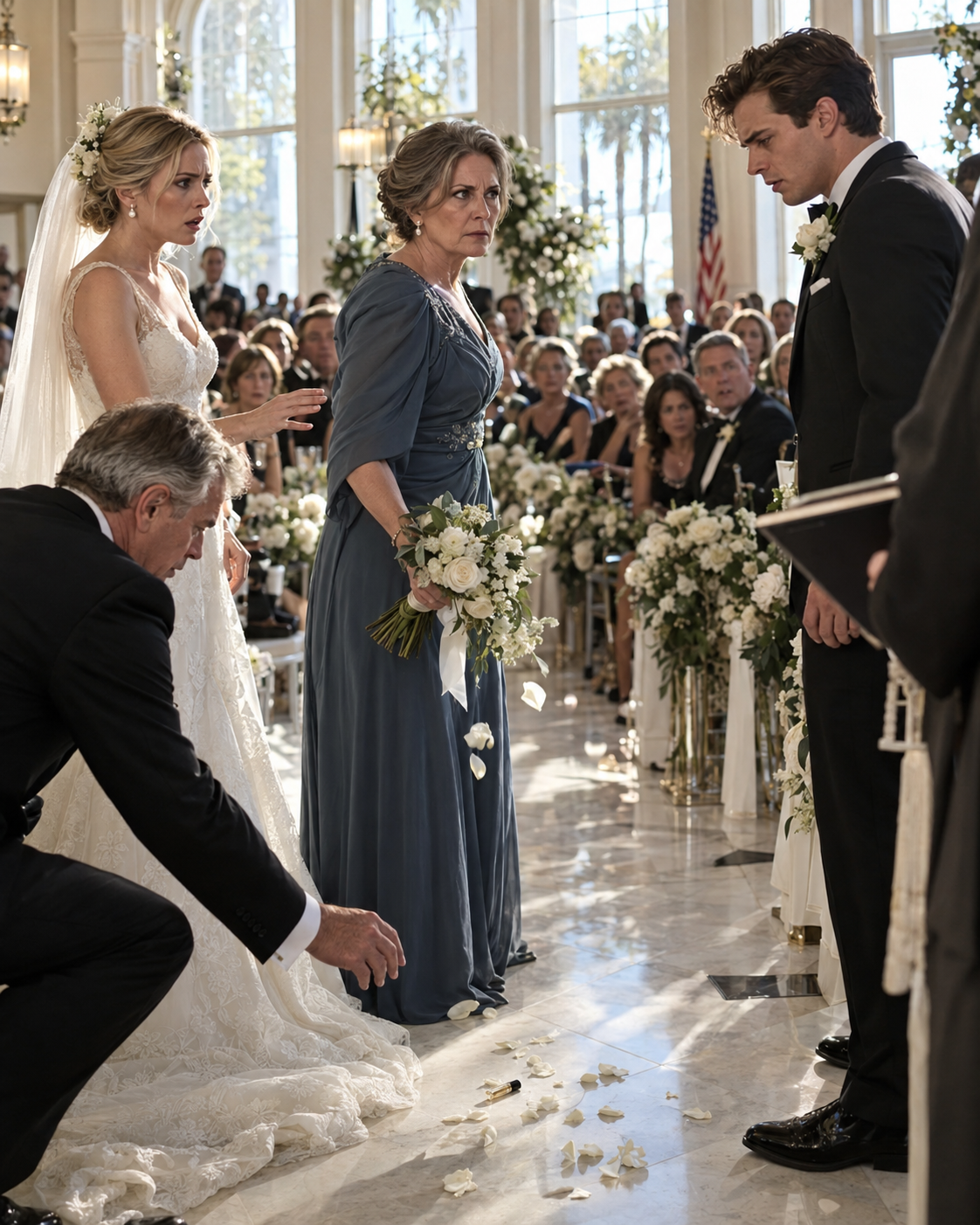
There was no confusion in her eyes anymore.
Only exhaustion.
And beneath the exhaustion, something stronger.
Callum was asked to remain near the altar while the agents documented the evidence.
He stood perfectly still.
For the first time since I had met him, I saw no performance left.
No charm.
No polished smile.
No carefully chosen words.
Just a man realizing that the structure he had built around himself was beginning to collapse.
Archer looked toward him.
Their eyes met.
It lasted only a second.
But I saw it.
Father and son were no longer thinking about the wedding.
They were thinking about consequences.
Phyllis Crane arrived twenty minutes later carrying a thick folder.
She placed the documents in front of the agents.
The toxicology report.
Bernard Lusk’s chemical analysis.
The hotel security footage.
The co-trustee petition.
Harper’s statement.
Sasha’s statement.
And the audio recording.
Every piece fit.
One by one.
Like bolts tightening into place.
I looked at Marian.
She was standing beside me, her hand resting lightly against my arm.
It was the same familiar weight I had felt for thirty-one years.
I leaned toward her.
“Three weeks,” I whispered.
She looked at me.
“You carried all of this for three weeks.”
She glanced toward the tall windows.
Outside, the Charleston harbor was silver beneath the October sun.
“I needed your face to be honest,” she said.
I did not understand.
She continued.
“You cannot pretend not knowing.”
I stared at her.
“If you had known what I knew, Archer would have seen it at the rehearsal dinner.”
She paused.
“And everything we built for this morning would have been useless.”
I swallowed.
“You wanted them to believe they were still winning.”
“Yes.”
I looked at her for a long moment.
“You planned this?”
“Not all of it.”
She glanced toward Harper.
“Harper did the hardest part.”
I followed her eyes.
My daughter was standing near the window.
She looked small in that enormous dress.
But she did not look broken.
Marian reached into her clutch and pulled out a folded piece of paper.
“The recording.”
I looked at her.
“You knew about it?”
“I asked Harper to make it.”
My mouth went dry.
“Why?”
“Because we needed them to talk.”
Marian’s voice was quiet.
“I needed them to believe Harper was still confused. Still trusting. Still unaware.”
She looked at me.
“So she went to that dinner.”
I remembered the recording.
Callum.
Archer.
Their voices.
Their certainty.
They had spoken freely because they thought they were safe.
Harper had sat across from them and listened.
Then she had brought the truth home.
My daughter had walked into that restaurant knowing she might never look at the man she loved the same way again.
And she had done it anyway.
I looked at her.
She caught my eye.
Neither of us spoke.
I walked over.
“Are you all right?”
She nodded.
Then she shook her head.
Then she laughed once, without humor.
“I don’t know.”
I put my hand on her shoulder.
“That’s okay.”
She looked down at her dress.
“I thought I loved him.”
“You did.”
Her eyes filled.
“That makes it worse.”
“No,” I said softly.
“It makes what they did worse.”
She looked at me.
I wanted to tell her that everything would be fine.
But I had learned something that morning.
Sometimes saying everything will be fine is another way of refusing to see how badly something hurts.
So I told her the truth.
“It will hurt for a while.”
She nodded.
“But you don’t have to hurt alone.”
She leaned into me.
And for the first time that day, I felt something inside my chest loosen.
The ceremony never happened.
There was no first kiss.
No vows.
No photographs of Harper and Callum smiling beneath an arch of flowers.
Instead, guests quietly left the room.
Some hugged Harper.
Some could not find the words.
A few avoided her eyes because they were embarrassed to have believed the beautiful version of the story.
I understood them.
People love appearances because appearances are easier.
A wedding is supposed to be joy.
A successful family is supposed to be respectable.
A handsome groom is supposed to be in love with his bride.
Nobody wants to stand in a room and discover that all those assumptions were wrong.
But assumptions do not change facts.
The charges were filed forty-eight hours later.
Callum pleaded not guilty.
Archer retained separate counsel.
The investigation continued.
The legal process moved slowly, much more slowly than my anger wanted it to.
I wanted immediate justice.
I wanted explanations.
I wanted Callum to look me in the eye and tell me why.
But there are some answers that do not heal anything.
Sometimes knowing why a person betrayed you only gives the betrayal a vocabulary.
Sasha cooperated fully with the prosecution.
She admitted everything.
She told investigators when she started.
Where she got the substance.
What Callum told her.
What Archer told Callum.
And how she convinced herself that what she was doing was harmless.
She received a suspended sentence.
She moved to her sister’s apartment in Asheville.
She never contacted Harper again.
Harper never contacted her.
That loss was different from the others.
It did not have the clean shape of betrayal.
Sasha had been her closest friend.
For years, Harper had trusted her with things she had never told me.
Their friendship had survived college.
Jobs.
Breakups.
Family arguments.
Bad birthdays.
Long nights.
And then, somehow, a cup of coffee had become the place where trust ended.
Harper told me once that forgiving Sasha would not bring their friendship back.
“I can understand why she did it,” she said.
“That doesn’t mean I have to let her near me again.”
I told her she was right.
The co-trustee petition was invalidated.
The Whitaker Trust remained entirely in Harper’s name.
Untouched.
Protected.
Waiting for her.
But something else changed.
Harper stopped talking about the trust as if it were something she had to protect from other people.
She began talking about it as if it were hers.
That distinction mattered.
Six months after the wedding that never happened, she asked me to drive with her to King Street.
It was a cool spring morning.
The city smelled like coffee, rain, and old brick warming beneath the sun.
We stopped in front of a two-room commercial space with high ceilings and enormous windows.
Harper stood on the sidewalk for several minutes.
I did not interrupt her.
She stared through the glass at the empty interior.
Then she smiled.
A small smile.
Not the smile she had worn for Callum.
Not the careful expression she had practiced while pretending everything was normal.
Something real.
“I’ll put my name on it,” she said.
I looked at her.
“What will you call it?”
She shrugged.
“I don’t know yet.”
She touched the glass.
“Maybe Whitaker Textile Studio.”
I smiled.
“I like it.”
She laughed.
“Of course you do.”
The following Tuesday, she signed the lease.
I watched her put her name on the last page.
Her hand did not shake.
I thought about the other signature.
The one on the petition she had never knowingly signed.
The one designed to take something from her.
This signature was different.
This one gave something back.
Ownership.
Choice.
A future that belonged to her.
That evening, I drove home with Marian beside me.
The windows were down.
Charleston moved around us in the soft light of early evening.
Old buildings.
Iron gates.
Live oaks bending over the streets.
Marian had taken off her shoes and tucked her feet beneath her.
For several miles, neither of us spoke.
Then she lowered her phone.
“You never asked me something.”
I glanced at her.
“What?”
“Why I was quiet that morning.”
I looked back at the road.
She continued.
“You noticed.”
“I did.”
“You asked me once.”
“I did.”
“And then you let it go.”
I smiled faintly.
“I knew you would tell me what I needed to know when I needed to know it.”
She looked out the window.
For a few seconds, the only sound was the road beneath the tires.
Then she said, “I know that.”
I reached over.
She took my hand.
“That’s why I married you.”
We drove the rest of the way home like that.
Hand in hand.
Neither of us needing to say anything else.
Months later, I placed a photograph on the windowsill in my office.
It showed Marian, Harper, and me standing outside the new studio.
The sunlight was behind us.
The sign above the window read, “Whitaker Textile Studio.”
Harper was smiling.
Not the careful smile she had worn for eight weeks.
Not the smile she had used to reassure people.
Not the smile she had given Callum while she was trying to understand why her own mind felt unfamiliar.
This smile started in her eyes.
I knew that smile.
I had known it since she was a little girl.
It was the smile of someone who had been genuinely surprised by something good.
I look at that photograph often.
Some days, I look at it and feel grateful.
Other days, I look at it and remember the six weeks I did not know what was happening.
I remember every dinner where Harper said she was tired.
Every phone call where she sounded distant.
Every time I told myself she was simply overwhelmed.
I had spent thirty-four years learning not to trust appearances in buildings.
But when it came to my daughter, I trusted the surface.
That is something I have had to forgive myself for.
Because a father cannot see everything.
A husband cannot know everything.
A person cannot protect someone from every danger in the world.
But we can pay attention.
We can notice when a laugh sounds forced.
When silence lasts too long.
When someone who used to speak freely begins choosing every word.
We can ask twice.
We can stay when the answer is uncomfortable.
And we can believe the people we love when they finally find the courage to say, “Something is wrong.”
Harper survived what happened to her.
More than that, she rebuilt something that was hers.
Not the trust.
Not the money.
Not the business.
Herself.
That was the part nobody could sign away.
The part nobody could drug into submission.
The part nobody could place inside a legal document and steal.
I am sixty-two years old now.
I still think about that wedding sometimes.
Not the flowers.
Not the marble floor.
Not the four hundred guests.
I think about Harper’s hand closing around mine as she walked down the aisle.
For one second, before anyone else understood, she told me everything her voice could not.
And I almost missed it.
I did not miss it because I was careless.
I missed it because I trusted the story everyone else was telling.
That is how danger works sometimes.
It does not kick down your door.
It does not arrive wearing a mask.
It shakes your hand.
It remembers your birthday.
It learns your daughter’s coffee order.
It sits at your dinner table.
It tells you how lucky your family is.
And it waits for you to stop looking closely.
So now, when I think about what happened, I do not tell myself that I should have known everything.
I tell myself something simpler.
Look closer.
Listen longer.
And when someone you love reaches for your hand a little too tightly, do not assume it is just a gesture.
Sometimes that is the only warning you are going to get.
Sometimes love speaks before fear can find the words.
And when it does, you have to be there to hear it.