I watched Lars raise his champagne glass at the Portland hotel gala while his new fiancée smiled beside him
The envelope lay on the table between Henrik and me like something alive.
I stared at my grandmother’s handwriting until the letters blurred.
“Do not trust what you were told.”
Henrik didn’t reach for it.
He simply watched me.
“Do you want me to stay?”
I nodded.
That was all I could manage.
The envelope had been sealed decades ago, but the paper smelled faintly of cedar and dust, the same scent I remembered from my grandmother’s sewing room when I was a child.
My fingers trembled as I opened it.
Inside was a single sheet of cream-colored paper, folded around a small brass key.
The letter was dated eighteen years before my grandmother died.
My name wasn’t on it.
Neither was Lars’s.
It was addressed to someone named Eleanor Vale.
I read the first line twice.
“Eleanor, if Astrid ever comes looking for the runner, tell her the truth before someone else tells her a version that benefits them.”
My chest tightened.
Henrik leaned closer.
“Who’s Eleanor?”
“I don’t know.”
But even as I said it, a memory surfaced.
A woman who used to visit my grandmother on Sunday afternoons.
Silver hair.
Green coat.
Always carrying a leather case.
My grandmother called her Ellie.
I had forgotten her completely.
The rest of the letter explained that the silk runner had never been merely an heirloom.
My grandmother had woven it from a pattern passed through three generations of women in our family.
Hidden inside its border were variations of an old textile code, a visual language that recorded names, dates, places, and personal stories without writing them down.
The runner itself was beautiful.
But the pattern was the real inheritance.
I sat back.
“Why would she hide that?”
Henrik pointed to the final paragraph.
“Read.”
I did.
“My greatest fear is not that someone will steal the cloth, but that someone will steal the story and call it their own.”
For a moment, I couldn’t breathe.
Because suddenly, the strange clause in my divorce settlement didn’t feel strange anymore.
Lars hadn’t fought me over the photograph because it was sentimental.
He had fought to control the image because the pattern inside the runner could be studied, reproduced, and turned into something profitable.
My grandmother had known exactly what people might do with it.
I called Ruth before sunrise.
She listened without interrupting.
When I finished, she said, “Don’t contact Lars.”
“Why?”
“Because if this letter is genuine, you have something much bigger than a contract dispute.”
“What do I have?”
“A trail.”
Three days later, Ruth helped me trace the provenance of the runner.
The records led us to a private textile collection outside Seattle.
The runner had been sold shortly after I gave it to Lars.
Not temporarily.
Not privately.
Sold.
My name appeared nowhere on the transfer.
Lars had never told me.
I felt something cold move through me.
“He told me the buyer was holding it for the company.”
Ruth looked at the document.
“The buyer was a shell foundation.”
“Whose foundation?”
She turned the page.
“Lars’s.”
I stared at her.
Then she found something else.
A second transfer.
The foundation had sold the runner to a European design consortium five years later.
The amount was enormous.
Far beyond what Lars had told me the property had cost.
I remembered the first hotel.
The leaking roof.
The broken windows.
The bank threatening foreclosure.
I remembered Lars sitting at our kitchen table, telling me we had one chance.
I remembered selling my grandmother’s runner because I believed in him.
I had thought I sacrificed an heirloom to build our future.
Instead, he had used my trust as the first investment.
I didn’t cry.
Not then.
Some grief is too old to fit inside tears.
I went to the textile library with Henrik.
He unlocked a reference cabinet containing photographs and catalog records from private collections.
“Your grandmother wasn’t the only person working with this visual language,” he said.
He showed me examples from Scandinavian weaving traditions, immigrant communities, and American folk artists.
“People have been encoding memory into cloth for centuries.”
“So the pattern isn’t unique?”
“Maybe not.”
He turned another page.
“But your grandmother’s combination might be.”
There it was.
A photograph from a 1970s exhibition.
The same border rhythm.
The same interrupted diamond.
The same three-thread deviation that appeared on my grandmother’s runner.
I looked at the curator’s note.
The artist’s name was Eleanor Vale.
My knees nearly gave out.
“That’s her.”
Henrik looked at me.
“Ellie?”
I nodded.
Eleanor had been my grandmother’s collaborator.
And apparently, she was still alive.
Finding her took six weeks.
She lived in a small Oregon town, three hours from Portland.
I flew back alone.
When she opened the door, she was ninety-one and impossibly sharp-eyed.
She looked at me for several seconds.
Then she said, “You’re Margaret’s girl.”
My grandmother’s name had always been Margaret.
I swallowed.
“She left me a letter.”
Eleanor’s face changed.
“I wondered when you’d find it.”
She invited me inside.
Her house smelled like wool, tea, and old books.
On the wall hung a framed photograph of my grandmother holding the runner.
But there was something wrong.
The photograph wasn’t the same one I had known.
In this version, another woman stood beside her.
Eleanor.
And between them was a wooden loom.
“What happened?” I asked.
Eleanor sat down.
“Your grandmother discovered that the family pattern had been copied by a textile manufacturer decades ago.”
“Copied?”
“Not exactly.”
She opened a drawer and removed a folder.
Inside were letters, sketches, invoices, and photographs.
A designer had taken portions of the coded pattern and incorporated them into commercial collections without credit.
My grandmother had spent years trying to prove where the designs came from.
“She never wanted fame,” Eleanor said.
“She wanted the women who made them to remain visible.”
I looked at the documents.
Then I saw a familiar signature.
Lars’s.
My blood went cold.
Eleanor noticed.
“That man came here once.”
“When?”
“About seven years ago.”
“Why?”
“He wanted the history.”
I couldn’t speak.
“He offered money,” she continued. “I refused.”
“Did he know about the code?”
“He knew enough.”
That night, I sat in my hotel room and spread every document across the bed.
For years, I had believed Lars had simply taken credit for my creativity.
The truth was uglier.
He had understood the value of the stories behind the designs and had deliberately separated the work from the women who created it.
My hotel interiors had been built around textile concepts that came from my grandmother’s archive.
My branding system had grown from her visual language.
Even the company name had been inspired by a phrase she used in her notebooks.
I had thought I was carrying her forward.
Lars had been packaging her legacy for sale.
I called Ruth.
“We need to know what he did with the archive.”
She answered immediately.
“Rachel may know.”
She did.
Rachel had kept copies of old internal emails because she had always suspected something was wrong.
She sent them to Ruth.
There were dozens.
Lars discussing acquisition opportunities.
Freja discussing visual campaigns.
Consultants discussing how to make the company’s “heritage story” more marketable.
Then I found the email that changed everything.
It was from Lars to a consultant.
“Keep Astrid focused on design. She doesn’t need to understand the intellectual-property side.”
I read it three times.
The words were so casual that they hurt more than an insult would have.
He hadn’t misunderstood me.
He had managed me.
There was another email beneath it.
“She’ll sign anything if she thinks it’s for the business.”
I closed my laptop.
For eleven years, I had called my own disappearance generosity.
He had called it strategy.
When I returned to Copenhagen, Henrik didn’t ask me what I planned to do.
He simply helped me carry my boxes into the studio.
I expected anger to drive me.
Instead, something quieter arrived.
Clarity.
I finished Runner.
The piece was no longer an homage to my grandmother.
It became an argument.
The central panel contained the traditional pattern.
Around it, I wove interrupted lines representing the places where her story had been erased.
At the edges, I introduced my own symbols.
Not hers.
Mine.
When Professor Dalgard saw it, he stood silently for a long time.
Then he said, “Now you are no longer borrowing courage.”
The piece was selected for a major Nordic exhibition.
The same week, Ruth informed me that the design consortium had contacted her.
They wanted to discuss the runner.
I expected a threat.
Instead, they offered to return it.
Not for free.
They wanted a settlement.
I refused the money.
“I want the runner returned to my family,” I said.
“And I want the provenance corrected publicly.”
The negotiations lasted months.
Eventually, they agreed.
The runner came back in a climate-controlled case.
When I opened it, I touched the silk with one finger.
The fabric was thinner than I remembered.
But the colors were still alive.
I cried then.
Not because I had recovered an object.
Because I had recovered a piece of a story that had been stolen before I was old enough to understand what it meant.
The hotel company began unraveling soon afterward.
Investors demanded records.
Former employees spoke publicly.
The publication that had printed Freja’s feature issued a correction.
Freja left the company.
Lars stepped down from several positions.
None of it felt like victory.
Watching someone else’s life collapse does not automatically repair your own.
One afternoon, Lars called me.
I almost ignored him.
Instead, I answered.
“I found the emails,” I said.
He was silent.
“I found out about the foundation.”
Still silent.
Finally he said, “I never meant for you to be hurt.”
I closed my eyes.
There it was.
The sentence people use when they don’t want to say the sentence that matters.
“You meant for me not to know.”
He didn’t answer.
“Those are different things.”
“I thought I was protecting what we built.”
“No,” I said. “You were protecting what you believed you owned.”
He breathed heavily.
Then he said, “I did love you.”
I believed him.
That was the hardest part.
People can love you and still exploit you.
They can miss you and still manipulate you.
They can regret losing you without ever understanding what they took.
“I loved you too,” I said.
Then I ended the call.
Months later, I returned to Portland for the opening of a small exhibition featuring Runner.
The room was quiet when I arrived.
My grandmother’s original silk lay beneath protective glass.
Beside it hung my contemporary piece.
People stood between them, reading the story.
A young woman approached me.
“Are you Astrid?”
“Yes.”
She looked at the two pieces.
“My mother taught me to weave.”
I smiled.
“Then you already know something important.”
“What?”
“Nothing made by hand is ever only an object.”
She looked back at the runner.
“Who taught you?”
I thought of my grandmother.
Then Eleanor.
Then Mina.
Then Professor Dalgard.
Then Henrik waiting for me at train platforms without ever asking me to become someone else.
“Women who refused to disappear,” I said.
After the exhibition, I walked alone through the city.
Portland looked almost unchanged.
The hotel stood downtown, its windows glowing against the evening rain.
Once, I had stood inside those walls believing they were my future.
Now I could look at them without wanting them back.
My future was somewhere else.
That night, Henrik called from Copenhagen.
“Did you survive?”
“Barely.”
“Good.”
I laughed.
Then he said, “There’s something I haven’t told you.”
I stopped walking.
“What?”
“I found another reference to your grandmother’s pattern.”
My smile disappeared.
“Where?”
“In a private archive in Boston.”
My heart began beating faster.
“Whose archive?”
There was a pause.
Then Henrik said a name I had never heard before.
“The Hale Foundation.”
I stared through the rain.
“My family doesn’t have a foundation.”
“I know.”
The line went quiet.
Then he added, “Astrid, whoever created it did so before your grandmother died.”
For a long moment, I couldn’t move.
I looked through the hotel windows one last time.
Then I turned away.
I had spent years believing my story was about leaving Lars.
It wasn’t.
It was about learning that sometimes the life you lose is only the doorway into the life you were supposed to find.
I had thought the runner was the final thread connecting me to my grandmother.
Now I understood it might be the first.
I flew back to Copenhagen three days later.
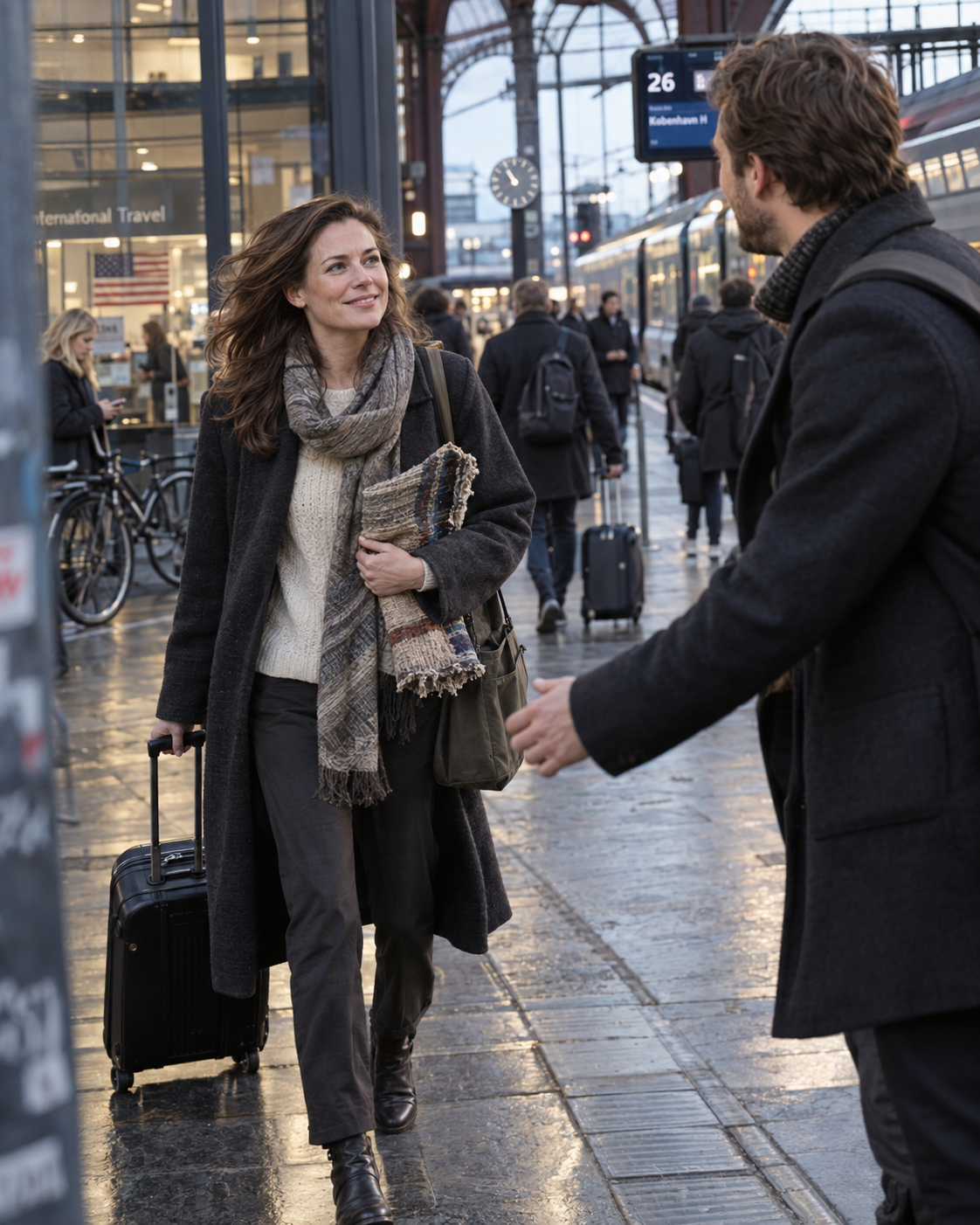
Henrik met me at the station.
We walked beneath the silver evening sky, our shoulders touching, while I told him everything.
He listened until I finished.
Then he asked, “Are you afraid?”
I looked at the blue enamel mug waiting on the windowsill of my studio apartment.
I looked at my unfinished loom.
I looked at the hands that had spent years weaving everyone else’s dreams.
“Yes,” I said.
“Good.”
I smiled.
“Why is that good?”
“Because you’re finally afraid of something that belongs to you.”
That night, I sat at my loom until dawn.
I placed my grandmother’s pattern beside my own.
Then I threaded the first new line.
For the first time, I wasn’t repairing what someone else had broken.
I was deciding what deserved to survive.
And somewhere across the ocean, inside an archive that supposedly shouldn’t exist, another piece of my family’s story was waiting for me.
I just didn’t know yet whether it had been hidden to protect me…
or hidden because someone was still afraid of what I would discover.