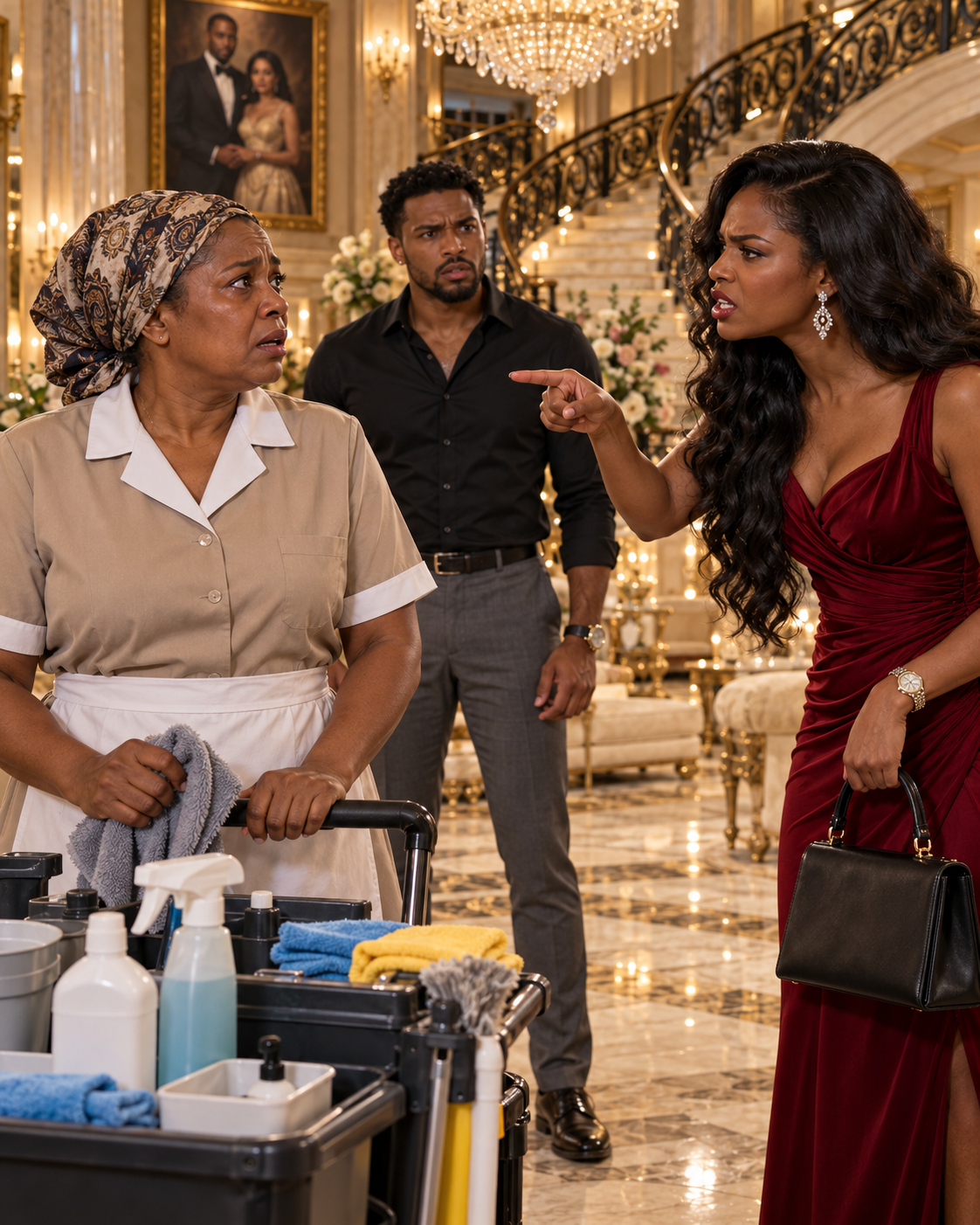
I watched Cassandra throw a crystal wineglass onto the marble floor and order me to clean it with my bare
Nadia looked from me to Samuel as though the room had suddenly become unfamiliar.
I could almost see the question forming in her mind.
“You’re his mother?”
I nodded.
“The same woman?”
She gave a breathless laugh.
“The housekeeper who taught me how to make chicken pot pie?”
“The very same.”
Her eyes filled with tears.
“I thought you were leaving because you had to go back to work somewhere else.”
“I did have to leave,” I said gently.
“But I wasn’t leaving you.”
Nadia glanced toward Samuel again.
He was trying not to smile too obviously, which only made him look younger.
“Please,” I said, “sit down before both of you make me feel like a matchmaker in a bad movie.”
Nadia laughed.
The tension broke.
Samuel pulled out a chair for her, and she thanked him without the slightest trace of performance.
That tiny exchange told me more than a dozen conversations ever could.
He respected her.
She appreciated it.
Neither of them was trying to impress the other.
Still, I knew better than to decide their future for them.
My test had been about character, not romance.
So I told myself I would step back.
For once, I meant it.
The next few weeks unfolded quietly.
Samuel began visiting Nadia’s family home.
Nadia came to dinner with us on Sundays.
Sometimes I watched them talk across the table while pretending to be deeply interested in serving dessert.
They talked about books.
Faith.
Travel.
Their fathers.
Their dreams.
And, occasionally, money.
Whenever the conversation touched Samuel’s wealth, Nadia never became awkward or falsely modest.
She simply treated it as one part of his life instead of the definition of his worth.
One night, after dinner, I found her helping me wash dishes.
“You don’t have to do that,” I said.
“I know.”
“Then why are you doing it?”
She dried a plate and smiled.
“Because you’re not a servant here.”
I looked at her.
“Neither are you.”
She gave me a puzzled expression.
I laughed.
“We’re both family tonight.”
That word hung in the air.
Family.
Not because she had married my son.
Not because of his money.
Because of how she had treated me when she thought I could give her nothing.
But while something beautiful was beginning in our home, the damage Cassandra had caused was not disappearing so easily.
Samuel ended the relationship completely.
Cassandra refused to accept it at first.
She sent long messages.
Then flowers.
Then letters.
Then apologies that somehow always returned to what she had lost.
“I can change.”
“I didn’t know who she was.”
“I was under pressure.”
“I love you.”
Samuel showed me the messages once.
I handed the phone back.
“Do you believe her?”
“No.”
“Then don’t answer.”
He nodded.
But several weeks later, Cassandra appeared outside his office.
Security called him.
“Do you want me to have her removed?”
Samuel stood silent for a moment.
Then he said, “No.”
I looked at him.
He explained later.
“I realized something.”
“What?”
“I don’t want my life to be built around punishing people who hurt me.”
That was when I knew he had learned what I had hoped he would.
The goal was never revenge.
It was discernment.
Cassandra eventually stopped calling.
But Nadia did not.
Her relationship with Samuel deepened slowly.
There were no dramatic declarations.
No expensive vacations designed for photographs.
Their happiest moments were ordinary.
Coffee before work.
Long drives.
Helping me arrange shelves in my home library.
A Sunday afternoon when the three of us got caught in the rain carrying groceries from the car.
Nadia laughed so hard that Samuel stood in the driveway laughing with her.
I watched from the porch and thought about the first time I had seen Cassandra smile.
Even that smile had always seemed to ask what she could gain.
Nadia’s smile asked for nothing.
One evening, Samuel sat beside me on the porch.
“Mom.”
“Yes?”
“I need to ask you something.”
My heart immediately tightened.
“What happened?”
He smiled.
“I want to marry Nadia someday.”
I said nothing.
He looked nervous.
“You don’t have to answer.”
I laughed.
“Samuel, I am your mother, not a royal council.”
He smiled.
“Then what do you think?”
I looked through the window where Nadia was helping herself to another piece of pie.
“I think you already know.”
He nodded.
“But I want your blessing.”
I took his hand.
“You have it.”
He hugged me so tightly that I nearly cried.
But the story did not end with an engagement.
Because Nadia still had one thing she needed to tell us.
The following month, she asked to speak with me privately.
We sat in my study.
She looked unusually serious.
“I need to tell you something about Cassandra.”
I felt my shoulders tense.
“Is she bothering you?”
“No.”
“Then what is it?”
Nadia took a slow breath.
“She has been asking me about Samuel’s finances.”
My stomach dropped.
“What exactly did she ask?”
“She wanted to know whether he had changed any of his trusts.”
I stared at her.
“How would she even know about them?”
“I don’t know.”
I leaned back.
“Did she say why?”
Nadia shook her head.
“But she said something strange.”
“What?”
“She said, ‘Your sister won’t let this go.'”
I understood immediately.
Cassandra was not planning another romance.
She was looking for leverage.
And Nadia, despite being innocent, was standing between her and whatever she wanted.
I called Samuel.
He arrived within the hour.
Nadia repeated everything.
Samuel’s face went still.
“I thought it was over.”
“So did I,” I said.
He looked at me.
“What do we do?”
“First, nothing emotional.”
He nodded.
“Then we find out what she is trying to do.”
Over the next several days, Samuel quietly reviewed his accounts and legal documents.
Nothing was missing.
Nothing had been altered.
But one unusual request had been filed through an attorney associated with Cassandra’s family.
The request sought information about a trust Samuel had established years earlier.
His attorney rejected it immediately.
Still, it meant Cassandra had not walked away empty-handed.
She had information.
And possibly help.
Then Nadia discovered the rest.
Cassandra had been asking their mother for access to old family records.
When their mother refused, Cassandra became furious.
“Why are you protecting her?”
she had demanded.
Their mother answered, “Because you are the one who betrayed us.”
That night, Nadia came to our house shaking.
I pulled her into my arms.
“You are safe here.”
She cried against my shoulder.
“I don’t understand how someone can want so much from another person.”
I stroked her hair.
“Because some people mistake possession for love.”
She looked at me.
“Did you ever make that mistake?”
I thought about my own marriage.
About how many years I had spent being useful instead of being seen.
“Once,” I said.
“And what did you learn?”
“That love that costs you your dignity is not love worth paying for.”
She nodded slowly.
I wanted her to remember that sentence forever.
The following spring, Samuel proposed.
Not with a helicopter.
Not on a yacht.
Not beneath fireworks.
He took Nadia to the little garden where she and I had once grown tomatoes behind the house.
He cooked dinner himself.
He burned the first batch of bread.
He laughed.
She laughed.
Then he knelt.
Nadia cried before he even finished the question.
When he told me afterward, I hugged him and said, “You learned something important.”
He grinned.
“From the undercover housekeeper?”
“Especially from her.”
Their wedding was beautiful without trying to prove anything.
Nadia wore a simple ivory dress.
Samuel wore the same watch his father had given him when he graduated.
There were flowers in the church.
There was music.
There were tears.
And at the reception, Nadia found me standing alone for a moment.
She wrapped her arms around me.
“You changed my life.”
I shook my head.
“No.”
“You did.”
“I only opened a door.”
“You gave me a mother.”
I could no longer hold back my tears.
“I think,” I whispered, “you gave me a daughter.”
Across the room, Samuel was watching us.
His expression held the kind of peace I had prayed for without ever saying the prayer aloud.
That should have been the ending.
Maybe in another life, it would have been.
But several months after the wedding, a letter arrived.
There was no return address.
My name was written across the envelope in careful black ink.
I opened it alone.
Inside was one sentence.
“You tested the wrong daughter.”
My blood ran cold.
There was no signature.
I immediately called Samuel.
He arrived with Nadia.
We sat together in the study while I handed him the letter.
His expression changed.
“Do you think this came from Cassandra?”
“I don’t know.”
Nadia stared at the page.
Then she whispered, “I do.”
She turned the paper over.
There was a faint imprint beneath the ink.
A pressed flower.
Nadia recognized it instantly.
“It was on Cassandra’s desk the last time I saw her.”
Samuel’s jaw tightened.
“Why would she say we tested the wrong daughter?”
Nadia looked frightened.
“I think she means our mother.”
We all stared at each other.
Her mother?
The woman who had openly condemned Cassandra?
The woman who had helped raise both sisters?
Nadia began shaking her head.
“No.”
I moved closer.
“Don’t assume anything yet.”
But the sentence had already planted a shadow.
The next morning, Nadia called her mother.
She did not answer.
Neither did she answer Samuel’s calls.
By evening, Nadia was crying in my kitchen.
“I knew she was disappointed in Cassandra,” she whispered.
“But I never believed she was part of it.”
I took her hand.
“Then don’t punish her with a suspicion you cannot prove.”
Nadia looked at me.
“You’re teaching me patience again.”
I smiled.
“Patience is not silence.”
She squeezed my fingers.
“Then what is it?”
“Patience is allowing truth enough time to reveal itself.”
Three days later, her mother finally came.
She arrived at our front door carrying an old leather folder.
Her face looked exhausted.
Nadia opened the door.
“Mom?”
Her mother walked inside.
“I should have told you years ago.”
We gathered in the living room.
The folder contained old contracts, photographs, and letters.
Cassandra had discovered years earlier that their father had left part of the family business in a trust for both daughters.
But Cassandra had tried to redirect the trust entirely to herself.
Their mother had stopped her.
When Cassandra discovered that Nadia would inherit an equal share, she became furious.
“I thought she wanted Samuel because of his money,” Nadia whispered.
Her mother shook her head.
“She wanted your share too.”
The truth was uglier than any of us had imagined.
Cassandra had been planning not only to marry Samuel for access to his wealth, but to isolate Nadia and pressure her into surrendering her inheritance.
I looked at Nadia.
She was crying.
“Why didn’t you tell me?”
Her mother answered softly.
“Because I was ashamed.”
Nadia stood.
“Shame belongs to the person who did the wrong thing, not the person who was kept in the dark.”
Her mother broke down.
They embraced.
And I realized something important.
The story had never really been about Cassandra.
It had been about the choices available to all of us after betrayal.
Samuel could have become bitter.
Nadia could have become suspicious of everyone with money.
Their mother could have disappeared beneath her shame.
I could have spent the rest of my life proving that I had been right.
Instead, we chose something harder.
We chose honesty.
We chose boundaries.
We chose forgiveness without pretending the damage never happened.
Years later, our family gathered for dinner at my house.
Nadia brought dessert.
Samuel arrived carrying flowers.
Their children raced through the hallway.
The room was loud.
Messy.
Warm.
Alive.
I stood in the kitchen for a moment and remembered kneeling on Cassandra’s marble floor with broken crystal in my hands.
Back then, I had wondered whether people could truly reveal themselves through small acts of cruelty.
Now I knew the deeper truth.
Character was not revealed only in the moment someone had power over us.
It was revealed in what we did with that power.
Samuel had wealth and chose responsibility.
Nadia had opportunity and chose humility.
Their mother had secrets and eventually chose truth.
And I had spent years trying to protect my son without realizing I also needed to protect the woman who was his mother.
That woman was me.
Later that night, Samuel came into the kitchen.
“Mom.”
“Yes?”
He kissed my forehead.
“Thank you.”
“For what?”
“For teaching me that a person’s value isn’t measured by what they own.”
I smiled.
“And who taught me?”
He laughed.
“Apparently, a housekeeper named Patience.”
I looked toward the dining room.
Nadia was laughing with the children.
I watched them for a long moment.
Then I thought about the warning letter hidden in my desk.
I had never thrown it away.
Not because I was afraid.
Because it reminded me that life could surprise us even after we believed the story was finished.
I walked to the window.
Outside, the streetlights glowed softly against the dark.
Behind me, my family filled the house with laughter.
For years, I had believed a mother’s greatest job was to protect her children from people who might hurt them.
I finally understood that it was also to teach them how to recognize goodness when it appeared quietly, without wealth, applause, or reward.
And sometimes, the greatest blessing arrives disguised as the person everyone else overlooks.
I closed the curtain.
For the first time in a very long time, I did not feel the need to investigate what tomorrow might bring.
I simply trusted that whatever chapter came next, we would meet it with open eyes, honest hearts, and enough courage to walk away from anything that asked us to become less than who we were meant to be.